FAW Jiefang(000800)

Search documents
17家账期承诺车企均作出表态
Mei Ri Jing Ji Xin Wen· 2025-09-15 09:17
Group 1 - Nine automotive manufacturers, including NIO, Great Wall Motors, Xiaomi Auto, and others, have committed to implementing the "Supplier Payment Norms Initiative" to foster a collaborative ecosystem between vehicle manufacturers and parts suppliers [1] - A total of 17 automotive companies have now made clear commitments regarding payment terms, indicating a unified effort to promote high-quality development in the automotive industry [1]





蔚来、长城、小米、北汽、一汽等17家账期承诺车企均已表态
Bei Jing Ri Bao Ke Hu Duan· 2025-09-15 09:07
Core Viewpoint - A total of 17 automotive companies have committed to implementing the "Automobile Complete Vehicle Enterprises Supplier Payment Norms Initiative," aiming to foster a collaborative and win-win ecosystem between complete vehicles and components, thereby promoting high-quality development in the automotive industry [1][8]. Group 1: Company Responses - NIO emphasizes the importance of a healthy supply chain for product quality and user experience, committing to long-term, mutually beneficial relationships with partners and adherence to the payment norms [1]. - Great Wall Motors adheres to a philosophy of "true partnership and win-win cooperation," ensuring timely payments and optimizing payment processes to support small and medium-sized enterprises [2]. - Xiaomi Motors supports the initiative, highlighting the significance of timely payments for maintaining a stable industrial chain and committing to a payment period of within 60 days [3]. - Leap Motor commits to a "60-day payment" principle and aims to streamline approval processes to ensure efficient payment flows, contributing to the stability of the supply chain [4]. - XPeng Motors reaffirms its commitment to a 60-day payment period and emphasizes the importance of trust and support from partners for sustainable development [5]. - Geely Auto Group has already implemented a 60-day payment period and aims to enhance the efficiency of capital turnover within the supply chain [6]. - BAIC Group expresses its commitment to fair and transparent payment practices, focusing on optimizing payment processes to support the health of the supply chain [6][7]. - Jianghuai Automobile Group is enhancing payment efficiency and transparency, ensuring all suppliers, including SMEs, receive timely payments [7]. - China FAW Group emphasizes its role in maintaining a stable market economy and has unified the payment period to 60 days, optimizing internal processes [8]. Group 2: Industry Context - The initiative has received support from various national departments, including the Ministry of Industry and Information Technology, highlighting the government's focus on stabilizing the supply chain and promoting high-quality development in the automotive sector [4][8]. - The collective commitment from these automotive companies reflects a broader industry trend towards enhancing supplier relationships and ensuring financial stability within the supply chain [1][8].
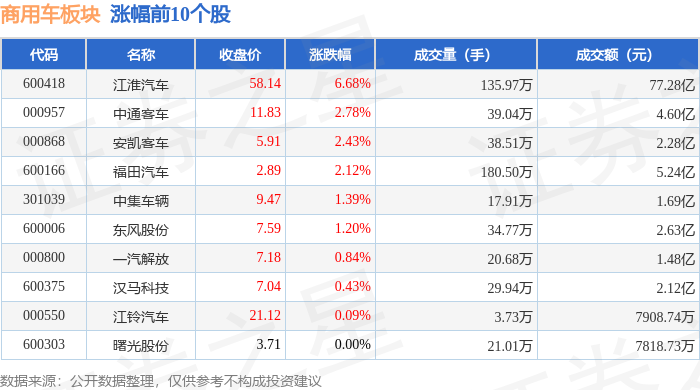
商用车板块9月15日涨2.58%,江淮汽车领涨,主力资金净流入4.05亿元
Zheng Xing Xing Ye Ri Bao· 2025-09-15 08:42
Group 1 - The commercial vehicle sector increased by 2.58% on September 15, with Jianghuai Automobile leading the gains [1] - The Shanghai Composite Index closed at 3860.5, down 0.26%, while the Shenzhen Component Index closed at 13005.77, up 0.63% [1] - Jianghuai Automobile's closing price was 58.14, reflecting a rise of 6.68% with a trading volume of 1.3597 million shares and a transaction value of 7.728 billion [1] Group 2 - The commercial vehicle sector saw a net inflow of 405 million in main funds, while retail funds experienced a net outflow of 108 million [3][4] - Jianghuai Automobile had a net inflow of 423 million in main funds, with a net outflow of 32.3 million in speculative funds [4] - The trading volume and transaction values for other companies in the sector varied, with notable performances from Zhongtong Bus and Ankai Bus, which saw increases of 2.78% and 2.43% respectively [1][3]


河南新科起重机股份有限公司被中国一汽集团旗下3家公司禁入半年
Qi Lu Wan Bao· 2025-09-15 04:53
Group 1 - The core point of the news is that Henan Xinke Crane Co., Ltd. has been officially banned from participating in procurement by several subsidiaries of China FAW Group, with the ban period set from September 4, 2025, to March 3, 2026 [1] Group 2 - Henan Xinke Crane Co., Ltd. was established in 2008 and is one of the early manufacturers of new-type cranes in China [3] - The company covers an area of approximately 150,000 square meters and possesses over 500 advanced production and testing equipment [3] - It has developed an annual production capacity of 3,000 new-type cranes, supported by one production base and one research and development center [3]


八部门印发《汽车行业稳增长工作方案(2025—2026年)》,理想i6将于月底发布 | 投研报告
Zhong Guo Neng Yuan Wang· 2025-09-15 03:28
Group 1 - The core viewpoint of the report highlights the positive momentum in the automotive industry, supported by government policies aimed at stabilizing growth from 2025 to 2026 [1][2] - The report notes that the A-share automotive sector outperformed the broader market, with the Shanghai and Shenzhen 300 Index rising by 1.38% and the automotive sector increasing by 1.74% [1][2] - Key developments in the industry include the release of the "Automotive Industry Stabilization Growth Work Plan (2025-2026)" by the Ministry of Industry and Information Technology and other departments, as well as significant advancements in electric vehicle sales and technology [2][3] Group 2 - The report suggests focusing on various companies within the automotive sector, including BYD, Great Wall Motors, and Li Auto, among others, indicating a diverse range of investment opportunities [3] - In the commercial vehicle segment, companies such as China National Heavy Duty Truck Group and FAW Jiefang are highlighted as potential investment targets [3] - The automotive parts sector is also emphasized, with recommendations for companies like Midea Group and Fuyao Glass, showcasing a broad spectrum of investment prospects across the industry [3]


新能源与新材料周度报告:新能源汽车全年目标销量1550万辆,增速20%左右-20250914
Dong Zheng Qi Huo· 2025-09-14 13:16
1. Report Industry Investment Rating No relevant content provided. 2. Core Viewpoints of the Report - The "Automobile Industry Steady Growth Work Plan (2025 - 2026)" aims for about 32.3 million vehicle sales in 2025, a 3% YoY increase, with around 15.5 million new energy vehicle sales, a 20% YoY increase, and a 6% YoY growth in automobile manufacturing added - value. In 2026, the industry is expected to maintain a stable and positive development trend [1][105][116]. - From January to August, China's automobile sales reached 21.128 million, a 12.6% YoY increase, and new energy vehicle sales were 9.62 million, a 36.7% YoY increase, achieving 65.4% and 61.9% of the annual targets respectively [1][106][118]. - In the 36th week (September 1 - 7), new energy passenger vehicle retail sales were 220,000, a 0.5% YoY decrease, and the annual cumulative retail sales were 7.645 million, a 23.4% YoY increase. The single - week penetration rate reached 60.6%, and the annual cumulative penetration rate was 51.9%, showing a slow upward trend [2][109][118]. - In July, global new energy vehicle sales reached 1.392 million, an 18.5% YoY increase, and from January to July, sales were 9.233 million, a 25.9% YoY increase. Except for China, Europe and other regions had significant growth, with 29.5% and 53.4% growth respectively from January to July [2][118]. - In August, the US new energy vehicle sales were 177,000, an 18.4% YoY increase, much higher than the overall vehicle growth rate of 2%. From January to August, the cumulative sales were 1.01 million, a 2.4% YoY increase [2][112][119]. 3. Summary by Related Catalogs 3.1 Financial Market Tracking - The weekly price changes of relevant sectors and listed companies are presented. For example, BYD's closing price on September 12 was 105.91 yuan, with a - 1.26% weekly change; CATL's closing price was 325 yuan, with a - 0.03% weekly change [13][15][16]. 3.2产业链数据跟踪 3.2.1 China New Energy Vehicle Market Tracking - **Sales and Exports**: In August, new energy vehicle production and sales were 1.391 million and 1.395 million respectively, with YoY growth of 27.4% and 26.8%. From January to August, production and sales were 9.625 million and 9.62 million respectively, with YoY growth of 37.3% and 36.7%. In August, new energy vehicle exports were 224,000, a 100% YoY increase. From January to August, exports were 1.532 million, an 87.3% YoY increase [106][107][108]. - **Inventory Changes**: Data on monthly new additions to new energy passenger vehicle channel inventory and manufacturer inventory are provided [25][26]. - **Delivery Volumes of Chinese New Energy Vehicle Manufacturers**: Monthly delivery volumes of manufacturers such as Leapmotor, Li Auto, XPeng, NIO, Zeekr, Aion, Voyah, and Deepal are presented [28][29][33]. 3.2.2 Global and Overseas New Energy Vehicle Market Tracking - **Global Market**: In July, global new energy vehicle sales reached 1.392 million, an 18.5% YoY increase, and from January to July, sales were 9.233 million, a 25.9% YoY increase [2][118]. - **European Market**: Relevant data on new energy vehicle sales and penetration rates in Europe, including the UK, Germany, and France, are provided [44][45][49]. - **North American Market**: In August, US new energy vehicle sales were 177,000, an 18.4% YoY increase. From January to August, the cumulative sales were 1.01 million, a 2.4% YoY increase. Data on North American new energy vehicle sales and penetration rates are also presented [2][112][119]. - **Other Regions**: Data on new energy vehicle sales and penetration rates in other regions, such as Japan, South Korea, and Thailand, are provided [60][61][65]. 3.2.3 Power Battery Industry Chain - Data on power battery installation volume (by material), export volume (by material), weekly average price of power battery cells, and material costs are presented. Information on the operating rates and prices of ternary materials, precursors, lithium iron phosphate, negative electrode materials, electrolytes, and other related materials is also provided [76][78][82]. 3.2.4 Other Upstream Raw Materials - Data on the daily prices of rubber, glass, steel, and aluminum are provided [97][98][100]. 3.3 Hot News Summaries 3.3.1 China: Policy Dynamics - The eight - department joint issuance of the "Automobile Industry Steady Growth Work Plan (2025 - 2026)" aims to achieve specific sales and growth targets for 2025 and 2026 [1][105][116]. - The six - department joint launch of a three - month special rectification action for online chaos in the automobile industry aims to improve the handling efficiency of online chaos and regulate marketing and publicity behaviors [105]. - The two - department release of the "Implementation Opinions on Promoting High - Quality Development of 'Artificial Intelligence +' Energy" promotes the application of artificial intelligence in energy - related fields [106]. 3.3.2 China: Industry Dynamics - In August, new energy vehicle production and sales data are as stated above. From January to August, the production and sales of new energy vehicles also showed significant growth [106][107][108]. - From September 1 - 7, new energy retail sales decreased by 3% YoY, and the cumulative retail sales increased by 25% [109]. - In August, China's power battery installation volume was 62.5GWh, a 32.4% YoY increase. From January to August, the cumulative installation volume was 417.9GWh, a 43.1% YoY increase [110][111]. - The China Association of Automobile Manufacturers is preparing to establish a new energy vehicle battery branch [111]. 3.3.3 Overseas: Policy Dynamics - Mexico plans to raise import tariffs on products from Asian countries such as China, South Korea, and India to 50%, which requires congressional approval [112]. - The US has exempted a variety of products, including gold, graphite, and nickel, from tariffs [112]. 3.3.4 Overseas: Industry Dynamics - In August, US new energy vehicle sales were 177,000, an 18.4% YoY increase [112][113][119]. 3.3.5 Overseas: Enterprise Dynamics - Construction of South Korean battery factories in the US has been interrupted due to immigration enforcement. LG Energy Solution has taken corresponding measures [113][114]. - VinFast delivered 72,167 vehicles globally in the first half of 2025, with significant growth in vehicle and motorcycle sales. In the second quarter, revenue increased by 91.6% YoY, and the net loss was approximately 812 million US dollars [115]. - InoBat, a Slovakian electric vehicle battery manufacturer, received 54 million euros in subsidies and 456,000 euros in loans from the Spanish government to support the construction of a battery super - factory [116][117]. 3.4 Industry Views The "Automobile Industry Steady Growth Work Plan (2025 - 2026)" sets clear goals for 2025 and 2026, and current market data shows the development status of the new energy vehicle industry [1][116][118]. 3.5 Investment Suggestions - China's new energy vehicle market penetration rate has reached a relatively high level. In 2025, high - competitiveness new models are continuously launched, and price wars are gradually ending. - Due to severe trade protectionism in Europe and the US, there are risks in exports. Attention should be paid to new growth points such as Belt and Road countries and the Middle East. - In the competitive landscape, domestic brands' market shares continue to expand. Attention should be paid to enterprises with strong product capabilities, smooth overseas expansion, and stable supply [3][120][121].


1.8万辆爆表!8月新能源重卡渗透率创新高!TOP3均超2000 TA暴涨11倍!| 头条
第一商用车网· 2025-09-14 07:13
Core Viewpoint - The domestic new energy heavy truck market has shown remarkable growth in 2025, with sales consistently exceeding 10,000 units per month and an average year-on-year growth rate of 190% from January to July [1]. Sales Performance - In August 2025, the new energy heavy truck market sold 17,800 units, marking a 7% increase from July and a 182% increase year-on-year, making it the second-highest sales month in the history of the market [3][5]. - The average monthly sales from January to August 2025 reached 13,700 units, with a total of 113,700 units sold, reflecting a 180% year-on-year increase [22][28]. Market Penetration - The penetration rate of new energy heavy trucks reached a record high of 26.61% in August 2025, up from 25.89% in July and significantly higher than the 13.61% for the entire year of 2024 [9][12]. - From January to August 2025, the penetration rate averaged 23.39%, compared to 10.48% in the same period last year [9]. Competitive Landscape - In August 2025, five companies held over 10% market share: XCMG (15.98%), FAW Liberation (15.21%), SANY (14.36%), Shaanxi Automobile (10.91%), and China National Heavy Duty Truck Group (10.04%) [17]. - A total of 14 companies sold over 100 units in August, with three companies exceeding 2,500 units [12]. Company Performance - The top three companies in August 2025 were XCMG (2,839 units), FAW Liberation (2,702 units), and SANY (2,551 units) [13]. - Year-to-date, XCMG and SANY have sold 18,600 and 17,600 units respectively, with year-on-year growth rates of 169% and 164% [22][25]. Future Outlook - The new energy heavy truck market is expected to exceed 180,000 units in total sales for 2025, with over 20 companies already surpassing their total sales from the previous year [28].




海外华媒中国一汽看“智造”:擘画未来产业新图景
Zhong Guo Xin Wen Wang· 2025-09-12 11:40
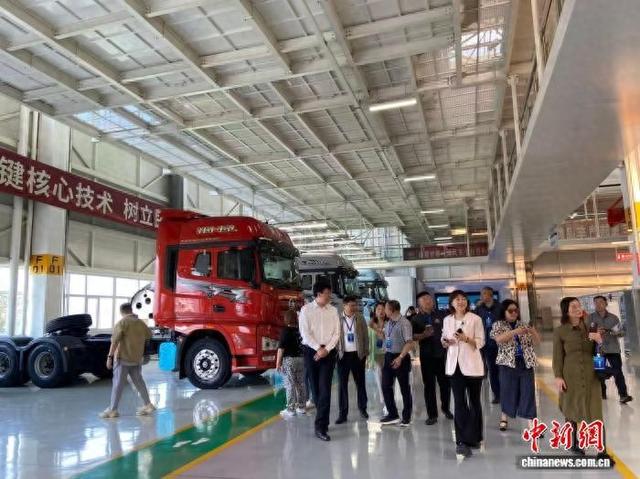
Core Insights - The event "Five Colors of Jilin, Four Seas Transmission" showcased the advancements in automotive technology at China FAW Group Corporation, highlighting the integration of robotics and automation in manufacturing processes [1][3]. Group 1: Technological Advancements - The intelligent factory at China FAW features automated robotic transport vehicles and precision robotic arms, demonstrating significant technological progress in the automotive industry [1]. - The factory has pioneered a fully automated tire assembly technology that utilizes industrial robots and Automated Guided Vehicles (AGVs) for seamless operation without human intervention [1]. - The robotic arms are capable of complex movements, ensuring precise installation of components ranging from tires to screws [1]. Group 2: Product Innovations - The event included a demonstration of the Hongqi "Tianran 1" flying car, which features a modular design allowing for vertical takeoff and landing, showcasing the future of transportation [3]. - The Hongqi intelligent ecological cabin integrates advanced technologies such as autonomous driving and vehicle networking, emphasizing user comfort and smart interaction [3]. Group 3: Cultural and Historical Significance - The visit to the Hongqi Cultural Museum provided insights into the history and development of China FAW and the Hongqi brand, reflecting the company's journey and achievements in the automotive sector [4]. - Participants expressed admiration for China FAW's manufacturing capabilities and the potential for expanding into international markets, indicating a strong belief in the company's innovative capacity [4].
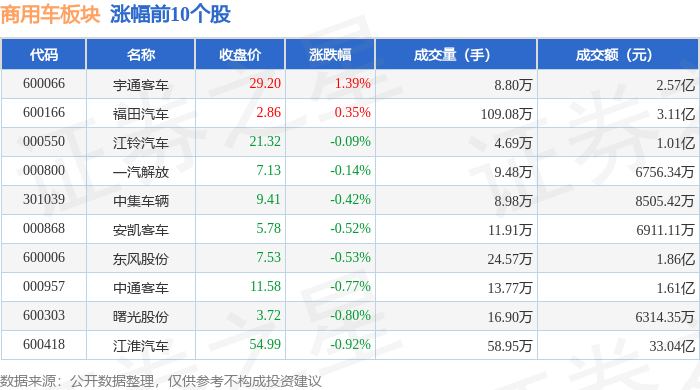
商用车板块9月12日跌1.02%,金龙汽车领跌,主力资金净流出5.4亿元
Zheng Xing Xing Ye Ri Bao· 2025-09-12 08:31
Group 1 - The commercial vehicle sector experienced a decline of 1.02% on September 12, with King Long Automobile leading the drop [1][3] - The Shanghai Composite Index closed at 3883.69, up 0.22%, while the Shenzhen Component Index closed at 12996.38, up 0.13% [1] - Major stocks in the commercial vehicle sector showed mixed performance, with Yutong Bus increasing by 1.39% and King Long Automobile decreasing by 1.49% [1][3] Group 2 - The net outflow of main funds in the commercial vehicle sector was 540 million yuan, while retail investors saw a net inflow of 315 million yuan [3][4] - The detailed fund flow indicated that King Long Automobile had a significant net outflow of 39.38 million yuan from main funds [4] - Other companies like Ankai Bus and Foton Motor also experienced varying levels of net inflow and outflow from different investor categories [4]

8月重卡销9.2万辆大增47%!TOP5均破万重汽第一 奇瑞涨2倍排第几?| 头条
第一商用车网· 2025-09-12 06:58
Core Viewpoint - The heavy truck market in China experienced significant growth in August 2025, achieving a sales volume of 91,600 units, representing a year-on-year increase of 47%, marking the fifth consecutive month of growth [5][10][20]. Sales Performance - In August 2025, the total sales of trucks (including chassis and tractors) reached 271,600 units, with a month-on-month increase of 3% and a year-on-year growth of 17% [3]. - The heavy truck segment alone sold 91,600 units in August, with a month-on-month increase of 8% and a year-on-year increase of 47%, which is an expansion of 1 percentage point compared to July's growth of 46% [10][20]. - Historically, August is typically a slow season for heavy truck sales, with the average sales over the past decade being approximately 68,400 units. The sales in August 2025 are considered a strong performance [3][6]. Cumulative Sales Data - From January to August 2025, cumulative heavy truck sales reached 715,700 units, ranking second in the last five years and sixth in the last decade, with a year-on-year increase of 14% [8][15]. - The average monthly sales for the first eight months of 2025 approached 90,000 units, significantly higher than the average monthly sales in 2024 and 2023, indicating a clear recovery in the heavy truck market [8]. Market Share and Competition - In August 2025, five companies achieved sales exceeding 10,000 units, with the top five companies accounting for 91.34% of the market share [10][12]. - The leading companies in sales for August included Heavy Truck with 25,600 units, followed by Liberation, Dongfeng, Shaanxi Automobile, and Foton [10]. - Cumulatively, the top ten companies accounted for 98.06% of the market share from January to August 2025, with the top five companies holding a combined share of 90.90%, indicating increased industry concentration [17]. Growth Trends - All top ten companies in the heavy truck market reported year-on-year growth in August, with notable increases from Foton and Chery, which saw growth rates of 172% and 237%, respectively [12][15]. - The heavy truck market is expected to continue its growth trend into the traditional peak season of "Golden September and Silver October" [20].