WLY(000858)

Search documents
直线拉升!涨停潮,来了
中国基金报· 2025-12-15 05:13
Market Overview - The A-share market experienced a collective decline in the morning session, with the Shanghai Composite Index down by 0.11%, the Shenzhen Component down by 0.71%, and the ChiNext Index down by 1.29% [1] - The total trading volume in the Shanghai and Shenzhen markets reached 1.18 trillion yuan, a decrease of 529 billion yuan compared to the previous trading day [4] Financial Sector Performance - The financial sector saw a broad increase, with the insurance sector leading the market with a rise of over 4% [4] - Notable individual stock performances included China Ping An rising nearly 5%, China Pacific Insurance up 4%, and New China Life and China Life both increasing by over 2% [8][9] - The recent adjustment by the financial regulatory authority to lower risk factors for insurance companies investing in certain indices has positively impacted the sector [9] Consumer Sector Dynamics - The consumer sector showed significant gains, particularly in food and beverage and commercial retail, with many stocks hitting the daily limit [12] - The Ministry of Commerce and other regulatory bodies announced measures to boost consumption, which contributed to the rally in consumer stocks [13] Alcohol Industry Insights - The liquor sector rebounded, with Kweichow Moutai increasing by 0.49% to a market value of 1.7878 trillion yuan [16][19] - Moutai's recent policy to control supply has led to a rise in wholesale prices for its products [18] Aerospace and Technology Sector - The aerospace sector saw a surge, with stocks like Aerospace Electromechanical and Aerospace Technology rising significantly, with some stocks hitting the daily limit [21][22] - The performance of commercial aerospace stocks remains active, reflecting ongoing interest in the sector [21]








食品饮料周报(25年第46周):消费场景平稳修复,茅台释放稳价预期-20251215
Guoxin Securities· 2025-12-15 05:10
Investment Rating - The report maintains an "Outperform the Market" rating for the food and beverage sector [4][5][10]. Core Views - The food and beverage sector is expected to see a recovery in consumer scenarios, with a stable price expectation for Moutai [1][3]. - The sector is entering a left-side layout phase, with high-quality companies expected to gain greater growth potential [2][10]. - The report highlights the differentiation in the fundamentals of various categories, with beverages outperforming food and alcohol [2][10]. Summary by Relevant Sections 1. Sector Overview - The food and beverage sector (A-shares and H-shares) experienced a cumulative decline of 1.52% this week, with A-shares down 1.63% and H-shares up 0.07% [1]. - The top five gainers in the food and beverage sector this week were Yanjinpuzi (5.11%), Kuaijishan (4.85%), New Dairy (3.22%), Chenguang Biological (3.09%), and Anji Food (3.08%) [1]. 2. Alcohol Sector - In the liquor segment, the report recommends focusing on leading companies like Luzhou Laojiao, Shanxi Fenjiu, Guizhou Moutai, and Yingjia Gongjiu, while also monitoring the reform pace of Wuliangye and Yanghe [2][10]. - The report notes that the current market is in a left-side layout phase, with positive signals expected from both demand and supply sides [10]. 3. Beverage Sector - The beverage industry is experiencing a sustained boom, with leading companies significantly outperforming the market [14]. - The report continues to recommend companies like Nongfu Spring and Dongpeng Beverage, which are accelerating their national and platform expansion [14]. 4. Food Sector - In the snack segment, the report emphasizes strong alpha stocks, particularly in the konjac snack category, with leading companies like Weilong and Yanjinpuzi showing strong competitive advantages [11][12]. - The restaurant supply chain is showing signs of stabilization, with recommendations for leading companies like Yihai International and Haitian Flavoring [12]. 5. Earnings Forecast and Investment Ratings - The report provides earnings forecasts for key companies, with Guizhou Moutai expected to have an EPS of 75.79 in 2026, and Luzhou Laojiao with an EPS of 8.04 in the same year [4]. - The average PE ratio for these companies is projected to be around 18.9 for Moutai and 16.0 for Luzhou Laojiao in 2026 [4].



深夜突发!四大公司齐发重要公告,涉及长江电力、五粮液等
Sou Hu Cai Jing· 2025-12-15 04:49
深夜突发!四大公司齐发重要公告,涉及长江电力、五粮液等 半夜刷手机突然弹出一堆公告推送,持仓长江电力、五粮液的股民瞬间清醒,没持股的也赶紧围观——2025年12月中下旬,A股深夜接连迎来"公告潮",长 江电力、五粮液、海光信息、中科曙光四大行业龙头扎堆发布重磅消息,既有控股股东真金白银增持,也有百亿重组搁浅、业绩下滑+大额扩能的反差操 作。每一份公告都能在巨潮资讯网、上海证券交易所等官方平台查到原文,关键数据、决策依据一目了然。 公告明确终止原因:交易规模大、涉及相关方多,论证历时较长,且当前市场环境较筹划之初变化较大,重组条件不成熟 。双方都强调,终止不会影响日 常生产经营,后续仍保持产业协同,且至少1个月内不再筹划重大资产重组。受此影响,12月10日中科曙光跌停,海光信息一度跌超5%,两家公司的投资者 说明会记录可在交易所官网查询,详细回应了股价波动、后续合作等问题 。 四、股民避坑指南:3个关键点,跟着官方信息走 增持后,三峡集团及其一致行动人合计持股从128.65亿股增至129.68亿股,持股比例从52.58%提升至53.00%,刚好触及1%的权益变动刻度 。更关键的是, 这只是增持计划的一部分——三 ...



贵州首发白酒消费券,“短期刺激+长效调整”能否助力行业跨越周期?
Sou Hu Cai Jing· 2025-12-15 03:10
12月上旬,先是某名酒企业调低出厂价,以给经销商"补贴"的形式实现实质降价;再是贵州省商务厅推 出"2025年多彩贵州欢乐购"白酒消费券活动,一家名酒企业、一个核心产区,就此拉开了行业以主动调 整姿态来适应市场现实形势的帷幕。 那么,这种"补贴""消费券",为何在此时推出?这属于企业以及产区的个别行为,还是会成为蔓延行业 的大潮流?是短期举措,还是会长期化? 名酒企业、产区对这种已推出的补贴与消费券的看法,将影响整个行业走势。 事实上,包括贵州产区在内,整个白酒产业都面临着去产能、去库存的大环境,同时,还需要面对消费 端的活力不足等问题。 数据显示,中国白酒行业总产能已经从巅峰期的1300万千升以上,逐年下降到400万千升左右。 在行业库存高企、消费端活力不足的态势下,总有人要迈出"改变"的第一步。 贵州省商务厅推出的"2025年多彩贵州欢乐购"白酒消费券活动,补贴幅度高达12%(8.8折)、单户单日 一次优惠、每单最高500元补贴,对于有购买意图的消费者而言,有着相当大的吸引力。 不过,与针对电子类产品的补贴举措相比,一个偏向于地域产区,另一个则着眼于全国全行业;且从优 惠幅度、活动延续时间来看,针对电子类 ...
龙头酒企量价管控打开修复空间,易方达白酒(03189.HK)盘中最高涨近2%
Xin Lang Cai Jing· 2025-12-15 02:41
Group 1 - The white liquor sector experienced a collective rebound on December 15, 2025, with E Fund White Liquor (03189.HK) rising nearly 2% during trading, and stocks like Jiu Gui Jiu, Jin Hui Jiu, and Jin Zhong Zi Jiu increasing over 4% [1] - E Fund White Liquor is the first exchange-traded fund in the Hong Kong market focused on the mainland white liquor industry, closely tracking the China Securities White Liquor Index, which selects stocks related to white liquor production [1] - The top ten weighted stocks in the index include leading liquor companies such as Kweichow Moutai, Wuliangye, and Luzhou Laojiao [1] Group 2 - Guosen Securities reports that leading liquor companies like Moutai and Wuliangye are proactively managing supply and pricing to alleviate pressure on distributors and stabilize market prices, which is expected to enhance market confidence [2] - The demand for white liquor is stabilizing, and with supply clearing, there is an expectation for improved sales during the Q1 2026 Spring Festival, followed by a potential recovery in the second half of the year due to low base effects [2] - E Fund White Liquor (03189.HK) is the world's first white liquor-themed ETF, focusing on leading companies in the Chinese white liquor industry [2]
ETF盘中资讯 | 政策力挺消费复苏,“茅五泸汾洋”集体飘红!食品ETF(515710)上探1.36%,机构:白酒处估值与预期双底
Sou Hu Cai Jing· 2025-12-15 02:32
Group 1 - The food and beverage sector is experiencing a significant upward trend, with the Food ETF (515710) showing a maximum intraday increase of 1.36% and currently up by 1.19% [1] - Major liquor stocks are seeing substantial gains, with brands like Jiu Gui Jiu, Jin Hui Jiu, and Jin Zhong Zi Jiu rising over 4%, while others like Ying Jia Gong Jiu and Gu Qing Gong Jiu are up over 3% [1] - Leading liquor companies such as Kweichow Moutai, Wuliangye, and Luzhou Laojiao are also performing well, contributing to the overall positive sentiment in the sector [1] Group 2 - The Ministry of Commerce, the People's Bank of China, and the Financial Regulatory Bureau jointly issued a notice to enhance collaboration between commerce and finance, aiming to boost consumption [3] - Analysts suggest that the current period is crucial for consumption structure upgrades and the acceleration of new consumption, indicating that the notice has significant implications for stimulating consumption [3] - The Food ETF (515710) has seen substantial net subscriptions, with a total of 65.61 million yuan in net subscriptions over the last five trading days, indicating strong investor interest [3] Group 3 - The Food ETF (515710) tracks the CSI sub-index for the food and beverage industry, with approximately 60% of its holdings in high-end and mid-range liquor stocks, and nearly 40% in other beverage and dairy sectors [4] - Investors can also access core assets in the food and beverage sector through the Food ETF linked funds [4]


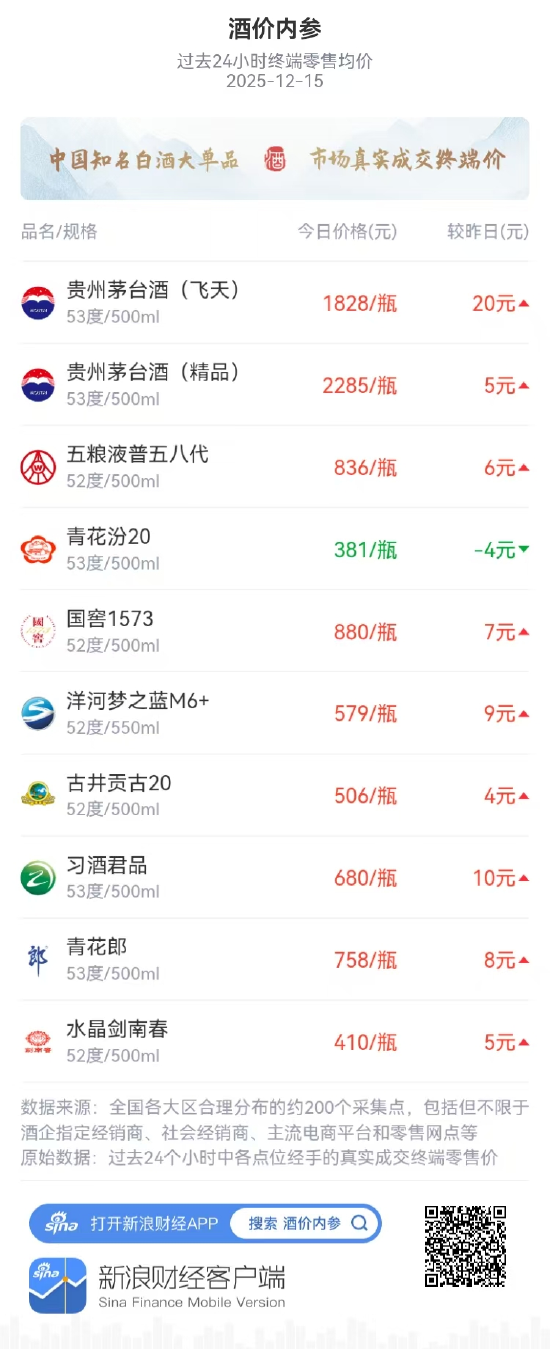
酒价内参12月15日价格发布 古井贡古20上涨4元/瓶
Xin Lang Cai Jing· 2025-12-15 01:40
Group 1 - The core viewpoint of the article highlights a significant rebound in the retail prices of the top ten baijiu products, with an overall increase of 70 yuan, reaching a total price of 9143 yuan, marking a six-day high [1] - The market is experiencing a broad-based price increase, with a notable rise in trading volume, exceeding the usual levels by over 50% [1] - The price of Feitian Moutai has increased by 20 yuan per bottle, leading the price surge, while other brands like Xijiu Junpin and Yanghe Dream Blue M6+ also saw price increases [1][5] Group 2 - A false notification purportedly from Kweichow Moutai regarding supply and price control circulated on social media, causing market fluctuations, but the company quickly refuted the claims [2] - Moutai emphasized that all official communications regarding product supply and pricing will be released through their official channels, warning against misinformation that could disrupt market order [2] - Experts noted the sensitivity of the baijiu market to supply and demand dynamics, especially towards the end of the year, highlighting the potential for market speculation due to such false information [2]

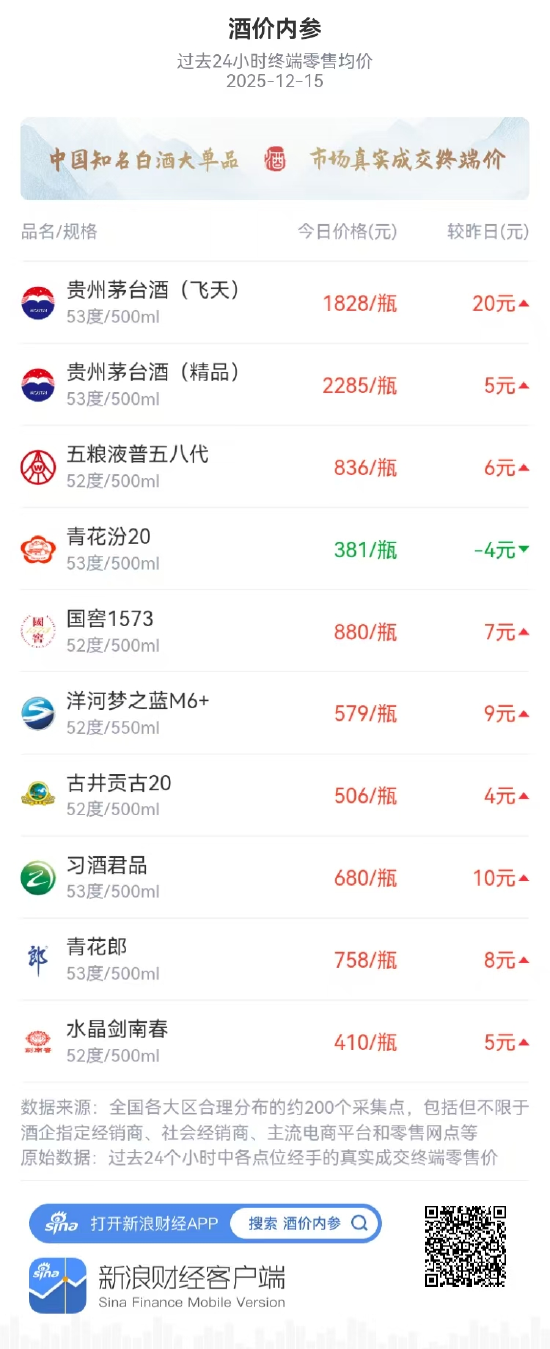
酒价内参12月15日价格发布 五粮液普五八代价格上涨6元/瓶
Xin Lang Cai Jing· 2025-12-15 01:40
Group 1 - The core viewpoint of the article highlights a significant rebound in the retail prices of the top ten liquor products, with the total price reaching 9143 yuan, an increase of 70 yuan from the previous day, marking a six-day high [1] - The market is experiencing a broad-based price increase, with a notable rise in trading volume, exceeding the usual levels by over 50% [1] - The price of Feitian Moutai has increased by 20 yuan per bottle, leading the price surge, while other brands like Xijiu Junpin and Yanghe Dream Blue M6+ also saw price increases [1][5] Group 2 - A false notification purportedly from Kweichow Moutai regarding product supply and price control circulated on social media, causing market fluctuations; however, Moutai has officially denied the authenticity of this document [2] - Moutai emphasized that all official communications regarding supply and pricing policies will be released through their official channels, warning against reliance on unofficial sources [2] - Experts have cautioned that such misinformation can disrupt the sensitive supply-demand dynamics in the liquor market, especially towards the end of the year [2]
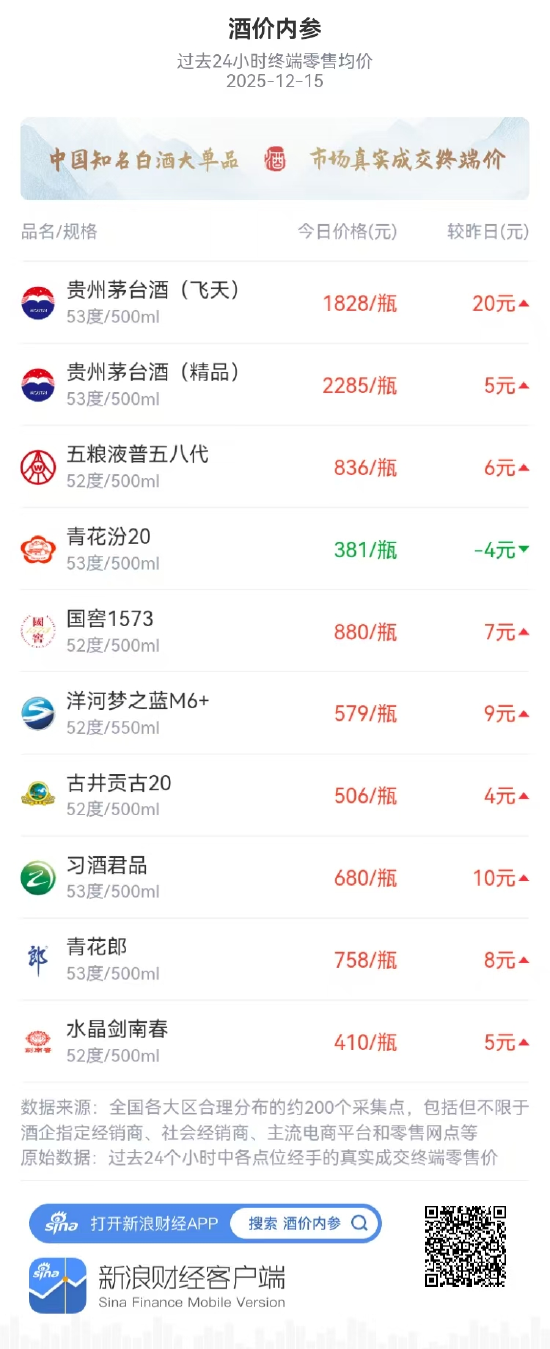
酒价内参12月15日价格发布 洋河梦之蓝M6+上涨9元/瓶
Xin Lang Cai Jing· 2025-12-15 01:34
Core Insights - The white liquor market has experienced a significant rebound in retail prices, with the average price of the top ten products rising to 9143 yuan, an increase of 70 yuan from the previous day, marking a six-day high [1] - Market confidence and trading activity have notably improved, with transaction volumes increasing by over 50% compared to normal levels [1] Price Movements - The price of Feitian Moutai increased by 20 yuan per bottle, leading the price surge [1] - Other notable price increases include Xijiu Junpin (+10 yuan), Yanghe Dream Blue M6+ (+9 yuan), and Qinghua Lang (+8 yuan) [1] - The only product to see a price decrease was Qinghua Fen 20, which fell by 4 yuan per bottle [1] Market Dynamics - A false notification claiming to be from Kweichow Moutai regarding supply and price control circulated on social media, causing market fluctuations [2] - Kweichow Moutai quickly refuted the claims, emphasizing that all official communications regarding supply and pricing will be made through their official channels [2] - Experts warn that such misinformation can disrupt the sensitive supply-demand dynamics in the white liquor market, especially towards the end of the year [2]
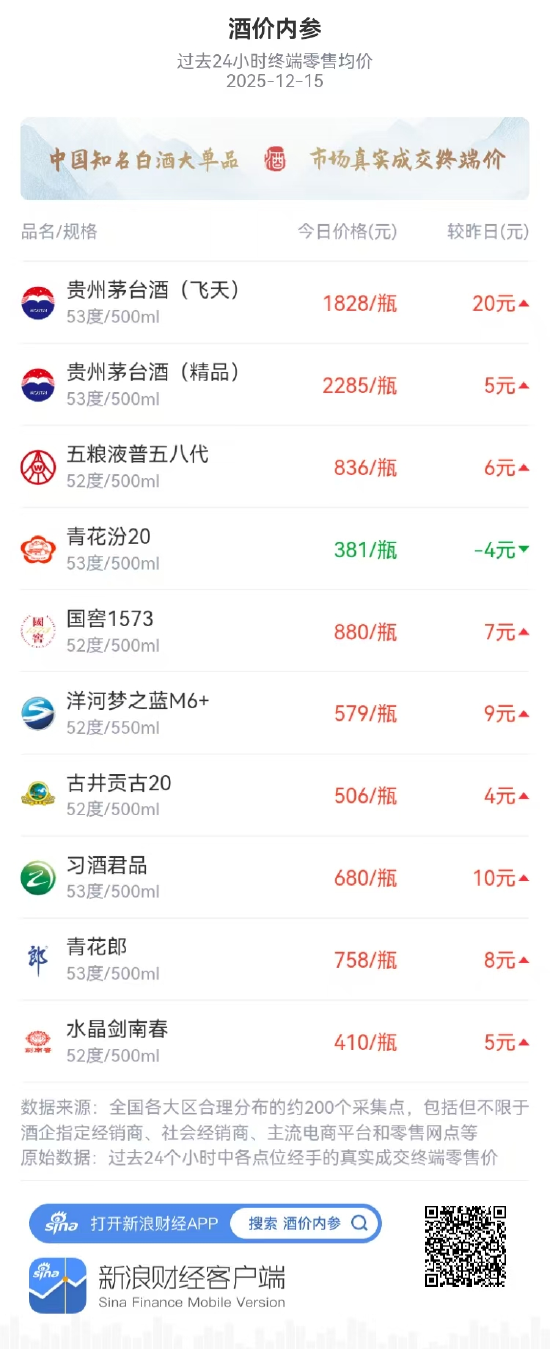
酒价内参12月15日价格发布 习酒君品价格上涨10元/瓶
Xin Lang Cai Jing· 2025-12-15 01:21
Core Insights - The white liquor market has shown a strong rebound in retail prices, with the average price of the top ten products rising to 9143 yuan, an increase of 70 yuan from the previous day, marking a six-day high [1][8] - Market confidence and trading activity have significantly improved, with transaction volumes increasing by over 50% compared to normal levels [1][8] - A recent false announcement claiming to be from Kweichow Moutai regarding supply and price control caused market fluctuations, but the company quickly refuted the claims [3][9] Price Movements - The market experienced a broad increase in prices, led by Kweichow Moutai, which rose by 20 yuan per bottle, driving overall price increases [2][8] - Other notable price increases include: - Xijiu Junpin: +10 yuan - Yanghe Dream Blue M6+: +9 yuan - Qinghua Lang: +8 yuan - Guojiao 1573: +7 yuan - Premium Moutai: +5 yuan - Wuliangye Pu 58: +6 yuan - Crystal Jian Nan Chun: +5 yuan - Gu Qing Gong 20: +4 yuan - The only product to see a price decrease was Qinghua Fen 20, which fell by 4 yuan [2][6][11] Data Collection Methodology - The data for the "Wine Price Reference" is collected from approximately 200 sampling points across various regions, including designated distributors, social distributors, major e-commerce platforms, and retail outlets [1][8] - The aim is to provide an objective, real, scientific, and traceable dataset regarding the market prices of well-known white liquors [1][8]