NEW HOPE(000876)

Search documents
新希望:饲料业务今年有较好的盈利
Zheng Quan Ri Bao Wang· 2025-09-30 12:15
Group 1 - The company, New Hope (000876), has diversified its business beyond pig farming to include a feed business, which has also shown good profitability this year [1]

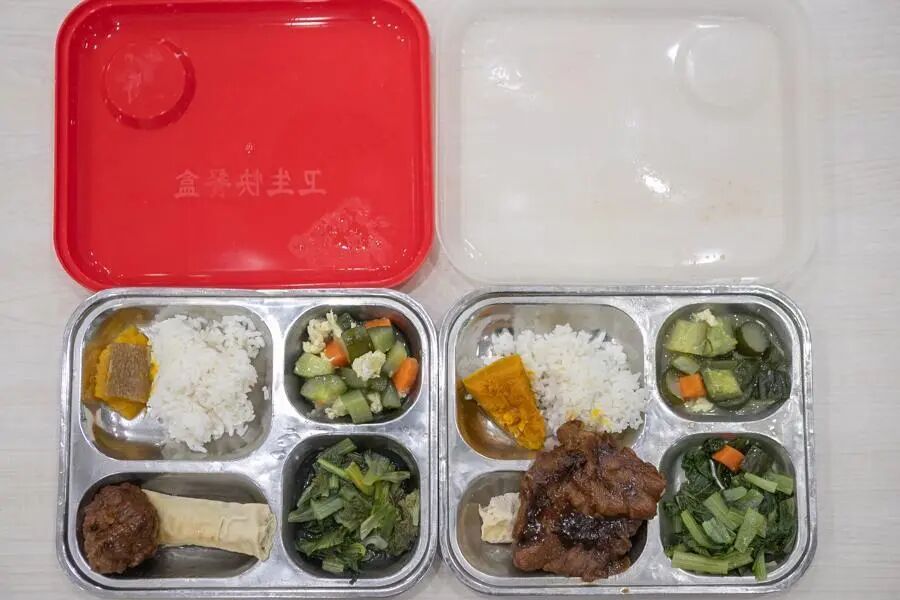
臭虾仁事件调查:上海供餐巨头背靠新希望集团却以“小企业”身份竞标?
Xin Lang Cai Jing· 2025-09-29 13:12
Core Viewpoint - The "stinky shrimp" incident in Shanghai has sparked outrage among parents and revealed the complex capital dynamics behind school meal suppliers, particularly Shanghai Lujie Industrial Development Co., Ltd. (Lujie) and its connections to the New Hope Group [3][4]. Group 1: Company Background - Lujie supplies meals to over 600 schools in Shanghai and is linked to Kilcoy Global Foods, Ltd. (KGF), which has a complex ownership structure involving New Hope Group and its founder Liu Yonghao's family [3][4]. - KGF reported nearly $2.2 billion in total revenue for 2024, a 17.3% year-on-year increase, with net profits exceeding $60 million, marking a 74.1% rise [4][5]. Group 2: Business Practices - Lujie has been accused of misrepresenting its size by participating in bids as a "small enterprise" despite having over 1,000 employees and significant revenue, which contradicts its classification as a large enterprise [3][8]. - The company’s subsidiary, Lujie (Shanghai) Enterprise Development Co., Ltd., claimed to be a small enterprise with 69 employees and revenue of 212 million yuan in 2023, while its parent company operates on a much larger scale [6][8]. Group 3: Supply Chain and Quality Control - The shrimp involved in the incident was sourced from a company also linked to KGF, indicating a tightly controlled supply chain from sourcing to meal preparation [9][10]. - Lujie is connected to a food testing company that conducts inspections for the meals served in schools, raising concerns about potential conflicts of interest as Lujie may be both the supplier and the quality controller [11][12].

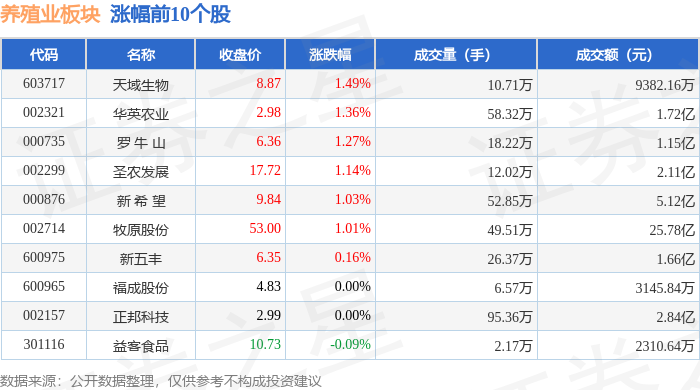
养殖业板块9月29日涨0.14%,天域生物领涨,主力资金净流出2.65亿元
Zheng Xing Xing Ye Ri Bao· 2025-09-29 08:39
Core Insights - The aquaculture sector saw a slight increase of 0.14% on September 29, with Tianyu Biological leading the gains [1] - The Shanghai Composite Index closed at 3862.53, up 0.9%, while the Shenzhen Component Index closed at 13479.43, up 2.05% [1] Aquaculture Sector Performance - Tianyu Biological (603717) closed at 8.87, up 1.49% with a trading volume of 107,100 shares and a transaction value of 93.82 million yuan [1] - Huaying Agriculture (002321) closed at 2.98, up 1.36% with a trading volume of 583,200 shares and a transaction value of 172 million yuan [1] - Luoniushan (000735) closed at 6.36, up 1.27% with a trading volume of 182,200 shares and a transaction value of 115 million yuan [1] - Other notable performers include Shengnong Development (002299) at 17.72 (+1.14%), New Hope (000876) at 9.84 (+1.03%), and Muyuan Foods (002714) at 53.00 (+1.01%) [1] Capital Flow Analysis - The aquaculture sector experienced a net outflow of 265 million yuan from institutional investors, while retail investors saw a net inflow of 1.91 million yuan [2] - Notable net inflows from retail investors were observed in New Hope (000876) with 7.82 million yuan and Huaying Agriculture (002321) with 6.16 million yuan [3] - Conversely, Wens Foodstuffs (300498) faced a significant net outflow of 39.40 million yuan from institutional investors [3]


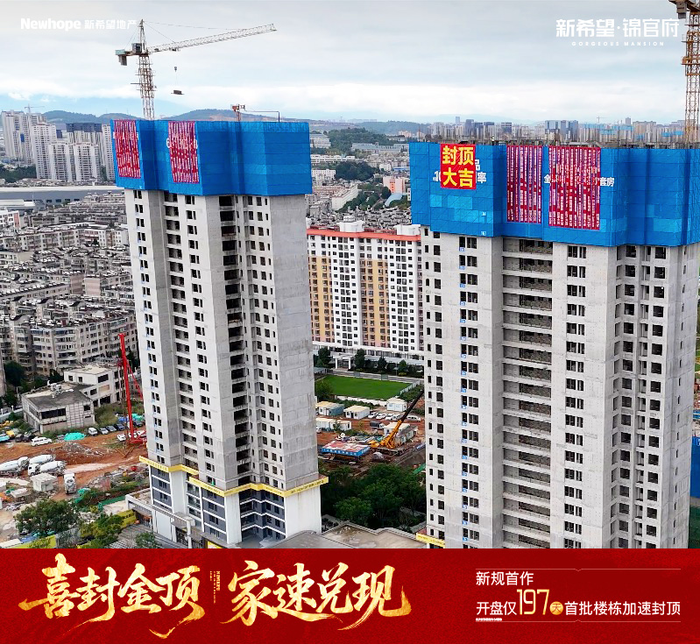
新希望速度!锦官府首批房源封顶,鉴证匠心造诣
Xin Lang Cai Jing· 2025-09-28 08:27
Core Viewpoint - The real estate industry is currently facing challenges, with the ability to deliver quality products becoming a core standard for measuring the strength of real estate companies. The market is experiencing deep adjustments, and customer expectations for product quality and delivery have significantly increased. New Hope's Jin Guan Fu project has emerged as a leader in this context, showcasing efficient delivery and high standards to restore confidence in the market [1][9]. Group 1: Project Overview - New Hope's Jin Guan Fu project celebrated the topping out of its first batch of houses just 197 days after its launch, marking a significant milestone in the development process [5]. - The project is positioned as a pioneer in the new regulatory residential area in eastern Kunming, responding directly to market and customer demands [9]. - The project has been recognized for its high product quality and delivery capabilities, with previous projects by New Hope also achieving early deliveries, enhancing market trust [7]. Group 2: Market Performance - The project has seen impressive market engagement, with over 1,772 groups visiting the display area within five hours of its opening, and over 100 units sold within the first two hours [16]. - In June, the project achieved the highest sales in both the number of units and total area in Kunming, indicating strong market performance and demand [16]. - The introduction of the 143㎡ unit has been particularly successful, with high actual usage rates and appealing design features contributing to its popularity [21]. Group 3: Product Features - Jin Guan Fu emphasizes quality through meticulous design in both visible and hidden aspects, catering to modern family needs for spacious, multifunctional, and comfortable living spaces [14]. - The project boasts a high actual usage rate of 107%, with features such as a spacious living area and flexible design options, making it attractive to potential buyers [21]. - The commitment to quality and speed in delivery is a key focus for New Hope, aiming to provide customers with a reliable and reassuring product experience [9].
行业周报:生猪能繁去化逻辑加强,牛肉牛奶或于2026年实现联动向上-20250928
KAIYUAN SECURITIES· 2025-09-28 06:07
Investment Rating - The industry investment rating is "Positive" (maintained) [1] Core Viewpoints - The logic of breeding sow reduction is strengthening, and beef and milk are expected to achieve upward linkage in 2026. As of September 26, 2025, the average price of live pigs in China is 12.50 yuan/kg, with a week-on-week decrease of 0.20 yuan/kg and a year-on-year decrease of 5.51% [11][16] - The investment logic for live pigs is marginally improving, driven by both fundamental and policy factors. The price of live pigs is expected to rise in the second half of 2025 due to strong support from previous breeding sow reductions and winter piglet losses [29][32] Summary by Sections Weekly Observation - The logic of breeding sow reduction is strengthening, and beef and milk are expected to achieve upward linkage in 2026. The average price of live pigs is 12.50 yuan/kg, with a week-on-week decrease of 0.20 yuan/kg and a year-on-year decrease of 5.51% [11][16] - The average price of beef is 66.27 yuan/kg, with a month-on-month increase of 2.10% and a year-on-year increase of 7.74% [23] Weekly Market Performance (September 22-26) - The agricultural index underperformed the market by 2.18 percentage points, with the Shanghai Composite Index rising by 0.21% and the agricultural index falling by 1.97% [34][36] - Leading stocks include ST Jinggu (+15.68%), Huaying Agriculture (+5.76%), and Biological Shares (+3.78%) [34][40] Price Tracking (September 22-26) - The average price of live pigs is 12.45 yuan/kg, down 1.81% from the previous week. The average price of piglets is 21.29 yuan/kg, down 4.87% [46] - The average price of beef is 65.90 yuan/kg, with a week-on-week increase of 0.30 yuan/kg [54] Recommendations - Recommended stocks in the pig sector include Muyuan Foods, Wens Foodstuff Group, and Juxing Agriculture [20][29] - In the feed sector, recommended stocks include Haida Group and New Hope [29] - In the pet food sector, recommended stocks include Guibao Pet, Zhongchong Shares, and Petty Shares [32]




全国“5元猪价区”过半 猪业产能过剩何解?
2 1 Shi Ji Jing Ji Bao Dao· 2025-09-26 09:26
Core Viewpoint - The pig market is experiencing a downturn despite the traditional peak season, with prices dropping and concerns over excess production capacity [1][2][3] Price Trends - As of September 26, the average price of external three yuan pigs in China is 12.71 yuan/kg, down 0.04 yuan/kg from the previous day, with half of the regions experiencing prices in the "5 yuan pig price zone" [1] - The average price of pigs in the third week of September was 13.85 yuan/kg, and the average pork price was 24.51 yuan/kg, reflecting a 0.8% decrease from the previous week [1][2] Supply and Demand Dynamics - High inventory levels and the release of production capacity by leading enterprises are contributing to the oversupply in the pig industry, compounded by weak consumer demand [2][3] - The number of breeding sows is projected to reach a high of 40.8 million by November 2024, indicating sustained supply levels [2] Industry Adjustments - Major pig farming companies are actively reducing production capacity, with a consensus on the need for quality improvement and capacity reduction [5][6] - Companies like Wens Foodstuffs and New Hope are implementing measures to control the number of breeding sows and reduce average slaughter weights [8] Market Sentiment and Future Outlook - Analysts suggest that the market may stabilize by November as excess capacity is gradually absorbed, with potential for price recovery [5][6] - The industry is expected to evolve into a "three-three" structure, balancing large enterprises, specialized farms, and medium-sized family farms to better withstand cyclical fluctuations [9]

射阳新希望生物科技有限公司成立
Zheng Quan Ri Bao Zhi Sheng· 2025-09-26 06:34
Group 1 - A new company, Sheyang New Hope Biotechnology Co., Ltd., has been established with a registered capital of 20 million yuan [1] - The legal representative of the new company is Wang Min, and its business scope includes feed production, feed additive production, and aquaculture [1] - The company is wholly owned by Shandong New Hope Liuhe Group Co., Ltd., which is a subsidiary of New Hope Liuhe (000876) [1]
争议中的上海绿捷,“校园团餐背后的资本巨兽”
阿尔法工场研究院· 2025-09-26 00:25
Core Viewpoint - The article discusses the intricate relationship between capital investment and the food service industry, particularly focusing on the case of GreenExpress Foods, Ltd. (Green捷) and its parent company Kilcoy Global Foods (KGF), emphasizing the need for responsible capital management in sectors impacting public health and trust [2][48][49]. Group 1: Company Background - Hosen Capital (Cayman), Ltd. was established in October 2011 as a private equity investment management firm, initially taking minor stakes in various food consumption projects [3]. - In 2013, Hosen made a significant move by acquiring a controlling stake in Kilcoy Pastoral Company, an Australian beef processing firm, which later transformed into KGF [3][4]. - KGF expanded its operations globally, with a notable acquisition of Green捷 in 2018 for $170 million, which specializes in providing meal solutions for schools in Shanghai [3][12]. Group 2: Financial Performance - Green捷 reported a revenue of $84.71 million in 2017, with a gross margin of 24.4% and a net profit margin of 15.7%, showcasing its profitability in the school meal sector [28]. - The company received $952,000 in government subsidies in 2017, contributing to its financial stability [33]. - KGF's overall revenue grew from $1.071 billion in 2018 to $2.195 billion in 2024, indicating significant growth and expansion in its market presence [40]. Group 3: Ownership Structure - KGF's ownership is complex, with major shareholders including Ananta Trust (45.44%) and Hosen Capital (38.95%), indicating a deep connection with New Hope Group and its family trust [21][25]. - The ownership structure involves multiple offshore entities, complicating the transparency of the capital network [23]. - New Hope Group has been instrumental in KGF's growth, leveraging its financial resources and expertise in the food sector [26][27]. Group 4: Market Impact and Challenges - The acquisition of Green捷 has positioned KGF as a significant player in the Chinese meal solutions market, with a reported revenue increase of $38.3 million in just three months post-acquisition [36]. - Despite its profitability, KGF faces scrutiny regarding the quality and safety of its meal solutions, particularly in the context of recent controversies surrounding school meals [12][47]. - The article highlights the importance of balancing capital growth with social responsibility, especially in sectors that directly affect public health [48][49].

“上海臭虾”背后的绿捷年入5.6亿,新希望刘永好父女间接控股
3 6 Ke· 2025-09-25 13:10
Core Viewpoint - The incident involving spoiled shrimp fried eggs served to students in Shanghai has exposed the complex capital dynamics behind the city's school lunch suppliers, particularly Shanghai Lujie Industrial Development Co., Ltd. [1][2] Company Overview - Shanghai Lujie, established in 2014, has grown to supply over 500 schools with more than 500,000 meals daily by 2024, up from 360,000 meals for 331 schools in 2017 [6][10]. - The company was acquired by Kilcoy Global Foods (KGF) in 2018 for approximately $170 million, making KGF the direct controlling shareholder [7][10]. Incident Details - The issue began on September 15, when parents reported that the shrimp fried eggs served at schools had a foul smell or contained sand [3][5]. - An internal investigation revealed that 18 kilograms of thawed shrimp contained insect contaminants, leading to a company-wide recall of the affected products [3][5]. - Despite the recall, 50 schools had already served the contaminated meals, resulting in student complaints of discomfort [5]. Regulatory Response - Following the incident, Shanghai's education department and market regulators launched an investigation, confirming that the shrimp met national safety standards but highlighting the company's failure to report the contamination [5][25]. - The incident has prompted the education department to expand parental involvement in meal oversight and implement new national standards for campus meal services starting December 1 [25]. Financial Performance - KGF's financial performance has been strong, with total revenue increasing from $1.8707 billion in 2023 to $2.195 billion in 2024, a growth of 17.3% [25]. - The net profit for KGF rose from $34.7 million in 2023 to $60.4 million in 2024, marking a 74.1% increase [25]. Capital Dynamics - The ownership structure of KGF shows that the Liu family, through Ananta Trust, holds 45.44% of the shares, indicating significant family control over the company [9][14]. - If KGF successfully goes public in the U.S., it would become the seventh publicly listed company under the Liu family's portfolio [18][19].

东兴证券晨报-20250925
Dongxing Securities· 2025-09-25 09:06
Core Insights - The report highlights a significant decline in pig prices, with the average price of live pigs dropping to 12.82 yuan/kg by September 19, marking a three-year low [5][6] - The report indicates that the supply side is experiencing pressure due to increased market supply, while demand remains weak, particularly affected by high temperatures in August [5][6] - The government is implementing stricter policies to control pig production capacity, aiming to stabilize prices and promote high-quality development in the industry [6] Industry Overview - In August 2025, the average prices for piglets, live pigs, and pork were 33.63 yuan/kg, 14.35 yuan/kg, and 24.98 yuan/kg, respectively, showing month-on-month declines of 5.87%, 3.77%, and 1.52% [5] - The report notes that the number of breeding sows in July was 40.42 million, with a slight decrease, indicating a trend of capacity reduction in the industry [5] - The report anticipates that the short-term pressure on pig prices will lead to a long-term upward trend as the government’s capacity reduction policies take effect [6] Company Insights - Major companies in the pig farming sector, such as Muyuan Foods and Wens Foodstuff Group, reported significant declines in sales prices in August, with average sales prices of 13.51 yuan/kg and 13.90 yuan/kg, respectively [7] - The report suggests that companies with strong cost advantages are likely to maintain profitability despite the current market pressures [6] - The report recommends focusing on leading companies in the industry, such as Muyuan Foods and Wens Foodstuff Group, which are expected to perform well in the long term [6]