CMSK(001979)

Search documents
房地产行业周报:新房二手房成交低位波动 招商蛇口发行10亿元中期票据
Xin Lang Cai Jing· 2025-08-20 04:30
Market Performance - The real estate index increased by 3.9% during the 33rd week, ranking 6th among 31 primary industry sectors [1] Policy Developments - Tianjin announced that depositors can withdraw their housing provident fund to pay for the down payment of existing homes [2] - Guangzhou issued guidelines for rural housing construction management, clarifying the "one household, one residence" standard [2] - Fuzhou introduced 16 supportive policies for real estate project development, focusing on streamlining planning approvals and optimizing project management [2] - Changsha County released ten measures to promote a stable and healthy real estate market, aimed at boosting housing consumption and investment confidence [2] - Hainan adjusted its regulatory policies to encourage the use of "purchase instead of construction" for resident relocation in areas with high housing inventory [2] Company Updates - China Jinmao reported a single-month sales amount of 8.46 billion RMB for July 2025, with cumulative sales of 61.807 billion RMB from January to July [3] - China Resources Land acquired three land parcels in July 2025, with a total floor area of approximately 272,100 square meters and a total consideration of 1.55 billion RMB [3] - China Merchants Shekou and China Resources jointly won a land bid in Shenzhen for 8.64 billion RMB, with a premium rate of 34.81% [3] Sales Data - New home transactions decreased by 2% week-on-week, while second-hand home transactions increased by 2% [4] - In the 33rd week, 20 cities recorded a total transaction area of 1.4 million square meters for new homes, with a year-to-date cumulative transaction area of 63.8 million square meters, down 8% year-on-year [4] - Second-hand home transactions in 11 cities reached 1.73 million square meters in the 33rd week, with a year-to-date cumulative area of 64.13 million square meters, up 13% year-on-year [4] Investment Strategy - The demand for new homes and land in core cities is driven by quality supply, but this may pressure old inventory and second-hand home sales [4] - Effective policies are crucial, with expectations for further progress in urban village renovations and land reserves [4] - Second-hand home prices may serve as an indicator for the real estate market bottoming out, with new homes having premium potential based on quality [4] - Recommended focus on companies with strong product moats, stable rental income from quality commercial real estate, and stock brokerage services in the second-hand home market, including Greentown China, China Resources Land, Swire Properties, China Resources Mixc Life, and Beike-W [4]


房地产行业周报:新房二手房成交低位波动,招商蛇口发行10亿元中期票据-20250820
Huachuang Securities· 2025-08-20 04:11
Investment Rating - The report maintains a "Buy" rating for the real estate sector, specifically recommending China Merchants Shekou's issuance of 1 billion yuan in medium-term notes [2]. Core Insights - The real estate sector index increased by 3.9% in the 33rd week, ranking 6th among 31 primary industry sectors [8]. - New home transactions in 20 monitored cities decreased by 21% year-on-year, while second-hand home transactions in 11 cities saw a slight decline of 2% year-on-year [21][29]. - The report emphasizes the importance of effective policies and broad fiscal measures to support the market, with a focus on urban village renovations and inventory management [29]. Summary by Sections Industry Basic Data - The total number of listed companies in the real estate sector is 107, with a total market capitalization of 1,198.27 billion yuan and a circulating market capitalization of 1,148.68 billion yuan [2]. Sales Performance - In the 33rd week, the average daily transaction area for new homes in 20 cities was 20.0 million square meters, reflecting a 2% decrease from the previous week and a 21% decrease year-on-year [19]. - The total transaction area for new homes in the first seven months of the year was 63.8 million square meters, down 8% year-on-year [21]. Financing Activities - Most bond issuances in the week were from local state-owned enterprises, with China Merchants Shekou and Poly Real Estate issuing the largest amounts [27][28]. Investment Recommendations - The report suggests focusing on companies with strong product moats, stable rental income from quality commercial real estate, and the stock brokerage business in the existing housing market. Key companies to watch include Greentown China, China Resources Land, Swire Properties, China Resources Mixc Life, and Beike-W [29].

上海招鼎置业有限公司成立,注册资本14亿元
Xin Lang Cai Jing· 2025-08-20 03:56
天眼查工商信息显示,8月19日,上海招鼎置业有限公司成立,法定代表人为黄俊杰,注册资本14亿人 民币,经营范围包括房地产开发经营、住宅室内装饰装修、物业管理等。股权全景穿透图显示,该公司 由招商蛇口(001979)旗下上海虹润置业有限公司、中国旅游集团旗下杭州旅投房地产开发有限公司共 同持股。 ...
谁在疯狂买地?
3 6 Ke· 2025-08-20 02:37
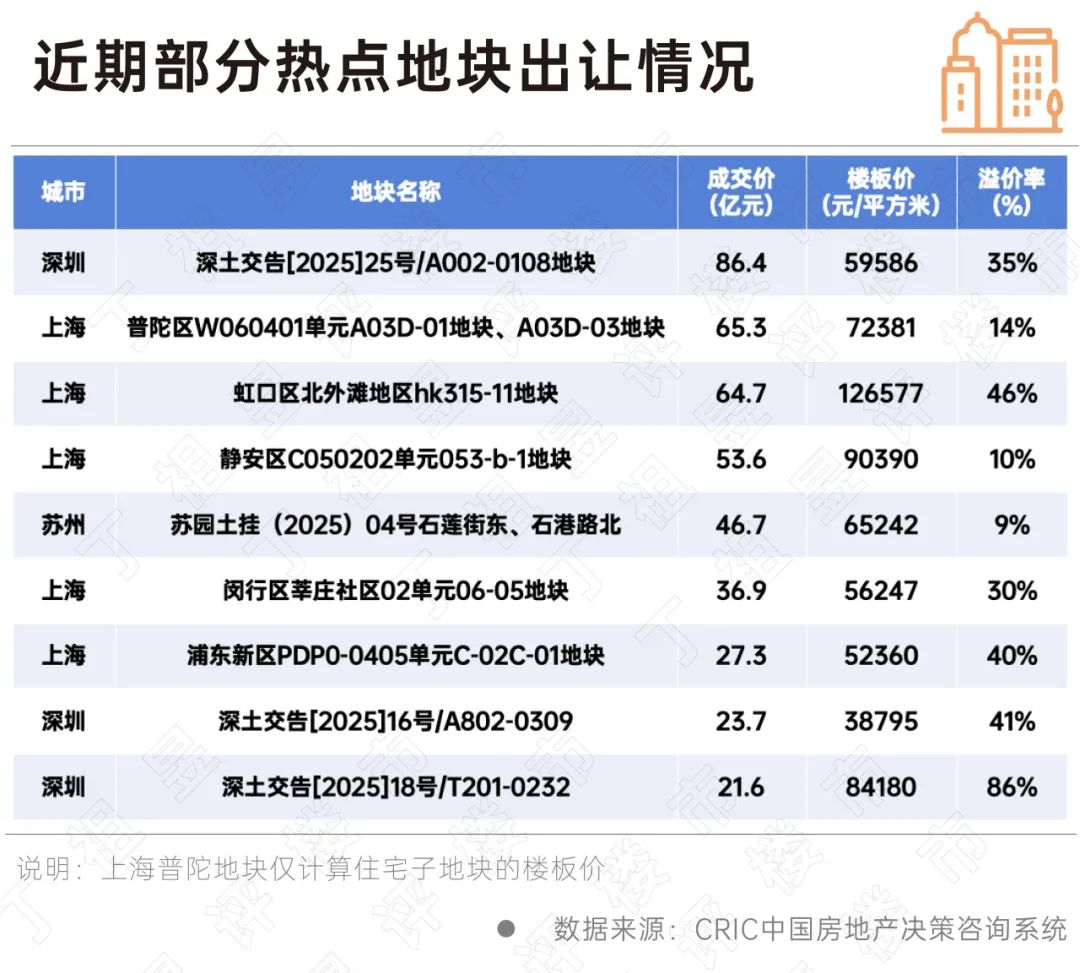
Core Insights - The land market in major cities like Shanghai, Shenzhen, and Suzhou has been reignited by multiple high-premium land transactions, indicating a renewed interest from developers despite the overall real estate market still stabilizing [1][3][4] Group 1: Land Market Activity - On August 15, a residential land parcel in Shenzhen's Bao'an district was sold for 8.64 billion yuan, with a premium rate of 35%, setting a new record for the Bao'an center area [1][5] - The land parcel in Shenzhen's Nanshan district sold for a floor price of 84,180 yuan per square meter, achieving a premium rate of 86.1%, marking a new high since the removal of the 15% premium cap in 2024 [1][4] - In Shanghai, a land parcel in the Xuhui district was sold for 1.225 billion yuan, with a premium rate of 22.38%, setting a new national record for land price at 200,257 yuan per square meter [1][4] Group 2: Market Trends - The proportion of premium land transactions in 30 key cities reached 30% in the first seven months of 2025, the highest in three years, indicating a significant increase in developer interest [7][8] - The average premium rate for these transactions was 26%, nearly doubling compared to the previous two years, reflecting a strong recovery in land acquisition sentiment [8][11] - Despite a general decline in new and second-hand home sales, the land market is showing signs of activity, with developers focusing on high-value land in core urban areas [2][3][18] Group 3: Developer Behavior - The top 10 real estate companies accounted for 70% of the total land acquisition value, highlighting a concentration of investment among leading firms [11][12] - Central and state-owned enterprises dominate the land market, leveraging their financial strength to secure premium land parcels, while private companies are more selective in their acquisitions [18] - The competitive landscape is intensifying as developers target high-quality land in core cities, with expectations of future market stability and price recovery [18]



招商蛇口等在上海成立置业公司,注册资本14亿
Qi Cha Cha· 2025-08-19 08:10
Group 1 - The core point of the article is the establishment of Shanghai Zhaoding Real Estate Co., Ltd. with a registered capital of 1.4 billion yuan [1] - The company is co-owned by Hangzhou Lvtou Real Estate Development Co., Ltd. and Shanghai Hongrun Real Estate Co., Ltd., a wholly-owned subsidiary of China Merchants Shekou Industrial Zone Holdings Co., Ltd. [1] - The business scope of the new company includes real estate development and operation, residential interior decoration, property management, parking services, and landscaping engineering construction [1]
存量房收储政策优化有望助力库存逐步去化
Orient Securities· 2025-08-19 06:43
Investment Rating - The report maintains a "Positive" investment rating for the real estate industry in China, indicating an expected return that is stronger than the market benchmark index by over 5% [3]. Core Insights - The report highlights that the optimization of existing housing storage policies is expected to gradually assist in inventory reduction. The People's Bank of China announced a 300 billion yuan re-loan for affordable housing, which supports local state-owned enterprises in acquiring existing residential properties for allocation as affordable housing. The report notes that the slow progress in storage is primarily due to pricing discrepancies between developers and local governments, and the responsibility for compliance and profitability lies with local governments [1][5]. - The report suggests that there is room for policy optimization, such as removing price caps to encourage developers to sell inventory, extending re-loan terms, and lowering interest rates to improve project profitability. These cumulative effects are expected to gradually aid in inventory reduction and enhance the recovery slope of real estate stock prices [1][5]. - The report emphasizes that the recovery of the real estate industry and stock prices does not solely depend on the timing of policy announcements. The decline in risk-free interest rates and the reduction in industry risk assessments are the main drivers for the recovery of real estate stocks. The report indicates that the real estate sector is entering a new bottoming phase, with the influence of the denominator (risk-free rates) surpassing that of the numerator (industry challenges), leading to a potential rebound in stock prices [5]. Summary by Sections Policy Evaluation - The report discusses the marginal optimization of existing housing storage policies, which is expected to facilitate inventory reduction. The People's Bank of China has set up a 300 billion yuan re-loan to support local state-owned enterprises in acquiring existing residential properties for affordable housing [1]. - The report identifies that the slow progress in storage is due to the pricing discrepancies between developers and local governments, with local governments bearing the ultimate responsibility for compliance and profitability [1][5]. Investment Recommendations - The report recommends focusing on specific stocks, including China Merchants Shekou (001979, Buy), Poly Developments (600048, Buy), Beike-W (02423, Buy), Longfor Group (00960, Buy), and Gemdale Corporation (600383, Accumulate) [6].



招商蛇口等在上海成立置业公司 注册资本14亿元
Zheng Quan Shi Bao Wang· 2025-08-19 05:43
Group 1 - Shanghai Zhaoding Real Estate Co., Ltd. has been established with a registered capital of 1.4 billion yuan [1] - The legal representative of the company is Huang Junjie [1] - The business scope includes real estate development, residential interior decoration, property management, parking services, and landscaping engineering [1] Group 2 - The company is jointly held by Hangzhou Lvtou Real Estate Development Co., Ltd. and Shanghai Hongrun Real Estate Co., Ltd., a wholly-owned subsidiary of China Merchants Shekou [1]
招商蛇口股价下跌1.31% 联合华润置地86亿元深圳拿地
Jin Rong Jie· 2025-08-18 18:01
Group 1 - The stock price of China Merchants Shekou (招商蛇口) was reported at 9.05 yuan as of August 18, 2025, down 1.31% from the previous trading day, with a trading volume of 744,186 hands and a transaction amount of 677 million yuan [1] - On August 15, China Merchants Shekou and China Resources Land (华润置地) won a bid for a land parcel in Shenzhen's Bao'an District for 8.64 billion yuan, with a premium rate of 34.81%, setting a new record for floor price in the Bao'an central area and becoming the highest-priced residential land in Shenzhen's 2025 land auction market [1] - As of August 18, the net outflow of main funds for China Merchants Shekou was 94.83 million yuan, accounting for 0.12% of its circulating market value, with a cumulative net outflow of 2.94 million yuan over the past five trading days [1] Group 2 - The main business of China Merchants Shekou includes real estate development and operation, and it is the flagship enterprise of the urban comprehensive development and operation sector under China Merchants Group, covering three major segments: park development and operation, community development and operation, and cruise industry construction and operation [1]
房地产行业资金流出榜:万通发展等6股净流出资金超5000万元
Zheng Quan Shi Bao Wang· 2025-08-18 08:59
Market Overview - The Shanghai Composite Index rose by 0.85% on August 18, with 29 sectors experiencing gains, led by the communication and comprehensive sectors, which increased by 4.46% and 3.43% respectively [1] - The real estate and oil & petrochemical sectors were the biggest losers, declining by 0.46% and 0.10% respectively, with the real estate sector at the top of the decline list [1] Capital Flow Analysis - The net outflow of capital from the two markets was 16.057 billion yuan, with 8 sectors seeing net inflows. The electronics sector led with a net inflow of 5.040 billion yuan and a daily increase of 2.48%, followed by the communication sector with a net inflow of 4.904 billion yuan and a daily increase of 4.46% [1] - The non-bank financial sector had the largest net outflow, totaling 7.087 billion yuan, followed by the power equipment sector with a net outflow of 5.090 billion yuan. Other sectors with significant outflows included pharmaceuticals, basic chemicals, and real estate [1] Real Estate Sector Performance - The real estate sector declined by 0.46% with a total net outflow of 2.004 billion yuan. Out of 100 stocks in this sector, 40 rose, including 1 hitting the daily limit, while 45 fell, including 1 hitting the lower limit [2] - Among the stocks with net inflows, the top three were Tibet Urban Investment with a net inflow of 55.565 million yuan, Tianbao Infrastructure with 33.574 million yuan, and Rongsheng Development with 22.805 million yuan [2] - The stocks with the largest net outflows included Wantong Development with a net outflow of 757.669 million yuan, Quzhou Development with 581.442 million yuan, and Poly Development with 179.508 million yuan [3]



10强房企“谁进谁退”?
3 6 Ke· 2025-08-18 06:13
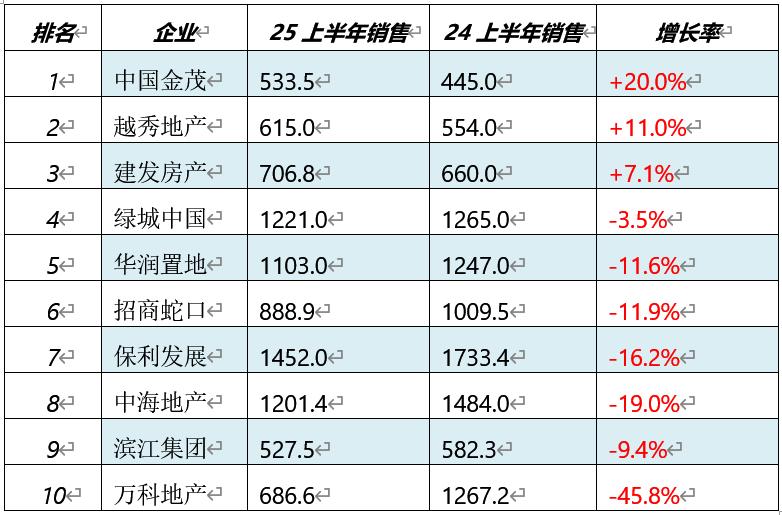
Core Viewpoint - The real estate industry in China is experiencing a significant shift, with the top 10 large enterprises becoming the "stabilizers" of the market as mid-sized companies face collapse. The future may see a consolidation into 5 to 7 dominant players [1][2]. Group 1: Sales Performance - The top 10 real estate companies are undergoing a "dual differentiation" in sales performance, with the leading firms experiencing a decline while the mid-tier companies are showing growth. For instance, only 3 out of the top 10 achieved positive growth, with China Jinmao at 19%, Yuexiu at 11%, and Jianfa at 7% [3][4]. - The head companies are collectively facing negative growth, with Vanke reporting a decline of 46%, and other major players like China Overseas, Poly, and China Merchants also showing significant drops [4][5]. - The average sales growth rate for the top 100 companies has decreased by 11.8%, indicating that even leading firms are not immune to the downturn [5]. Group 2: Land Acquisition Trends - The year 2025 is characterized as a "land acquisition year" for the top 10 companies, driven by improved sales and better land offerings from local governments compared to 2024 [6][7]. - There is a clear distinction between aggressive "Tiger" companies, which are acquiring land at a rapid pace (e.g., Poly's land acquisition increased by 276% to 414 billion, China Overseas by 228% to 393 billion), and the more cautious "Wolf" companies, which are growing at a slower rate [10][12]. - The "Tiger" companies are defined by high acquisition volumes (over 400 billion) and significant growth rates (100% to 300%), while the "Wolf" companies are characterized by lower volumes (below 300 billion) and growth rates under 40% [9][12]. Group 3: Company Classification - The top 10 companies can be categorized into three main groups based on their sales and land acquisition strategies: aggressive, cautious, and balanced [17][34]. - The aggressive group includes companies like Jinmao, China Merchants, China Overseas, and Poly, which exhibit high land acquisition and low sales [23][26]. - The cautious group, represented by companies like Vanke, is focused on maintaining sales while limiting land acquisition, with Vanke experiencing a 45.8% drop in sales and a 95% decrease in land acquisition [27][29]. - The balanced group includes companies like China Resources, Greentown, and Jianfa, which maintain a moderate approach to both sales and land acquisition [34][36]. Group 4: Market Concentration - The concentration of the top 10 companies is increasing, with their land acquisition intensity averaging 0.4, significantly higher than the 0.26 average of the top 100 companies [41][42]. - The top 10 companies now account for 73% of the new value added in the market, indicating a shift towards larger, financially robust firms [41][42]. - The ongoing market downturn is likely to further consolidate the industry, with smaller firms facing increasing challenges to survive due to insufficient land acquisition [42].