
GOTION(002074)

Search documents
2025年中国储能BMS行业产业链、SWOT、市场规模、产值、竞争格局及发展趋势研判:行业技术成熟度和标准化程度显著提升,带动储能BMS规模扩张[图]
Chan Ye Xin Xi Wang· 2026-01-11 01:03
Core Insights - The energy storage Battery Management System (BMS) is a critical component for safety in energy storage systems, transitioning the industry from "passive protection" to "active safety" [1][3] - The market for new energy storage systems in China is expected to grow significantly, with the BMS market projected to reach 3.448 billion yuan in 2024 and 2.475 billion yuan in 2025, despite a decline in overall value due to price reductions [1][3] Industry Definition and Classification - Energy storage BMS is the core control component of energy storage systems, responsible for real-time data collection, state diagnosis, and safety protection [2] - BMS can be classified based on enterprise type, application field, and technology architecture [2] Current Industry Status - The global energy storage BMS market is expected to reach 6.252 billion yuan in 2024, with the Asia-Pacific region accounting for 62.01% of the market share [3] - In China, the BMS market is projected to grow from 275 million yuan in 2020 to 3.448 billion yuan in 2024, with a potential decline to 2.475 billion yuan in 2025 due to pricing pressures [3] Industry Value Chain - The energy storage BMS industry value chain includes upstream suppliers of key materials and components, midstream hardware production and software development, and downstream system integrators [4] SWOT Analysis - The energy storage BMS industry is supported by national policies aimed at promoting new energy storage, positioning it as a core component of the new power system [5] Competitive Landscape - The domestic energy storage BMS market features three main types of participants: self-developed BMS by battery companies, system integrators with self-development capabilities, and third-party specialized manufacturers [6][7] - Leading self-developed BMS companies include CATL, BYD, and Guoxuan High-Tech, which leverage their technology to enhance product competitiveness [6] - Comprehensive manufacturers like Sungrow and Haibo Innovation develop BMS products tailored to their systems [7] - Specialized third-party BMS manufacturers focus on technological differentiation and cost optimization [7] Development Trends - The energy storage market in China is expected to maintain rapid growth, driven by the dual carbon goals and the construction of new power systems [8] - The maturity and standardization of BMS technology are anticipated to improve, leading to further industry expansion [9] - Future trends indicate a shift towards integration, intelligence, openness, and scalability in the BMS industry [9]






光伏、电池出口退税新政出台,对市场有何影响?
Qi Huo Ri Bao· 2026-01-11 00:14
Core Viewpoint - The recent announcement by the Ministry of Finance and the State Taxation Administration regarding the adjustment of export tax rebate policies for photovoltaic and other products reflects the optimization and transformation of the country's support for the new energy industry, which will further promote high-quality development in the photovoltaic and lithium battery sectors [1] Photovoltaic Industry - The announcement states that from April 1, 2026, the value-added tax export rebate for photovoltaic products will be completely canceled, marking the first comprehensive cancellation since the industry was included in the export rebate policy in October 2013 [2] - The export rebate policy for the photovoltaic industry began in October 2013, allowing companies to enjoy a rebate rate of up to 50%. However, due to increasing competition, the rebate policy has been gradually optimized, with a previous reduction from 13% to 9% announced on November 15, 2024 [2] - The China Photovoltaic Industry Association noted that since 2024, the industry has faced fierce competition in overseas markets, leading to a "volume increase and price decrease" trend, where some companies engaged in low-price competition, effectively turning the export rebate into a subsidy for foreign buyers [2] - The cancellation of the export rebate is seen as a policy to promote high-quality development in the industry, with the adjustment expected to help stabilize export prices and reduce the risk of trade frictions [3] - The industry has begun to show signs of improvement, with upstream prices recovering to reasonable levels and downstream prices trending upward [3] Lithium Battery Industry - The announcement also includes a phased reduction in the export rebate for battery products, decreasing from 9% to 6% from April 1, 2026, and completely canceling it by January 1, 2027 [5] - The adjustment aims to guide the battery industry away from pure scale expansion and alleviate the pressure of homogenized competition, encouraging companies to enhance product technology and value [5] - Major battery exporters include companies like CATL and Guoxuan High-Tech, with CATL reporting a gross margin of 23% for domestic business and 29% for overseas business in the first quarter of 2025 [5] Short-term Market Dynamics - There is an expectation of a "rush to export" phenomenon in the short term as companies accelerate production and order fulfillment before the policy takes effect, potentially leading to a spike in export data [6] - The demand for lithium carbonate may see a short-term boost due to increased battery orders before the rebate cancellation, although the long-term impact may suppress demand due to increased costs [6] - Current inventory levels for lithium carbonate are rising, with a reported weekly inventory of approximately 110,000 tons as of January 8, indicating a shift towards marginal accumulation [6]

固态电池供应商备战2027:目标定好了,路线还在争
Jing Ji Guan Cha Wang· 2026-01-09 12:33
Core Insights - The solid-state battery industry is experiencing renewed interest from investors due to clear profitability and order visibility in the supply chain, with a significant focus on achieving mass production by 2027 [2][3][6] - Major automotive companies are targeting 2027 for the application of solid-state batteries in vehicles, with many planning to complete product development or testing by 2026 [4][5] Industry Developments - Companies like Tian Shi Ke Feng have begun to engage with potential investors after overcoming initial funding challenges, with plans to expand production capacity significantly in 2026 [2] - The Ministry of Industry and Information Technology has identified solid-state batteries as a key area for development, aiming to establish 3-5 leading companies by 2027 [3] Technical Challenges - The path to mass production of solid-state batteries is fraught with challenges, including material technology discrepancies and shortages in core equipment [6][8] - The industry is divided on material technology routes, with significant competition between oxide and sulfide electrolytes, each having distinct advantages and challenges [10][12] Material Innovations - Solid-state batteries are recognized for their high energy density and intrinsic safety, making them suitable for various applications, although their cost-effectiveness in electric vehicles remains a concern [7][8] - The development of silicon-carbon and lithium metal anodes is ongoing, with companies reporting progress in small-scale trials [9][10] Equipment and Production - The lack of mature mass production equipment poses a significant barrier, with many companies resorting to self-developed solutions to meet production demands [14][19] - The production process for solid-state batteries requires high precision and specialized equipment, which increases costs and complicates the manufacturing process [20][21] Market Dynamics - The solid-state battery supply chain is characterized by a collaborative approach among suppliers and manufacturers, with a focus on meeting evolving technical requirements from cell manufacturers [23][24] - The competitive landscape is marked by a "race" among cell manufacturers to explore various material suppliers, emphasizing the need for continuous innovation and adaptation [24]





GGII:1-11月全球动力电池装机975.3GWh 同比增长32%
智通财经网· 2026-01-09 10:44
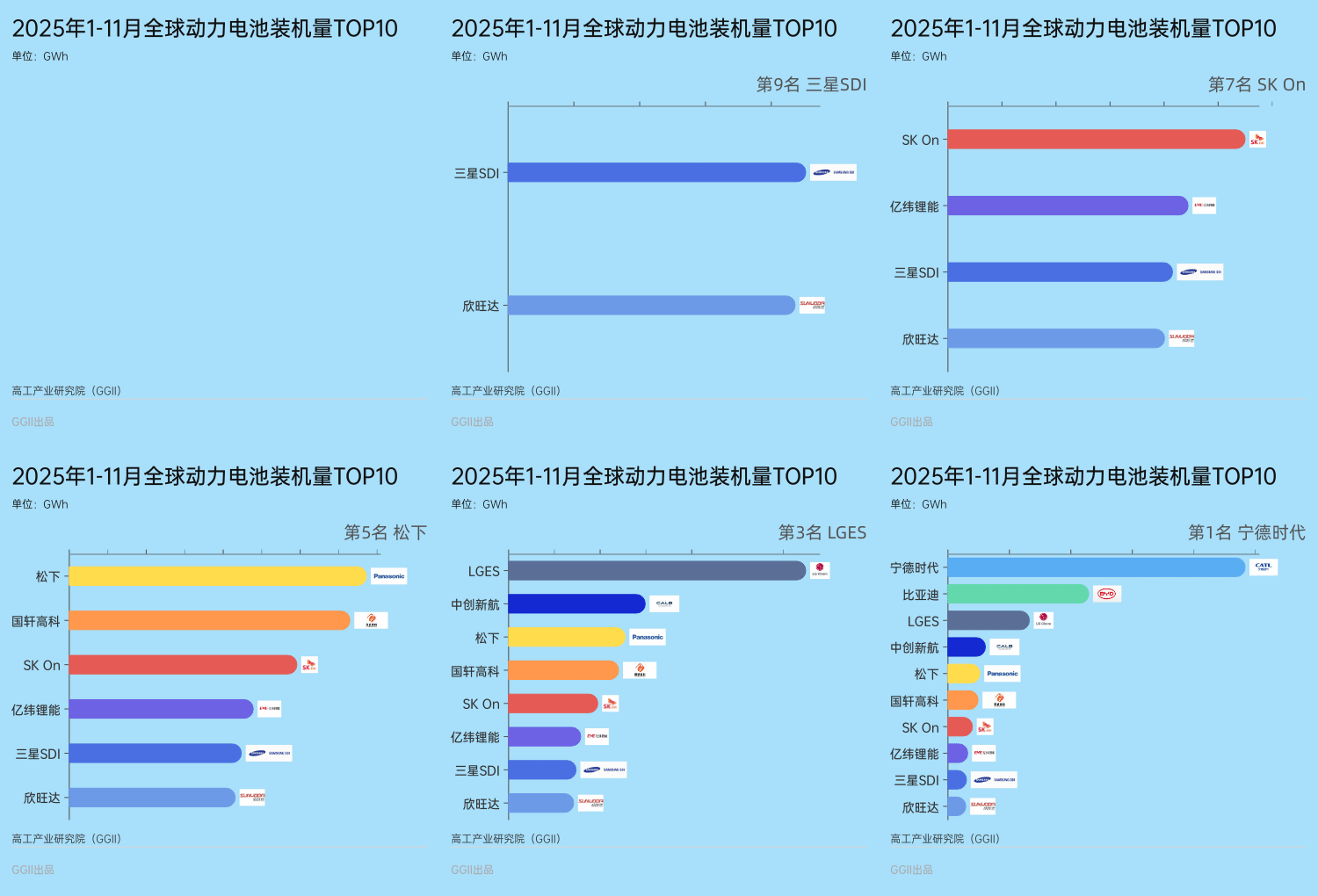
Group 1 - The core viewpoint of the article highlights a decline in global electric vehicle (EV) sales and battery installation volumes in November, with a year-on-year growth of only 7% for EV sales and a 20% growth for battery installations, both showing a 2 percentage point decrease from the previous month [1] - In the cumulative period from January to November 2025, global EV sales reached 18.009 million units, representing a 22% year-on-year increase, which drove the global battery installation volume to approximately 975.3 GWh, a 32% year-on-year growth [1] - China accounted for 64% of the global battery installation volume, with six out of the top ten companies in the industry being Chinese [1] Group 2 - Among the top ten global battery installation companies, Guoxuan High-Tech (002074.SZ) achieved the highest market share increase, rising by 8 percentage points compared to the same period last year, driven by rapid growth in both domestic and international markets [1] - The data indicates that the total battery installation volume in China was 624.3 GWh, significantly higher than other countries, with the United States at 109.7 GWh and Germany at 37.3 GWh [8] - The global battery installation volume includes data from electric vehicles (EV), plug-in hybrid electric vehicles (PHEV), and fuel cell vehicles (FCV), excluding hybrid electric vehicles (HEV) [8]
年度榜单丨2025年中国动力锂电池TOP10发布
起点锂电· 2026-01-09 02:41
Group 1 - The core viewpoint of the article is the analysis and forecast of the Chinese power lithium battery market for 2025, highlighting significant growth in shipment volumes and market size due to increasing penetration of new energy vehicles [2] - In 2025, the shipment volume of power lithium batteries in China is expected to reach 936 GWh, representing an 18% year-on-year increase [2] - By 2030, the shipment volume is projected to grow to 2550 GWh, indicating a continuous upward trend in the automotive power battery market [2] Group 2 - The price trend for lithium batteries in 2025 indicates that the average price for lithium iron phosphate batteries will be 0.38 yuan/wh, while the average price for ternary lithium batteries will be 0.65 yuan/wh [3] - Future price fluctuations will depend on market demand, with ternary lithium batteries expected to oscillate between 0.5-0.7 yuan/wh and lithium iron phosphate batteries between 0.35-0.5 yuan/wh [3] - The price difference between ternary lithium batteries and lithium iron phosphate batteries is anticipated to remain between 0.1-0.2 yuan/wh [3] Group 3 - The top 10 power lithium battery companies in China for 2025 include CATL, BYD, Zhongchuang Xinhang, Guoxuan High-Tech, Yiwei Lithium Energy, Hive Energy, Ruipu Lanjun, Xinwanda, Inpai Battery, and Funeng Technology [5]

四部门联合召开动力和储能电池行业座谈会,十余家头部企业参与
Cai Jing Wang· 2026-01-09 02:05
Group 1 - The core focus of the meeting held on January 7 was to further regulate the competitive order in the power and energy storage battery industry [1] - The meeting was attended by 16 companies, including 13 power and energy storage battery manufacturers such as CATL, BYD, and others [1] - Additionally, 3 system integrators participated in the meeting, indicating a collaborative effort across different sectors within the industry [1]

汽车早餐 | 四部门联合召开动力和储能电池行业座谈会;吉利获L3级自动驾驶道路测试牌照;广汽国际与Grab达成战略合作
Zhong Guo Qi Che Bao Wang· 2026-01-09 01:21
Group 1: Battery Industry - A joint meeting was held by four government departments to discuss the regulation of the power and energy storage battery industry, involving 16 companies including major players like CATL and BYD [2] Group 2: Automotive Industry - The Ministry of Industry and Information Technology is soliciting public opinions on seven proposed mandatory national standards for intelligent connected vehicles, including safety requirements for automatic parking systems [3] - Geely has obtained a Level 3 autonomous driving road test license for its Zeekr 9X model in Hangzhou [9] - Xpeng Motors' CEO predicts that 2026 will mark the true beginning of autonomous driving in China and the U.S., with the company's second-generation VLA achieving Level 4 autonomous driving capabilities [11] - Dongfeng Motor is in discussions to produce passenger vehicles in Turkey, with plans to start production within the year [12] Group 3: Strategic Partnerships and Investments - GAC International has formed a strategic partnership with Grab to collaborate on delivering 20,000 high-performance electric vehicles in Southeast Asia over the next two years [10] - Intramco, a company under Xincheng Capital, has partnered with Leap Motor to supply charging products for its future electric vehicles produced in Europe [14] - Faraday Future aims to achieve positive cash flow and a gross margin of 20% within three years, as announced during its shareholder day event [15] Group 4: Technology and Innovation - Hyundai's stock price surged following the announcement of increased investments in robotics and artificial intelligence, alongside a meeting between its chairman and NVIDIA's CEO [6] - Elon Musk's AI startup xAI completed a $20 billion funding round, exceeding its initial target of $15 billion, with investors including NVIDIA and Cisco [7] Group 5: Economic Cooperation - The Ministry of Commerce is accelerating negotiations for the second phase of the China-South Korea Free Trade Agreement, focusing on enhancing economic cooperation and exploring new areas such as high-end manufacturing and green industries [4] - Guangzhou's government has released a plan to cultivate strategic industries, including artificial intelligence and new energy storage, as part of its advanced manufacturing strategy [5]


1月9日投资早报|中国石化与中国航油实施重组,万科董事、执行副总裁郁亮辞职,华夏幸福2025年年度经营业绩将出现亏损
Xin Lang Cai Jing· 2026-01-09 00:34
Market Overview - On January 8, 2026, the A-share market saw all three major indices rise, with the Shanghai Composite Index closing at 3888.60 points, up 0.34%, and the Shenzhen Component Index at 12984.08 points, up 0.85% [1] - The Hong Kong stock market declined, with the Hang Seng Index falling 1.17% to 26149.31 points, and the Hang Seng Tech Index down 1.05% to 5678.34 points [1] - In the U.S. stock market, the Dow Jones Industrial Average rose by 270.03 points, or 0.55%, closing at 49266.11 points, while the Nasdaq Composite fell by 104.26 points, or 0.44% [1] Corporate News - On January 8, 2026, the State-owned Assets Supervision and Administration Commission announced the restructuring of China Petroleum & Chemical Corporation (Sinopec) and China National Aviation Fuel Group [2] - China Aviation Fuel is recognized as Asia's largest provider of aviation fuel services, while Sinopec is the world's largest refining company and China's top aviation fuel producer [2] Industry Developments - On January 8, 2026, the Ministry of Industry and Information Technology (MIIT) led a meeting to address irrational competition in the lithium battery industry, involving 16 major companies including CATL and BYD [3] - The meeting aimed to promote self-regulation within the industry, with participation from industry associations [3] Regional Initiatives - Guangzhou has issued a plan to accelerate the construction of advanced manufacturing, supporting market-driven intelligent computing infrastructure and telecom companies in building smart computing centers [4] - The plan aims to integrate artificial intelligence across various sectors by 2035, fostering over 1000 AI industry models and creating numerous application scenarios in fields such as manufacturing and healthcare [4]

国轩高科股份有限公司关于第五期员工持股计划非交易过户完成的公告
Zhong Guo Zheng Quan Bao - Zhong Zheng Wang· 2026-01-08 23:12
Core Viewpoint - The company has successfully implemented its fifth employee stock ownership plan, involving the transfer of 9.439993 million shares, sourced from repurchased A-shares, to enhance employee engagement and align interests with shareholders [1][2]. Group 1: Employee Stock Ownership Plan Overview - The fifth employee stock ownership plan was approved during the board and supervisory meetings held on August 28, 2025, and the first extraordinary shareholders' meeting on September 23, 2025 [1]. - The total number of shares transferred under this plan is 9.439993 million, which represents 0.52% of the company's total share capital as of December 31, 2025 [2][6]. - The shares were sourced from the company's repurchased shares, and the actual use aligns with the initial repurchase plan [2]. Group 2: Subscription and Funding Details - The plan allows for a maximum of 11.202539 million shares to be involved, with a subscription price set at 21.07 yuan per share, aiming to raise up to 236.0375 million yuan [4]. - A total of 696 participants subscribed to the plan, contributing a total of 198.9007 million yuan, which has been fully paid [4][5]. - The funding sources for the plan include employees' legal salaries, self-raised funds, and other legally permitted means, with no financial assistance or guarantees provided by the company [4]. Group 3: Lock-up and Release Conditions - The plan has a maximum duration of 60 months, with different lock-up periods for two categories of participants based on their roles and contributions [7]. - The first category has a lock-up period of 24, 36, and 48 months, while the second category has a lock-up period of 12, 24, and 36 months, with specific release ratios for each period [7]. Group 4: Related Party and Independence - The company's controlling shareholders and actual controllers did not participate in the employee stock ownership plan, ensuring no conflict of interest [8]. - The plan holders include some directors and senior management, but they will recuse themselves from voting on related proposals to maintain independence [8][9]. Group 5: Accounting Treatment - The company will follow the accounting standards for share-based payments, recognizing the impact of the employee stock ownership plan on its financial results based on annual audit reports [10].
开年即冲刺 全力保交付 订单“催更” 锂电企业扩产马不停蹄
Zhong Guo Zheng Quan Bao· 2026-01-08 22:01
Core Viewpoint - The lithium battery industry is experiencing a significant investment boom, driven by increasing demand for energy storage and stable growth in power battery installations, leading to a tight supply-demand balance in 2026 [4][6]. Group 1: Company Expansion Plans - Longpan Technology plans to invest up to 2 billion yuan to build a new production base for 240,000 tons of high-pressure lithium iron phosphate annually, as existing capacity cannot meet customer demand [1][2]. - In addition to Longpan Technology, several companies, including Fulin Precision, Dongfang Zirconium, and Xinzhou Bang, have announced investment plans for lithium battery projects, continuing the expansion trend from 2025 [1][2]. - Longpan Technology has previously raised funds to build projects with capacities of 110,000 tons and 85,000 tons of high-performance phosphate-based cathode materials, with ongoing capacity expansion efforts [2]. Group 2: Industry Investment Trends - Since 2025, over 282 investment projects in the lithium battery industry chain have been announced in China, with a total investment exceeding 820 billion yuan, marking a year-on-year increase of over 74% [2]. - The investment trend is not only domestic but also expanding internationally, with companies like Xinzhou Bang planning to invest approximately 260 million USD in a lithium-ion battery materials project in Saudi Arabia [3]. Group 3: Market Dynamics - The surge in lithium battery investments is attributed to multiple factors, including the explosive growth in energy storage demand, steady increases in power battery installations, and rapid technological advancements [4][5]. - The industry has transitioned from a state of oversupply to a tight balance since mid-2025, with expectations of continued investment momentum into 2026 due to strong demand growth [6][7]. - Companies are increasingly adopting a rational approach to expansion, focusing on "order capacity" to avoid blind investments and ensure sustainable growth [6][7].


