Bank of Ningbo(002142)

Search documents
YiwealthSMI |非“说教式”反诈内容屡上榜,捕捉热点是机构“破圈”秘诀
Di Yi Cai Jing· 2025-08-01 06:35
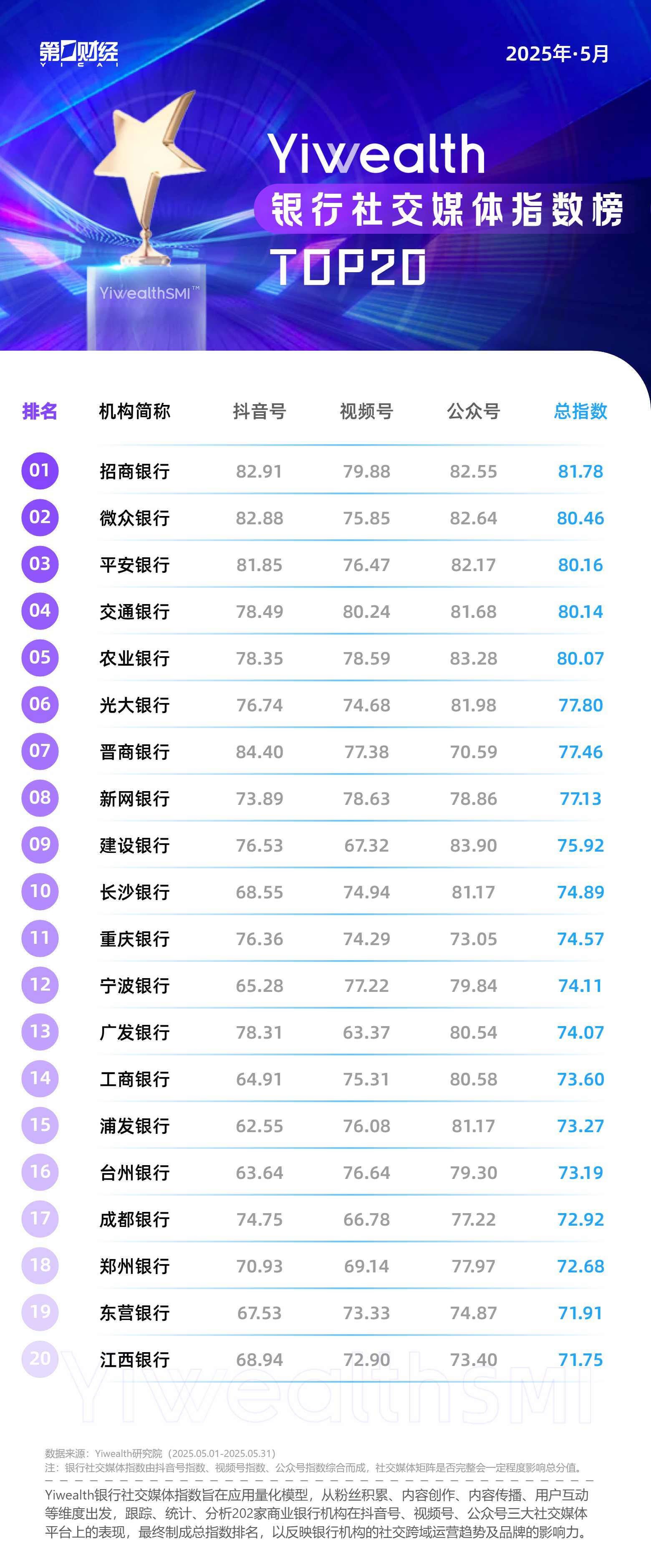
Group 1 - The May 2025 Bank Social Media Index (SMI) shows that the rankings are still concentrated at the lower end, primarily involving small and medium-sized banks [1] - Four banks, including Zheshang Bank and Hebei Bank, dropped out of the top rankings, while banks like Pudong Development Bank and Zhengzhou Bank entered the list [1] - The SMI is based on a quantitative model that tracks and analyzes the performance of 202 commercial banks across platforms like Douyin and WeChat [7][36] Group 2 - Popular Douyin videos from banks are closely tied to current hot topics and widely appealing themes, such as the Dragon Boat Festival and youth culture [2] - Notable content includes a series by WeBank that tells the story of a grandfather selling dumplings at a low price, which gained significant user engagement with 51,000 likes [2] - Banks are encouraged to move away from traditional promotional methods to attract user engagement, as demonstrated by Guangfa Bank's creative approach combining storytelling with anti-fraud education [2] Group 3 - The top-performing videos on video platforms often leverage holiday themes, with banks like Dongguan Bank promoting discounts during the Dragon Boat Festival and 618 shopping festival [3] - The WeChat public account rankings primarily focus on welfare and benefits for users [3] Group 4 - The rankings for Douyin and video platforms show that banks like China Merchants Bank and WeBank are leading in user engagement metrics [5][6] - The index reflects the banks' ability to create engaging content and accumulate followers across social media platforms [7][36] Group 5 - The public account rankings highlight various banks offering promotional activities, such as China Construction Bank providing benefits for members and China Agricultural Bank promoting commemorative coins [34][36] - The data indicates a trend where banks are increasingly utilizing social media to enhance customer engagement and promote their services [36]





5家银行业绩快报预喜 4家归母净利润增长超13%
2 1 Shi Ji Jing Ji Bao Dao· 2025-08-01 04:49
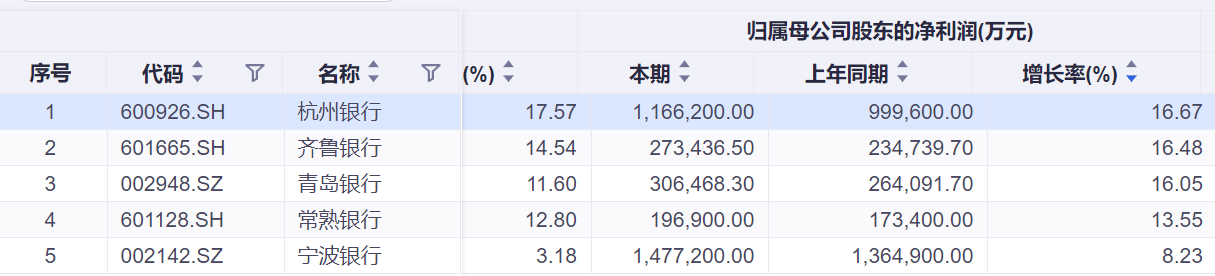
Core Viewpoint - Qingdao Bank reported a positive performance for the first half of 2025, with significant growth in revenue and net profit, reflecting a stable banking sector amidst broader industry trends [1] Financial Performance - Qingdao Bank's operating income for H1 2025 reached 7.662 billion yuan, a year-on-year increase of 7.50% [1] - The net profit attributable to shareholders was 3.065 billion yuan, up 16.05% compared to the previous year [1] - Total assets as of June 30, 2025, amounted to 743.028 billion yuan, growing by 7.69% year-on-year [1] - Total liabilities were reported at 695.944 billion yuan, reflecting a growth of 7.89% [1] - The non-performing loan ratio stood at 1.12%, a decrease of 0.02 percentage points from the end of the previous year [1] - The provision coverage ratio improved to 252.80%, an increase of 11.48 percentage points from the end of the previous year [1] Industry Trends - Among the banks that have disclosed their performance reports, all have shown positive growth in net profit, with four banks achieving double-digit growth [1] - Hangzhou Bank reported a net profit of 11.662 billion yuan for H1 2025, marking a 16.67% increase year-on-year [3] - Qilu Bank's net profit reached 2.734 billion yuan, up 16.48% year-on-year [5] - Ningbo Bank's operating income was 37.16 billion yuan, with a net profit of 14.772 billion yuan, reflecting growth rates of 7.91% and 8.23% respectively [4] - Changshu Bank reported a net profit of 1.969 billion yuan, a year-on-year increase of 13.55% [6] Asset Quality - Hangzhou Bank maintained a stable asset quality with a non-performing loan ratio of 0.76% and a provision coverage ratio of 520.89% [4] - Qilu Bank's non-performing loan ratio decreased to 1.09%, with a provision coverage ratio of 343.24%, up 20.86 percentage points [5] Dividend Trends - Several banks, including Changsha Bank and Su Nong Bank, are planning mid-term dividends to enhance investor returns [7][8] - The trend of mid-term dividends is seen as a strategy to improve liquidity and provide stable cash flow for investors [8][9]


国家“个贷与服务业贷款贴息”战略,对A股影响(一)
Sou Hu Cai Jing· 2025-08-01 03:56
Core Insights - The State Council held a meeting on July 31, 2025, to implement personal consumption loan interest subsidy policies and service industry loan interest subsidy policies, aimed at reducing credit costs for residents and financing costs for service industry entities, thereby stimulating consumption potential and enhancing market vitality [1] Group 1: Beneficiary Analysis - The "policy intensity - industry elasticity - valuation safety margin" three-dimensional model was constructed to identify beneficiaries, leading to three main beneficiary lines [2] - Key beneficiaries in the consumer finance infrastructure layer include: - China Merchants Bank (招商银行) with over 20% market share in consumer loans, expected to see growth in its consumer loan business due to the subsidy policy [2] - BYD (比亚迪) benefiting from reduced car purchase costs through auto loan subsidies, likely to boost sales in the electric vehicle sector [2] - Hengsheng Electronics (恒生电子) anticipated to receive numerous orders for bank subsidy system upgrades due to increased demand [2] - Tongqinglou (同庆楼), a regional restaurant leader, expected to expand operations and improve service quality due to reduced financing costs [2] - Ningbo Bank (宁波银行), which has the highest proportion of small and micro loans in the industry, will see new growth opportunities from the subsidy policy [2] Group 2: Consumption Recovery and Upgrade - Beneficiaries in the consumption recovery layer include: - Wuliangye (五粮液), a high-end liquor brand, expected to benefit from the recovery of high-end consumption in banquet scenarios [3] - Songcheng Performance (宋城演艺), a leader in the cultural tourism sector, likely to attract more visitors and enhance performance due to tourism subsidies [3] - Yili (伊利股份), a dairy industry leader, expected to benefit from the upgrade in dairy consumption and cost reductions [3] - Midea Group (美的集团), anticipated to see increased demand for home appliances due to the combination of old-for-new policies and interest subsidies [3] - Haitian Flavoring (海天味业), expected to experience growth in demand for condiments as the restaurant industry recovers [3] - Yanghe (洋河股份), benefiting from the recovery of banquet consumption in the mid-range liquor segment [3] Group 3: Long-term Value and Innovation - Beneficiaries in the consumption upgrade empowerment layer include: - Heng Rui Medicine (恒瑞医药), expected to see growth in innovative drugs and medical consumption due to increased resident spending [5] - Aier Eye Hospital (爱尔眼科), benefiting from rising demand for refractive surgery as consumer spending on eye health increases [5] - Haier Smart Home (海尔智家), anticipated to see growth in high-end smart home product sales due to interest subsidies [5] - China Duty Free Group (中国中免), expected to benefit from the recovery of inbound tourism and support for duty-free consumption [5] - Gree Electric (格力电器), likely to see increased demand for home appliances due to favorable policies and channel reforms [5] Group 4: Economic Impact - The "double interest subsidy" policy is distinct from traditional infrastructure stimulus, as it aims to precisely activate consumer demand to drive economic circulation, demonstrating stronger targeting and effectiveness [7]






金融Agent落地,谁能“敲开”银行的大门?
3 6 Ke· 2025-07-31 09:13
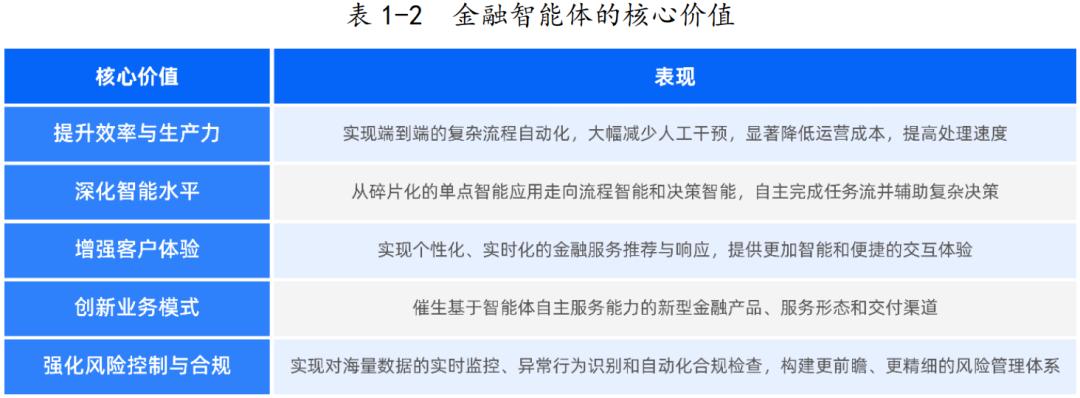
Core Insights - The Chinese banking industry is at a turning point with the emergence of AI technology, particularly AI Agents, which are set to revolutionize core banking functions such as credit and risk management by significantly enhancing productivity and efficiency [1][3][21] - AI Agents, built on large AI models, can autonomously perform tasks, assist in decision-making, and provide personalized financial services, thereby reducing manual intervention and operational costs [1][3][4] Group 1: AI Agent Implementation and Value - AI Agents are becoming a core focus for banks, with significant investments being made to develop and implement these technologies [4][6] - The core values of AI Agents include improving efficiency through end-to-end automation, enhancing decision-making capabilities, and providing personalized customer experiences [3][21] - Major banks like ICBC and Agricultural Bank of China are leading in financial technology investments, with ICBC planning to spend approximately 28.518 billion yuan in 2024 [6][8] Group 2: Bank-Specific Developments - Agricultural Bank of China has introduced the "Mosu Loan Scoring Card" AI Agent, which can generate credit reports in 30 seconds, significantly speeding up the due diligence process [8] - Postal Savings Bank is rapidly advancing its AI capabilities, achieving over 87.5% automation in alarm troubleshooting through its AI Agents [9] - Other banks, including China Merchants Bank and Ping An Bank, are also developing their own AI Agents to enhance data analysis and customer service [11][12] Group 3: Technology Partnerships - Banks are increasingly collaborating with technology companies to bridge the technological gap and enhance their AI capabilities [13][20] - Major tech players like Baidu, Alibaba, and Tencent are providing comprehensive AI solutions and infrastructure, which are crucial for the successful implementation of AI Agents in banking [14][15] - The partnership between banks and tech companies is essential for unlocking the potential of AI in the financial sector, especially for smaller banks [13][20] Group 4: Challenges and Future Outlook - Despite the rapid development of AI Agents, many banks are still focused on non-core applications, indicating a gap between potential and actual implementation [21][22] - The banking sector requires high accuracy and reliability from AI systems, which currently face challenges such as a 95% accuracy rate in leading financial models [23][24] - The transition to AI-driven banking is a long-term process that necessitates a solid AI strategy and collaboration between banks and technology providers to achieve significant ROI [30][31]



银行行业资金流入榜:农业银行、招商银行等净流入资金居前
Zheng Quan Shi Bao Wang· 2025-07-31 08:51
| 代码 | 简称 | 今日涨跌幅(%) | 今日换手率(%) | 主力资金流量(万元) | | --- | --- | --- | --- | --- | | 601288 | 农业银行 | 1.12 | 0.17 | 32637.20 | | 600036 | 招商银行 | 0.14 | 0.36 | 26861.57 | | 601398 | 工商银行 | 0.93 | 0.18 | 22617.27 | | 601939 | 建设银行 | 0.97 | 1.54 | 17738.39 | | 600016 | 民生银行 | -0.81 | 0.77 | 14577.83 | | 601009 | 南京银行 | -2.21 | 0.53 | 11566.19 | | 600926 | 杭州银行 | -1.89 | 1.02 | 10447.54 | | 601229 | 上海银行 | -1.25 | 0.51 | 7535.77 | | 601658 | 邮储银行 | 0.88 | 0.41 | 7029.01 | | 002966 | 苏州银行 | -1.61 | 0.86 | 5127.33 | | ...

城商行板块7月31日跌1.69%,青岛银行领跌,主力资金净流入3.55亿元
Zheng Xing Xing Ye Ri Bao· 2025-07-31 08:32
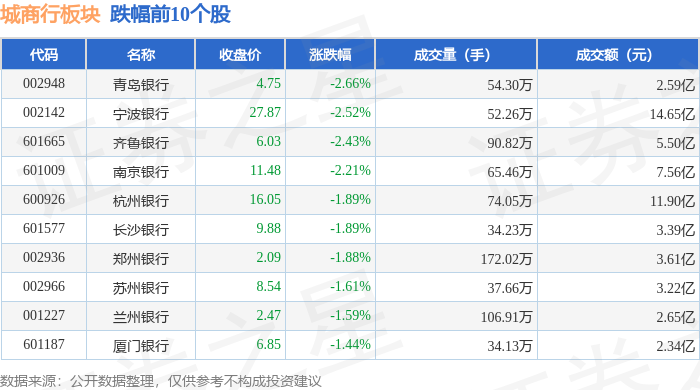
证券之星消息,7月31日城商行板块较上一交易日下跌1.69%,青岛银行领跌。当日上证指数报收于 3573.21,下跌1.18%。深证成指报收于11009.77,下跌1.73%。城商行板块个股涨跌见下表: 从资金流向上来看,当日城商行板块主力资金净流入3.55亿元,游资资金净流出3.48亿元,散户资金净流 出672.91万元。城商行板块个股资金流向见下表: | 代码 | 名称 | 主力净流入(元) | 主力净占比 游资净流入 (元) | | 游资净占比 散户净流入(元) | | 散户净占比 | | --- | --- | --- | --- | --- | --- | --- | --- | | 601009 南京银行 | | 1.36亿 | 18.02% | -7561.65万 | -10.00% | -6062.50万 | -8.02% | | 600926 杭州银行 | | 8796.45万 | 7.39% | -6639.21万 | -5.58% | -2157.24万 | -1.81% | | 002966 苏州银行 | | 5001.57万 | 15.54% | -2207.49万 | -6.86% ...

业绩预喜!首批上市银行中期快报出炉 还有多家银行释放中期分红意向
Mei Ri Jing Ji Xin Wen· 2025-07-31 01:47
上市银行中报季拉开序幕,目前已有杭州银行、常熟银行、宁波银行、齐鲁银行4家区域性银行发布了 2025年半年度业绩快报,营收和归母净利润均实现同比增长,且资产质量稳中向好,不良率较年初持平 或有所下降。 记者注意到,随着中报披露脚步临近,A股银行已于日前完成了2024年度分红派息。此外,多家银行已 释放出2025年中期分红意向,受到市场关注。 四家区域性银行率先发布业绩快报 盈利预喜的同时,上述四家银行的资产规模也在稳步增长。截至6月末,宁波银行总资产达3.47万亿 元,较上年末增长11.04%。另一家万亿元规模的杭州银行,6月末总资产达2.24万亿元,较上年末增长 5.83%。 此外,齐鲁银行资产总额突破7500亿元,较上年末增长8.96%;常熟银行资产总额也迈过4000亿元关 口,较年初增长9.46%。 从信贷情况来看,这四家银行的信贷增速均维持正增长,其中宁波银行贷款和垫款总额较上年末增长 13.36%,齐鲁银行贷款总额较上年末增长10.16%;杭州银行和常熟银行的上半年贷款增幅分别为7.67% 和4.40%。 资产质量方面,这四家银行的不良贷款率较上年末持平或有所下降。其中,杭州银行、宁波银行、常熟 银 ...
业绩预喜!首批上市银行中期快报出炉,还有多家银行释放中期分红意向
Mei Ri Jing Ji Xin Wen· 2025-07-31 01:08
每经记者|李玉雯 每经编辑|张益铭 上市银行中报季拉开序幕,目前已有杭州银行、常熟银行、宁波银行、齐鲁银行4家区域性银行发布了 2025年半年度业绩快报,营收和归母净利润均实现同比增长,且资产质量稳中向好,不良率较年初持平 或有所下降。 资产质量方面,这四家银行的不良贷款率较上年末持平或有所下降。其中,杭州银行、宁波银行、常熟 银行6月末不良贷款率均为0.76%,前两者较上年末持平,常熟银行则较上年末下降了0.01个百分点。齐 鲁银行6月末不良贷款率为1.09%,较上年末下降了0.1个百分点。 截至目前,已有四家区域性中小银行发布了2025年半年度业绩快报,营收和归母净利润均实现同比增 长,其中常熟银行实现了营收、净利双双两位数增长。 具体来看,今年上半年,宁波银行实现营业收入371.60亿元,较上年同期增长7.91%;归属于母公司股 东的净利润147.72亿元,较上年同期增长8.23%。 杭州银行的营收和净利润同样达到百亿元级。该行上半年实现营业收入200.93亿元,较上年同期增长 3.89%;实现归属于上市公司股东的净利润116.62亿元,较上年同期增长16.67%。 除了杭州银行,齐鲁银行的净利润增速也 ...
33家银行,发行超2300亿元
Jin Rong Shi Bao· 2025-07-30 13:31
7月24日晚间,瑞丰银行也发布公告称,该行于近日发行了3亿元规模的科创债,成为了第三家参与科创 债发行的农商行。 进入今年7月,中小银行科技创新债券发行明显提速,长沙银行(601577)、宁波银行(002142)、瑞 丰银行(601528)等近10家城商行、农商行宣布发行科创债,规模合计超150亿元。 "为积极响应国家创新驱动发展战略,我行成功 簿记 发行全国首单区块链平台科技创新债券,高效引入 金融'活水'精准浇灌科创沃土。"7月29日,广西北部湾银行发行规模15亿元的科创债,获得市场投资机 构踊跃认购,全场认购倍数达3.40倍。 除了上述两家银行外,今年7月以来,还有长沙银行、嘉兴银行、宁波银行、成都农商行、桂林银行、 天津银行先后公布了科创债发行的最新进展,合计发行规模157亿元。 5月7日,中国人民银行、证监会联合发布《关于支持发行科技创新债券有关事宜的公告》,从丰富科技 创新债券产品体系和完善科技创新债券配套机制等方面,对支持科技创新债券发行提出一揽子措施。 记者注意到,目前,多数中小银行科创债票面利率集中在1.7%至1.9%之间,虽高于政策性银行和国有 大行发行利率,但相较于传统融资工具依旧较低。 ...