
Hunan Gold(002155)

Search documents
A股黄金概念股集体下跌,白银有色跌超4%
Ge Long Hui A P P· 2026-02-10 05:27
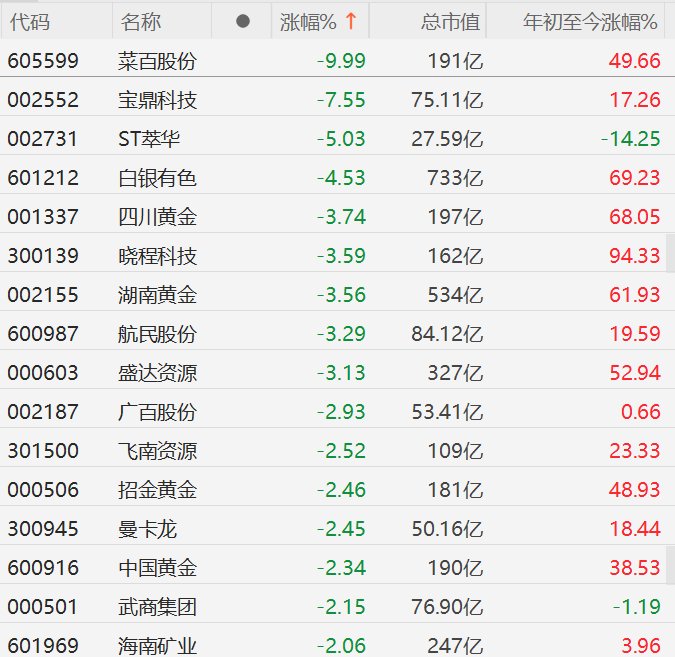
Group 1 - The A-share market saw a collective decline in gold concept stocks, with notable drops including Caibai Co., Ltd. hitting the daily limit down, and Baoding Technology falling over 7% [1] - Other companies such as Silver Industry and Sichuan Gold also experienced significant declines, with drops exceeding 4% and 3% respectively [1] Group 2 - Specific stock performance data shows Caibai Co., Ltd. down by 9.99% with a total market value of 19.1 billion, while Baoding Technology decreased by 7.55% with a market cap of 7.511 billion [2] - Sichuan Gold and Xiaocheng Technology reported declines of 3.74% and 3.59% respectively, with market values of 19.7 billion and 16.2 billion [2] - The year-to-date performance indicates that despite recent declines, some companies like Xiaocheng Technology have seen a significant increase of 94.33% since the beginning of the year [2]


【干货】锑产业链全景梳理及区域热力地图
Qian Zhan Wang· 2026-02-10 03:09
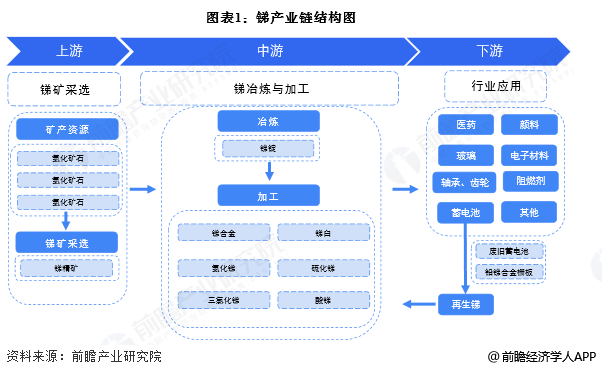
Core Insights - The antimony industry is characterized by its high industrial value and strategic importance, with antimony being used as an additive in various industrial applications [1] - The antimony supply chain includes upstream mining and selection, midstream smelting and processing, and downstream applications such as flame retardants and batteries [1][3] Group 1: Industry Overview - Antimony is a scarce resource with significant industrial applications, classified as a strategic mineral resource by the government [1] - The antimony supply chain consists of three main segments: upstream (mining and selection), midstream (smelting and processing), and downstream (applications) [1][3] - Key applications of antimony include flame retardants, glass, electronic materials, bearings, gears, and batteries, with the latter allowing for the recycling of antimony [1] Group 2: Key Companies and Production Data - Major upstream companies in the antimony mining sector include Hunan Gold, Huaxi Nonferrous, and Huayu Mining [3] - In 2024, Hunan Gold is projected to produce 29,209 tons of antimony, a decrease of 6.15% year-on-year, while Huaxi Nonferrous expects a production increase of 9.17% to 15,417.7 tons [10] - Midstream companies such as Hengbang Co. and Zhuhai Group are involved in smelting and processing, with Hengbang Co. reporting revenue of 957 million yuan from related operations in 2024 [10] Group 3: Regional Distribution - The antimony industry is predominantly concentrated in Hunan province, followed by Guangxi, Guangdong, and Jiangxi, with a significant disparity in the number of companies compared to other regions [5][7] - The majority of upstream, midstream, and recycling companies are located in Hunan, with other provinces like Tibet and Guangxi having fewer enterprises [7] Group 4: Investment Trends - Investment activities in the antimony sector from 2022 to 2025 highlight ongoing developments and strategic initiatives by key players [11] - Companies are focusing on enhancing production capabilities and exploring new product developments, particularly in high-precision alloys and recycling processes [10]


湖南黄金跌2.32%,成交额7.20亿元,主力资金净流入1813.04万元
Xin Lang Cai Jing· 2026-02-10 02:00
Core Viewpoint - Hunan Gold's stock price has experienced significant fluctuations, with a year-to-date increase of 64.01% but a recent decline of 5.57% over the past five trading days [1] Group 1: Stock Performance - As of February 10, Hunan Gold's stock price was 34.59 CNY per share, with a trading volume of 720 million CNY and a turnover rate of 1.32%, resulting in a total market capitalization of 54.052 billion CNY [1] - The stock has been on the龙虎榜 (top trading list) five times this year, with the most recent appearance on February 3, where it recorded a net buy of -540 million CNY [1] - Year-to-date, Hunan Gold's stock has increased by 64.01%, with a 5.57% decline in the last five trading days, a 60.44% increase over the last 20 days, and a 59.11% increase over the last 60 days [1] Group 2: Financial Performance - For the period from January to September 2025, Hunan Gold achieved a revenue of 41.194 billion CNY, representing a year-on-year growth of 96.26%, and a net profit attributable to shareholders of 1.029 billion CNY, up 54.28% year-on-year [2] - The company has distributed a total of 1.228 billion CNY in dividends since its A-share listing, with 553 million CNY distributed over the past three years [3] Group 3: Shareholder Structure - As of September 30, 2025, Hunan Gold had 118,300 shareholders, an increase of 14.70% from the previous period, with an average of 13,211 shares held per shareholder, a decrease of 12.81% [2] - The second-largest shareholder is Hong Kong Central Clearing Limited, holding 30.0837 million shares, an increase of 1.8283 million shares from the previous period [4] - New shareholders include the Gold ETF (517520) and the Qianhai Kaiyuan Gold and Jewelry Mixed A Fund (001302), while other funds have reduced their holdings [4]
有色金属行业周报:临近春节假期致需求走弱,铜铝价格以稳为主
Huaxin Securities· 2026-02-10 00:24
Investment Rating - The report maintains a "Recommended" investment rating for the gold, copper, aluminum, tin, and antimony industries [10][12]. Core Views - The demand for copper and aluminum has weakened as the Spring Festival approaches, leading to stable prices in these metals [6][9]. - The gold market is supported by the Federal Reserve's ongoing interest rate cuts, which are expected to continue throughout the year [10]. - The report highlights a tightening supply for copper, which is expected to support prices [10]. Summary by Sections 1. Industry Performance - The non-ferrous metals sector (Shenwan) has shown a performance of +3.3% over 1 month, +24.2% over 3 months, and +102.0% over 12 months, outperforming the CSI 300 index [3]. 2. Price and Inventory Data - Copper prices: LME copper closed at $12,900 per ton, down 4.02% from January 30, while SHFE copper closed at ¥99,810 per ton, down 3.26% [6]. - Aluminum prices: Domestic electrolytic aluminum prices are at ¥23,110 per ton, down ¥1,530 from January 30 [8]. - Inventory levels: LME copper inventory is at 183,275 tons, with a week-on-week increase of 8,300 tons, while SHFE copper inventory is at 248,911 tons, up 15,907 tons [6]. 3. Downstream Demand - The operating rate for domestic refined copper rod production is 69.07%, down 0.47 percentage points, while the operating rate for aluminum profiles is 36.0%, down 8.3 percentage points [8][9]. - The report notes that as the Spring Festival approaches, downstream processing enterprises are beginning to shut down, leading to a decline in demand [9]. 4. Recommendations for Individual Stocks - Recommended stocks in the gold sector include Zhongjin Gold, Shandong Gold, and China National Gold International [12]. - In the copper sector, recommended stocks include Zijin Mining, Western Mining, and Jincheng Mining [12]. - For aluminum, recommended stocks include Shenhuo Co., Yunnan Aluminum, and Tianshan Aluminum [12]. - In the tin sector, recommended stocks include Tin Industry Co. and Huaxi Nonferrous [12].





2月9日主力资金流向日报
Sou Hu Cai Jing· 2026-02-09 09:45
Market Overview - On February 9, the Shanghai Composite Index rose by 1.41%, the Shenzhen Component Index increased by 2.17%, the ChiNext Index climbed by 2.98%, and the CSI 300 Index gained 1.63% [1] - Among the tradable A-shares, 4,612 stocks rose, accounting for 84.39%, while 759 stocks declined [1] Capital Flow - The net inflow of main funds reached 33.038 billion yuan for the day [1] - The ChiNext saw a net inflow of 12.730 billion yuan, while the STAR Market had a net inflow of 1.496 billion yuan, and the CSI 300 constituents experienced a net inflow of 17.303 billion yuan [1] Industry Performance - Out of the 31 first-level industries classified by Shenwan, 31 industries rose, with the top performers being Communication and Comprehensive, which increased by 5.17% and 4.70%, respectively [1] - The Electronics industry led the net inflow of funds with 8.051 billion yuan and a daily increase of 2.97%, followed by the Computer industry with a net inflow of 6.785 billion yuan and a daily increase of 2.88% [1] Individual Stock Performance - A total of 2,310 stocks experienced net inflows, with 941 stocks having net inflows exceeding 10 million yuan, and 172 stocks with net inflows over 100 million yuan [2] - The stock with the highest net inflow was Sungrow Power Supply, which rose by 6.10% with a net inflow of 1.471 billion yuan, followed by 360 Security Technology and Newyeason with net inflows of 1.435 billion yuan and 1.307 billion yuan, respectively [2] - Conversely, 73 stocks had net outflows exceeding 100 million yuan, with Data Harbor, Hunan Gold, and CATL leading the outflows at 889 million yuan, 844 million yuan, and 769 million yuan, respectively [2]




资金风向标 | 两融余额较上一日减少172亿元 有色金属行业获融资净偿还额居首
Sou Hu Cai Jing· 2026-02-09 03:19
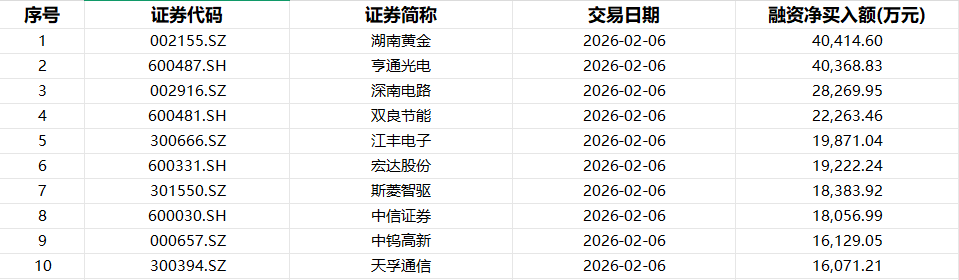
Summary of Key Points Core Viewpoint - As of February 6, the margin trading balance in A-shares is 26,636.6 billion yuan, a decrease of 17.2 billion yuan from the previous trading day, accounting for 2.6% of the A-share circulating market value [1] Group 1: Margin Trading Data - The margin trading transaction amount on the same day was 191.166 billion yuan, down by 8.185 billion yuan from the previous trading day, representing 8.83% of the A-share transaction amount [1] - All 31 primary industries in Shenwan showed a net repayment status, with the non-ferrous metals industry having the highest net repayment amount of 2.052 billion yuan [1] Group 2: Individual Stock Performance - A total of 21 individual stocks had a net buying amount exceeding 100 million yuan, with Hunan Gold leading at a net buying amount of 404.146 million yuan [2] - Other notable stocks with significant net buying amounts include Hengtong Optic-Electric, Shenzhen South Circuit, Shuangliang Energy, Jiangfeng Electronics, Hongda Shares, Starlight Intelligent Drive, CITIC Securities, Zhongtung High-Tech, and Tianfu Communication [2]



ETF盘中资讯|央行连续15个月增持黄金!现货黄金重返5000美元,有色ETF华宝(159876)强势拉升2.6%,盘中收复5日均线!
Sou Hu Cai Jing· 2026-02-09 01:58
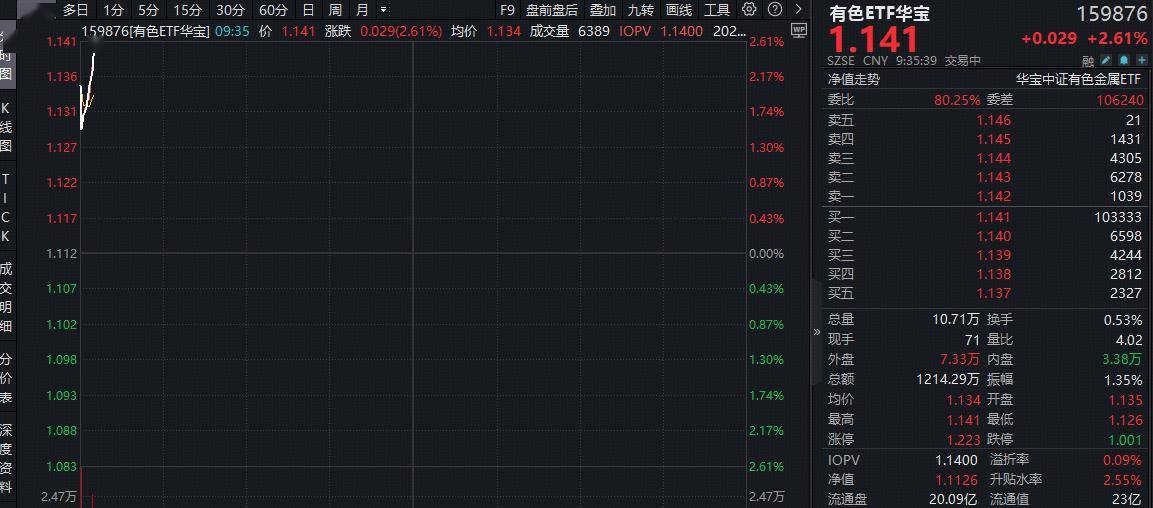
Core Viewpoint - The continuous increase in gold reserves by the People's Bank of China (PBOC) for 15 consecutive months has positively impacted the performance of the non-ferrous metals sector, particularly the Huabao Non-Ferrous ETF, which saw a strong rise of 2.61% on February 9 [1][4]. Group 1: Market Performance - The Huabao Non-Ferrous ETF (159876) experienced a price increase of 2.61%, recovering above the 5-day moving average [1]. - The ETF's trading volume reached 63,890, with an average price of 1.134 [2]. - Key stocks in the non-ferrous sector, such as Hunan Silver, Shenghe Resources, and Northern Rare Earth, saw gains exceeding 3% [3]. Group 2: Central Bank Actions - The PBOC's gold reserves stood at 74.19 million ounces as of January 2026, up from 74.15 million ounces in December 2025, marking the 15th consecutive month of increases [3]. - The demand for gold from central banks remains strong, providing a supportive foundation for gold prices [4]. Group 3: Industry Outlook - Analysts predict that the non-ferrous metals sector will maintain a strong performance due to supply-demand mismatches, macroeconomic easing, and industrial upgrades, with high profitability expected to last 3-5 years [4]. - The Huabao Non-Ferrous ETF covers a wide range of metals, including copper, aluminum, gold, rare earths, and lithium, making it an efficient tool for investors to gain exposure to the sector [5].


黄金概念股普涨,湖南白银涨超4%,紫金矿业涨超3%
Ge Long Hui· 2026-02-09 01:47
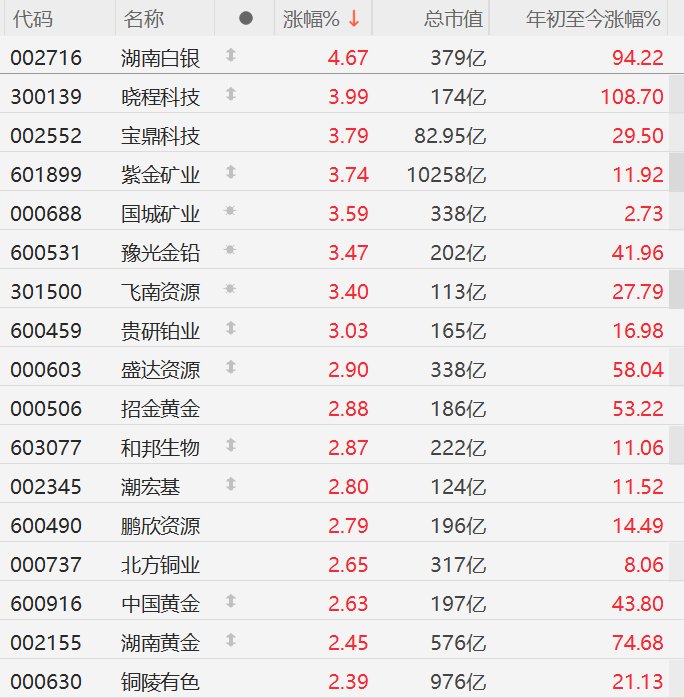
Group 1 - The A-share market saw a general rise in gold-related stocks, with Hunan Silver rising over 4% and several other companies increasing by more than 3% [1] - Gold and silver prices rebounded, with spot gold reaching $5046.79 and spot silver at $81.67 [1] Group 2 - Hunan Silver (002716) increased by 4.67%, with a total market value of 37.9 billion and a year-to-date increase of 94.22% [2] - Xiaocheng Technology (300139) rose by 3.99%, with a market value of 17.4 billion and a year-to-date increase of 108.70% [2] - Baoding Technology (002552) saw a rise of 3.79%, with a market value of 8.295 billion and a year-to-date increase of 29.50% [2] - Guocheng Mining (000688) increased by 3.59%, with a market value of 33.8 billion and a year-to-date increase of 2.73% [2] - Yuguang Gold and Lead (600531) rose by 3.47%, with a market value of 20.2 billion and a year-to-date increase of 41.96% [2] - Other notable increases include Feinan Resources (301500) at 3.40%, Guizhou Platinum Industry (600459) at 3.03%, and China Gold (600916) at 2.63% [2]
A股异动丨黄金概念股普涨,湖南白银涨超4%,紫金矿业涨超3%
Ge Long Hui A P P· 2026-02-09 01:43
Group 1 - The A-share market saw a broad increase in gold-related stocks, with notable gains from Hunan Silver, which rose over 4%, and several other companies like Xiaocheng Technology, Baoding Technology, and Zijin Mining, all increasing by more than 3% [1] - The weakening of the US dollar and the rebound in gold and silver prices contributed to this surge, with spot gold rising to $5046.79 and spot silver reaching $81.67 [1] Group 2 - Hunan Silver (002716) experienced a 4.67% increase, with a total market capitalization of 37.9 billion and a year-to-date increase of 94.22% [2] - Xiaocheng Technology (300139) saw a 3.99% rise, with a market cap of 17.4 billion and a year-to-date increase of 108.70% [2] - Baoding Technology (002552) increased by 3.79%, with a market cap of 8.295 billion and a year-to-date increase of 29.50% [2] - Other notable companies include Zijin Mining (601899) with a 3.74% increase and a market cap of 1025.8 billion, and Guocheng Mining (000688) with a 3.59% increase and a market cap of 33.8 billion [2]
378股获融资买入超亿元,中际旭创获买入25.79亿元居首
Di Yi Cai Jing· 2026-02-09 01:18
Group 1 - On February 6, a total of 3,771 A-shares received financing funds for purchase, with 378 stocks having purchase amounts exceeding 100 million yuan [1] - The top three stocks by financing purchase amount were Zhongji Xuchuang, Xinyi Sheng, and Tianfu Communication, with amounts of 2.579 billion yuan, 2.098 billion yuan, and 1.696 billion yuan respectively [1] - One stock had a financing purchase amount accounting for over 30% of the total transaction amount, with Zhend Medical, Chutian Expressway, and Xiechang Technology ranking highest at 38.43%, 27.3%, and 25.42% respectively [1] Group 2 - There were 21 stocks with a net financing purchase exceeding 100 million yuan, with Hunan Gold, Hengtong Optic-Electric, and Shenzhen South Circuit ranking highest at 404 million yuan, 404 million yuan, and 283 million yuan respectively [1]

