
Hunan Gold(002155)

Search documents
金银市场遭遇黑色星期三,白银价格暴跌近15%,黄金也跌超3%,黄金股多股跌停,一些投资者却开始疯狂扫货
Sou Hu Cai Jing· 2026-02-06 17:08
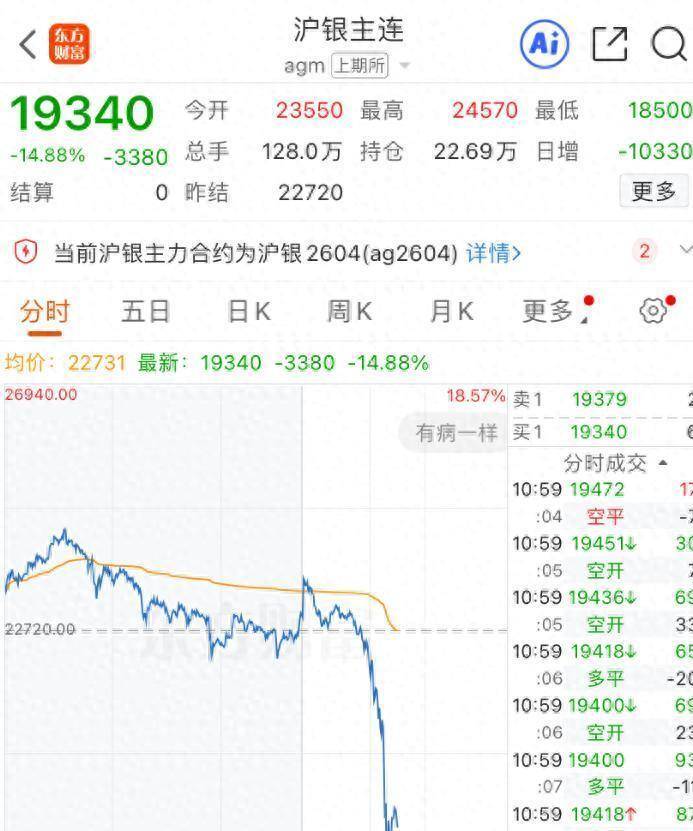
Core Viewpoint - The precious metals market experienced a dramatic decline on February 5, 2026, with silver prices plummeting over 14% and gold dropping more than 3%, leading to significant losses in related stocks and a stark contrast between capital market panic and physical market demand [1][3][4]. Market Performance - On February 5, silver prices fell to a low of $75.83 per ounce, while the Shanghai Futures Exchange saw silver contracts drop nearly 15% to 19,340 yuan per kilogram. Gold prices fell below the critical psychological level of $4,800 [1][4]. - A significant number of stocks related to gold and silver, such as Hunan Gold and Sichuan Gold, hit their daily limit down, reflecting a widespread sell-off in the sector [1][4][5]. Market Dynamics - The decline was preceded by a strong performance in January, where gold prices reached nearly $5,600 per ounce and silver exceeded $120 per ounce, resulting in gains of over 25% for gold and 60% for silver in just a month [3][4]. - The sell-off on February 5 was characterized by a lack of liquidity and a surge in stop-loss orders, creating a downward spiral in prices [4][6]. Regulatory Changes - Prior to the crash, exchanges raised margin requirements for silver contracts, which forced leveraged traders to either add funds or face forced liquidation, exacerbating the price decline [6][12]. - Major banks issued risk warnings to clients regarding the heightened volatility in the precious metals market, advising caution and stricter trading rules [12]. Institutional Behavior - Large investment institutions began to adjust their portfolios, with noticeable outflows from major gold ETFs during the price drop, indicating a shift in institutional sentiment [7][12]. - Analysts noted that the market's reaction was influenced by macroeconomic factors, including potential changes in U.S. Federal Reserve leadership and interest rate expectations, which could strengthen the dollar and negatively impact gold and silver prices [6][12]. Physical Market Response - Despite the turmoil in the capital markets, physical gold and silver demand surged in places like Shenzhen, where customers flocked to purchase gold bars, viewing the price drop as an opportunity [9][10]. - Retail gold prices adjusted downward in response to falling wholesale prices, making gold jewelry more attractive to consumers [10]. Analyst Perspectives - Analysts from various firms expressed differing views on the causes of the market decline, with some attributing it to technical adjustments and profit-taking, while others pointed to macroeconomic uncertainties stemming from U.S. Federal Reserve personnel changes [12][13]. - The overall sentiment in the market shifted from extreme optimism to fear, with many investors now closely monitoring support levels and physical demand to gauge future price stability [13].





超150亿资金涌入化工板块!背后逻辑是什么?|掘金日报(2.6)
和讯· 2026-02-06 10:19
Market Overview - The three major indices in A-shares experienced slight declines, with the Shanghai Composite Index down 0.25% to 4065 points, the Shenzhen Component down 0.33%, and the ChiNext down 0.73% [2] - The total market turnover was 2.16 trillion yuan, a decrease of 308 billion yuan from the previous trading day, with over 2700 stocks rising [2] Sector Performance - The oil and gas, chemical, and mining sectors showed strong performance, with multiple stocks such as Tongyuan Petroleum and Junyou Co. hitting the daily limit [4] - The chemical sector saw an overall increase of 1.45%, with core sub-industries like basic chemicals and diversified chemicals leading the gains [16] - The basic chemical sector had a net inflow of over 156.73 billion yuan, while the power equipment sector saw a net inflow exceeding 203.54 billion yuan [6] Fund Flow Analysis - Main funds shifted away from defense, media, and food and beverage sectors, moving towards power equipment and basic chemicals [5] - The chemical industry ETF saw significant inflows, with a total of 14.49 billion yuan in net inflows over the past 15 days, indicating strong market confidence in the sector [20] Stock Highlights - Hunan Gold and Data Port were among the top gainers, with net inflows of nearly 29 billion yuan and over 20 billion yuan, respectively [10] - Stocks like Hunan Rihua and Zhejiang Wenlian saw significant outflows, with declines of 7.63% and 9.79% [10] Market Sentiment - The market is currently in a "trial period," with a high number of first-day limit-up stocks but lacking a unified logic, indicating rapid rotation of funds [14] - The strong performance of the chemical sector is attributed to a combination of rising product prices, supply-side contraction, and demand from emerging sectors, suggesting a fundamental recovery rather than mere speculation [17]



湖南国企改革板块2月6日涨0.17%,湖南黄金领涨,主力资金净流入6.18亿元
Sou Hu Cai Jing· 2026-02-06 09:03
Core Viewpoint - The Hunan state-owned enterprise reform sector experienced a slight increase of 0.17% on February 6, with Hunan Gold leading the gains, while the Shanghai Composite Index and Shenzhen Component Index saw declines of 0.25% and 0.33% respectively [1] Group 1: Market Performance - The Hunan state-owned enterprise reform sector's main stocks showed a mixed performance, with Hunan Gold leading the rise [1] - The Shanghai Composite Index closed at 4065.58, down 0.25%, and the Shenzhen Component Index closed at 13906.73, down 0.33% [1] Group 2: Capital Flow - The main capital inflow into the Hunan state-owned enterprise reform sector was 618 million yuan, while retail investors saw a net outflow of 291 million yuan and speculative funds had a net outflow of 327 million yuan [1]

四点半观市 | 机构:全球市场“投资中国”热情回升
Sou Hu Cai Jing· 2026-02-06 08:47
Market Overview - On February 6, the A-share market experienced a pullback after an initial rise, with the Shanghai Composite Index closing at 4065.58 points, down 0.25% [1] - The Nikkei 225 index in Japan rose by 0.81% to 54253.68 points, while the Korean Composite Index fell by 1.44% to 5089.14 points [1] - Domestic commodity futures saw most contracts decline, with liquefied petroleum gas, alumina, and fuel rising over 1% [1] Bond Market - The 30-year government bond futures contract closed up 0.42%, with a final price of 112.570 yuan, an increase of 0.470 yuan [2] - Other government bond futures also saw slight increases, with the 10-year bond futures up 0.08% and the 5-year bond futures up 0.03% [2] ETF Performance - The chemical sector ETFs showed strong performance, with the chemical ETF (159870) rising by 2.64% [2] - Other chemical ETFs also reported gains, with increases of 2.49% and 2.47% for different funds [2] Capital Flow - On February 6, the top ten stocks by net capital inflow included Wuzhou Xinchun, with a net inflow of 1.22 billion yuan [3] Institutional Insights - PwC's recent report indicates a resurgence in global investment interest, with China regaining its attractiveness as a key investment destination [4] - DBS Bank's senior investment strategist noted that institutional investors dominate the long positions in the international gold futures market, suggesting a strategy of holding low and selling at high prices [4]


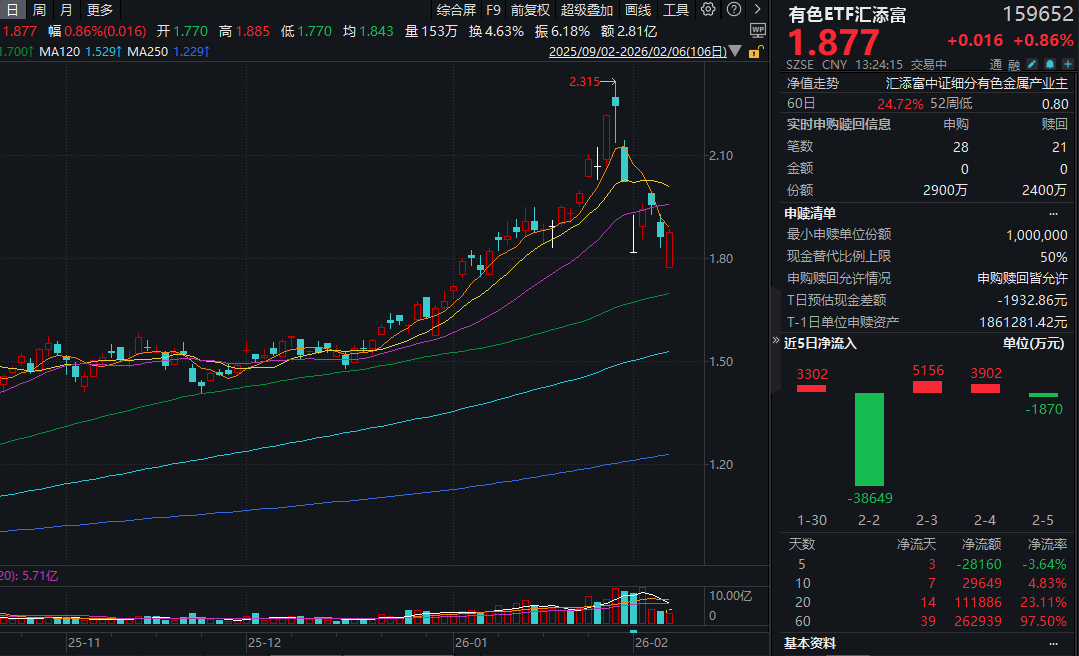
主力资金流入前20:五洲新春流入12.20亿元、数据港流入10.78亿元
Jin Rong Jie· 2026-02-06 07:29
Core Insights - The main focus of the news is on the top 20 stocks with significant capital inflow as of February 6, highlighting their respective amounts and performance in terms of percentage change. Group 1: Capital Inflow - The stock with the highest capital inflow is Wuzhou Xinchun, attracting 1.22 billion yuan [1] - Data Port follows closely with an inflow of 1.078 billion yuan [1] - Tianji Co. has an inflow of 1.065 billion yuan, marking a strong performance [1] Group 2: Stock Performance - Wuzhou Xinchun shows a price increase of 10.01% [2] - Data Port has a price increase of 10% [2] - Tianji Co. reports a price increase of 9.99% [2] Group 3: Industry Breakdown - Wuzhou Xinchun belongs to the General Equipment sector [2] - Data Port is categorized under Internet Services [2] - Tianji Co. is part of the Battery industry [2] Group 4: Additional Stocks - Hunan Gold has a capital inflow of 883 million yuan with a price increase of 9.94% [1][2] - Shanshan Co. sees an inflow of 726 million yuan and a price increase of 10.03% [1][2] - Galaxy Electronics has an inflow of 672 million yuan with a price increase of 10.06% [1][2] Group 5: Other Notable Stocks - The stock with the lowest inflow in the top 20 is Sanhua Intelligent Control, with an inflow of 481 million yuan and a price increase of 2.06% [3] - Other notable stocks include Northern Rare Earth with an inflow of 495 million yuan and a price increase of 3.73% [3] - Fenghuo Communication has an inflow of 493 million yuan with a price increase of 5.58% [3]



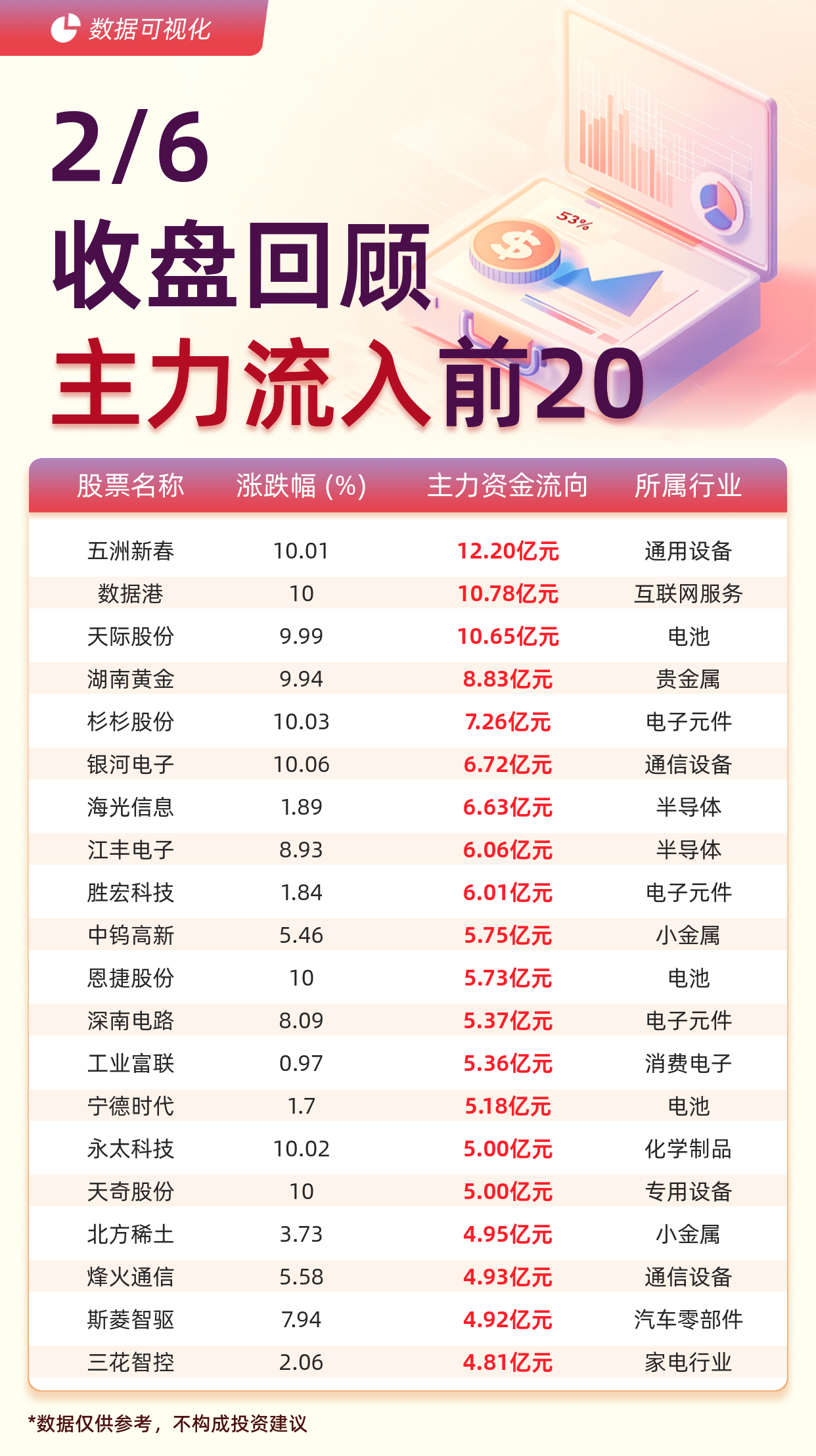
现货黄金反弹!湖南黄金涨停,有色ETF汇添富(159652)翻红涨1%,盘中资金涌入!近10日“吸金”近3亿元!
Xin Lang Cai Jing· 2026-02-06 06:35
Group 1 - Spot gold and silver experienced a "V-shaped" rebound, with gold increasing by 1% and silver rising over 2% after initial declines of more than 2% and 8% respectively [1] - The non-ferrous sector saw a corresponding rise, with the ETF Huatai-PineBridge (159652) gaining nearly 1% and attracting nearly 10 million yuan in net inflows during the session, totaling close to 300 million yuan over the past 10 days [1] - The China Securities Galaxy believes that the recent price corrections in gold and silver are normal profit-taking actions after reaching historical highs, which may help to release overheated market sentiment [2] Group 2 - In January, the China Logistics and Purchasing Federation reported that the commodity price index rose for the ninth consecutive month, reaching a three-and-a-half-year high, with a month-on-month increase of 6.3% to 125.3 points [3] - Among 50 monitored commodities, 33 saw price increases, with lithium carbonate, refined tin, and refined nickel leading with month-on-month increases of 48.4%, 20.2%, and 19.5% respectively [3] - The non-ferrous metals price index rose significantly by 9.9% month-on-month, driven by factors such as international monetary policy and geopolitical influences [3] Group 3 - Recent pricing logic for non-ferrous metals is shifting from short-term supply and demand to broader macroeconomic factors, benefiting from ongoing fiscal expansion and liquidity in major economies [4] - The copper market is characterized by both supply and demand constraints, with limited new mine production and ongoing supply disruptions, while demand is driven by energy transition and AI industries [4] - The non-ferrous sector is highlighted as having significant investment value due to favorable macroeconomic conditions, with the Huatai-PineBridge ETF (159652) being recommended for its comprehensive exposure to various metal sectors [4][5] Group 4 - The Huatai-PineBridge ETF (159652) has a leading concentration of core strategic commodities such as copper, gold, aluminum, lithium, and rare earths, with a top five stock concentration of 38% [8] - The ETF's index has shown superior performance since 2022, with a cumulative return leading its peers and a lower maximum drawdown, indicating a better investment experience [10] - The index's price increase is driven by earnings rather than valuation expansion, with a current PE ratio of 26.27, down 52% from five years ago, suggesting a favorable valuation [10]
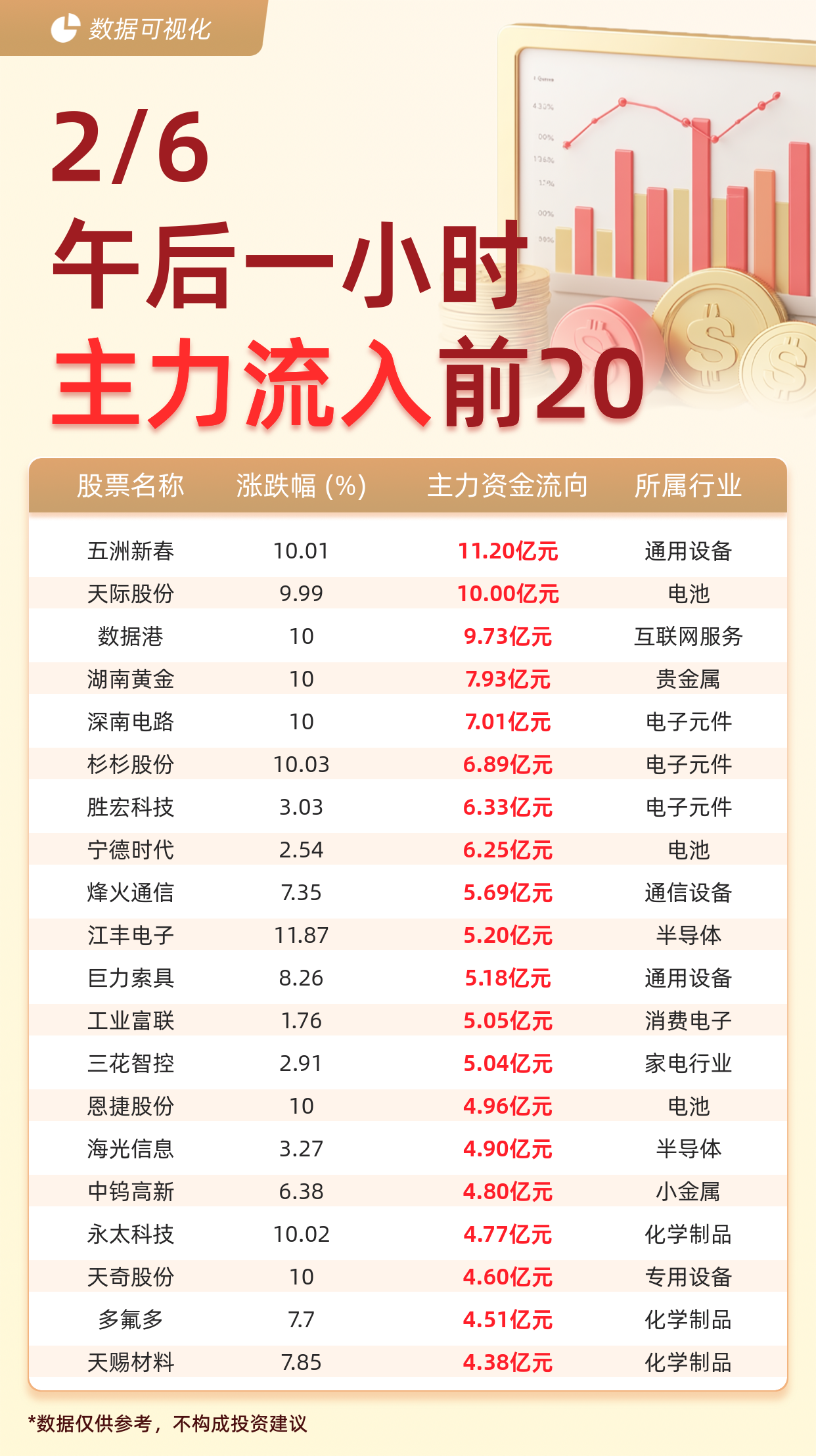
主力资金流入前20:五洲新春流入11.20亿元、天际股份流入10.00亿元
Jin Rong Jie· 2026-02-06 06:27
Group 1 - The top 20 stocks with significant capital inflow as of February 6 include Wuzhou Xinchun (1.12 billion), Tianji Co. (1 billion), and Data Port (973 million) [1] - Wuzhou Xinchun saw a price increase of 10.01%, while Tianji Co. and Data Port both increased by 9.99% and 10% respectively [2] - Other notable stocks include Hunan Gold (10% increase, 793 million), and Shennan Circuit (10% increase, 701 million) [2][3] Group 2 - The electronics sector is represented by companies like Shennan Circuit, Shanshan Co., and Shenghong Technology, with inflows of 701 million, 689 million, and 633 million respectively [2][3] - The battery industry includes significant players such as Ningde Times (2.54% increase, 625 million) and Enjie Co. (10% increase, 496 million) [2][3] - Chemical products sector features companies like Yongtai Technology (10.02% increase, 477 million) and Duofluor (7.7% increase, 451 million) [3]


黄金股票ETF基金(159322)涨近1%,现货黄金重新站上4850美元/盎司
Xin Lang Cai Jing· 2026-02-06 05:45
Core Viewpoint - The gold industry is experiencing a positive trend, with significant increases in stock prices and a rebound in spot gold prices, indicating a favorable outlook for gold investments in the coming years [1][2]. Group 1: Market Performance - As of February 6, 2026, the CSI Hong Kong-Shenzhen Gold Industry Stock Index (931238) rose by 0.23%, with notable increases in constituent stocks such as Hunan Gold (up 10.00%), Chaohongji (up 9.98%), and Hangmin Co. (up 9.95%) [1]. - The gold ETF fund (159322) increased by 0.70%, with the latest price at 2.02 yuan [1]. Group 2: Gold Price Outlook - Spot gold has rebounded to over $4,850 per ounce, reflecting a daily increase of 1.57% and a recovery of nearly $200 from its daily low [1]. - Huatai Securities predicts that under the backdrop of de-globalization, central banks will continue to increase gold allocations, which will support a long-term rise in gold prices, potentially reaching a range of $5,400 to $6,800 per ounce between 2026 and 2028 [1]. Group 3: Investment Potential - Currently, the proportion of investable gold in global financial assets stands at 2.89%, which is significantly below the 2011 peak of 3.6%, indicating substantial room for increased allocation [1]. - The CSI Hong Kong-Shenzhen Gold Industry Stock Index comprises 50 large-cap companies involved in gold mining, refining, and sales, reflecting the overall performance of gold industry stocks in the mainland and Hong Kong markets [1][2].


大反攻!三大指数全线飘红,超3800股上涨!黄金股爆发,湖南黄金涨停,化工板块集体走强|A股早盘
Mei Ri Jing Ji Xin Wen· 2026-02-06 04:21
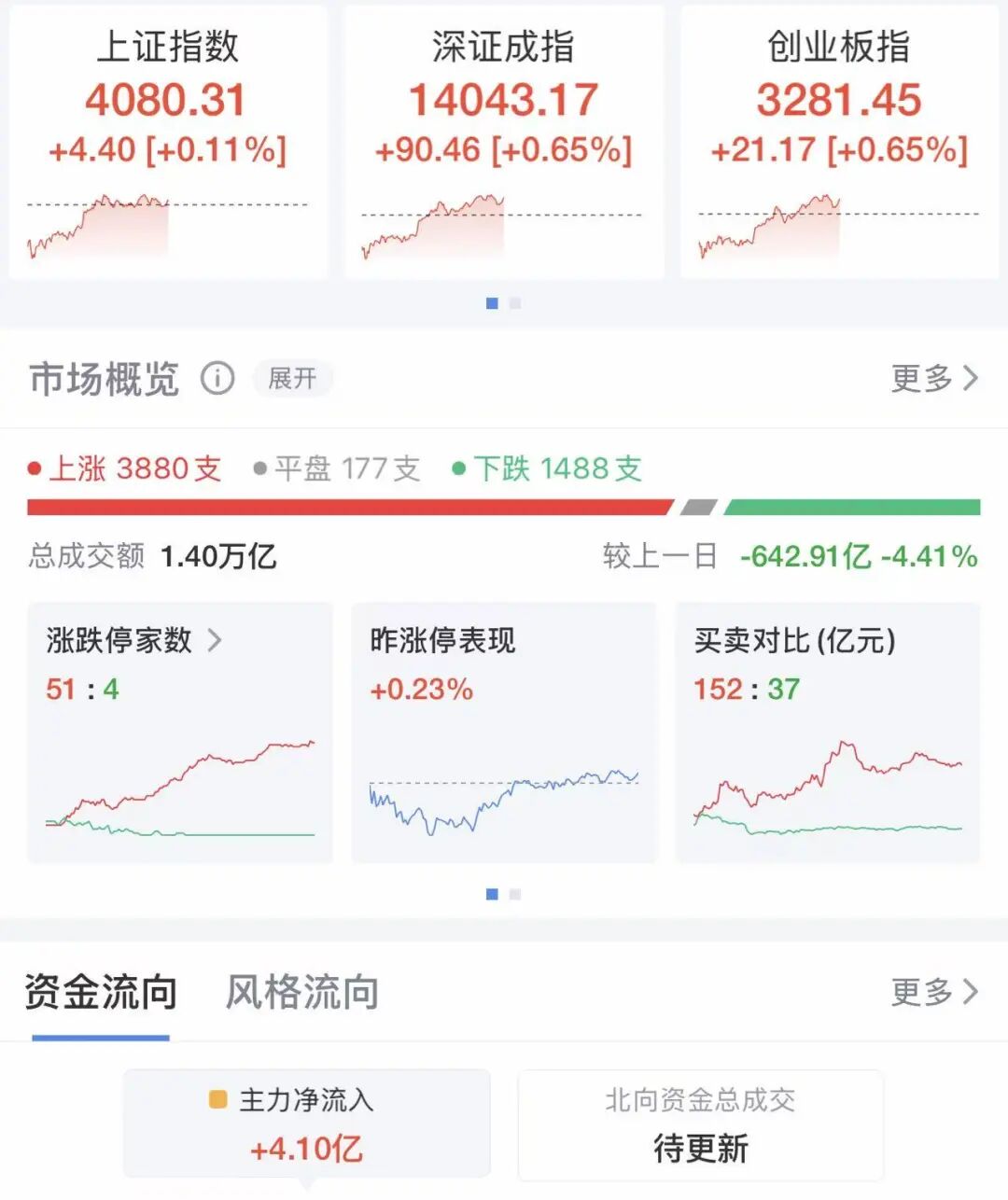
编辑|段炼 杜波 校对|金冥羽 封面图片|视觉中国(图文无关) 2月6日早盘,A股低开后探底回升。截至中午收盘,三大指数全线翻红,沪指报4080.31点,涨0.11%,深成指报14043.17点,涨0.65%,创业板指报 3281.45点,涨0.65%。全市超3800股上涨。 化工板块集体走强,沧州大化、金牛化工、百川股份、百合花涨停;中药股开盘大涨,特一药业、汉森制药等涨停;机器人概念股表现活跃,五洲新春、 联诚精密等涨停;黄金板块回暖,湖南黄金涨停。 每经记者|杜恒峰 每经编辑|段炼 记者|杜恒峰 (免责声明:本文内容与数据仅供参考,不构成投资建议,使用前请核实。据此操作,风险自担。) | | | 童金 | | | | --- | --- | --- | --- | --- | | | | 2956.81, +1.40% | | | | 新闻 大V | 成分 | 资金 | 研报 | | | 湖南黄金 | | | | | | SZ002155 | | 35.98 | +10.00% | 0.00% | | 业绩龙头5 市值龙头 5 | | | | | | 晓程科技 | | | | | | @ SZ30013 ...
A股午评:创业板指涨0.65% 化工板块集体走强
2 1 Shi Ji Jing Ji Bao Dao· 2026-02-06 04:05
Market Overview - The market experienced a rebound after an initial drop, with all three major indices turning positive. The Shanghai Composite Index rose by 0.11%, the Shenzhen Component increased by 0.65%, and the ChiNext Index also gained 0.65% [1] - The total trading volume in the Shanghai and Shenzhen markets reached 1.38 trillion yuan, a decrease of 63.3 billion yuan compared to the previous trading day [1] Sector Performance - The chemical sector showed strong performance, with stocks such as Cangzhou Dahua, Jinniu Chemical, Baichuan Shares, and Baihehua hitting the daily limit [1] - The humanoid robot concept stocks were active, with Wuzhou Xinchun, Liancheng Precision, and Tianqi Shares also reaching the daily limit [1] - The non-ferrous metals sector rebounded, with Hunan Gold and Xianglu Tungsten hitting the daily limit [1] - The optical communication concept saw a volatile recovery, with Hangdian Shares achieving five consecutive daily limits in six days [1] - The traditional Chinese medicine sector opened actively, with Te Yi Pharmaceutical hitting the daily limit [1] Declining Sectors - The consumer sector faced a collective decline, particularly in the liquor and tourism hotel segments, with Huangtai Liquor hitting the daily limit down and Dalian Shengya also reaching the limit down [1]


