IFLYTEK(002230)

Search documents
科大讯飞:公司通过全资子公司持有长光卫星技术股份有限公司0.72495%的股份
Mei Ri Jing Ji Xin Wen· 2026-02-11 03:53
科大讯飞(002230.SZ)2月11日在投资者互动平台表示,公司通过全资子公司吉林科讯信息科技有限公 司,持有长光卫星技术股份有限公司0.72495%的股份。 每经AI快讯,有投资者在投资者互动平台提问:科大讯飞投资长光卫星出资多少?持有多少股份? (记者 王晓波) ...

2025胡润中国500强出炉:合肥4家企业再度上榜 阳光电源、科大讯飞、中环新能源……
Zhi Tong Cai Jing· 2026-02-10 10:03
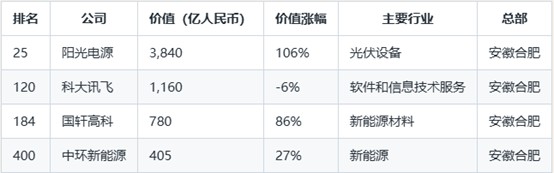
Group 1 - The HuRun Research Institute released the "2025 HuRun China 500 Strong," listing the top 500 non-state-owned enterprises in China ranked by enterprise value [1] - Hefei has four companies on the list: Sungrow Power Supply (300274), iFlytek (002230), Guoxuan High-Tech (002074), and Zhonghuan New Energy (01735) [1] - Hefei ranks sixth in the "Most Favored Manufacturing Base" category of the HuRun China 500 Strong [1] Group 2 - Sungrow Power Supply has a market value of 384 billion, with a growth rate of 106%, leading the photovoltaic equipment sector [2] - iFlytek has a market value of 116 billion, with a decline of 6%, recognized as a leader in artificial intelligence [2] - Guoxuan High-Tech has a market value of 78 billion, with an 86% increase, focusing on strategic cooperation with well-known automotive companies [2] - Zhonghuan New Energy has a market value of 40.5 billion, with a 27% growth, rapidly developing its integrated business model [2] Group 3 - The photovoltaic industry is undergoing a new round of "reshuffling," but companies like Sungrow Power Supply, Guoxuan High-Tech, and Zhonghuan New Energy show strong operational capabilities and growth potential [3] - The global energy transition is accelerating, driving continuous growth in photovoltaic market demand, with expectations of exceeding 5000 GW of installed capacity by 2030 [3] - The synergistic development of "photovoltaics + energy storage" will address intermittency issues and enhance market competitiveness [3] - Continuous efforts in technological innovation, cost control, and market expansion are essential for companies to seize industry development opportunities [3]



2025胡润中国500强出炉:合肥4家企业再度上榜 阳光电源、科大讯飞、中环新能源(01735)……
智通财经网· 2026-02-10 09:52
Core Insights - The HuRun Research Institute released the "2025 HuRun China 500 Strong," ranking 500 non-state-owned enterprises in China based on their value, with Hefei having four companies listed [1] - Hefei ranks sixth in the "Most Favored Manufacturing Bases" according to the HuRun China 500 Strong [1] Company Summaries - **Sungrow Power Supply**: Ranked 1st with a value of 384 billion RMB, showing a 106% increase, leading in the photovoltaic equipment sector [2] - **iFlytek**: Ranked 120th with a value of 116 billion RMB, experiencing a 6% decrease, recognized as a leader in artificial intelligence and software services [2] - **Guoxuan High-Tech**: Ranked 184th with a value of 78 billion RMB, up by 86%, focusing on new energy materials and strategic partnerships with automotive companies [2] - **China National Building Material Group**: Ranked 400th with a value of 40.5 billion RMB, showing a 27% increase, rapidly developing integrated solutions in new energy and storage [2] Industry Trends - The photovoltaic and new energy sectors are undergoing a significant transformation, with companies like Sungrow, Guoxuan, and China National Building Material Group demonstrating strong operational capabilities and growth potential [3] - The global energy transition is accelerating, with expectations that the total installed capacity of photovoltaic systems will exceed 5000 GW by 2030, driving demand in the market [3] - The synergistic development of "photovoltaics + energy storage" is expected to address intermittency issues and enhance market competitiveness [3]
沪深北交易所同日“亮剑”:再融资新政对A股影响(附精选股票)
Sou Hu Cai Jing· 2026-02-10 06:14
Core Viewpoint - The simultaneous release of refinancing optimization measures by Shanghai, Shenzhen, and Beijing stock exchanges marks a significant transformation in China's capital market, aimed at enhancing capital allocation efficiency and reshaping the A-share market landscape [1]. Group 1: Policy Framework and Differences - The policy frameworks of the three exchanges are highly similar, focusing on "supporting the strong, limiting the weak, promoting innovation, and enhancing convenience and regulation" [2]. - Shanghai Stock Exchange emphasizes "main board" characteristics, tailoring financing rules for large, mature technology companies [2]. - Shenzhen Stock Exchange adopts a bolder stance on supporting technology innovation, easing fundraising restrictions for growth-oriented enterprises [2]. - Beijing Stock Exchange focuses on "innovative small and medium-sized enterprises," addressing their financing challenges with flexible policies [2]. Group 2: Strategic Insights on Separate Announcements - The decision to release policies on the same day rather than a joint announcement reflects the nuanced wisdom of tiered regulation in China's capital market [3]. - Different market positioning allows each exchange to cater to the unique characteristics and needs of the enterprises they serve, avoiding a one-size-fits-all approach [3]. - The simultaneous release creates a strong policy resonance, reinforcing market perception of deepening capital market reforms while maintaining the distinct identities of each exchange [3]. Group 3: Deep Impacts on Market Perception - The new measures aim to shift the long-standing fear of "blood-sucking" effects of refinancing, which was believed to drain market funds and destabilize the market [4]. - The principle of "supporting the strong, limiting the weak" will act as a catalyst for market differentiation, favoring quality companies, especially in hard technology, while raising barriers for poorly performing firms [4]. - The policy directs resources towards "new productive forces," providing strong support for leading companies in sectors like semiconductors, AI, biomedicine, and high-end manufacturing [5]. - Allowing companies that have experienced stock price declines to raise funds through methods like private placements and convertible bonds offers a lifeline to solid businesses facing temporary challenges [6]. - A complete regulatory loop is established, tightening post-fundraising supervision while relaxing initial approvals, transforming refinancing from a mere "money-raising tool" to an "engine" for corporate development [7]. Group 4: Implications for Investors - The coordinated actions of the three exchanges signify the entry of China's refinancing mechanism into a "precise drip irrigation" era, providing tailored financing support for different types of enterprises [8]. - Investors are advised to focus on genuinely innovative and well-governed companies while avoiding those that merely chase trends without substance [8]. - The transformation of refinancing from a "blood-sucking machine" to a "blood-producing pump" is expected to enhance the value discovery function of the A-share market, leading to a healthier and more vibrant capital market [8].







2025年中国脑机接口行业研发现状分析 企业研发投入呈增长趋势【组图】
Qian Zhan Wang· 2026-02-10 05:12
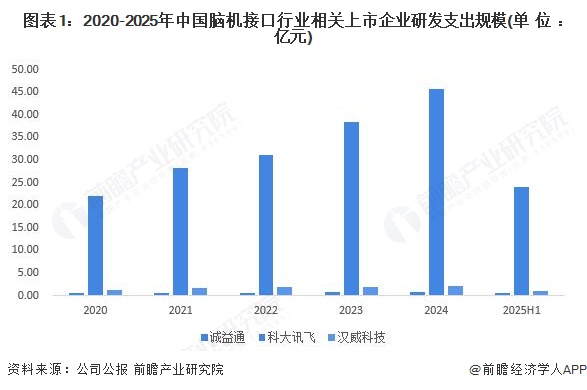
Group 1 - The core viewpoint of the article highlights the increasing investment and research activity in the brain-computer interface (BCI) industry in China, with a focus on key companies and patent trends [1][4][5] Group 2 - The research and development investment in the BCI industry by listed companies in China is steadily increasing from 2020 to 2024, indicating a strengthening of R&D efforts [1] - The number of patent applications in China's BCI industry showed a steady growth trend, peaking at 258 applications in 2021, followed by a decrease to 209 applications in 2024 [4] - Tianjin University is identified as the leading patent applicant in the BCI sector, with a total of 126 related patents, followed by South China University of Technology and Xi'an Jiaotong University with 80 and 78 patents respectively [5][7] - The most popular technology patents in the BCI industry are in the category of electrical digital data processing (G06F), with a total of 1,013 patents, followed by diagnostic and surgical technologies (A61B) with 712 patents, and specific computing models (G06N) with 313 patents [8]



公司互动丨这些公司披露在光伏、商业航天等方面最新情况
Di Yi Cai Jing· 2026-02-09 14:33
Group 1: Robotics - Yingzi Network's revenue from intelligent service robots is relatively small [1] Group 2: Photovoltaics - Nanfang A has the capability to produce 9-11N polycrystalline silicon, primarily for the solar photovoltaic industry [1] - Zhongli Group's photovoltaic business has not yet involved space photovoltaic fields [1] - Sungrow Power has not yet engaged in space photovoltaic products [1] Group 3: Batteries - Shuanghuan Technology's sodium-ion battery cathode material pilot base has recently produced its first batch of products [1] Group 4: Commercial Aerospace - Juguang Technology does not have products applied in the commercial aerospace field [1] - Fengmao Co. has not made substantial progress in business expansion within the commercial aerospace sector [1] Group 5: Other Developments - Xinyi Semiconductor's 1.6T optical module products have achieved mass delivery and are in the process of increasing production capacity [1] - China Merchants Shekou has engaged in duty-free business with positive results, covering duty-free services for high-speed passenger ships on Hong Kong-Macau routes and outbound ports [1] - Wanda Film has invested in and produced the film "Fast and Furious 3," scheduled for release during the Spring Festival [1] - Dalian Electric Porcelain's Jiangxi company has a production plan for 2026 that is nearly full [1] - iFlytek's brain science research is still in the exploratory stage, with the company maintaining attention and appropriate investment [1] - Jingyan Technology's Vietnam operations have commenced and received the first batch of orders [1] - Haiguang Information's business layout has not yet involved TPU chips [1] - Haohua Technology has not yet achieved mass production of trifluoromethanesulfonic lithium [1]



量子科技相关利好汇总!技术突破政策加码齐落地,产业国产化与商业化双轨加速前行
Xin Lang Cai Jing· 2026-02-09 10:09
Group 1 - Zhongke Shuguang, based in Beijing, is a leading enterprise in high-performance computing, cloud computing, and big data, with a comprehensive self-developed technology system in computing infrastructure [1][29] - The company collaborates with top research institutions to develop quantum computing supporting technologies and has launched dedicated computing infrastructure for quantum computing [1][29] - Future prospects include becoming a core service provider for quantum computing industrialization, leveraging national computing network construction and quantum technology policies [1][29] Group 2 - iFlytek, located in Hefei, is a leader in intelligent voice and AI, focusing on the integration of quantum computing and AI applications [2][30] - The company aims to optimize AI model training efficiency using quantum computing's parallel processing advantages and explores quantum algorithms in various fields [2][30] - Future developments may lead to differentiated advantages in quantum intelligent interaction and optimization algorithms [2][30] Group 3 - Hengtong Optic-Electric, based in Suzhou, is a global leader in optical communication and energy interconnection, with a significant market share in quantum communication [3][31] - The company has developed quantum key distribution (QKD) equipment and has a market share of over 40% in quantum optical cables [3][31] - Future strategies include enhancing core devices and exploring the integration of quantum communication with marine communication [3][31] Group 4 - Aerospace Electronics, located in Beijing, is a core enterprise in aerospace electronic information, focusing on quantum sensing and navigation technologies [4][32] - The company develops high-precision aerospace sensors based on quantum effects and supports the construction of space-based quantum communication networks [4][32] - Future advancements may position the company as a key supplier in aerospace quantum technology applications [4][32] Group 5 - Zhongtian Technology, based in Nantong, specializes in optical cables and renewable energy, focusing on the infrastructure for quantum key distribution networks [5][34] - The company collaborates with other quantum technology firms to provide supporting equipment for quantum communication systems [5][34] - Future efforts may include the development of specialized optical devices and solutions for quantum communication [5][34] Group 6 - Huagong Technology, located in Wuhan, is a leader in laser processing and optoelectronic devices, focusing on core optical devices needed for quantum communication [6][35] - The company aims to become a key supplier of quantum communication components and explore quantum sensing technology applications [6][35] - Future developments may enhance the company's position in the quantum communication market [6][35] Group 7 - China West Electric, based in Xi'an, focuses on quantum sensing technology applications in power systems, developing high-precision monitoring sensors [7][36] - The company aims to enhance the stability and intelligence of power systems through quantum sensing technology [7][36] - Future strategies may solidify the company's core advantages in quantum monitoring and precision measurement [7][36] Group 8 - AVIC Optoelectronics, located in Luoyang, specializes in high-precision connectors and optoelectronic components for quantum communication and computing [8][37] - The company aims to support the miniaturization and integration of quantum devices through its advanced manufacturing capabilities [8][37] - Future developments may expand the company's role in the quantum technology supply chain [8][37] Group 9 - Southern Power Grid Digital, based in Guangzhou, focuses on digital power grid solutions and quantum key distribution technology in power systems [9][38] - The company aims to establish a quantum security protection system for critical power infrastructure [9][38] - Future initiatives may position the company as a benchmark in quantum security applications within the power industry [9][38] Group 10 - China Great Wall, located in Beijing, is a leader in self-controlled computing and information security, focusing on post-quantum cryptography [10][39] - The company develops solutions to ensure information system security in the quantum computing era [10][39] - Future advancements may enhance the company's offerings in quantum security solutions [10][39] Group 11 - Kehua Data, based in Xiamen, specializes in data center infrastructure and energy management, providing power solutions for quantum computing facilities [11][41] - The company aims to become a core supplier for quantum computing infrastructure as the industry grows [11][41] - Future developments may optimize energy solutions for quantum computing centers [11][41] Group 12 - State Grid Information Communication, located in Beijing, focuses on digital power and information communication, exploring quantum key distribution in power networks [12][42] - The company aims to enhance the security of power communication networks through quantum technology [12][42] - Future strategies may solidify the company's role in promoting quantum communication applications in the power sector [12][42] Group 13 - Tiantong Co., based in Haining, specializes in magnetic materials and sapphire crystals, focusing on high-performance sapphire substrates for quantum computing [13][43] - The company aims to become a key supplier of materials essential for quantum chip manufacturing [13][43] - Future developments may expand the application of quantum materials in various quantum devices [13][43] Group 14 - Shenzhou Information, a leader in financial technology, focuses on quantum key distribution in the financial sector [14][44] - The company aims to build a quantum security financial service system to protect financial data [14][44] - Future initiatives may enhance the integration of quantum technology in financial services [14][44] Group 15 - Qiming Star, located in Beijing, is a leader in network security, focusing on the development of post-quantum cryptography technologies [15][45] - The company aims to provide comprehensive network security solutions to protect against quantum computing threats [15][45] - Future advancements may position the company as a core service provider in post-quantum security [15][45] Group 16 - Electric Science Network Security, based in Chengdu, focuses on quantum security technologies, including quantum key distribution and post-quantum cryptography [16][47] - The company aims to become a key player in quantum security for critical information infrastructure [16][47] - Future developments may enhance the company's capabilities in quantum security solutions [16][47] Group 17 - Keda Guokai, located in Hefei, focuses on the intersection of quantum computing and big data, developing algorithms for quantum data processing [17][48] - The company aims to accelerate the industrialization of quantum computing technologies [17][48] - Future initiatives may open new growth opportunities in the intelligent software industry [17][48] Group 18 - Guangdong Measurement, based in Guangzhou, specializes in calibration and testing services for quantum technology products [18][49] - The company aims to ensure the measurement accuracy and stability of quantum devices [18][49] - Future developments may position the company as a core calibration service provider in the quantum technology sector [18][49] Group 19 - Dongxin Peace, located in Zhuhai, focuses on quantum key distribution technology for IoT security applications [19][50] - The company aims to enhance the security of IoT devices and data transmission through quantum technology [19][50] - Future initiatives may solidify the company's position in the quantum security market for IoT [19][50] Group 20 - Hengbao Co., based in Zhenjiang, specializes in smart cards and financial technology, focusing on quantum security in financial transactions [20][51] - The company aims to develop quantum secure payment systems to protect financial data [20][51] - Future developments may enhance the company's offerings in quantum security applications within the financial sector [20][51] Group 21 - Datang Telecom, located in Beijing, focuses on integrated circuit design and quantum communication chip development [21][52] - The company aims to support the miniaturization and integration of quantum devices through specialized chips [21][52] - Future advancements may position the company as a key supplier in the quantum chip market [21][52] Group 22 - Guomin Technology, based in Shenzhen, focuses on post-quantum cryptography for security chips in various industries [22][54] - The company aims to ensure the security of devices and data in the quantum computing era [22][54] - Future developments may enhance the company's capabilities in the quantum security chip market [22][54]


MAXHUB智慧教室落地尼泊尔,见证教育的另一种可能
Sou Hu Wang· 2026-02-09 08:04
Group 1: Core Insights - The integration of digital technology in education is transforming teaching methods and learning philosophies, as seen in various regions of Asia, including Nepal [1] - Saint Joseph Boarding School, founded by Amith Singh, aims to provide an alternative educational path that diverges from traditional methods [2] Group 2: Educational Philosophy - The school emphasizes independent thinking and holistic development, with courses addressing social issues such as gender equality and family dynamics [4] - Amith Singh encourages female students to pursue their dreams and careers, promoting the idea that their value extends beyond marriage [4][6] Group 3: Technological Integration - The introduction of MAXHUB smart classrooms aligns with the school's commitment to enhancing educational quality, facilitating easier teaching methods [7] - The smart classroom technology fosters interactive learning, allowing students to engage actively and access global resources, thus breaking geographical barriers [7] Group 4: Global Impact of MAXHUB - MAXHUB's initiatives reflect a broader trend of supporting educational equity and digital transformation globally, with operations in 8 countries and services in over 140 regions [10] - The company focuses on real teaching scenarios to meet the actual needs of educators and students, providing efficient teaching tools and diverse learning methods [10] Group 5: Future Directions - MAXHUB aims to deepen its localized service capabilities and continue technological innovation to support organizations seeking efficiency and connectivity [12]

A股1.88万亿研发投入开启AI元年 340万技术人才锻造新质生产力
Chang Jiang Shang Bao· 2026-02-09 06:54
Core Insights - The article highlights the significant breakthroughs in general artificial intelligence (AGI) technology and its integration across various industries, marking a transformative shift in productivity globally [1] - A-share listed companies in China are prioritizing technological innovation, particularly in AI, as a central aspect of their development strategy [1] Group 1: R&D Investment Overview - In 2024, the total R&D investment by A-share listed companies reached 1.88 trillion yuan, accounting for 51.96% of the national R&D expenditure [1] - The number of R&D personnel in these companies totaled 3.42 million, representing 11.08% of the total workforce [1] - The Shanghai Stock Exchange companies' R&D investment exceeded 1 trillion yuan, making up nearly 40% of the national corporate R&D spending [2] Group 2: Sector-Specific R&D Insights - The computer, machinery, defense, automotive, pharmaceutical, and communication sectors showed high R&D intensity, with respective contributions of 14%, 6%, 5%, 5%, 4%, and 4% [2] - The Science and Technology Innovation Board (STAR Market) saw its R&D investment reach 168.08 billion yuan in 2025, which is 2.5 times its net profit, reflecting a 6.4% year-on-year growth [2] - The Shenzhen Stock Exchange companies' total R&D investment surpassed 760 billion yuan, with 410 companies having an R&D intensity exceeding 10% [3] Group 3: Leading Companies in R&D - BYD led the A-share market with R&D expenses of 53.195 billion yuan, focusing on advancements in blade battery technology and smart driving algorithms [3] - China State Construction maintained a strong position with R&D investment of 45.459 billion yuan, focusing on smart construction and low-carbon materials [4] - Companies like ZTE, iFlytek, and Hikvision are increasingly investing in AI infrastructure and applications, with a significant portion of their R&D resources directed towards AI-related fields [4]


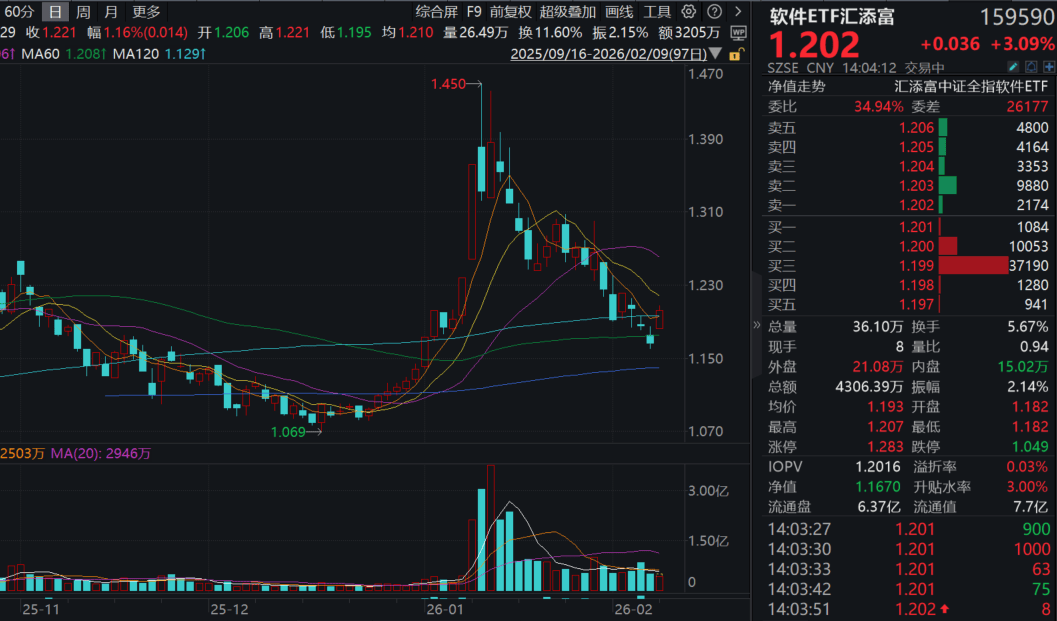
字节Seedance2.0引爆AI应用!软件板块强势反弹,三六零涨停!软件ETF汇添富(159590)大涨超3%!AI大模型"终结"软件行业?黄仁勋、机构发声
Sou Hu Cai Jing· 2026-02-09 06:52
Group 1: Software ETF Performance - The software ETF Huatai (159590) saw most of its constituent stocks perform positively, with Dongfang Guoxin rising over 16%, Wanjing Technology increasing by over 11%, and 360 reaching the daily limit [2] - Key stocks and their performance include: - 360 (601360): 4.03% weight, 9.97% increase, trading volume of 4.363 billion - Keda Xunfei (002230): 12.40% weight, 2.72% increase, trading volume of 2.972 billion - Tonghuashun (300033): 7.02% weight, 3.54% increase, trading volume of 2.591 billion - Dongfang Guoxin (300166): 0.92% weight, 16.83% increase, trading volume of 2.201 billion - Wanjing Technology (300624): 1.18% weight, 11.57% increase, trading volume of 2.154 billion [3] Group 2: AI Video Generation Technology - ByteDance's AI video generation model, Seedance 2.0, has gained significant attention for its ability to create high-quality videos from text or images in under 60 seconds, featuring multi-scene narratives [4] - The model addresses key pain points in AI video generation, such as controllability and coherence, and is expected to catalyze a rebound in AI applications [5][6] - The technology is seen as a turning point for video generation, shifting the focus from technical capabilities to content quality and narrative value [7][8] Group 3: Market Sentiment and Future Outlook - Market sentiment is currently at a low point, but the introduction of Seedance 2.0 is expected to stimulate the AI application sector, particularly in cloud services and computing [5] - Analysts predict that the AI industry will see significant growth as the technology matures, with a focus on AI applications and the integration of AI agents into business processes [10][11] - The evolution of AI agents is anticipated to lead to structural changes in the industry, with increased demand for hardware and a shift in application entry points [12]