IFLYTEK(002230)

Search documents
【最全】2025年中国人工智能代理行业上市公司全方位对比(附业务布局汇总、业绩对比、业务规划等)
Qian Zhan Wang· 2025-08-20 10:59
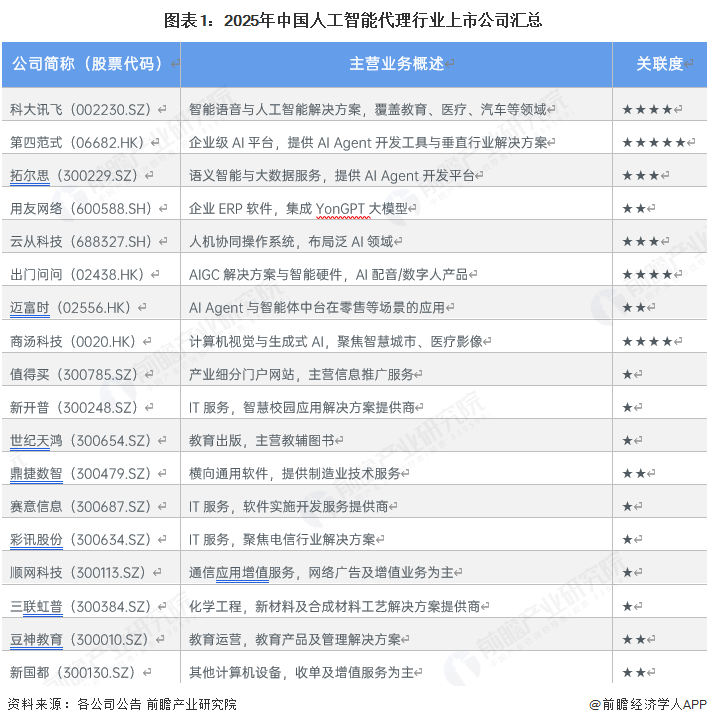
Group 1 - The core viewpoint of the article highlights the rapid development and diverse applications of the artificial intelligence (AI) agency industry in China, emphasizing the importance of R&D investment and the competitive landscape among key players [1][2][3]. Group 2 - The article provides a summary of major listed companies in the AI agency sector, including Keda Xunfei, Fourth Paradigm, and others, showcasing their business layouts and competitive advantages [1][2]. - Key companies are focusing on vertical fields and leveraging large model technology to create differentiated AI agency products, with leading firms like Keda Xunfei and SenseTime utilizing self-developed large models across multiple scenarios [2][3]. - The industry is characterized by three main features: deep vertical scene implementation, ecological cooperation, and standardization of industry solutions [3]. Group 3 - A comparison of basic information among AI agency companies reveals that some firms excel in specific verticals, while others adopt a cross-domain expansion strategy, covering various sectors such as finance, education, and healthcare [2][10]. - Keda Xunfei's AI learning machine has been a top seller in major e-commerce platforms, with its smart education business generating significant revenue [10]. - Fourth Paradigm has established partnerships with major financial institutions to implement AI solutions in risk control and asset management [10]. Group 4 - R&D investment is a critical factor for success, with Keda Xunfei's R&D expenditure reaching 4.58 billion yuan in 2024, representing a 19.37% increase year-on-year [4][5]. - Some companies, like SenseTime, exhibit high R&D spending but struggle with revenue generation, indicating a mismatch between R&D resources and commercialization capabilities [5][6]. - The proportion of R&D personnel is a key indicator of a company's technological drive, with Keda Xunfei having a significantly higher percentage of R&D staff compared to industry averages [6]. Group 5 - The business performance of AI agency companies varies, with Fourth Paradigm achieving a total revenue of 5.261 billion yuan in 2024, marking a 25.1% year-on-year increase [15]. - In contrast, CloudWalk Technology experienced a revenue decline of 36.69% to 398 million yuan in 2024, despite some segments showing high growth [16]. - Companies like Tuolisi maintain high gross margins despite slower revenue growth, indicating a focus on high-margin customized services [16]. Group 6 - The strategic planning of AI agency companies reflects differentiated approaches in technology investment and product roadmaps, impacting their market positioning and operational efficiency [18]. - Keda Xunfei is pursuing a strategy of deepening its industry model while expanding its presence in education and healthcare [19]. - Fourth Paradigm is focusing on integrating agent technology with world models to enhance its service offerings across various industries [19].


AI手机概念上涨2.77%,5股主力资金净流入超亿元
Zheng Quan Shi Bao Wang· 2025-08-20 10:13
Group 1 - The AI mobile concept sector rose by 2.77%, ranking second among concept sectors, with 23 stocks increasing in value, led by Nanchip Technology, Water Crystal Optoelectronics, and Lingyi Technology, which rose by 12.62%, 7.94%, and 7.03% respectively [1][2] - The main capital inflow into the AI mobile concept sector was 537 million yuan, with 12 stocks receiving net inflows, and 5 stocks exceeding 100 million yuan in net inflow, with ZTE Corporation leading at 1.374 billion yuan [2][3] - The top stocks by net inflow ratio included Changying Precision, ZTE Corporation, and Furong Technology, with net inflow ratios of 11.41%, 10.39%, and 10.13% respectively [3][4] Group 2 - The concept sectors with the highest daily gains included Tonghuashun Fruit Index at 3.70%, AI mobile at 2.77%, and National Big Fund Holdings at 2.76%, while sectors with declines included Monkeypox Concept at -0.86% and Recombinant Protein at -0.85% [2] - The trading volume and turnover rates for leading stocks in the AI mobile concept included ZTE Corporation at 8.39% turnover and a daily increase of 5.66%, and Changying Precision at 8.41% turnover with a daily increase of 2.99% [3][4] - Stocks with significant declines included Shenghong Technology at -4.33%, Siquan New Materials at -3.47%, and Daoming Optics at -0.70% [1][4]



脑机接口,引起下一场中美科技战?
思宇MedTech· 2025-08-20 09:26
Core Viewpoint - Brain-computer interface (BCI) technology has made significant advancements in China, with the inclusion of BCI services in medical insurance and competitive pricing compared to international counterparts like Neuralink [2][3]. Group 1: Technological Advancements - In 2025, China successfully completed its first invasive BCI clinical trial, positioning itself as a key player alongside Neuralink [3]. - The development of ultra-flexible electrodes by companies like JieTi Medical has overcome traditional BCI limitations, allowing for enhanced patient experiences [3][8]. - Neuralink's high-precision invasive technology, while advanced, comes with exorbitant costs, making it less accessible [5][7]. Group 2: Cost and Accessibility - The cost of invasive BCI procedures in China is significantly lower, with prices for invasive surgeries around 6,552 RMB (approximately 912 USD) compared to Neuralink's estimated costs of 5,000 to 10,000 USD [2][3]. - Non-invasive BCI options in China are even more affordable, with prices ranging from 1,000 to 5,000 RMB, making them comparable to mid-range smartphones [15]. Group 3: Competitive Landscape - The competition between Neuralink and Chinese companies highlights differing technological approaches, with the latter focusing on practical, cost-effective solutions [4][8]. - Chinese companies are exploring both invasive and non-invasive technologies, aiming to broaden the application of BCI in various sectors, including healthcare and consumer markets [8][19]. Group 4: Data and Standards Control - The accumulation and analysis of brainwave data are crucial for establishing industry standards, which will determine future market leadership [16]. - Chinese companies are adopting a multi-faceted approach to data collection, enhancing their ability to set standards in the BCI industry [17]. Group 5: AI Integration and Future Prospects - The integration of AI with BCI technology is expected to create a significant data advantage, enabling the development of more sophisticated AI applications tailored to Asian cultural contexts [20]. - China's advancements in BCI technology not only focus on technical superiority but also aim to influence global standards and cultural practices [21].

科大讯飞(002230)8月20日主力资金净流入5553.39万元
Sou Hu Cai Jing· 2025-08-20 08:21
Group 1 - The core viewpoint of the news is that Keda Xunfei (002230) has shown positive financial performance with significant revenue and profit growth in the latest quarterly report [1] - As of August 20, 2025, Keda Xunfei's stock price closed at 50.5 yuan, reflecting a 1.67% increase, with a trading volume of 559,300 hands and a transaction amount of 2.79 billion yuan [1] - The company reported total operating revenue of 4.658 billion yuan for the first quarter of 2025, representing a year-on-year growth of 27.74%, and a net profit attributable to shareholders of 193.25 million yuan, up 35.68% year-on-year [1] Group 2 - Keda Xunfei has made investments in 129 companies and participated in 5,000 bidding projects, indicating a strong presence in the market [2] - The company holds 2,744 trademark registrations and 5,000 patents, showcasing its commitment to intellectual property [2] - Keda Xunfei has obtained 60 administrative licenses, further solidifying its operational capabilities [2]
具身智能,产业智变新引擎!「2025科技创变者大会」邀您共探产业变革浪潮
机器人大讲堂· 2025-08-20 08:04
Core Insights - The 2025 Science and Technology Innovator Conference focuses on "Embodied Intelligence" as a new engine for industrial transformation, emphasizing the importance of hard technology commercialization and a comprehensive service model that addresses the challenges of transitioning from technology to product [1][5]. Group 1: Conference Overview - The conference will feature a one-day main forum covering topics such as "embodied intelligence," "humanoid robots," "computing power," "chips," and "core components" [5]. - Over 500 participants, including scientists, entrepreneurs, industry experts, and investors, will discuss the development paths following breakthroughs in critical technologies [5]. Group 2: Technological Trends - Embodied intelligence is emerging as a bridge between the virtual and real worlds, driving intelligent upgrades across various industries [3]. - The past year has shown a clear trajectory of advancement in embodied intelligence, with significant developments in AI brain integration and physical robotics capabilities [3]. - The potential for a unified market similar to the automotive supply chain is anticipated, which could reshape supply chain dynamics [3]. Group 3: Industry Transformation in China - China is transitioning from a "follower" to a "local leader" in hardware technology and is accelerating its software technology development in the field of embodied intelligence [4]. - The industry chain is undergoing deep restructuring, with upstream hardware components moving towards domestic production, midstream platforms becoming more accessible, and downstream users seeking customized solutions [4]. Group 4: Application and Innovation - The conference will unveil the "Top 10 Applications of Embodied Intelligence," creating a platform for demand-side propositions and technology solutions [6]. - High-end manufacturing and consumer technology sectors will collaborate to validate and promote the industrialization of embodied intelligence [5]. Group 5: Ecosystem and Collaboration - The event aims to build an innovative community with over 500 ecosystem partners from various industries, including high-end manufacturing and consumer services [8]. - A comprehensive media outreach strategy will ensure extensive coverage, engaging a wide audience through various channels [8].
武汉经开区高标准打造后官湖总部区
Zhong Guo Xin Wen Wang· 2025-08-20 08:00
Group 1 - The core idea of the news is the development of the Houguan Lake Headquarters District in Wuhan Economic Development Zone, which aims to create a hub for headquarters economy and integrate various industries [1][3][5] - The Houguan Lake Headquarters District covers an area of approximately 9 square kilometers and has attracted over 20 headquarters enterprises, with total revenue and industrial scale exceeding 8 billion yuan [3][5] - Key projects in the area include the establishment of the Central China Headquarters of iFlytek, which is set to accommodate 600 employees by the end of this year [1][3] Group 2 - The project "Jingkai·Boxin Private Island" is located in the core of the Houguan Lake Headquarters District, integrating high-rise offices, international commerce, lakeside villas, and high-end residences [3][5] - The China Urban Headquarters Economic Industrial Park, with a total investment of approximately 5.8 billion yuan, aims to create a national-level demonstration park for production and urban integration [5] - The Wuhan Economic Development Zone is enhancing infrastructure in the Houguan Lake Headquarters District, with plans to attract 15,000 market entities and achieve a total investment scale of 83 billion yuan during the 14th Five-Year Plan period [9]

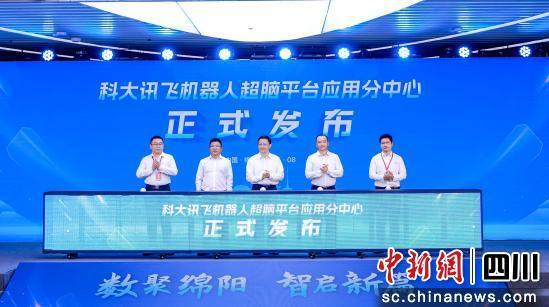
让机器人“能听会懂” 绵阳揭开AI产业新图景
Zhong Guo Xin Wen Wang· 2025-08-20 03:20
Group 1 - The core focus of the news is the launch of the iFlytek Robot Super Brain platform, showcasing advancements in AI and robotics, particularly in natural language processing and interaction capabilities [3][5] - The platform has already served over 500 robot companies and connected 15,000 developers, indicating a strong ecosystem in industrial, service, special, and humanoid robotics [3] - A total of 12 projects were signed during the event, with a total investment amounting to 3.5 billion yuan, highlighting significant financial commitment to the digital economy in Mianyang [3][4] Group 2 - Baidu's establishment of an AI industrial base in Mianyang aims to create a comprehensive platform for data labeling, computing power support, model transformation, and talent training, reflecting confidence in the local digital economy [4] - The first phase of the Mianyang Digital Economy Industrial Park has attracted 21 companies, including iFlytek and Baidu, with major players like Huawei and Inspur also participating, indicating a robust industrial cluster [4] - The goal is to cultivate a "Super Brain+" ecosystem by 2027, focusing on breakthroughs in 20 core technologies and the introduction of 20 leading AI talent teams, aiming to establish the park as a national model for new productivity [5]

研判2025!中国AI会议耳机行业产业链、相关政策及市场规模分析:远程协作与跨国会议驱动需求爆发,2025年AI会议耳机市场有望冲刺10.58亿元[图]
Chan Ye Xin Xi Wang· 2025-08-20 01:33
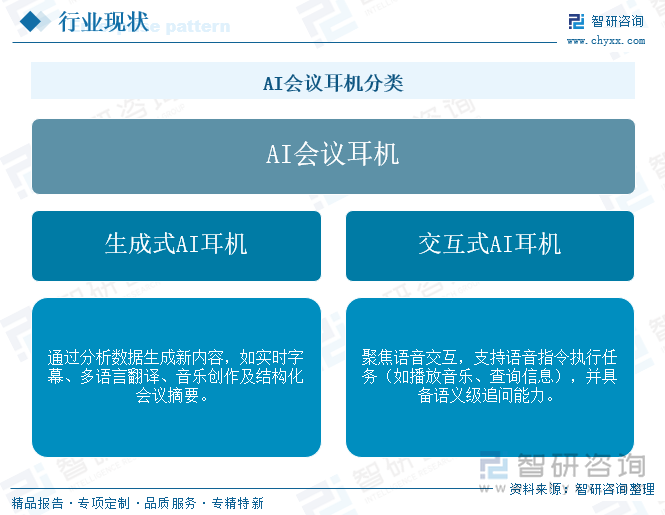
Core Viewpoint - The AI conference headset industry in China is rapidly growing, with a market size projected to reach 710 million yuan in 2024, representing a year-on-year growth of 162.96%, and expected to reach 1.058 billion yuan in 2025, driven by increasing demand for efficient office and smart meeting solutions [1][11]. Industry Overview - AI conference headsets are wearable audio devices integrated with artificial intelligence technology, designed to enhance meeting efficiency. Their core functions include real-time voice transcription, multilingual translation, meeting summary generation, intelligent noise cancellation, and interactive voice assistants [2]. - The industry is categorized into generative AI headsets and interactive AI headsets based on their technical architecture [2]. Industry Supply Chain - The upstream of the AI conference headset industry includes components such as AI chips, electronic components, batteries, casings, ear tips, microphones, and sensors, as well as production equipment like SMT machines and audio testing devices. The midstream involves the manufacturing of AI conference headsets, while the downstream includes retail channels such as supermarkets, mobile phone specialty stores, and e-commerce platforms [4]. Market Size - The AI conference headset market in China is expected to grow significantly, with a market size of 710 million yuan in 2024 and a forecast of 1.058 billion yuan in 2025, driven by the increasing demand for efficient office solutions, especially in remote and multinational meeting scenarios [11]. Key Companies' Performance - The market is expected to form a competitive landscape characterized by "ecological giants, vertical scene leaders, and long-tail innovators" by 2025. Major players include Huawei, Xiaomi, and Apple, leveraging their ecosystems to enhance device interconnectivity [13]. - Companies like Future Intelligence and iFLYBUDS Pro from iFLYBUDS have made significant advancements in AI conference headsets, offering features such as automatic meeting minutes generation and real-time translation capabilities [15][17]. Industry Development Trends 1. **Technological Innovation**: AI conference headsets are expected to achieve breakthroughs in voice recognition and translation capabilities, supporting more languages and dialects, and integrating more intelligent features [19]. 2. **Market Expansion**: The demand for AI conference headsets is anticipated to grow across various sectors, including education, healthcare, and finance, driven by the rise of remote work and hybrid work models [20][21]. 3. **Standardization and Regulation**: The industry is likely to see increased regulation and standardization efforts to ensure product quality and safety, addressing performance metrics such as voice recognition accuracy and battery life [22].

机器人产业商业化落地进程不断加快,机器人ETF嘉实(159526)盘中涨近2%
Sou Hu Cai Jing· 2025-08-19 06:24
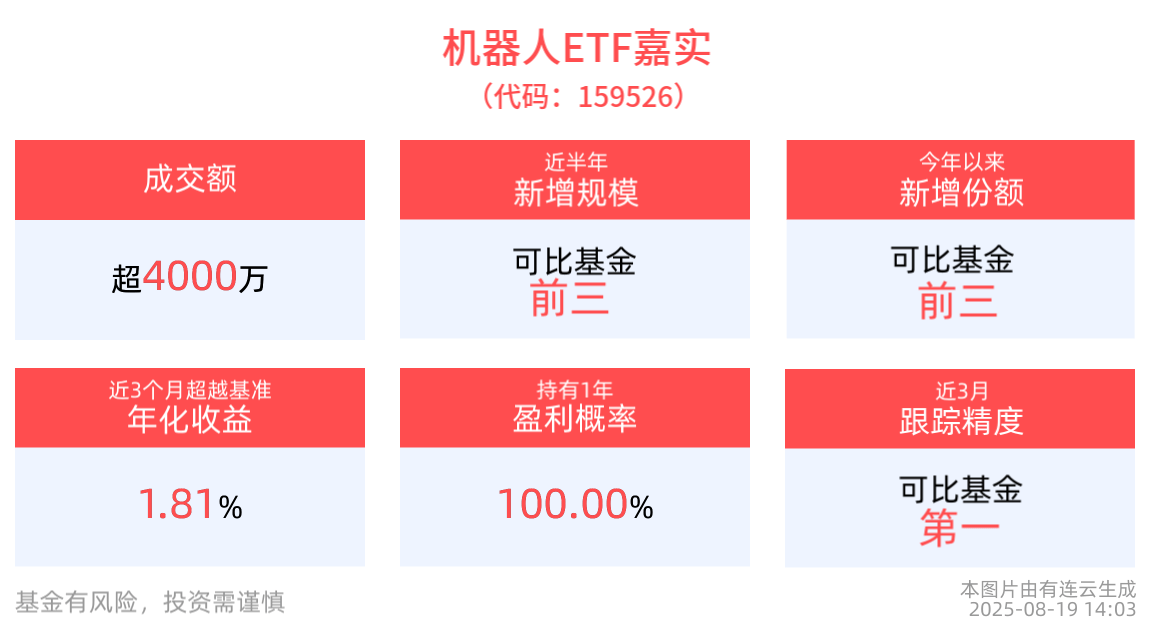
Group 1: ETF Performance and Liquidity - The liquidity of the Robot ETF managed by Jiashi has a turnover rate of 8.09%, with a transaction volume of 44.39 million yuan [3] - Over the past week, the average daily transaction volume of the Robot ETF reached 44.26 million yuan [3] - The ETF's scale has increased by 200 million yuan in the past six months, with a share growth of 23.7 million shares this year [3] Group 2: Financial Performance - As of August 18, 2025, the net value of the Robot ETF has risen by 8.92% over the past six months, ranking in the top two among comparable funds [3] - The highest monthly return since inception was 25.78%, with the longest consecutive monthly gains being three months and a maximum increase of 37.12% [3] - The average return during the rising months is 8.93% [3] Group 3: Key Holdings - As of July 31, 2025, the top ten weighted stocks in the CSI Robot Index include Keda Xunfei, Huichuan Technology, Stone Technology, Dahua Technology, Zhongkong Technology, Dazhu Laser, Shuanghuan Transmission, Robot, Ecovacs, and Julun Intelligent, collectively accounting for 48.86% of the index [3] Group 4: Industry Developments - Zhiyuan Innovation (Shanghai) Technology Co., Ltd. has partnered with Fulian Precision Engineering Co., Ltd. for a project worth several million yuan, marking the first large-scale commercial contract for embodied robots in the industrial sector in China [5] - The current phase of humanoid robots is likened to the "iPhone era," indicating significant industry potential, with dexterous hands expected to account for over 30% of the robot's value [5] Group 5: Technological Advancements - The robot industry is entering a rapid development phase, with the commercialization process accelerating [6] - Sensors are identified as the core hardware for the intelligence level of humanoid robots, with technological iterations driving significant advancements [6] - The value and technical requirements of sensors may undergo substantial changes due to the accelerated product iterations by main manufacturers [6]


人形含量第一的机器人ETF鹏华(159278)涨超2%,位列ETF榜前五
Xin Lang Cai Jing· 2025-08-19 05:42
Group 1 - The core viewpoint of the articles highlights the strong performance of the robotics industry, particularly in the context of the World Robot Conference (WRC) held in Beijing, showcasing various applications of embodied intelligent robots [1][2] - The National Securities Index for Robotics (980022) has seen a significant increase of 2.82%, with key stocks such as Hechuan Technology (688320) rising by 16.68% and Top Group (601689) by 10.00% [1] - The recent WRC featured nearly 200 traditional and humanoid robot companies, launching over 100 new products, demonstrating applications in industrial tasks, consumer activities, and entertainment [1] Group 2 - According to Guoxin Securities, the future of the robotics industry is expected to follow a path from "specific scenarios to cross-specific scenarios to general scenarios," indicating a variety of forms will emerge [2] - The current challenge for humanoid robots lies in their algorithm capabilities, which limits their ability to generalize across different scenarios; initial applications are expected in B-end specific scenarios [2] - The top ten weighted stocks in the National Securities Index for Robotics account for 40.09% of the index, with companies like Stone Technology (688169) and Ecovacs (603486) leading the list [2]