
Binjiang Group(002244)

Search documents
滨江集团:截至2025年7月31日公司股东总户数为30500户
Zheng Quan Ri Bao Wang· 2025-08-01 12:45
证券日报网讯滨江集团(002244)8月1日在互动平台回答投资者提问时表示,截至2025年7月31日,公 司合并普通账户和融资融券信用账户的在册股东总户数为30500户。 ...

房地产及建材行业双周报(2025、07、18-2025、07、31):基建发力叠加“防内卷”及消费提振,预计建材企业基本面将持续修复-20250801
Dongguan Securities· 2025-08-01 10:19
Investment Rating - The report maintains a "Neutral" rating for both the real estate and building materials sectors [1][3]. Core Insights - The report highlights that the construction materials sector is expected to continue its recovery due to increased infrastructure investment and consumption stimulation, supported by government policies [3][4]. - The real estate sector has shown weakened sales momentum in recent months, with a focus on policy impacts for short-term rebounds and a need for improved sales recovery and company fundamentals for medium-term outlook [3][28]. - The building materials sector is facing challenges such as weak demand, excess capacity, and inventory pressure, but upcoming policies are expected to enhance environmental standards and control capacity, positively impacting profitability [4][50]. Summary by Sections Real Estate Sector - The central government is emphasizing urban renewal and fiscal measures to support the real estate market, including the issuance of special bonds [3][28]. - The real estate sector has seen a slight increase of 0.66% over the past two weeks, outperforming the CSI 300 index by 0.24 percentage points [15][20]. - Key companies to watch include Poly Developments, China Merchants Shekou, and China Vanke, focusing on stable operations and strong positions in first and second-tier cities [3][28]. Building Materials Sector - The building materials sector has experienced a 6.23% increase over the past two weeks, ranking second among 31 sectors [29][31]. - Cement prices are under pressure due to weak demand, with the national average price at 320 RMB per ton, down 4 RMB from the previous week [36][50]. - Companies such as Conch Cement and Huaxin Cement are recommended for their solid fundamentals and attractive dividend yields [4][50]. Consumer Building Materials - Retail sales of building and decoration materials reached 15.8 billion RMB in June, with a year-on-year growth of 1.0% [5][53]. - The report anticipates a recovery in sales and profit margins for consumer building materials companies due to market improvements and cost optimization strategies [7][53]. - Recommended companies include Beixin Building Materials, Rabbit Baby, and Three Trees for their competitive advantages and solid fundamentals [7][53].




前7月重点房企拿地总额同比增长34.3%,热点城市土拍热度不减
证券时报· 2025-08-01 10:11
Core Viewpoint - The total land acquisition amount of the top 100 real estate companies in China reached 578.3 billion yuan from January to July, marking a year-on-year increase of 34.3% [2][5][4] Group 1: Land Acquisition Data - From January to July, the top 100 real estate companies acquired land worth 578.3 billion yuan, with a slight month-on-month increase of 1 percentage point [2][5] - In terms of equity land acquisition, China Overseas Land & Investment ranked first with 54.2 billion yuan, followed by Greentown China with 52.2 billion yuan, and Poly Developments with 42.4 billion yuan [6] - Regarding new value added, Greentown China led with 111.6 billion yuan, followed by China Overseas Land & Investment with 93.5 billion yuan, and Poly Developments with 90.7 billion yuan [7] Group 2: Regional Land Acquisition Insights - The top 10 companies in the Yangtze River Delta acquired 180.2 billion yuan, leading among the four major city clusters, while the Beijing-Tianjin-Hebei region's top 10 companies acquired 89.4 billion yuan, ranking second [8] - The top 10 companies in the central and western regions acquired 45.7 billion yuan, ranking third [8] - State-owned enterprises remain dominant in land acquisition in key cities, with private enterprises only supplementing land reserves in specific areas [8] Group 3: Competitive Landscape in Key Cities - In July, competition for quality land in core cities remained intense, with some plots undergoing numerous rounds of bidding, such as 89 rounds in Nanjing and 43 rounds in Hangzhou [11] - Record-breaking land prices were observed, with a plot in Shanghai's Xuhui District selling for 200,000 yuan per square meter, setting a new national record [11] - The competition is driven by companies seizing opportunities to acquire quality plots in core cities, as local governments release premium and scarce land to attract investment [11][12] Group 4: Future Trends and Challenges - Companies are increasingly focusing on project safety and profitability certainty, particularly in core areas of major cities, where high premium transactions are expected to continue [12] - There is a growing trend towards enhancing product competitiveness, with improvements in design and construction quality becoming essential for future success [12]


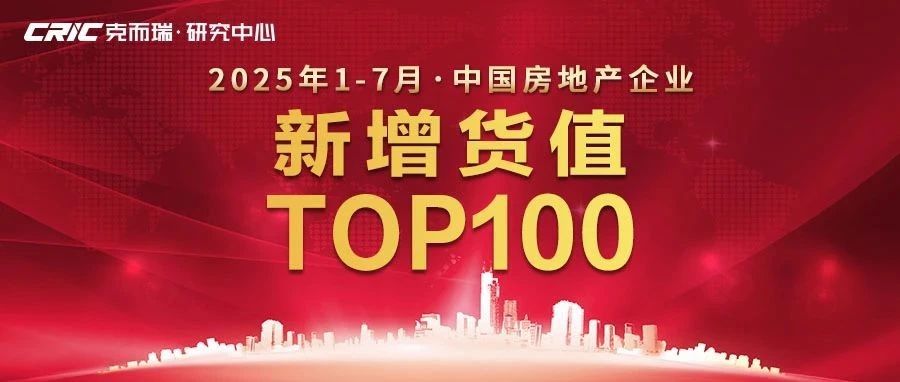
2025年1-7月中国房地产企业新增货值TOP100排行榜
克而瑞地产研究· 2025-08-01 09:25
Core Viewpoint - The real estate market in China is expected to see an increase in the supply of high-quality residential land in the second half of 2025, with more transactions of premium land parcels anticipated across various regions [1][17]. Group 1: Land Market Trends - In July 2025, the total amount spent by 30 companies on land acquisition was 52.9 billion, a decrease of 16% month-on-month but an increase of over 50% year-on-year, indicating a recovery in land acquisition willingness among leading firms [16][29]. - The average premium rate for land in July reached 9.9%, the highest since the second quarter of 2025, driven by the sale of several high-quality residential plots in major cities like Shenzhen, Shanghai, and Suzhou [18]. - The total area of commercial and residential land sold nationwide as of July 25 was 41.94 million square meters, reflecting a seasonal decline of 13% in area and 18% in monetary value [18]. Group 2: New Land Value and Acquisition - The threshold for the top 100 companies in terms of new land value decreased by 10% year-on-year to 2.76 billion, while the total price threshold increased by 16% [20]. - The total new land value for the top 100 real estate companies reached 1.3295 trillion, with a year-on-year growth of 17% and a 33% increase in total price, although the growth rate has slowed compared to the first half of the year [24]. - The top five companies accounted for a significant portion of new land value, with a threshold of 73.7 billion, indicating a clear disparity in land acquisition among leading firms [20]. Group 3: Market Concentration and Investment Behavior - The top 10 real estate companies accounted for 70% of the new land value, showing a slight decrease of 3 percentage points from the previous month but an increase of 8 percentage points compared to the end of 2024 [25]. - The land acquisition-to-sales ratio for the top 100 companies remained at 0.3, reflecting an improvement in investment willingness compared to previous years [25]. - Despite the overall cautious approach, there is a notable focus on core cities and high-value land, with many companies still hesitant to invest heavily in less desirable areas [29][31]. Group 4: Future Outlook - The second half of 2025 is expected to see more high-quality residential land entering the market, with a continued focus on core urban areas, while lower-tier markets may remain subdued [31]. - Central state-owned enterprises are likely to dominate the land market, leveraging their financial strength and risk management capabilities to secure prime plots [31].
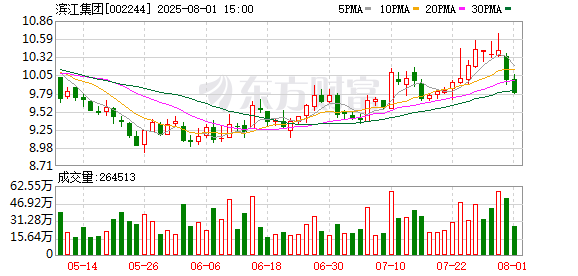
滨江集团最新股东户数环比下降10.75% 筹码趋向集中
Zheng Quan Shi Bao Wang· 2025-08-01 09:10
Core Viewpoint - Binjiang Group reported a decrease in the number of shareholders and a decline in stock price, despite strong revenue and profit growth in the first quarter [2] Group 1: Shareholder and Stock Performance - As of July 31, the number of shareholders for Binjiang Group was 30,500, a decrease of 3,672 from the previous period, representing a decline of 10.75% [2] - The closing price of Binjiang Group was 9.79 yuan, down 1.90%, with a cumulative decline of 0.31% since the concentration of shares began [2] - Over the past trading days, the stock experienced 6 increases and 4 decreases [2] Group 2: Financial Performance - In the first quarter, Binjiang Group achieved operating revenue of 22.508 billion yuan, a year-on-year increase of 64.27% [2] - The net profit for the same period was 976 million yuan, reflecting a year-on-year growth of 47.88% [2] - The basic earnings per share were 0.3100 yuan, with a weighted average return on equity of 3.48% [2] Group 3: Earnings Forecast and Analyst Ratings - On July 15, the company released a half-year earnings forecast, estimating a net profit between 1.633 billion yuan and 1.982 billion yuan, with a change range of 40.00% to 70.00% [2] - In the past month, the stock received buy ratings from 5 institutions, with the highest target price set at 12.74 yuan by CITIC Securities on July 15 [2]
2025年7月房企销售数据点评:房企销售热度低位,优质企业跑赢市场
Shenwan Hongyuan Securities· 2025-08-01 03:44
Investment Rating - The report maintains an "Overweight" rating for the real estate sector, indicating a positive outlook for quality companies with strong product capabilities and inventory management [4][5]. Core Insights - The sales performance of real estate companies in July 2025 showed a significant decline, with a year-on-year decrease of 23% in sales amount and 26.6% in sales area. Cumulatively, the first seven months of 2025 saw an 18.4% decline in sales amount compared to the previous year [4][5]. - The report highlights a structural differentiation in the sales market, with first and second-tier cities performing better than third and fourth-tier cities. It suggests that the real estate market will exhibit a "structurally strong + overall weak" pattern moving forward [4][5]. - The report emphasizes that while the broad housing demand has bottomed out, the recovery of residents' balance sheets will take approximately two years, which will delay the expected positive cycle in price and volume [4][5]. Summary by Sections Sales Performance - In July 2025, the top three companies by sales were Poly Developments (18 billion), China Merchants Shekou (15.6 billion), and Vanke (13.5 billion). The threshold for the top three has decreased from 15.9 billion in the same month last year to 13.5 billion this year [4][5]. - The cumulative sales for the first seven months of 2025 were led by Poly Developments (163.2 billion), China Overseas (132 billion), and China Resources (123.6 billion), with significant year-on-year declines for most companies [4][5]. Investment Recommendations - The report recommends focusing on quality real estate companies with strong product capabilities and inventory management, such as Jianfa International, Binhai Group, China Resources Land, and Jianfa Holdings. It also suggests monitoring companies like Greentown China and China Jinmao [4][5]. - For undervalued recovery companies, the report highlights New Town Holdings, Yuexiu Property, China Merchants Shekou, Poly Developments, China Overseas, Longfor Group, and Huafa Group as potential investment opportunities [4][5].


7月土拍市场高温 多地楼面价纪录获刷新
Zheng Quan Shi Bao Wang· 2025-08-01 02:53
Core Insights - The land auction market is experiencing heightened activity, with record floor prices being set in multiple cities during July 2025, indicating strong competition for prime land parcels [1][2] - The total land acquisition amount for the top 100 real estate companies reached 578.3 billion yuan from January to July 2025, reflecting a year-on-year increase of 34.3% [1][3] - Major state-owned enterprises dominate land acquisitions, with eight out of the top ten companies being state-owned, while some private companies like Binjiang Group are also making significant investments [2][3] Land Auction Dynamics - Intense bidding activity is characterized by numerous rounds of bidding and high premium rates, exemplified by the Shenzhen Qianhai Guiwan plot, which saw 12 companies participate in 158 rounds, resulting in a final premium rate of 86.1% [2] - The competitive nature of land acquisition is driven by the scarcity of quality land, as seen in the Shanghai Xuhui District plot, which is the first new residential land in a decade for the area, enhancing its desirability [2][3] Future Outlook - The "reduced quantity and improved quality" model for land supply is expected to continue, particularly in first-tier cities like Beijing, Shanghai, and Shenzhen, where core land parcels will likely maintain high premium transactions [3] - In contrast, third and fourth-tier cities are anticipated to see land transactions primarily at base prices, with some cities potentially adjusting supply structures to attract investment [3] - Companies are urged to avoid acquiring high-priced land to mitigate challenges in subsequent project development, emphasizing the need for enhanced design capabilities and product competitiveness in the housing market [3]
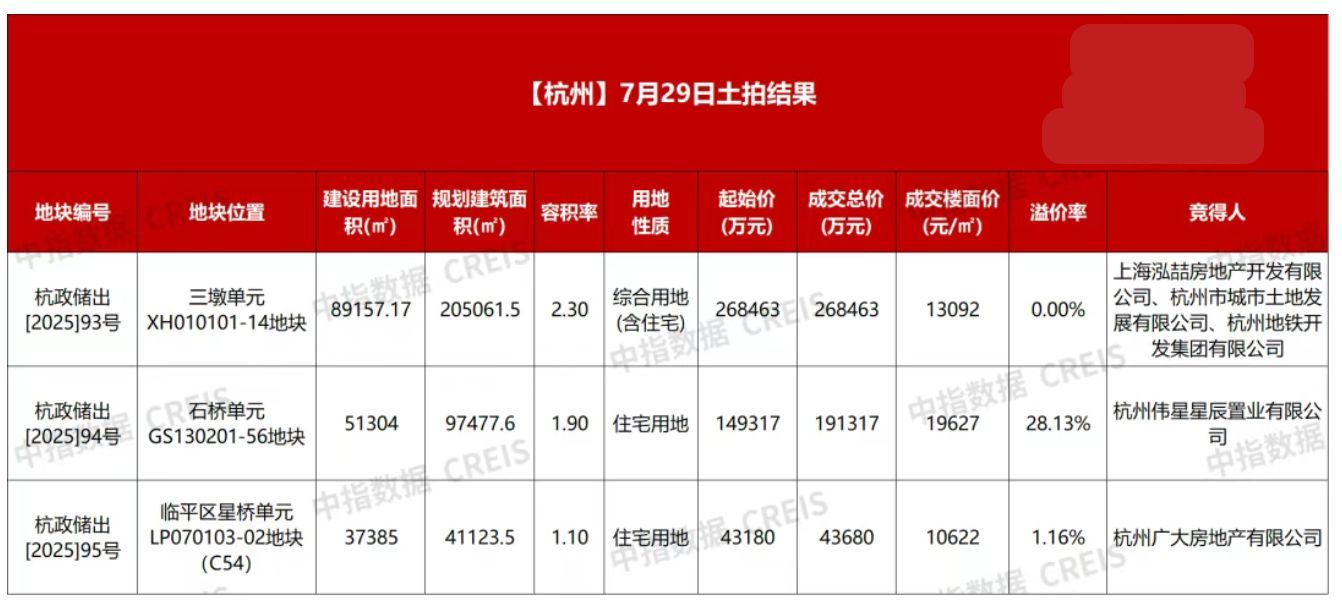
7月杭州土拍揽金超百亿元:民营房企主导拿地
Mei Ri Jing Ji Xin Wen· 2025-08-01 02:00
Core Insights - The core point of the article is the summary of the land auction results in Hangzhou for July, highlighting the competitive bidding for residential land and the trends in the real estate market, particularly the shift towards quality projects and the participation of private enterprises in land acquisition [1][3][10]. Group 1: Land Auction Results - On July 29, three residential land parcels were successfully auctioned in Hangzhou, marking the conclusion of the July land auction [1]. - The most competitive bidding occurred for the Shiqiao unit in Gongshu District, where Weixing Real Estate won the bid with a total price of 1.913 billion yuan and a floor price of 19,627 yuan per square meter, reflecting a premium rate of 28.13% [1][2]. - The total amount for the eight residential land parcels auctioned in July reached approximately 10.2 billion yuan, indicating a relatively stable market compared to the intense competition in the first half of the year [3][10]. Group 2: Market Trends - The land market in Hangzhou is experiencing a division, with core area quality land being highly sought after while non-core areas continue to see low premium transactions [3][11]. - Private enterprises have shown a strong willingness to acquire land, with five private companies successfully obtaining six parcels in July, including two by Binjiang Group [4][10]. - The trend of enhancing product quality is evident, with developers being pushed to improve design capabilities and meet higher standards due to the introduction of quality improvement pilot projects [3][11]. Group 3: Developer Participation - Notably, the successful bidders in July included several private companies such as Greentown China, Weixing Real Estate, and others, indicating a robust presence of private developers in the market [4][10]. - Weixing Real Estate emphasized its commitment to the Hangzhou market, stating that this acquisition is part of its strategy to maintain steady growth and risk control [9][10]. - The participation of non-local companies, such as Zhongde Tiancheng Construction Group, reflects a broader trend of external developers entering the Hangzhou market [5][10].

新房销售迎季节性调整
HTSC· 2025-08-01 01:15
Investment Rating - The report maintains an "Overweight" rating for the real estate development and service sectors [5] Core Insights - New home sales in July 2025 experienced seasonal adjustments, with a month-on-month decline of 38.1% and a year-on-year decline of 23.2%, indicating a weakening market momentum [1] - The report highlights an expected acceleration in the implementation of real estate policies, particularly in first-tier cities and core areas, which may exceed expectations [1] - The sales threshold for the top 10 real estate companies increased significantly, while sales amounts for various tiers of companies showed a month-on-month decline [2] - The concentration of top real estate companies has increased, with the top 10 companies accounting for 52.8% of total sales among the top 100 companies, reflecting a trend towards consolidation [3] - Overall market activity in the real estate sector has declined, suggesting a traditional off-season, with a recommendation to focus on companies with advantages in core city layouts [4] Summary by Sections New Home Sales - In July 2025, new home sales saw a month-on-month decrease of 38.1% and a year-on-year decrease of 23.2%, with cumulative sales from January to July down 14.4% year-on-year [1] Sales Thresholds - The sales thresholds for the top 10, 20, 30, 50, and 100 real estate companies were 616 billion, 217 billion, 147 billion, 77 billion, and 25 billion respectively, with the top 10 showing a year-on-year increase of 5.0% [2] Company Concentration - The top 10 companies' sales accounted for 52.8% of the total sales of the top 100 companies, indicating a slight increase in concentration compared to the previous year [3] Market Activity - The market activity for new and second-hand homes in 44 cities showed a month-on-month decline of 34.4% and 28.2% respectively, indicating a seasonal downturn [4] Recommendations - The report recommends focusing on real estate developers with strong credit, good city locations, and quality products, as well as top property management companies and REITs benefiting from asset revaluation in Hong Kong [4]


中指研究院:1-7月TOP100企业拿地总额5783亿元 同比增长34.3%
智通财经网· 2025-07-31 23:48
智通财经APP获悉,中指研究院发布《2025年1-7月全国房地产企业拿地TOP100排行榜》。2025年1-7月,TOP100企业拿地总额5783亿元,同比增长 34.3%,相比上月增幅小幅增长1个百分点。2025年以来,土地市场热度不减,同比不断走高。拿地企业仍以央国企为主,拿地金额前十企业中8家为央国 企,部分民企亦有一定投资强度,如滨江集团拿地金额位居前十,邦泰集团、大华集团等也进入拿地金额前二十。 | 排名 | 企业 | 拿地金额 (亿元) | 排名 | 企业 | 拿地面积 (万m2) | | --- | --- | --- | --- | --- | --- | | 1 | 中海地产 | 542 | 1 | 绿城中国 | 248 | | 2 | 绿城中国 | 522 | 2 | 保利发展 | 205 | | 3 | 保利发展 | 424 | ਤ | 中海地产 | 203 | | ব | 建发房产 | રૂટર | 4 | 建发房产 | 162 | | 5 | 滨江集团 | 347 | 5 | 邦泰集团 | 155 | | 6 | 中国余茂 - | 279 | 6 | 束润置城 | 119 | | | ...
