
SFY(002572)

Search documents
轻工制造、纺织服饰行业3月投资策略展望:春节假期消费较火热,上海市优化地产政策
BOHAI SECURITIES· 2026-03-02 08:26
Group 1: Industry Overview - The consumption during the Spring Festival was robust, with domestic travel reaching 596 million trips, an increase of 95 million trips compared to the previous year, and total spending of 803.48 billion yuan, marking a historical high for both visitor numbers and spending [10][20]. - The Shanghai government has implemented measures to optimize real estate policies, which are expected to boost the real estate market and support the recovery of related industries [3][69]. - The retail sales of social consumer goods in the furniture category for 2025 is projected to be 209.19 billion yuan, reflecting a year-on-year growth of 14.62% [4][21]. Group 2: Key Company Announcements - Sun Paper Industry reported a 5.05% year-on-year increase in net profit attributable to shareholders for 2025, with total revenue of approximately 39.18 billion yuan, a decrease of 3.79% from the previous year [6][58]. - Mengjie Home Textile announced that major shareholder Li Jianwei plans to reduce his holdings by 3.2 million shares, which is about 0.43% of the company's total shares [6][59]. Group 3: Market Performance - From February 2 to February 27, the light industry sector outperformed the CSI 300 index by 2.67 percentage points, with a growth of 2.76% compared to the CSI 300's 0.09% [8][60]. - The textile and apparel sector underperformed the CSI 300 index by 0.13 percentage points, with a slight decline of 0.04% [8][65]. Group 4: Monthly Strategy - The report maintains a "neutral" rating for the light industry and textile sectors, while recommending "buy" ratings for companies such as Oppein Home, Sophia, and others [11][71]. - The report highlights the potential for recovery in the real estate sector and related industries due to recent policy optimizations in major cities [69].




造纸轻工周报:关注关税政策变化、AI眼镜新品催化,家居和内需消费有望边际改善-20260226
Shenwan Hongyuan Securities· 2026-02-26 13:43
Investment Rating - The report maintains a "Positive" outlook on the paper and light industry sectors, highlighting potential improvements in domestic demand and the impact of tariff policy changes [1][2]. Core Insights - The report emphasizes the expected marginal improvement in domestic demand, driven by real estate policy stabilization and consumer confidence recovery [2][10]. - The AI glasses market is anticipated to see significant growth, with Meta's sales surging and Apple's upcoming product launch expected to enhance market penetration [2][12]. - The paper industry is experiencing price stability and potential profitability improvements due to strong overseas production control and rising prices [2][14]. Summary by Sections Export Sector - Changes in tariff policies are expected to boost export performance, with recommendations for companies like 嘉益股份, 匠心家居, and 永艺股份 due to their strong performance certainty [2][4]. - The U.S. Supreme Court's ruling against additional tariffs and the introduction of a 10% global tariff are pivotal developments [4][10]. Home Furnishing Sector - The home furnishing industry is at a valuation bottom, with real estate policies likely to catalyze upward valuation adjustments [2][10]. - The sector is witnessing accelerated consolidation, with mid-tier companies exiting and capital entering leading firms, enhancing industry concentration [2][11]. - Companies like 顾家家居, 索菲亚, and 欧派家居 are highlighted for their potential valuation recovery [2][11]. AI Glasses Sector - Meta's smart glasses sales have seen explosive growth, with a reported increase of nearly threefold, while Apple's anticipated entry is expected to further drive market penetration [2][11]. - The report suggests focusing on companies like 康耐特光学 and 明月镜片, which are well-positioned in this emerging market [2][12]. Paper Industry - The report notes that overseas pulp mills are showing strong production control intentions, leading to price increases [2][14]. - Companies like 太阳纸业 and 玖龙纸业 are recommended due to their integrated operations and cost advantages [2][14]. Domestic Demand - There is an expectation of marginal improvement in domestic demand, with companies like 百亚股份 and 公牛集团 identified as potential beneficiaries [2][17]. - The report highlights the importance of consumer confidence and spending power recovery in driving demand [2][17].



又一家居企业冲击港股上市,2025年营收超8亿元,主要客户有顾家、索菲亚等
Sou Hu Cai Jing· 2026-02-26 02:29
Core Viewpoint - Company is preparing for an IPO on the Hong Kong Stock Exchange, with J.P. Morgan and CCB International as joint sponsors, aiming to become the first listed company among the "Six Little Dragons of Hangzhou" [3] Group 1: Financial Performance - Company is projected to achieve revenue of 820 million yuan in 2025, with a gross margin of 82.2% and an adjusted net profit of 57.1 million yuan, marking a turnaround from previous losses [1] - The company's net losses according to accounting standards are expected to be 646 million yuan in 2023, 513 million yuan in 2024, and 428 million yuan in 2025, with an adjusted net profit of 57.1 million yuan [1] Group 2: Market Position and Growth - As of 2024, the company is a leading provider of spatial design software in China, holding a market share of 23.2%, with business expansion into international markets including South Korea, Southeast Asia, the United States, and India [3] - The Chinese spatial design software market is anticipated to grow from 3.3 billion yuan in 2024 to 6.6 billion yuan by 2029, with a compound annual growth rate (CAGR) of 18.9% for cloud software, significantly outpacing traditional on-premise software [3] Group 3: Company Background and Products - Company was co-founded by Huang Xiaohuang, Chen Hang, and Zhu Hao, who are university classmates with prior experience at renowned companies such as NVIDIA, Microsoft, Amazon, and the National Center for Supercomputing Applications [3] - The company offers a core cloud-native platform "CoolJiaLe," a localized solution for international markets "Coohom," and professional services providing 3D composite datasets "SpatialVerse," utilizing cloud-native architecture and AI-driven technology [3] Group 4: Investment and Shareholding - Company has received investments from multiple institutions including IDG Capital, GGV Capital, and Hillhouse Capital among others [4] - Pre-IPO shareholding includes Huang Xiaohuang with 15.46%, Chen Hang with 11.04%, Zhu Hao with 4.22%, and Wide Future Group Limited with 3.67% [4] - "CoolJiaLe" has established strategic partnerships with several well-known home furnishing companies, including Kuka Home and Sophia [4]

轻工制造、纺织服饰行业周报:美国关税政策再生变,对华关税迎边际下降-20260224
BOHAI SECURITIES· 2026-02-24 09:05
Investment Rating - The report maintains a "Neutral" rating for the light industry manufacturing and textile apparel sectors [6][53] - Specific companies such as Oppein Home (603833), Sophia (002572), Pathfinder (300005), Semir Apparel (002563), Guibao Pet (301498), and Zhongchong Co. (002891) are given an "Overweight" rating [6][53] Core Insights - The U.S. Supreme Court ruled that the large-scale tariff policies implemented by the Trump administration were illegal, leading to a marginal decrease in tariffs on imports from China [2][14] - Following the ruling, President Trump signed an executive order to impose a 10% temporary import tariff, which was later increased to 15% [14] - The current U.S. tariff policy is expected to provide some support for domestic export chain enterprises in terms of order and valuation improvement [4][52] Industry News - The light industry manufacturing sector outperformed the CSI 300 index by 0.17 percentage points from February 9 to February 13, with a performance of 0.53% compared to the CSI 300's 0.36% [3][45] - The textile apparel sector underperformed the CSI 300 index by 3.14 percentage points during the same period, with a performance of -2.77% [3][48] Important Company Announcements - Pathfinder plans to implement a stock incentive plan for 72 employees, involving 6.7268 million shares [44] - Yutong Technology intends to acquire 51% of Dongguan Huayan New Materials for 449 million yuan [44] Market Review - The light industry manufacturing sector's performance was influenced by changes in actual control, price increases from leading paper companies, and significant order signings [45] - The textile apparel sector's performance was affected by fluctuations in gold and lithium carbonate prices, as well as issues related to information disclosure by some companies [48]

2026年中国室内门行业特征、供需及市场规模洞察: 行业整体维持低位运行[图]
Chan Ye Xin Xi Wang· 2026-02-16 01:01
Core Insights - The indoor door industry in China is experiencing a decline in both production and market demand, with a projected production of 96.37 million units and a demand of 91.686 million units in 2025, reflecting a year-on-year decrease of 2.16% in production [10][11] - The market size for indoor doors is expected to be approximately 68.81 billion yuan in 2025, showing a slight decrease compared to previous years [10][11] Industry Overview - Indoor doors are defined as doors installed within residential spaces, categorized into bedroom doors, bathroom doors, and kitchen doors, contrasting with outdoor doors [2][3] - The market has traditionally been dominated by handcrafted wooden doors, but advancements in technology have led to the development of metal composite doors and other varieties [2][3] Industry Characteristics - The indoor door industry is highly correlated with the real estate cycle, with demand reliant on new housing completions and renovations of existing properties [4][5] - The industry faces low entry barriers, resulting in a large number of small manufacturers and low market concentration, leading to significant product homogeneity and intense price competition [4][5] Policy Background - From 2024 to 2025, numerous policies related to indoor doors are being introduced, focusing on environmental regulations, standard upgrades, and incentives for renovation of existing properties [6][7] - Key policies include the release of the "General Technical Requirements for Wooden Doors and Windows" and local subsidies for renovating old housing [6][7] Industry Chain - The upstream of the indoor door industry includes raw material suppliers such as wood, resin, steel, and glass, while the midstream consists of manufacturers like TATA and MengTian, who design and produce the doors [8] - The downstream market is primarily driven by residential and commercial real estate, linking demand closely to housing completions and renovations [8] Current Development Status - The indoor door industry saw steady growth from 2017 to 2021, but has since entered a phase of decline due to a downturn in the real estate market and reduced demand for renovations [10][11] - The industry is currently in a deep adjustment phase, with both production and demand continuing to decrease [10][11] Competitive Landscape - The indoor door market is characterized by increasing competition from home furnishing companies entering the sector, with many small enterprises facing challenges in management and production efficiency [14][15] - The industry struggles with issues such as outdated manufacturing processes, insufficient R&D capabilities, and severe product homogeneity [14][15] Development Trends - The indoor door industry is shifting towards smart home integration, with leading brands introducing smart door products featuring advanced security and monitoring capabilities [17] - There is a growing emphasis on green and low-carbon practices, driven by stricter environmental standards and consumer demand for sustainable products [17]


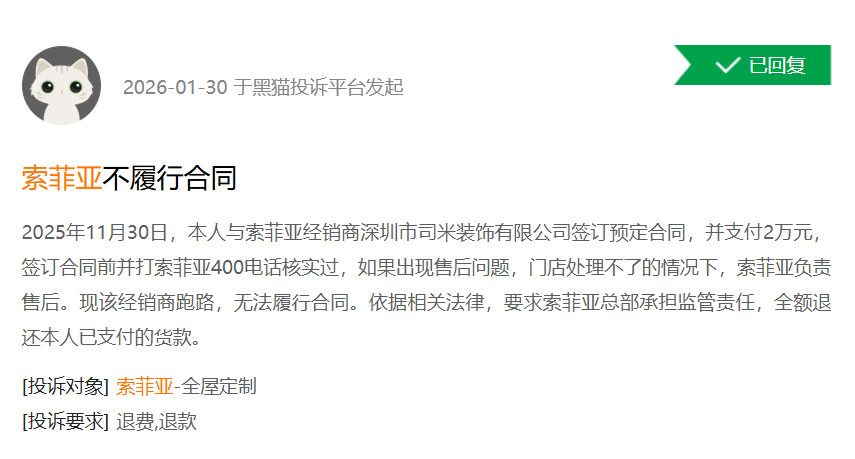
ESG观察|授权经销商“跑路”,索菲亚“塌房”,谁为消费者兜底?
Xin Lang Cai Jing· 2026-02-14 04:00
Core Viewpoint - The incident involving Sophia's brand Simi cabinets highlights significant risks in social responsibility and corporate governance within the rapidly expanding home furnishing industry, as a licensed dealer in Shenzhen suddenly closed, leaving hundreds of homeowners in financial distress with estimated losses reaching millions [1][16]. Group 1: Incident Overview - The crisis began with collective complaints from consumers on social media and complaint platforms, revealing that a Simi cabinets store in Shenzhen abruptly shut down, leaving customers unable to receive their orders or refunds [2][17]. - Many consumers were directed to the store through official channels, including advertisements and customer service recommendations from Sophia, which led them to trust the legitimacy of the dealer [2][17]. - The closure of the store resulted in significant confusion regarding the contractual obligations, as the signing entity and the actual payment recipient were not aligned, complicating the consumers' efforts to seek redress [8][21]. Group 2: Company Response - On February 5, Simi cabinets confirmed the dealer's issues, attributing the consumer losses to the dealer's financial troubles and unauthorized business practices [8][21]. - The company stated that it was also a victim in this situation, which sparked dissatisfaction among consumers who felt that the brand should take responsibility for the actions of its authorized dealer [8][21]. - As of February 7, Sophia announced that it had initiated delivery processes for valid orders in its system, while advising consumers with unrecorded orders to report to the authorities for legal assistance [9][22]. Group 3: ESG Performance and Implications - Sophia's ESG rating from Refinitiv on January 30 was C-, ranking last among four companies in the home goods sector, with low scores in environmental, social, and governance categories [10][22]. - The incident exposed a gap between Sophia's ESG commitments and actual practices, indicating a lack of effective integration of ESG management into business operations, particularly in high-risk franchise management [11][23]. - The company has recognized the urgency of the situation and plans to conduct comprehensive evaluations of its partners, implement electronic contract systems for traceability, and establish dedicated consumer service channels [11][23]. Group 4: Industry Perspective - The challenges faced by Sophia reflect broader governance issues in the home furnishing industry, particularly regarding franchise models during rapid expansion [12][24]. - Industry leaders are encouraged to establish stricter dealer admission standards and utilize digital technologies to enhance transparency in supply chains and sales processes [12][24]. - The competitive edge of home furnishing companies should extend beyond store numbers and revenue to include responsible management across the entire value chain, embedding ESG principles at every operational level to prevent similar crises in the future [12][24].
造纸轻工周报 2026/02/02-2026/02/06:顺周期布局家居、造纸及消费;关注海外包装公司业绩-20260212
Shenwan Hongyuan Securities· 2026-02-12 05:57
Investment Rating - The report indicates a positive investment outlook for the home furnishing and paper industries, with specific recommendations for companies with high dividend safety margins and growth potential [3][5]. Core Insights - The home furnishing sector is at a valuation bottom, with real estate policies expected to catalyze upward valuation movements. Industry consolidation is accelerating, and companies like Gujia Home, Sophia, and Oppein are highlighted for their strong dividend safety margins [3][5]. - In the paper industry, short-term stability in boxboard prices is noted, with an optimistic mid-term supply-demand balance expected to enhance industry profitability. Companies like Nine Dragons Paper are recognized for exceeding performance expectations [3][5]. - Bull Group is positioned for steady recovery in its traditional business due to improving real estate and consumer sentiment, while new business areas such as overseas expansion and smart lighting present growth opportunities [3][5]. - Consumer sentiment is rebounding, with a focus on personal care growth stocks like Baiya, Dengkang Dental, and Zhongshun Jierou [3][5]. Summary by Sections Home Furnishing - The home furnishing sector is experiencing a valuation bottom, with real estate policies likely to improve market sentiment and demand. The increase in second-hand housing transactions is expected to support the demand side, leading to a long-term expansion of the industry [5][6]. - The report emphasizes the acceleration of industry consolidation since 2025, with mid-tier companies exiting the market and capital entering leading firms, enhancing industry concentration [6][16]. - Companies to watch include Gujia Home, Sophia, Oppein, Mousse, and Xilinmen, which are expected to benefit from valuation recovery [5][6]. Paper Industry - The report notes that boxboard prices are stable in the short term, with an anticipated improvement in the supply-demand structure that could enhance profitability in the mid-term. Companies like Sun Paper and Nine Dragons Paper are highlighted for their strong positions [3][5]. - The report suggests monitoring the potential impact of anti-involution policies and demand changes, which could contribute to cyclical elasticity in the paper sector [7][8]. - Specific recommendations include focusing on companies with integrated supply chains and significant cost advantages, such as Sun Paper and Nine Dragons Paper [7][8]. Bull Group - The Bull Group is expected to see steady recovery in its traditional business due to improving real estate and consumer sentiment. The company is also expanding into new areas such as smart lighting and renewable energy, which are anticipated to drive growth [10][11]. - The report highlights the company's competitive advantages in product, channel, and supply chain management, which are expected to support stable growth in 2026 [10][11]. Consumer Goods - The report indicates a rebound in consumer sentiment, with a focus on personal care growth stocks. Companies like Baiya, Dengkang Dental, and Zhongshun Jierou are noted for their potential in the market [13][14].



造纸轻工周报:顺周期布局家居、造纸及消费,关注海外包装公司业绩-20260212
Shenwan Hongyuan Securities· 2026-02-12 04:16
Investment Rating - The report maintains a positive outlook on the home furnishing and paper industries, indicating potential for valuation recovery and growth opportunities [3][5]. Core Insights - The home furnishing sector is at a valuation bottom, with real estate policies expected to catalyze upward valuation movements. Industry consolidation is accelerating, with a focus on companies with high dividend safety margins such as Gujia Home, Sophia, and Oppein [3][5]. - In the paper industry, short-term stability in corrugated box prices is noted, with an optimistic mid-term supply-demand balance expected to enhance industry profitability. Companies like Nine Dragons Paper are highlighted for exceeding performance expectations [3][5]. - Bull Group is positioned for steady recovery in its traditional business due to improving real estate and consumer sentiment, while new ventures in overseas markets, smart lighting, and renewable energy are opening growth avenues [3][5]. - Consumer sentiment is rebounding, with a focus on personal care growth stocks such as Baiya, Dengkang Dental, and Zhongshun Jierou [3][5]. Summary by Sections Home Furnishing - The sector is experiencing a valuation bottom, with real estate policies likely to improve market sentiment and demand. The increase in second-hand housing transactions is expected to support home furnishing demand, leading to a long-term expansion of the industry [5][6]. - The ongoing consolidation in the industry is pushing mid-tier companies out, while capital from industrial players is entering leading home furnishing firms, enhancing market concentration [5][6]. Paper Industry - Short-term price stability in corrugated boxes is observed, with a potential mid-term improvement in supply-demand dynamics expected to boost profitability. The report emphasizes the importance of integrated supply chains and cost advantages in companies like Sun Paper and Nine Dragons Paper [7][9]. - The report suggests that the paper industry is nearing a bottom, with cost structures supporting price stability and potential for upward movement in demand [7][9]. Bull Group - The company is expected to benefit from improving real estate conditions and consumer sentiment, with traditional business lines poised for recovery. New business areas such as smart lighting and renewable energy are anticipated to contribute to growth [11][12]. Consumer Goods - The report highlights a rebound in consumer sentiment, with a focus on personal care companies that are expected to show growth potential. Companies like Baiya and Dengkang Dental are noted for their promising performance in 2026 [14][15]. Packaging Industry - The report discusses the performance of overseas packaging companies, with Ball Corporation and Amcor showing strong results. Ball's revenue for FY25 reached $13.2 billion, a 12% increase year-on-year, while Amcor's revenue for FY26H1 was $11.2 billion, a 70% increase [15][16].
索菲亚,经销商跑了
Xin Lang Cai Jing· 2026-02-10 06:16
Core Viewpoint - The article discusses the issues faced by homeowners in Shenzhen who ordered custom home decoration products from the high-end brand Simi under the leading custom home furnishing company, Sophia, after the dealer suddenly absconded with their payments, affecting over 300 households and involving amounts exceeding ten million yuan [3][36]. Group 1: Incident Overview - Homeowners who ordered custom wardrobes and cabinets made advance payments ranging from tens of thousands to over 300,000 yuan, with some even paying in full [4][38]. - The dealer continued to solicit payments from homeowners just days before absconding, leaving homeowners unaware of the situation until notified by store employees [6][39]. - The dealer's actions have placed pressure on Sophia, as the contracts were signed under the name of Shenzhen Simi Decoration Co., Ltd., while the actual payment was received by another company, Anjia Tianxia [10][42]. Group 2: Company Structure and Dealer Relationship - The dealer, Anjia Tianxia, was established less than three years ago and is controlled by four individual shareholders, while Simi is backed by two natural person shareholders [12][46]. - Sophia's business model heavily relies on franchising, where dealers are responsible for customer acquisition, sales, and payment collection before ordering products from Sophia for installation [47]. - The relationship between the dealer and Sophia is characterized as authorized operation, where the dealer is responsible for selling Simi's products within a limited scope [48]. Group 3: Company Response and Consumer Rights - Sophia has stated that the dealer has not actually absconded but is handling the situation, while acknowledging that the dealer's financial issues have hindered order fulfillment [50]. - The company announced that it would selectively cover orders that can be verified in its system, while orders not recorded would be the responsibility of the dealer, leaving homeowners to pursue legal action [51][52]. - Homeowners are dissatisfied with Sophia's response, arguing that the brand's endorsement of the dealer implies a responsibility to vet and manage dealer risks [54]. Group 4: Industry Context and Challenges - The custom home furnishing industry is facing significant challenges due to a downturn in the real estate market, with Sophia experiencing an 8% decline in revenue and a 26% drop in net profit in the first three quarters of the previous year [24][57]. - Sophia is attempting to transition its business strategy from a single product focus to a comprehensive home solution approach, termed "full-case customization," to enhance consumer experience [30][62]. - The reliance on dealers, particularly those with complex ownership structures and diverse business operations, poses risks for Sophia, as evidenced by the recent incident with the dealer in Shenzhen [65].

渤海证券研究所晨会纪要(2026.02.10)-20260210
BOHAI SECURITIES· 2026-02-10 00:30
Macro and Strategy Research - Long-term care insurance (referred to as "long-term care insurance") is designed to mitigate the financial risks associated with long-term disabilities, providing economic security or service payments to individuals requiring ongoing personal care and medical assistance. There are three models in practice: social insurance, commercial insurance, and care allowances. To address the medical care needs arising from an aging population, China's long-term care insurance system has been piloted in 49 cities, transitioning from a "pilot" phase to a "promotion" phase during the 14th Five-Year Plan period [2][4]. - Japan's long-term care insurance was implemented in 2000, mandating that individuals over 40 must enroll. Funding is shared equally between public funds (taxes) and insurance premiums. Care service costs are generally covered 90% by the insurance, with individuals responsible for 10%, and some high-income groups covering 20-30%. The application process for care services follows a detailed recognition process, ensuring that public resources are prioritized for those in greatest need. As of April 2024, approximately 6.7% of the insured population utilizes care services, indicating that the insurance primarily addresses the low-frequency, high-risk care needs of the elderly [3]. - Currently, China's long-term care insurance system is still in the "pilot" stage, with only 0.8% of beneficiaries among participants as of 2024. Under the directive to "promote long-term care insurance" during the 14th Five-Year Plan, provinces like Hainan, Yunnan, and Hebei have released implementation plans. The insured groups include employees, retirees, flexible workers, and unemployed rural residents, with payment ratios of approximately 70% for employees and around 50% for non-employed rural residents [4]. - In comparison, there are notable differences between China's long-term care insurance and Japan's system in terms of funding sources, insured groups, benefit systems, and protected populations. Japan's long-term care insurance has undergone eight rounds of reforms, emphasizing a "prevention-first" approach, which can help control costs and establish community prevention and intervention systems for mild disabilities, serving as a significant reference for China's long-term care insurance system [5]. Fund Research - The public fund market saw a total scale exceeding 280 billion yuan, with the equity market experiencing a downturn. During the week from February 2 to February 6, 2026, all major equity indices declined, with the largest drop being 5.76% in the STAR 50 index. Among 31 primary industries, 18 saw gains, with the top five performing sectors being food and beverage, beauty care, electrical equipment, comprehensive, and transportation [6][8]. - The average decline for equity funds was 2.27%, with only 18.81% achieving positive returns. Fixed-income plus funds fell by an average of 0.23%, with 40.77% showing positive returns. Pure bond funds increased by 0.08%, with a remarkable 98.70% positive return rate. The average decline for pension target funds was 0.73%, with only 3.52% achieving positive returns. QDII funds also saw an average decline of 2.54%, with 13.95% showing positive returns [8]. - The ETF market experienced a net inflow of 14.899 billion yuan, with only cross-border ETFs achieving net inflows of 21.624 billion yuan. The average daily trading volume in the ETF market reached 619.629 billion yuan, with an average turnover rate of 9.49% [8]. Industry Research - The report highlights the importance of the upcoming Spring Festival consumption, with a focus on the potential recovery of valuations in the home furnishing sector. Nine departments have jointly issued a document to create a festive consumption atmosphere during the Spring Festival [10][13]. - From February 2 to February 6, the light industry manufacturing sector outperformed the CSI 300 index by 2.29 percentage points, while the textile and apparel sector outperformed by 2.66 percentage points [10]. - The Ministry of Commerce and other departments have launched the "2026 'Happy Shopping Spring' Special Activity Plan," which will take place from February 15 to 23, aiming to stimulate consumption through innovative cross-sector collaborations and incentives to enhance consumer participation. This policy is expected to positively impact the consumption of home appliances and home decoration products during the implementation period [13].