SUNWODA(300207)

Search documents
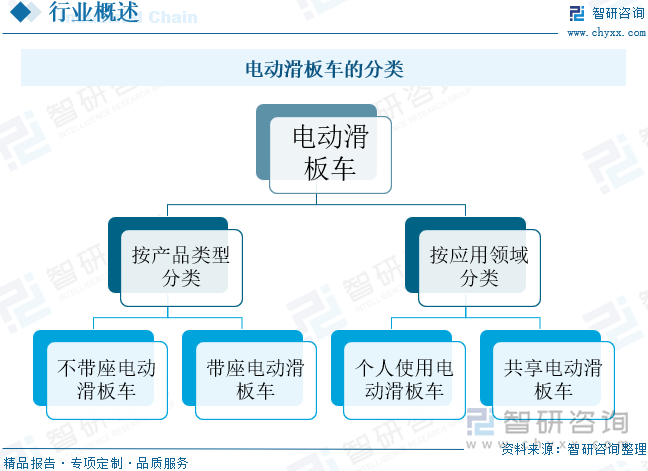
研判2025!中国电动滑板车行业发展历程、产业链、市场规模、重点企业及前景展望:随着人们对绿色出行方式的追求,电动滑板车市场潜力巨大[图]
Chan Ye Xin Xi Wang· 2025-06-02 04:44
Industry Overview - The electric scooter industry has rapidly developed in China, becoming a major manufacturing hub due to its energy-saving, quick charging, and strong endurance features [1][19] - The global electric scooter market is projected to reach approximately $26.73 billion in 2024 and is expected to grow to $55.01 billion by 2033, with a compound annual growth rate (CAGR) of 8.35% [1][21] - The industry benefits from the increasing popularity of shared scooters in the US and Europe, which has enhanced public awareness and led to the establishment of regulatory standards [1][19] Market Dynamics - The primary markets for electric scooters are Europe and North America, where short-distance travel accounts for 60% of travel demand [12] - The industry is characterized by a diverse and competitive landscape, with many brands and companies entering the market, focusing on technological innovation and quality improvement [23] - The introduction of national standards in China, such as GB/T 42825-2023, is expected to enhance industry regulation and consumer confidence [12][19] Key Players - Notable companies in the electric scooter market include Ninebot, Yadea, and Niu Technologies, which leverage strong technological capabilities and brand influence to dominate the market [2][24] - Ninebot's revenue from electric scooters and balance bikes is projected to be approximately 3.38 billion yuan in 2024 [24] - Niu Technologies reported an electric scooter revenue of about 2.96 billion yuan in 2024, reflecting a year-on-year growth of 25.52% [26] Technological Trends - The industry is expected to focus on technological innovations in battery, motor, and smart control systems, with advancements in lithium battery technology driving growth [28] - The integration of AI algorithms and enhanced user interaction technologies will significantly improve user experience and product performance [28] Future Outlook - The electric scooter market is anticipated to expand into diverse application scenarios beyond personal commuting, including logistics, recreational use, and specialized mobility devices for the elderly and disabled [29][30] - The shift towards an ecosystem-based business model, combining products with services, is likely to reshape the competitive landscape and enhance profitability [31]




欣旺达与航发集团达成锂电回收深度合作
起点锂电· 2025-05-31 06:39
Group 1 - The core viewpoint of the article highlights the collaboration between Luzhou Aviation Development Investment Group and Xinwanda Electronics, focusing on the dual carbon strategy and resource recovery strategy [1] - The partnership aims to leverage Luzhou Aviation's core assets in incremental distribution networks and zero-carbon park scenarios, while Xinwanda will utilize its technological and market advantages in the lithium battery industry [1] - The collaboration will focus on the "lithium battery secondary and recycling utilization" sector, aiming to create a closed-loop industrial chain covering battery recycling, secondary utilization, and regeneration [1] Group 2 - Both companies will seek cooperation in areas such as "zero-carbon park construction" and "energy storage system integration production lines," promoting the implementation of the "source-network-load-storage integration" model [1] - The partnership aims to inject green new momentum into the high-quality development of the regional economy through the application of energy storage technology scenarios [1] - Xinwanda Electronics is recognized as a leading global lithium-ion battery enterprise, with a diverse business portfolio that includes consumer products, power technology, energy technology, and smart hardware [1]


泸州航发集团与欣旺达签约
news flash· 2025-05-30 08:23
Core Viewpoint - Luzhou Aviation Development Investment Group Co., Ltd. and Xinwanda (300207) Electronics Co., Ltd. have officially signed a cooperation agreement focusing on the "lithium battery cascade and recycling" sector, aiming to build a closed-loop industrial chain covering battery recycling, cascade utilization, and regeneration [1] Group 1 - The collaboration will emphasize deep cooperation in the "lithium battery cascade and recycling" sector [1] - Both companies will seek cooperation in areas such as "zero-carbon park construction" and "energy storage system integration production lines" [1] - The partnership aims to promote the implementation of the "source-network-load-storage integration" model and the application of energy storage technology scenarios [1]
全球供应链重塑:美国货被拒背后,中国企业如何巧妙布局?
Sou Hu Cai Jing· 2025-05-29 14:06
Group 1 - The article highlights the significant shift in trade dynamics between the US and China, illustrated by American LPG carriers rerouting to Southeast Asia instead of China due to escalating tariff conflicts [1][3] - Despite a temporary agreement reached in mid-May to gradually dismantle tariffs, Chinese companies have already established new partnerships with suppliers from Canada and the Middle East, indicating a long-term shift away from US goods [3][12] - The retention of a 20% "fentanyl tariff" by the Trump administration has exacerbated distrust among American businesses, leading to concerns about the stability of future trade relations [7][11] Group 2 - The article discusses the implications of the trade agreement signed in Geneva in May 2025, which aims to eliminate 95% of tariffs on goods, but also notes the hidden challenges posed by the retained tariffs [8][9] - The article points out that American companies are facing significant losses due to reduced exports to China, with soybean exports dropping by 16.3% [16] - Chinese companies are actively restructuring their global supply chains, reducing reliance on US suppliers, as seen in the shift towards sourcing from countries like Russia, Brazil, and the Middle East [12][17] Group 3 - The article emphasizes the resilience of Chinese companies in the lithium battery sector, with exports to the US reaching a record high of $15.315 billion, despite US sanctions [19] - It highlights the challenges faced by American companies in finding alternatives to Chinese manufacturing, as many industries remain heavily dependent on China's production capabilities [22][24] - The article concludes with the notion that the ongoing trade war may lead to significant economic repercussions for the US, with potential losses in various sectors, including agriculture and semiconductors [24][28]




中证电池主题指数下跌0.91%,前十大权重包含国轩高科等
Jin Rong Jie· 2025-05-28 13:51
Core Viewpoint - The China Securities Battery Theme Index (CS Battery, 931719) has shown a decline of 0.91% to 2370.64 points, with a trading volume of 17.313 billion yuan, reflecting a mixed performance in the battery sector [1] Group 1: Index Performance - The CS Battery Index has increased by 2.55% over the past month, but has decreased by 13.54% over the last three months and is down 5.16% year-to-date [1] - The index was established on December 31, 2014, with a base value of 1000.0 points [1] Group 2: Index Composition - The top ten holdings in the CS Battery Index are: CATL (10.8%), Sungrow Power (8.73%), Sanhua Intelligent Control (6.69%), Yiwei Lithium Energy (6.5%), Greeenme (3.63%), Xinwanda (3.2%), Guoxuan High-Tech (3.13%), Tianci Materials (2.65%), Xianlead Intelligent (2.52%), and Kodali (2.5%) [1] - The index's market distribution shows that 79.55% of holdings are from the Shenzhen Stock Exchange, 19.58% from the Shanghai Stock Exchange, and 0.87% from the Beijing Stock Exchange [1] Group 3: Industry Breakdown - The industry composition of the CS Battery Index indicates that 82.46% is in the industrial sector, 12.68% in consumer discretionary, 3.74% in materials, and 1.12% in utilities [1] Group 4: Index Adjustment and Fund Tracking - The index samples are adjusted biannually, with adjustments occurring on the next trading day after the second Friday of June and December [2] - Public funds tracking the CS Battery Index include various ETFs and mutual funds, such as the China Merchants CS Battery Theme ETF and others [2]




首批建筑机器人固态电池成功量产交付
DT新材料· 2025-05-27 16:07
Core Viewpoint - The article highlights the advancements and applications of solid-state batteries in the construction and robotics industries, emphasizing their potential to address challenges such as labor shortages and safety risks in construction sites [1][2]. Group 1: Company Developments - Huyuan Lithium Innovation has delivered its first batch of solid-state battery packs to Jinhuang Intelligent Technology, which will be used in construction robots [1]. - The solid-state battery solution developed by Huyuan Lithium Innovation offers a higher energy density of 350Wh/kg, reducing the weight of battery packs by approximately 40% compared to traditional lithium batteries [1]. - Other companies, such as GAC Group and Guoxuan High-Tech, are also advancing solid-state battery technology for applications in humanoid robots and other emerging markets [2]. Group 2: Industry Trends - The construction industry is increasingly adopting robotics to mitigate labor shortages and enhance safety, leading to a growing demand for advanced battery solutions [1]. - Solid-state batteries are being recognized for their potential in various applications, including smart robots, with significant improvements in energy efficiency and safety [2]. - The industry is witnessing collaborations and investments aimed at developing solid-state battery technologies, with goals set for commercialization by 2028 [2].


多家企业已通过动力电池新国标
起点锂电· 2025-05-27 10:17
Core Viewpoint - The competition for "safety certification" in the electric vehicle battery industry has intensified, with the new national standard GB38031-2025 mandating "non-flammability and non-explosion" as compulsory requirements [1][2]. Group 1: Industry Developments - The Ministry of Industry and Information Technology released the new safety requirements for electric vehicle batteries, emphasizing extreme scenario testing [1]. - Nine battery manufacturers and twenty automotive companies have announced compliance with the new national standard, establishing safety benchmarks for the industry [2]. Group 2: Company Achievements - CATL became the first company in China to pass the new national standard certification for its Kirin battery, achieving this milestone with multiple product lines [3]. - BYD's blade battery and flash-charging blade battery have both passed the new national standard, showcasing their technological advantages [4]. - Zhongxin Innovation successfully obtained the new national standard certification, being one of the first battery companies to do so [5]. - Ruipu Lanjun's PHEV series battery was among the first to meet the new national standard, emphasizing high safety and long lifespan [6]. - XWANDA's flash-charging battery 3.0 received certification, setting a new safety benchmark for ultra-fast charging batteries [7]. - Zeekr's self-developed battery passed extensive testing, exceeding industry standards in safety [8]. Group 3: Market Trends - Major automotive brands, including Geely and Great Wall, have announced compliance with the new national standard, indicating a widespread industry shift towards enhanced safety [9]. - The majority of top electric vehicle manufacturers have already met the new safety requirements, reflecting a proactive approach to battery safety [9].
欣旺达: 2024年度权益分派实施公告
Zheng Quan Zhi Xing· 2025-05-26 10:17
Core Points - The company has approved the 2024 profit distribution plan, which includes a cash dividend of RMB 274,680,763.20 (including tax) based on a total share capital of 1,845,806,346 shares, excluding 14,601,258 shares that have been repurchased [1][2][4] - The cash dividend per 10 shares (including tax) is calculated to be approximately RMB 1.488134, while the cash dividend per share (including tax) is approximately RMB 0.1488134 [1][4] - The profit distribution plan was approved at the shareholders' meeting held on May 14, 2025, and the record date for the distribution is set for June 3, 2025, with the ex-dividend date on June 4, 2025 [2][3] Profit Distribution Details - The distribution will be made to all shareholders registered with the China Securities Depository and Clearing Corporation Limited Shenzhen Branch as of the record date [3] - The company will not withhold individual income tax for shareholders holding restricted shares, and tax will be calculated based on the holding period when the shares are transferred [2][3] - The cash dividend distribution will be directly credited to the shareholders' accounts through their securities companies or other custodians [3][4] Adjustments and Regulations - According to regulations, shares held in the repurchase account do not participate in the profit distribution, ensuring that the total share capital remains unchanged post-distribution [4][5] - The company will adjust the distribution ratio if there are changes in share capital after the board's approval of the profit distribution plan [2][4]
欣旺达(300207) - 2024年度权益分派实施公告
2025-05-26 10:00
1、欣旺达电子股份有限公司(以下简称"欣旺达"或"公司")2024年度股 东大会审议通过2024年度利润分派方案,由于公司实施了以集中竞价交易方式回 购公司股份方案,根据《中华人民共和国公司法》、《深圳证券交易所上市公司 自律监管指引第9号——回购股份》等规定,"上市公司回购专用证券账户中的 股份不享有股东大会表决权、利润分配、公积金转增股本、配股、质押等权利", 公司以现有总股本 1,845,806,346 股剔除已回购股份 14,601,258 股 后 1,831,205,088股为基数,向全体股东每10股派1.500000元人民币现金(含税), 最终实际派发现金红利为人民币274,680,763.20元(含税)。 2、本次权益分派实施后,按公司总股本(含回购专用证券账户持有股份) 折算的每10股现金分红(含税)=现金分红总额/总股本(含回购股份)*10股 =274,680,763.20元/1,845,806,346股*10股=1.488134元(保留六位小数,最后 一位直接截取,不四舍五入);按公司总股本(含回购股份)折算的每股现金分 红(含税) = 现 金 分 红 总 额 / 总 股 本 ( 含 回 ...
高工云看展①:动力电池技术深度与场景宽度突破边界
高工锂电· 2025-05-24 06:38
Core Viewpoint - The article discusses the upcoming 2025 High-Performance Sodium Battery and Solid-State Battery Technology and Application Summits, highlighting the critical turning point for the global new energy industry in 2025, with significant advancements in battery technology and market demands [2][3]. Group 1: Industry Trends - In 2025, the penetration rate of power batteries is expected to exceed 50%, and the energy storage market's battery shipments are projected to increase by over 60% year-on-year [3]. - Emerging scenarios such as low-altitude economy, humanoid robots, engineering machinery, and medical lithium batteries are driving diverse demands for battery performance, including ultra-fast charging, high discharge rates, long cycle life, and adaptability to extreme environments [3][4]. - The lithium battery industry is facing dual challenges of "technical breakthroughs" and "scenario breakthroughs," with material system iterations and structural design innovations being core directions for companies [3][4]. Group 2: Company Innovations - EVE Energy showcases a comprehensive product matrix covering various scenarios, including light-duty power, passenger vehicles, low-altitude economy, hydrogen energy, and medical applications, emphasizing a "safety first" technology route [5][6]. - Guoxuan High-Tech focuses on "green manufacturing," demonstrating a full-chain product lineup from positive and negative electrode materials to battery systems, with innovations in high-density materials and fast-charging capabilities [10][12]. - Lihua Power emphasizes standardized and high-rate cylindrical battery technology, achieving a 20% reduction in internal resistance through its true tabless structure [16][18]. - Ruipu Lanjun highlights its ultra-high energy density battery for low-altitude flying vehicles, achieving an energy density of 350Wh/kg and supporting a wide temperature range [21][23]. - Xindong Lithium Battery focuses on long-cycle and low-temperature battery technologies, achieving a standard cycle life of over 8,000 times and maintaining energy retention at extreme temperatures [25][27]. - Xinwanda introduces the industry's first supercharging battery for two-wheeled vehicles, capable of charging to 80% in 20 minutes, showcasing advancements in fast-charging technology [29][31]. Group 3: Regulatory Impact - The new national standard for power batteries, set to be implemented in 2026, is expected to accelerate industry reshuffling, enhancing safety standards and promoting upgrades towards high reliability and long life [36].