Sungrow Power Supply(300274)

Search documents
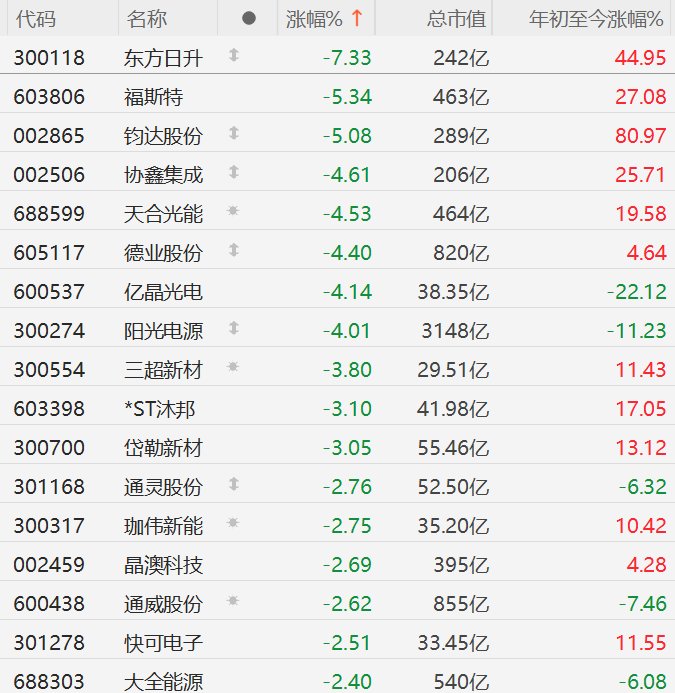
A股光伏股集体下跌,阳光电源跌超4%
Ge Long Hui A P P· 2026-01-28 03:50
| 代码 | 名称 | | 涨幅% ↑ | 总市值 | 年初至今涨幅%。 | | --- | --- | --- | --- | --- | --- | | 300118 | 东方日升 | 1 | -7.33 | 242亿 | 44.95 | | 603806 | 福斯特 | | -5.34 | 463亿 | 27.08 | | 002865 | 钧达股份 | 1 | -5.08 | 289亿 | 80.97 | | 002506 | 协鑫集成 | 1 | -4.61 | 206亿 | 25.71 | | 688599 | 天合光能 | 长 | -4.53 | 464亿 | 19.58 | | 605117 | 德业股份 | 1 | -4.40 | 820亿 | 4.64 | | 600537 | 亿闘米甲 | | -4.14 | 38.35亿 | -22.12 | | 300274 | 阳光电源 | 1 | -4.01 | 3148亿 | -11.23 | | 300554 | 三超新材 | 报 | -3.80 | 29.51亿 | 11.43 | | 603398 | *ST沐邦 | | -3.10 | ...





半日主力资金丨加仓有色金属、基础化工股 抛售电力设备股
Di Yi Cai Jing· 2026-01-28 03:50
主力资金早间净流入有色金属、基础化工、石油石化、建筑装饰等板块,净流出电力设备、国防军工、 医药生物、汽车等板块。 具体到个股来看,中国铝业、网宿科技、省广集团获净流入33.76亿元、29.54亿元、21.27亿元。 净流出方面,阳光电源、贵州茅台、航天电子遭抛售19.11亿元、15.44亿元、15.12亿元。 (本文来自第一财经) ...




阳光电源股价跌5.04%,长信基金旗下1只基金重仓,持有11.4万股浮亏损失90.99万元
Xin Lang Cai Jing· 2026-01-28 03:37
数据显示,长信基金旗下1只基金重仓阳光电源。长信中证科创创业50指数增强A(016729)四季度增 持5.94万股,持有股数11.4万股,占基金净值比例为7%,位居第六大重仓股。根据测算,今日浮亏损失 约90.99万元。 长信中证科创创业50指数增强A(016729)成立日期2022年12月13日,最新规模1.21亿。今年以来收益 3.23%,同类排名3912/5549;近一年收益74.21%,同类排名393/4285;成立以来收益71.72%。 1月28日,阳光电源跌5.04%,截至发稿,报150.21元/股,成交85.74亿元,换手率3.53%,总市值 3114.17亿元。 资料显示,阳光电源股份有限公司位于安徽省合肥市高新区习友路1699号,香港湾仔皇后大道东248号大 新金融中心40楼,成立日期2007年7月11日,上市日期2011年11月2日,公司主营业务涉及太阳能、风 能、储能、电动汽车等新能源电源设备的研发、生产、销售和服务。主营业务收入构成为:储能系统 40.89%,光伏逆变器等电力电子转换设备35.21%,新能源投资开发19.29%,其他2.86%,光伏电站发电 1.75%。 从基金十大重仓 ...
电新行业2025Q4基金持仓分析:静水流深,砥砺前行
Guolian Minsheng Securities· 2026-01-28 03:29
Investment Rating - The report maintains a "Buy" rating for key companies in the electric new energy sector, including CATL, Xiamen Tungsten, and others [2][3]. Core Insights - The electric new energy sector's overall fund holding ratio has decreased, with a notable decline in the holdings of new energy vehicle and power equipment sectors, while the industrial control sector saw a slight increase [6][18]. - The report emphasizes the importance of policy, technology, and demand factors influencing the various sub-sectors within the electric new energy industry, leading to different performance expectations [6][29]. Summary by Sections 1. Overall Fund Holdings in Electric New Energy Sector - As of Q4 2025, the fund holding ratio for the electric new energy sector is 8.73%, down by 0.93 percentage points quarter-on-quarter and 1.83 percentage points year-on-year [9][14]. - The market capitalization of the electric new energy sector accounts for 5.92% of the total market capitalization, with a slight decrease of 0.28 percentage points quarter-on-quarter but an increase of 0.81 percentage points year-on-year [9][14]. 2. Sub-sector Fund Holdings Analysis - The fund holding ratio for the new energy vehicle sector is 7.24%, down by 1.06 percentage points quarter-on-quarter and 1.30 percentage points year-on-year [18][21]. - The new energy power generation sector has a fund holding ratio of 2.19%, with a minor decrease of 0.05 percentage points quarter-on-quarter and a decrease of 0.30 percentage points year-on-year [18][24]. - The power equipment and industrial control sector's fund holding ratio is 1.28%, showing a slight increase of 0.14 percentage points quarter-on-quarter [18][26]. 3. Investment Recommendations 3.1 New Energy Vehicles - The report suggests focusing on companies with clear competitive advantages and improving profitability in the battery segment, such as CATL and A123 Systems [28]. - It also highlights the importance of materials and components in the supply chain, recommending companies like Keda and others [28]. 3.2 New Energy Power Generation - The report indicates a shift from policy-driven to market-driven demand for energy storage, recommending companies involved in energy storage integration and battery production [29]. - It emphasizes the growth potential in wind energy, particularly offshore wind, and suggests monitoring companies like Mingyang Smart Energy and Goldwind [30][32]. 3.3 Power Equipment and Industrial Control - The report identifies AIDC as a growth driver for power equipment demand, recommending companies with strong fundamentals and competitive pricing [34]. - It also notes the increasing importance of high-voltage construction in domestic demand, suggesting companies like XJ Electric and others [34][35].




新能源概念股走低,创业板新能源相关ETF跌超2%
Sou Hu Cai Jing· 2026-01-28 02:41
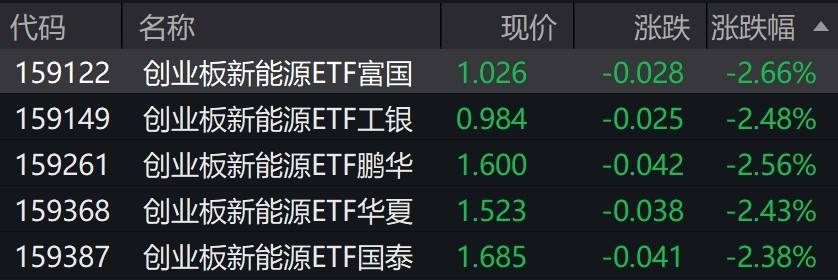
Core Viewpoint - The new energy concept stocks have declined, with significant drops in companies such as Sungrow Power Supply, Maiwei Co., Tianhua New Energy, and Jiejia Weichuang, all falling over 4% [1]. Group 1: Market Performance - The ChiNext new energy-related ETFs have also seen a decline, with an average drop exceeding 2% [1]. - Specific ETF performance includes: - ETF 富国: Current price 1.026, down 0.028 (-2.66%) [2] - ETF 工银: Current price 0.984, down 0.025 (-2.48%) [2] - ETF 鹏华: Current price 1.600, down 0.042 (-2.56%) [2] - ETF 华夏: Current price 1.523, down 0.038 (-2.43%) [2] - ETF 国泰: Current price 1.685, down 0.041 (-2.38%) [2] Group 2: Market Outlook - Analysts indicate that the market is currently in a critical phase of policy transition. The new energy vehicle market is gradually shifting towards a new stage that relies on product strength and normalized consumption patterns [1]. - Two key areas are highlighted for potential growth: 1. High-end manufacturers with differentiated products are expected to be less affected by changes in subsidy rules and reduced vehicle purchase taxes, benefiting from the high-end market trend and upward price movement of domestic brands [1]. 2. Domestic car companies expanding into overseas markets may achieve performance recovery through high growth and high margins in international sales [1].


光伏概念股走弱,相关ETF跌超2%
Sou Hu Cai Jing· 2026-01-28 02:41
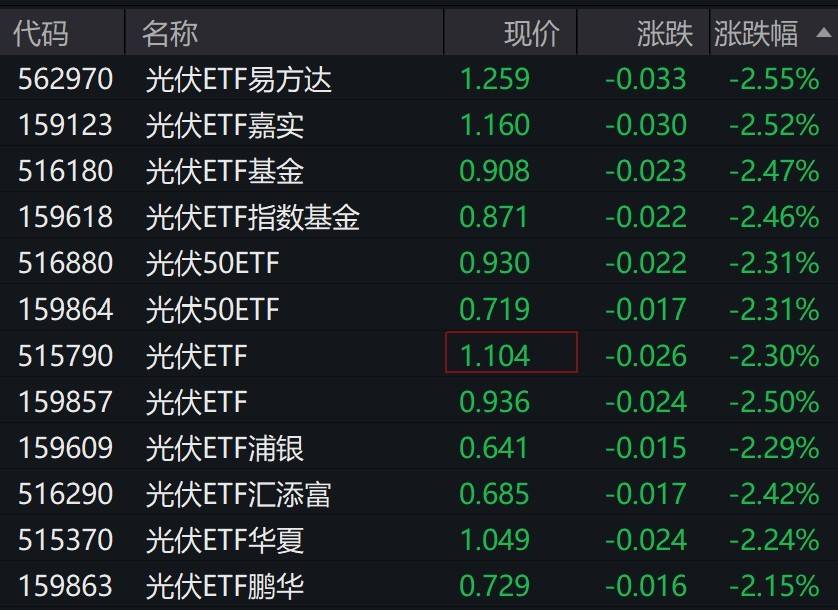
Group 1 - The photovoltaic concept stocks have weakened, with Maiwei Co., Ltd. dropping over 6%, Jiejia Weichuang falling over 5%, and both Sunshine Power and Deye Co., Ltd. declining over 4% [1] - Affected by the market, photovoltaic-related ETFs have decreased by over 2% [1] Group 2 - Various photovoltaic ETFs are showing declines, with the E Fund Photovoltaic ETF at 1.259, down 2.55%, and the Jiashi Photovoltaic ETF at 1.160, down 2.52% [2] - A brokerage firm indicates that China has submitted applications for over 200,000 satellite constellations, marking a new phase of large-scale deployment in commercial space, which will directly drive long-term demand for space photovoltaics [2] Group 3 - The current valuation of the photovoltaic industry remains at a historically low level [3] - Future policies regarding product sales price measures to combat internal competition, mergers and acquisitions among companies, increased industry entry barriers, and improved product quality standards are expected to be implemented [3] - The competitive landscape and industrial chain ecology of the photovoltaic industry are likely to optimize, presenting opportunities for valuation recovery [3]

韩国半导体出口同比大幅增长,DRAM价格持续上涨
Zhong Guo Neng Yuan Wang· 2026-01-28 01:17
Core Viewpoint - The data center sector is driving significant growth in the power equipment industry, with capital expenditures showing high growth trends, particularly in overseas markets, while domestic giants like Alibaba and Tencent are experiencing a slowdown in capital spending [1][3]. Demand Side - Overseas capital expenditures from major companies reached $99.617 billion in Q3 2025, reflecting an 80.39% year-on-year increase and a 9.54% quarter-on-quarter rise [3]. - Domestic capital expenditures for Alibaba amounted to 31.5 billion yuan in Q3 2025, a year-on-year increase of 80.10% but a quarter-on-quarter decrease of 18.55%. Alibaba reaffirmed its three-year investment framework of 380 billion yuan, indicating potential for further investment [3]. - Tencent's capital expenditures were 13 billion yuan in Q3 2025, showing a year-on-year decline of 24.05% and a quarter-on-quarter decline of 32.05%, with a downward revision of its annual guidance [3]. Supply Chain - NVIDIA reported total revenue of $57.006 billion in Q3 2025, with data center product revenue reaching $51.215 billion, marking a historical peak with a quarter-on-quarter growth of 24.62% and a year-on-year growth of 66.44%, accounting for over 89% of total revenue [4]. - TSMC's revenue for December 2025 was 335 billion new Taiwan dollars, a year-on-year increase of 20.4% but a quarter-on-quarter decline of 2.5%, achieving a record high for the same period [4]. - The CPU price index rose to 99.04 in November 2025, up from 98.20 in October, while DRAM spot prices surged from $27.14 on November 17, 2025, to $71.25 by January 23, 2026, reflecting a significant increase of over 178% within two months [4]. - South Korea's semiconductor exports reached $10.73 billion from January 1 to January 20, 2026, representing a substantial year-on-year growth of 70.2% and accounting for 29.5% of total exports, an increase of 9.6 percentage points compared to the previous year [4]. Application Side - The number of models in use is steadily increasing, with token usage from January 13 to January 19, 2026, reaching 7.50 trillion, a slight decrease of 1.96% [5]. - The release of new models such as Grok4Fast, GPT-5nano, and gpt-oss-20B in Q3 2025 led to a decline of over 50% in the price of tokens for models scoring above 40 on the Artificial Analysis intelligence index [5]. Investment Recommendations - The construction of data centers is expected to drive demand for HVDC and SST technologies, with an anticipated global increase of approximately 14 GW in data center installations in 2024. Major cloud providers are expected to maintain high capital expenditures, with TSMC's capital expenditures projected to reach $52-56 billion in 2026, a year-on-year increase of about 30% [6]. - The increasing power density of data center cabinets is likely to enhance the penetration of HVDC and SST technologies, with smart busbars expected to see widespread adoption [6]. - Recommended stocks include Zhongheng Electric (002364), Oulu Tong (300870), Weiteng Electric (688226), and Sunshine Power (300274), with additional attention suggested for Kehua Data (002335), Keda (002518), Kelu Electronics (002121), Magmi Tech (002851), Jinpan Technology (688676), and Sifang Co. (601126) [6].



光储行业跟踪:12月光伏组件出口同比高增,储能价格持续上涨
Shanghai Aijian Securities· 2026-01-27 09:49
Investment Rating - The industry is rated as "Strongly Outperforming the Market" [3][37]. Core Insights - The report highlights a significant increase in the export value of photovoltaic components, reaching approximately $2.314 billion in December 2025, which represents a year-on-year growth of 18.22% [3][31]. - The report indicates that the average price of lithium battery energy storage systems in December 2025 increased by 2.82% compared to the previous month, with a weighted average bid price rising by 6.39% [3][19]. - The domestic photovoltaic installation capacity in November 2025 was 22.02 GW, reflecting a month-on-month growth of 74.76% but a year-on-year decline of 11.92% [3][25]. Summary by Sections Production - The report notes a decrease in the overall production of photovoltaic components in November 2025, with a month-on-month decline of 2.43% and an expected further decrease of 14.77% in December 2025 [3][4]. Prices - As of January 21, 2026, the price of polysilicon remained stable at 54.00 CNY/kg, while the price of TOPCon double-glass components increased by approximately 0.99% to 0.72 CNY/W [3][11]. Domestic Demand - The cumulative newly installed photovoltaic capacity from January to November 2025 reached 274.89 GW, showing a year-on-year increase of 33.25% [3][25]. Overseas Demand - The report states that the export value of inverters in December 2025 was $839 million, marking a year-on-year increase of 26.12% and a month-on-month growth of 9.38% [3][29].


摩根大通:阳光电源10大关键问题,AIDC 储能成增长王牌
鑫椤储能· 2026-01-27 07:39
Core Viewpoints - Morgan Stanley has identified Sungrow as a top pick in the Asia-Pacific utility and renewable energy sector for 2026, maintaining an "Overweight" rating with a target price of 250 RMB, up from a current price of 162.08 RMB. The report highlights two main advantages: the company's proprietary PCS technology and its focus on high-end markets, which provide strong growth resilience. Additionally, China's provincial electricity reform policies and potential AIDC storage orders are expected to catalyze performance growth [2]. Group 1: Key Insights from Field Research - The PCS technology is crucial for breaking into the AIDC storage market, as it meets the stringent response time requirements. Sungrow plans to sign and deliver small-scale AIDC storage orders by 2026, with significant growth expected in 2027. The company has already gained relevant experience through its "photovoltaic + storage base load" demonstration projects [3]. - Global energy storage installations are projected to grow over 40% in 2026, with significant regional disparities. The Chinese market is expected to double its installation capacity compared to 2025, while the Middle East, other Asian regions, and the EU are anticipated to see growth exceeding 50%. The U.S. market, however, is expected to slow due to OBBB policy impacts [6]. - Three key catalysts for Sungrow's performance growth have emerged: accelerated certification processes and order placements for AIDC storage products, the introduction of peak and valley pricing policies in more Chinese provinces, and discussions on energy transition in China's 14th Five-Year Plan, which may further unlock industry potential [7]. Group 2: Investor Questions and Answers - Sungrow's competitive advantage in the AIDC storage market lies in its high reliability and response speed, with a relatively stable competitive landscape due to high technical barriers. As the second-largest player in the global storage market, Sungrow's financing capabilities for inverters and storage systems position it as a preferred supplier for U.S. data centers [8]. - Energy storage can alleviate power supply tensions by balancing load during peak and off-peak periods. The demand for storage systems is expected to rise as power supply issues intensify in the U.S. due to AIDC deployments [9]. - The U.S. Department of Energy's proposed rules regarding large power loads accessing the grid may expedite the integration of storage systems, as mixed facilities that include storage are likely to benefit from faster grid access processes [11]. - To comply with OBBB policy requirements, Sungrow plans to establish a joint venture with non-Chinese partners to procure non-Chinese batteries, thereby reducing the Chinese component ratio in its storage systems [12]. - The reduction of battery export tax rebates in China is expected to have a limited impact on Sungrow's profit margins, as the company has included price adjustment clauses in most contracts to pass on additional costs to customers [13]. - Despite rising input costs, market expectations for Sungrow's gross margin are deemed reasonable, with a projected decline from 38% in 2025 to 33.5% in 2027, reflecting a 5 percentage point drop [14][15]. - Sungrow is expected to receive approval for its Hong Kong IPO in February 2026, with funds allocated for next-generation inverter R&D, overseas projects, digital upgrades, and operational support [16]. - The competitive landscape in China's storage market is intense, leading to a projected decline in Sungrow's market share from approximately 10% in 2024 to around 5% in 2025. However, the demand for high-quality products is expected to rebound in 2026, benefiting Sungrow [17]. - The AIDC storage business is anticipated to yield significant profit growth, with projections indicating low double-digit growth in 2027 if Sungrow captures one-third of the U.S. AIDC storage market [18]. - The AIDC high-voltage direct current (HVDC) power supply equipment market is projected to reach 200 billion RMB by 2030, with Sungrow potentially capturing a 20% market share, leading to a per-share valuation increment of 26.4 RMB by 2026 [20].
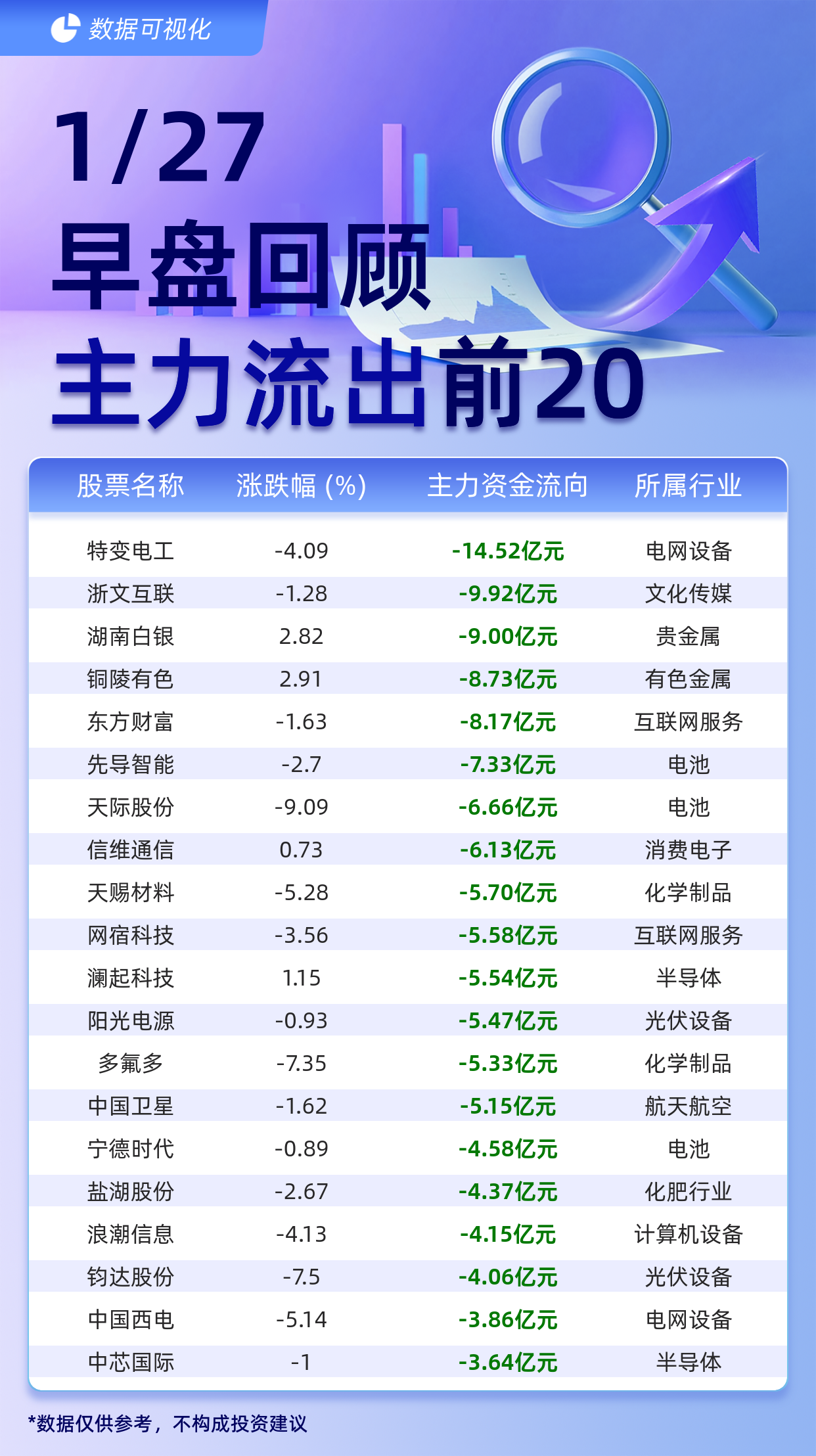
主力个股资金流出前20:特变电工流出14.52亿元、浙文互联流出9.92亿元
Jin Rong Jie· 2026-01-27 04:21
Core Viewpoint - The data indicates significant outflows of capital from various stocks, with notable amounts withdrawn from companies across different sectors, particularly in the electric equipment and battery industries [1][2][3]. Group 1: Major Stocks with Capital Outflows - TBEA Co., Ltd. experienced a capital outflow of 1.452 billion yuan, with a decline in stock price of 4.09% [2]. - Zhejiang Wenlian reported a capital outflow of 992 million yuan, with a stock price decrease of 1.28% [2]. - Hunan Silver saw a capital outflow of 900 million yuan, with a stock price increase of 2.82% [2]. - Tongling Nonferrous Metals had a capital outflow of 873 million yuan, with a stock price increase of 2.91% [2]. - Dongfang Fortune experienced a capital outflow of 817 million yuan, with a stock price decrease of 1.63% [2]. Group 2: Additional Stocks with Notable Outflows - Leading Intelligent reported a capital outflow of 733 million yuan, with a stock price decrease of 2.7% [2]. - Tianji Co., Ltd. faced a capital outflow of 666 million yuan, with a significant stock price drop of 9.09% [2]. - Xinyi Communication had a capital outflow of 613 million yuan, with a stock price increase of 0.73% [2]. - Tianci Materials saw a capital outflow of 570 million yuan, with a stock price decrease of 5.28% [2]. - Wangsu Science & Technology experienced a capital outflow of 558 million yuan, with a stock price decrease of 3.56% [2]. Group 3: Other Companies with Capital Outflows - Longi Green Energy reported a capital outflow of 547 million yuan, with a stock price decrease of 0.93% [3]. - Dufeng Co., Ltd. faced a capital outflow of 533 million yuan, with a stock price decrease of 7.35% [3]. - China Satellite had a capital outflow of 515 million yuan, with a stock price decrease of 1.62% [3]. - Contemporary Amperex Technology experienced a capital outflow of 458 million yuan, with a stock price decrease of 0.89% [3]. - Salt Lake Potash reported a capital outflow of 437 million yuan, with a stock price decrease of 2.67% [3].