
WENS FOODSTUFF GROUP CO.(300498)

Search documents
生猪养殖专题系列131:管控养殖产能为何从集团场切入?
Changjiang Securities· 2025-07-09 09:03
Investment Rating - The investment rating for the industry is "Positive" and maintained [10] Core Insights - The report suggests that controlling production capacity from group farms has a sufficiently large radiation scale and strong targeting, which may achieve significant control effects and impacts. In terms of slaughter scale, the degree of scale in the pig farming industry has reached a high level, with the 18 listed pig companies accounting for 24% of the industry's slaughter volume in 2024. The marginal contribution mainly comes from these 18 listed companies, which contributed 120% and 89% of the slaughter volume increment in 2022 and 2023, respectively. In 2024, they maintained growth even in a shrinking industry context, with the weight of group farms in the front-end breeding stock capacity changes also increasing, indicating strong targeting of production capacity control policies [2][6][16]. Summary by Sections Industry Scale and Concentration - The pig farming industry has shown a long-term trend of scale, with the proportion of entities slaughtering over 500 heads increasing from 12% in 2004 to 70% in 2024. The market share of listed companies reached 24% in 2024, indicating a high level of industry concentration. The industry experienced two rounds of accelerated concentration, with the number of small-scale farms decreasing significantly due to environmental regulations and the impact of African swine fever, which forced many small farmers out of the market [7][17][19]. Contribution of Listed Companies - After the African swine fever outbreak, the increase in industry slaughter volume has mainly been driven by the 18 listed companies. In years of declining industry slaughter volume, these companies have shown resilience, contributing positively to overall growth. For instance, in 2022, the listed companies' slaughter volume increased by 34.37 million heads, accounting for 120% of the total industry increment. In 2023, they contributed 23.87 million heads, representing 89% of the total increment. Even in 2024, when the industry faced negative growth, these companies still increased their overall slaughter volume by 9.32 million heads [8][46][47]. Trends in Production Capacity - The report highlights a trend towards specialization within the industry, with group farms gaining importance in front-end production capacity changes. The leading company, Muyuan Foods, maintained stable growth in breeding stock during the industry's contraction phase. From Q1 2024 to Q1 2025, the industry is expected to see a recovery of 470,000 breeding sows, while Muyuan's breeding stock is projected to grow by 340,000 during the same period [51][55]. Capital Expenditure and Market Dynamics - The capital expenditure of listed companies surged during the high-profit period following the African swine fever outbreak, with significant investments made to expand production capacity. However, since 2021, there has been a rationalization in the pace of capacity expansion, with capital expenditures decreasing and the industry experiencing reduced volatility in production capacity [31][40][42]. Conclusion - The report concludes that the pig farming industry is at a critical juncture, with significant contributions from large-scale listed companies and a shift towards more specialized production practices. The targeting of production capacity control policies from group farms is expected to yield positive results in managing industry dynamics [2][6][16].





研判2025!中国畜牧机器人行业发展背景、市场现状及布局企业分析:“农业强国”战略背景下,行业发展前景广阔[图]
Chan Ye Xin Xi Wang· 2025-07-09 01:20
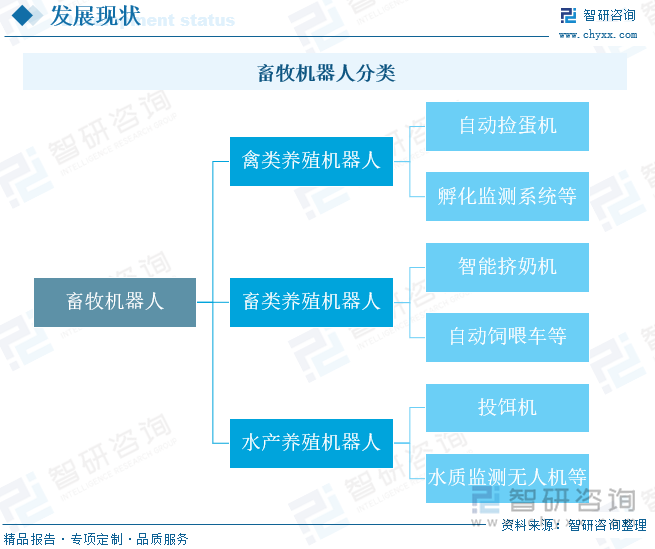
Core Viewpoint - The livestock robotics industry is experiencing significant growth driven by technological advancements and policy support, with the market expected to reach 1.87 billion yuan in 2024, a 20% increase year-on-year, and projected to exceed 2.2 billion yuan by 2025 [1][16]. Industry Overview - Livestock robots integrate sensor technology, artificial intelligence, automation control systems, and the Internet of Things to enhance efficiency, reduce labor costs, and achieve sustainable production in livestock farming [2][4]. - The main functions of livestock robots include environmental monitoring, feeding management, milking operations, disease warning, cleaning and disinfection, and data collection [2][4]. Market Structure - Feeding robots account for approximately 35% of the market, followed by milking robots at 25%, inspection robots at 20%, and cleaning robots at 15%, with other types making up less than 5% [18][19]. Development Stages - The development of livestock robots in China can be categorized into three stages: 1. **Emergence Phase (2000-2015)**: Introduction of European milking robots, with high costs and limited applicability [4]. 2. **Growth Phase (2016-2020)**: Acceleration of domestic alternatives due to policy support and capital influx, with costs decreasing by about 50% [4]. 3. **Explosive Phase (2021 onwards)**: Deep integration of AI and 5G technologies, leading to increased penetration of smart livestock equipment across various scales of farming [4]. Factors Driving Development - The large scale of livestock farming in China provides a vast market for livestock robots, with significant increases in livestock numbers and production volumes [8][11]. - Labor shortages in rural areas due to aging populations and declining workforce numbers are driving the demand for automation and mechanization in livestock farming [11]. - Continuous policy support aimed at modernizing the livestock sector is fostering the growth of the livestock robotics industry [13][15]. Industry Players - Key companies in the livestock robotics sector include Muyuan Foods, New Hope, Wens Foodstuff, and Lihua Technology, among others [2][24]. - Emerging companies such as Beijing Guoke Chengtai Agricultural Equipment and Hefei Lasset Robot Technology are also contributing to the innovation in this field [2][24]. Future Trends - The development of livestock robots is expected to lead to higher levels of automation and intelligence in livestock farming, enhancing economic benefits and sustainability [25]. - Future innovations will focus on improving efficiency, environmental sustainability, and animal welfare, further advancing agricultural technology in China [25].




多家上市猪企6月生猪价格有所下降
Guang Zhou Ri Bao· 2025-07-08 16:17
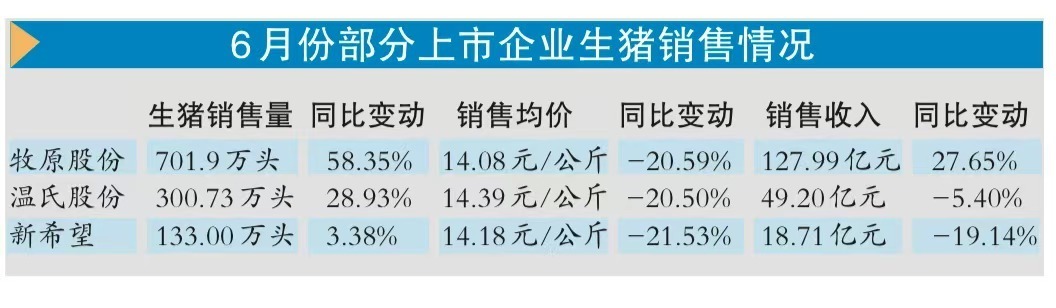
Core Viewpoint - The overall trend of pig prices has declined in June 2025, impacting the sales performance of major listed pig companies in China [1][2][3] Group 1: Sales Performance of Major Companies - Muyuan Foods reported a June average selling price of 14.08 CNY/kg, a year-on-year decrease of 20.59% and a month-on-month decrease from 14.52 CNY/kg [1][2] - Wens Foodstuff Group's June average selling price was 14.39 CNY/kg, reflecting a month-on-month decrease of 1.98% and a year-on-year decrease of 20.50% [1][2] - New Hope reported a June average selling price of 14.18 CNY/kg, with a month-on-month decrease of 2.81% and a year-on-year decrease of 21.53% [1][2] Group 2: Sales Volume and Revenue - Muyuan Foods sold 7.019 million pigs in June, a year-on-year increase of 58.35%, generating a revenue of 12.799 billion CNY, up 27.65% [2] - Wens Foodstuff Group sold 3.0073 million pigs, a year-on-year increase of 28.93%, with a revenue of 4.920 billion CNY, down 5.40% [2] - New Hope sold 1.33 million pigs, a year-on-year increase of 3.38%, with a revenue of 1.871 billion CNY, down 19.14% [2] Group 3: Market Outlook - The decline in pig prices is expected to impact company performance, but the second half of 2025 is anticipated to perform better than expected [3] - According to a report by招商证券, the overall pig price is expected to stabilize with support at the bottom, and the second half of the year may see better-than-expected prices due to limited supply growth [3] - 卓创资讯 forecasts that the average monthly price from July to December 2025 will range between 13.76 CNY/kg and 15.07 CNY/kg, with demand expected to decrease initially before increasing [3]
农林牧渔行业周报:猪价继续反弹,关注生猪板块投资机会-20250708
Yong Xing Zheng Quan· 2025-07-08 11:02
Investment Rating - The industry investment rating is maintained as "Increase" for the agricultural sector [6] Core Viewpoints - The agricultural sector outperformed the market by 1.01 percentage points during the week of June 30 to July 4, 2025, with a weekly increase of 2.55% [15][17] - The pig farming sector is highlighted as a key investment opportunity due to the recovery of breeding profits and the ongoing rise in pig prices [4][2] - The report emphasizes the importance of cost control for listed pig farming companies to navigate the pig cycle effectively [4] Summary by Sections Market Review - The agricultural sector index closed at 2,729.26, ranking 7th among 31 first-level industries in terms of weekly performance [15][17] - The fishery sector showed the best performance with a 5.13% increase, followed by breeding, agricultural product processing, feed, and planting sectors with respective increases of 3.12%, 2.96%, 2.30%, and 1.63% [17][19] Industry Dynamics - Pig prices continued to rise, with the national average price reaching 15.35 yuan/kg, a week-on-week increase of 4.28% [2] - Self-breeding profits increased to 119.72 yuan/head, while external piglet breeding profits improved to -26.26 yuan/head [2] - In the poultry sector, chicken prices remained under pressure due to high inventory levels, with broiler chick prices dropping to 1.36 yuan/chick, a 20% decrease week-on-week [2] Agricultural Products - Prices for wheat, corn, and soybean meal showed a week-on-week increase, with wheat averaging 2,451.06 yuan/ton (up 0.19%), corn at 2,367.14 yuan/ton (up 0.61%), and soybean meal at 2,928.00 yuan/ton (up 0.76%) [3][34] Investment Recommendations - The report suggests focusing on the pig farming sector, particularly companies with strong cost control such as Muyuan Foods, Wens Foodstuff Group, and others [4] - In the poultry sector, it recommends looking at integrated industry leaders like Shennong Development and Lihua Stock for yellow feathered chickens [4] - For feed, it highlights industry leaders like Haida Group and regional leaders like Hefeng Stock as beneficiaries of the recovery in livestock demand [4] - The report also emphasizes the importance of food security, recommending companies like Suqian Agricultural Development and Beidahuang [4]


汇丰:中国生猪行业_权重下降;能繁母猪库存稳定
汇丰· 2025-07-07 15:44
Investment Rating - The report maintains a "Buy" rating for Haid Group with a target price of RMB67.00, indicating a potential upside of 14.4% from the current price of RMB58.59 [5][9][32]. Core Insights - The hog weight reduction has had a limited impact on prices in 2025, with an increase in average hog weight observed in May 2025. This trend is driven by higher profits from larger hogs compared to smaller ones [3][10]. - Stable sow inventories are reported, with a slight month-on-month increase of 0.1% to 40.42 million heads as of the end of May 2025. This stability suggests an abundant hog supply, contributing to a downward trend in hog prices [4][13]. - The Hog Breeding Index has risen approximately 5% since the end of May 2025, indicating profitability in hog breeding during the first half of 2025, which is expected to maintain or increase sow inventories [4][13]. Summary by Sections Hog Weight and Prices - The average hog weight in China increased in May 2025, driven by profit motivations. Farmers are unlikely to comply with directives to reduce hog weight if larger hogs yield higher profits [3][10]. - A reduction in hog weight has led to increased supply in early June 2025, which may have pressured hog prices. However, early sales by large-scale farmers could help ease oversupply in July, potentially leading to price improvements [12][13]. Sow Inventories and Production Indicators - Sow inventories remained stable in the first half of 2025, with significant improvements in production indicators, including an 11% year-on-year increase in market pigs per sow and a 6% increase in piglets per sow [4][24]. - The report suggests that the hog price is on a downward trend for 2025-26, as stable sow inventories act as a leading indicator for supply [4][13]. Company Preferences - Haid Group is preferred due to expected improvements in feed sales volume in both domestic and international markets, with a likely increase in gross profit per ton in 2025 [5][9]. - Muyuan Foods and Wens Foodstuff Group are rated as "Hold," with target prices of RMB39.40 and RMB16.60, respectively, indicating potential downsides of 6.2% and 2.8% from current levels [6][32].

晚间公告丨7月7日这些公告有看头





第一财经· 2025-07-07 15:32
Core Viewpoint - Several listed companies in the Shanghai and Shenzhen markets have announced significant developments, including management changes, stock trading fluctuations, and major contracts, which may present investment opportunities and risks for investors [2]. Group 1: Management Changes and Legal Issues - Scanda's chairman and general manager, Li Yuejie, along with director Zhu Chuncheng, have been subjected to criminal coercive measures due to alleged violations related to information disclosure [3]. - Longhong High-Tech is planning to acquire 100% equity of Guangxi Changke, leading to a stock suspension for up to 10 trading days [6]. Group 2: Stock Trading and Performance - New Asia Electronics reported abnormal stock trading with a cumulative price deviation exceeding 20% over three days, while confirming that its operations are normal and consistent with previously disclosed share reduction plans [5]. - ST Tiexin announced the removal of risk warnings and a name change, which will increase the trading limit from 5% to 10% [8]. Group 3: Financial Performance Forecasts - Industrial Fulian expects a net profit increase of 36.84% to 39.12% year-on-year for the first half of 2025, driven by a surge in AI-related business [18]. - Huayou Cobalt anticipates a net profit increase of 55.62% to 67.59% for the same period, benefiting from integrated operations and rising cobalt prices [19]. - Guoli Co. forecasts a staggering net profit increase of 130.91% to 158.08% for the first half of 2025, attributed to new product and market expansions [20]. - Bangji Technology expects a net profit increase of 166.77% to 200.91%, driven by increased sales from direct sales channels [21]. - Lier Chemical predicts a net profit increase of 185.24% to 196% due to rising product sales and cost reduction efforts [25]. Group 4: Major Contracts and Projects - Huadian Science and Technology signed significant contracts worth approximately RMB 25.16 billion for coal handling and transportation systems [41]. - Aerospace Engineering is the first candidate for a project with a bid of RMB 23.92 billion for a coal gasification facility [43].

上市猪企6月销售简报集中出炉:肉价又跌了!
Zheng Quan Shi Bao· 2025-07-07 14:54
Core Insights - Multiple listed pig companies released their sales reports for June, indicating a general decline in sales prices and varying performance in sales volume and revenue among different companies [1][3][4] Group 1: Sales Performance - Muyuan Foods reported sales of 7.019 million pigs in June 2025, a year-on-year increase of 58.35%, with a sales revenue of 12.799 billion yuan, up 27.65% year-on-year [3] - Wens Foodstuff Group sold 3.0073 million pigs in June 2025, with a revenue of 4.92 billion yuan, showing a decline in sales volume and average price compared to May [3][4] - Shennong Group's sales volume decreased to 219,000 pigs in June 2025, with a revenue of 385 million yuan, reflecting a drop in both sales volume and price [4] Group 2: Price Trends - The average selling price of Muyuan Foods' pigs was 14.08 yuan/kg in June 2025, down 20.59% year-on-year [3] - Wens Foodstuff Group's average price for pigs was 14.39 yuan/kg, showing a year-on-year decline of 5.40% [3] - Shennong Group's average price for pigs was 14.35 yuan/kg, a decrease of 0.55% from May [4] Group 3: Cost Control and Efficiency - Many pig companies have managed to control breeding costs effectively, enhancing operational efficiency despite the overall low price trend [5][6][7] - New Hope reported a recent cost of 13 yuan/kg for fattened pigs, while Tianbang Bio aims to reduce costs to below 12.8 yuan/kg by the end of 2025 [7][8] - Muyuan Foods highlighted its cost advantage in piglet sales, contributing positively to its profitability [8]
上市猪企6月销售简报集中出炉:肉价又跌了!
证券时报· 2025-07-07 14:48
Core Viewpoint - The sales reports for June from multiple listed pig companies indicate a general decline in both sales prices and volumes, with notable variations among different companies [3][5][6]. Group 1: Sales Performance - Leading pig company Muyuan Foods reported sales of 7.019 million pigs in June 2025, a year-on-year increase of 58.35%, with a sales revenue of 12.799 billion yuan, up 27.65% year-on-year [5]. - Another major player, Wens Foodstuff Group, sold 3.0073 million pigs in June 2025, with a revenue of 4.92 billion yuan, showing a year-on-year price decline of 20.50% [6][7]. - Shennong Group reported a sales volume of 219,000 pigs in June 2025, with a revenue of 385 million yuan, reflecting a decrease in both sales volume and price compared to May [8]. - Dabeinong's sales figures for June 2025 showed a total of 666,100 pigs sold, generating a revenue of 1.078 billion yuan, with a decline in sales price [9]. Group 2: Cost Control and Efficiency - Despite the overall low prices in the pig market, many companies have managed to maintain effective cost control through refined management practices [11][12]. - New Hope reported that its recent operating cost for fattened pigs is around 13 yuan per kilogram [13]. - Tianbang Biological aims to reduce its breeding costs to below 12.8 yuan per kilogram by the end of 2025, with a target of 6.5 to 7 million pigs for the year [14]. - Haida Group has made significant progress in reducing overall breeding costs due to its established breeding model and advantages in feed research and development [15]. - Muyuan Foods claims to have a cost advantage in piglet sales, contributing positively to its profitability [16].
6月生猪价格下滑企业业绩承压 业内料下半年将好于预期
Zheng Quan Shi Bao Wang· 2025-07-07 14:38
Group 1 - The core viewpoint indicates that meat product prices are under pressure, leading to declining sales for breeding companies in June [1][2] - Wens Foodstuff reported sales of 104 million meat chickens in June, generating revenue of 2.288 billion yuan, with a chicken sales average price of 10.29 yuan/kg, showing month-on-month declines of 3.40%, 8.30%, and 4.28% respectively [1] - In June, Wens Foodstuff sold 3.0073 million pigs, with a revenue of 4.92 billion yuan and an average price of 14.39 yuan/kg, reflecting month-on-month changes of -4.69%, -7.57%, and -1.98% [1] Group 2 - New Hope reported sales of 1.33 million pigs in June, with a revenue of 1.871 billion yuan and an average price of 14.18 yuan/kg, showing month-on-month declines of 0.29%, 5.12%, and 2.81% respectively [1] - Juxing Agriculture announced sales of 419,900 pigs in June, with a revenue of 742 million yuan, and a 3.4% decrease in average price, while sales volume increased by 28% [2] - Xiangjia reported sales of 4.298 million live poultry in June, generating revenue of 68.1782 million yuan, with a significant decline in sales price due to market sluggishness [2] Group 3 - The industry is experiencing a seasonal consumption lull, with pig prices maintaining a fluctuating trend, and expectations for better performance in the second half of the year [2][3] - The report suggests that the supply of pigs will see limited growth by 2025, and high-quality pig enterprises may still achieve considerable profits [3] - The industry is currently operating at a marginal profit, with large pig enterprises focusing on increasing capacity utilization to reduce breeding costs [3]


农林牧渔行业周报:猪价高位回落,推荐“平台+生态”模式代表德康农牧-20250707
Hua Yuan Zheng Quan· 2025-07-07 12:14
Investment Rating - The industry investment rating is "Positive" (maintained) [4] Core Viewpoints - The pig price has retreated from its high, with the latest price at 14.94 CNY/kg and the average weight at 128.64 kg. The complete cost for leading enterprises has decreased to around 12 CNY/kg, indicating a potential for profit maintenance and valuation recovery [6][17][18] - The report emphasizes a shift from cyclical thinking to focusing on financial performance, suggesting that investment should transition from "cyclical thinking" to "quality and price" [18] - The report recommends focusing on companies with a "platform + ecosystem" model, highlighting DeKang Agriculture and Livestock as a representative, along with leading pig farming companies such as Muyuan Foods and Wens Foodstuff Group [18] Summary by Sections 1. Pig Industry - The latest pig price is 14.94 CNY/kg, with a slight increase in average weight to 128.64 kg. The price of 15 kg piglets remains stable at around 530 CNY/head. The industry is experiencing a short-term rebound in prices after a slight decline [6][17] - The official number of breeding sows in May was 40.42 million, a year-on-year increase of 1.15%, indicating a stable production capacity [7][17] - The report suggests that the government's commitment to stabilizing pig prices is strong, and capacity regulation may continue to increase [7][17] 2. Poultry Industry - The price of parent stock chicks remains high, with the latest price at 47.93 CNY, a week-on-week increase of 5.25%. The price of broilers is 2.95 CNY/kg, down 12% week-on-week and 18% year-on-year [19] - The industry faces a "high capacity, weak consumption" contradiction, leading to a reduction in production capacity among breeding farms [19] - The report highlights two main lines of focus: quality imported breeding stock leaders and fully integrated industry leaders [19] 3. Feed Industry - The report recommends Hai Da Group, noting a cash flow turning point and high overseas growth potential. The demand for aquaculture feed is expected to recover in 2025 [20][22] - The report indicates that the domestic capital expansion phase has ended, and leading companies are entering a new phase of stable cash flow [21][22] 4. Pet Industry - The report discusses the impact of potential tariffs on the pet industry, suggesting that the actual impact will be limited due to high profit margins and overseas factory layouts [23] - Companies with strong performance in their own brands, such as Guibao and Zhongchong, are highlighted as key focuses [23] 5. Agricultural Products - The USDA report indicates a slight reduction in soybean planting area for 2025, with a forecast of 83.4 million acres, a year-on-year decrease of 4% [24] - The report emphasizes that agricultural products are less affected by tariffs, and a reduction in imports may help prices rise from low levels [24] 6. Market and Price Situation - The Shanghai and Shenzhen 300 Index closed at 3982 points, up 1.54% from the previous week. The Agricultural and Forestry Index closed at 2729 points, up 2.55% [25][28] - The report notes that the aquaculture sector performed the best with a 5.13% increase [25]


