AMD(AMD)

Search documents
The stock market is barrelling toward a ‘show me the money’ moment for AI—and a possible global crash
Yahoo Finance· 2025-11-19 10:00
The back-of-the-envelope math is harsh: AI capex coming from tech companies listed in the S&P 500 is $400 billion or more per year, going forward. The biggest AI company—OpenAI, the maker of ChatGPT—has disclosed revenues of just $13 billion for 2025. Altman recently said revenues were “well more” than that , hinting they may hit $100 billion in 2027. But that’s still nowhere near the level of capex it’s committing to.On one level, that’s normal: Most industries feature a collection of companies that do bus ...






Billionaire David Tepper Just Loaded Up on These 3 Artificial Intelligence (AI) Stocks
The Motley Fool· 2025-11-19 09:44
Core Viewpoint - David Tepper's Appaloosa fund significantly increased its exposure to artificial intelligence (AI) stocks during Q3 2025, particularly through substantial investments in Advanced Micro Devices (AMD), Baidu, and Qualcomm [2][16]. Group 1: Advanced Micro Devices (AMD) - Appaloosa's largest new position in Q3 was a stake in AMD, with the fund purchasing 950,000 shares valued at $153.7 million [3]. - AMD aims to close the gap with its main competitor, Nvidia, and Tepper's investment in AMD was notably larger than the 8.6% increase in Appaloosa's position in Nvidia [4]. - Since the end of Q3, AMD's share price has surged nearly 70%, attributed to the company's recent business advancements, including a strategic partnership with OpenAI and a goal for a revenue compound annual growth rate exceeding 35% [6][7]. Group 2: Baidu - Tepper increased Appaloosa's stake in Baidu by 67.2% in Q3, indicating a bullish outlook on the Chinese tech stock [8]. - Baidu, often referred to as the "Google of China," operates a leading search engine and provides cloud services and autonomous ride-hailing [9]. - Baidu's stock has risen over 30% since the end of Q3, and it remains attractively valued with a forward price-to-earnings ratio below 16 [11]. Group 3: Qualcomm - Appaloosa significantly increased its position in Qualcomm by 255.7% during Q3 [12]. - Qualcomm generates over 60% of its revenue from phone chips, with Apple as its largest customer, but is also experiencing growth in automotive and IoT sectors [12]. - Qualcomm's stock has seen only a low single-digit percentage increase since the end of Q3, but the company's entry into data center and robotics markets, along with new AI accelerators, could yield long-term benefits [14][15].


美股三大指数齐跌 多只科技股下挫
Sou Hu Cai Jing· 2025-11-19 07:51
Market Performance - The major U.S. stock indices collectively declined, with the Dow Jones down 1.07%, S&P 500 down 0.83%, and Nasdaq down 1.21% on November 18 [1] - The Dow Jones has fallen 4.48% over four consecutive trading days since reaching a new high, while the Nasdaq and S&P 500 have dropped 4.16% and 3.41% respectively during the same period [1] Technology Sector Concerns - There are growing concerns regarding AI technology stocks, despite leading companies maintaining profit growth; investors are questioning the sustainability of large capital expenditures and their future profit growth potential [1] - Major tech stocks such as Amazon and AMD fell over 4%, while Microsoft and Nvidia dropped over 2%, indicating a broader market retreat in the tech sector [1] Economic Data and Federal Reserve Outlook - The absence of key economic data has made it difficult for the Federal Reserve and the market to accurately assess economic conditions and inflation trends, leading to a significant increase in hawkish sentiments within the Fed [2] - The probability of a 25 basis point rate cut by the Federal Reserve in December has dropped from approximately 66% to below 50% [2] Gold Price Support Factors - Multiple factors, including potential Fed rate cuts, a weaker dollar, central bank demand, and risk aversion, are expected to continue supporting gold prices [2]


?AI算力需求持续井喷 花旗高呼AMD(AMD.US)为“山丘之王” 力压英伟达与博通
Zhi Tong Cai Jing· 2025-11-19 03:10
(原标题:?AI算力需求持续井喷 花旗高呼AMD(AMD.US)为"山丘之王" 力压英伟达与博通) 智通财经APP获悉,尽管近期全球股市的芯片/半导体板块经历了一波回调,但华尔街金融巨头花旗集 团的半导体分析师团队表示,在与半导体业内资深工程师以及市场上的主流机构投资者们交流后,分析 师与投资者们对多家与AI算力基础设施密切相关的芯片公司依然持强力看涨态度,其中英伟达在PC与 数据中心芯片领域的最强劲竞争对手AMD(AMD.US)获评"最受青睐"的个股,被花旗视为"山丘之 王"(king of the hill),力压另外两大AI芯片巨头——英伟达(NVDA.US)与博通(AVGO.US)。 据了解,在AMD上周举行的分析师日活动上,AMD首席执行官苏姿丰给出了非常乐观的人工智能(AI) 算力芯片市场预期,并预计未来五年AMD业绩将呈现更加强劲的增长轨迹。苏姿丰公布了AMD未来三 到五年的财务基本面目标,她表示,AMD的目标是在数据中心人工智能芯片市场中占据"两位数"份 额,预计AMD数据中心芯片年营收将在五年内达到1000亿美元(相比之下当前约160亿美元),预计到 2030年利润增长两倍以上。 苏姿丰还预 ...
AI算力需求持续井喷 花旗高呼AMD(AMD.US)为“山丘之王” 力压英伟达与博通
智通财经网· 2025-11-19 03:01
Core Viewpoint - Despite recent pullbacks in the global semiconductor sector, Citigroup's semiconductor analysts maintain a bullish outlook on several AI-related chip companies, particularly highlighting AMD as the "king of the hill" in competition with Nvidia and Broadcom [1][6]. Group 1: AMD's Market Position and Growth Projections - AMD is recognized as a key competitor to Nvidia in the AI computing infrastructure space, with expectations of significant market share growth in the AI data center chip market, aiming for a "double-digit" share and projected annual revenue of $100 billion within five years, up from approximately $16 billion currently [1][2]. - AMD's CEO, Lisa Su, forecasts that the total addressable market (TAM) for AI data centers will exceed $1 trillion by 2030, representing a compound annual growth rate (CAGR) of over 40% from around $200 billion this year [2]. - AMD's third-quarter revenue surged by 36% year-over-year to $9.25 billion, surpassing Wall Street's average expectation of $8.7 billion, primarily driven by its data center business [3]. Group 2: Strategic Partnerships and Competitive Landscape - AMD has secured a significant 6GW AI GPU power procurement agreement with OpenAI, enhancing market optimism regarding its fundamentals and future valuation [3]. - The company is also gaining market share from Intel in the PC and data center server GPU and CPU segments, driven by strong demand for innovative AI-enabled products [4]. - Recent price increases in high-performance DRAM and NAND products, along with robust earnings from major players like TSMC and Samsung, bolster the long-term bullish narrative for AI computing infrastructure [4]. Group 3: Investor Sentiment and Future Earnings - Analysts from Citigroup express strong buy sentiment for AMD, projecting a future earnings per share (EPS) of $20 within three to five years, reinforcing the company's revenue and profit margin targets [5]. - Nvidia, while historically a leader in AI computing, is experiencing reduced investor enthusiasm due to expectations of slower EPS growth compared to AMD and Broadcom [6]. - Intel's improving server CPU business and positive sentiment around its foundry operations suggest a potential resurgence, although concerns remain about its path to profitability in the foundry segment [7]. Group 4: Analog Devices and Market Trends - In the analog chip sector, investor sentiment remains pessimistic, but Analog Devices (ADI) is viewed as a notable exception, with expectations of a strong recovery despite the overall sluggishness in the segment [8]. - Texas Instruments is perceived as a primary short target within the analog chip space, as market consensus anticipates continued downward revisions of its EPS [8].
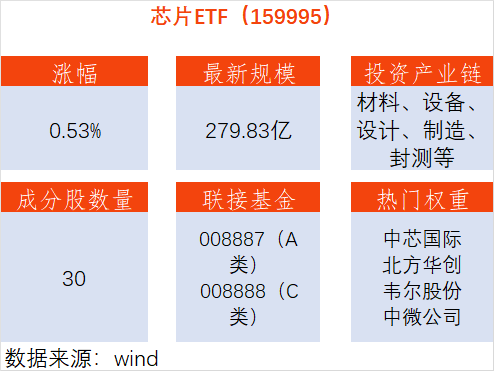
A股芯片板块早盘走强,芯片ETF(159995.SZ)上涨0.53%,瑞芯微等成分股领涨
Mei Ri Jing Ji Xin Wen· 2025-11-19 02:44
Group 1 - A-shares experienced a collective rise on November 19, with the Shanghai Composite Index increasing by 0.19%, led by gains in the communication, non-ferrous metals, and electronics sectors, while the comprehensive and real estate sectors saw declines [1] - The chip technology sector showed strong fluctuations, with the chip ETF (159995.SZ) rising by 0.53% as of 9:44 AM, and notable increases in component stocks such as Rockchip (5.12%), Amlogic (3.89%), Haiguang Information (1.37%), Zhaoyi Innovation (1.25%), and Cambricon (1.08%) [1] Group 2 - Nvidia's Blackwell is expected to achieve a total lifecycle shipment of 20 million units, contributing $500 billion in revenue over the next five quarters with the upcoming Rubin launch in 2026 [3] - AMD reported a record high revenue for Q3 2025, with an estimated 4% quarter-over-quarter growth for Q4 2025, and anticipates a CAGR of over 60% for its data center business [3] - Intel has indicated strong quarter-over-quarter growth in DC AI revenue for Q4 [3] - Domestic AI chip companies in China are maintaining a high growth trend in Q3 2025, although the SoC sector is experiencing a slowdown in growth due to subsidy reductions and rising storage chip prices [3] - The chip ETF (159995) tracks the National Chip Index, comprising 30 leading companies in the A-share chip industry, including SMIC, Cambricon, Changdian Technology, and Northern Huachuang [3]




全球最大的硅光企业诞生
半导体行业观察· 2025-11-19 01:35
Core Insights - GlobalFoundries has acquired Singapore-based silicon photonics manufacturer AMF, becoming a leading player in the silicon photonics sector [2] - Silicon photonics technology uses light instead of electrical pulses for data transmission, which is crucial for communication within chips, between components, and across servers [2] - NVIDIA plans to implement silicon photonics technology in its next-generation AI servers to reduce power consumption while increasing data transfer speeds, which is essential for managing millions of GPUs in data centers [2][3] - AMD is also investing heavily in this technology, having established a dedicated R&D center in Taiwan with an investment of nearly $300 million and previously acquiring Enosemi to enhance its competitive edge against NVIDIA [2][3] Industry Trends - The demand for silicon photonics technology is driven by the rapid expansion of AI data centers, which are experiencing significant increases in power consumption and placing pressure on electrical grids [3] - Tim Breen, CEO of GlobalFoundries, emphasized the importance of high-speed, precise, and energy-efficient data transmission for AI data centers and advanced telecommunications networks [3] - Silicon photonics is also a key technology for quantum computing, allowing for systems that do not require low-temperature cooling, making quantum computers more practical and cost-effective [3] Competitive Landscape - Major companies like AMD, NVIDIA, and GlobalFoundries are investing in silicon photonics, but several startups such as Ayar Labs, Celestial AI, and Lightmatter are also developing their own photonic technologies, indicating a competitive landscape [3] - While consumer-grade CPUs, GPUs, and motherboards are not expected to adopt this technology in the short term, it is already being utilized in large servers capable of processing terabytes of data per second [4] - Continued investment in AI data centers is anticipated to drive further research and development in this promising technology [4]

沙特500亿美元芯片计划获关键进展 美国将批准向AI公司Humain销售先进芯片
Zhi Tong Cai Jing· 2025-11-19 01:25
Core Viewpoint - The United States plans to approve the first sale of advanced AI chips to the Saudi Arabian company Humain, marking a significant development amid discussions between Saudi Crown Prince Mohammed bin Salman and U.S. President Donald Trump [1]. Group 1: AI Chip Sales and Agreements - The approval is expected to be part of a broader AI agreement between the U.S. and Saudi Arabia, potentially finalized within the week, allowing for a positive stance on a certain number of chip export applications to Saudi Arabia [1]. - The approved chip quantity is anticipated to reach tens of thousands of semiconductors, although specific details were not disclosed [1][2]. - The agreement follows months of negotiations aimed at alleviating U.S. concerns that semiconductor shipments to Saudi Arabia could ultimately benefit China [2]. Group 2: Humain's Role and Investments - Humain, established by Saudi Arabia's $1 trillion Public Investment Fund, has become central to the country's efforts in leveraging the AI investment boom [3]. - The company has plans to deploy up to 400,000 AI chips by 2030 and has already introduced an Arabic chatbot and other AI tools [3]. - Saudi Arabia's Crown Prince emphasized the importance of AI for economic growth, stating a short-term investment of approximately $50 billion in the semiconductor sector [3]. Group 3: Market Implications - The approval signifies a victory for major semiconductor companies like Nvidia and AMD, which have been seeking to supply the Middle Eastern market [1]. - The U.S. maintains export restrictions on AI chips to China, which adds complexity to the negotiations and agreements with Saudi Arabia [2]. - Humain's competitive advantage includes low energy costs for data centers, which is a significant factor in its appeal to Silicon Valley [3].
音频 | 格隆汇11.19盘前要点—港A美股你需要关注的大事都在这
Ge Long Hui A P P· 2025-11-19 00:37
Group 1 - The Ministry of Industry and Information Technology aims to establish around 200 high-standard digital parks by 2027, with effective deployment and application of computing infrastructure [1] - The Ministry of Finance has not released any policy documents regarding the implementation of "offshore wallets" and "Hong Kong HSBC" for the distribution of policy benefits in the Guangdong-Hong Kong-Macao Greater Bay Area [1] - The unemployment rate for Chinese youth aged 16-24, excluding students, fell to 17.3% in October [2] - Chongqing plans to achieve an artificial intelligence terminal industry scale of over 300 billion yuan by 2030 [2] - Pinduoduo's latest financial report shows a continuous investment of "100 billion support" for two consecutive quarters, with Q3 net profit declining quarter-on-quarter [2] - Baidu reported Q3 total revenue of 31.2 billion yuan, disclosing AI business revenue for the first time, with a growth rate of 50%, exceeding expectations [2] - Xiaomi Group's Q3 adjusted net profit reached 11.3 billion yuan, a year-on-year increase of 80.9%, surpassing expectations [2] - Xiaomi's Q3 smart electric vehicle and AI innovation business segment achieved operational profitability for the first time in a single quarter [2] - Suining's 38 companies plan to restructure, with a draft stating that Zhang Jindong and his wife must commit to injecting all personal assets into a trust [2] - Saiwei Electronics plans to purchase a portion of equity in Chipone, which focuses on the whole machine field of lithography [2] - Southbound funds significantly net bought Alibaba for 3.3 billion Hong Kong dollars, marking the fourth consecutive day of net buying [2] - Xiamen Tungsten New Energy plans to invest 600 million yuan to establish a wholly-owned subsidiary for a project with an annual production capacity of 50,000 tons of high-performance battery materials [2]

早报 | 49.1万张飞日本机票被取消;谷歌发布Gemini 3;于东来卸任胖东来总经理;普京:中国公民赴俄免签将生效
虎嗅APP· 2025-11-19 00:08
大家早上好!这里是今天的早报,每天早上,我都会在这里跟你聊聊昨夜今晨发生了哪些大事儿。 昨夜今晨 【美股连跌四天,英伟达跌近3%】 当地时间11月18日,美股三大指数集体收跌,道琼斯指数下跌498.500点,跌幅1.07%;标普500指数跌0.83%; 纳斯达克综合指数跌1.21%。 大型科技股多数下挫,亚马逊、AMD跌超4%,微软、英伟达跌超2%,特斯拉跌超1%。 【普京:中国公民赴俄免签政策将于近期生效】 据环球网援引今日俄罗斯(RT)、俄罗斯卫星网报道,当地时间11月18日,俄罗斯总统普京表示,针对中国 公民赴俄免签政策将于近期生效。 报道称,目前,俄罗斯公民可以免签前往中国。 中国外交部发言人郭嘉昆9月2日在例行记者会上表示,为进一步便利中外人员往来,中方决定扩大免签国家范 围,自2025年9月15日至2026年9月14日,对俄罗斯持普通护照人员试行免签政策。俄罗斯持普通护照人员来华 经商、旅游观光、探亲访友、交流访问、过境不超过30天,可免办签证入境。 这项交易体现出云计算和芯片供应商与领先AI开发商之间日益紧密的联系——后者再将资金花回在前者的服 务上。投资者对这类所谓的循环式AI交易愈发担忧,一 ...