BIDU(BIDU)

Search documents
Baidu Q3 Earnings & Revenues Beat Estimates Despite Y/Y Decline
ZACKS· 2025-11-19 16:50
Core Insights - Baidu, Inc. reported Q3 2025 non-GAAP earnings of $1.56 per ADS, exceeding estimates by 30%, but down 34.2% year over year [1] - Revenues for the quarter were $4.38 billion, a decline of 8.4% year over year, yet beating estimates by 1.7% [2] - The company introduced a new AI-native framework to highlight key valuation drivers and its evolving AI strategy [7] Financial Performance - Non-GAAP operating income was RMB 2.21 billion ($310 million), down 68.6% year over year, with an operating margin of 7.1%, a contraction of 1380 basis points [4] - Adjusted EBITDA was RMB 4.43 billion ($622 million), down 49.3% year over year, with a margin contraction of 1180 basis points to 14.2% [5] - Total cash and investments increased to RMB 296.4 billion ($41.64 billion) as of September 30, 2025, compared to RMB 124.2 billion ($17.34 billion) at the end of June 2025 [6] Segment Performance - Revenues from Baidu Core segment declined 7% year over year to RMB 24.66 billion ($3.46 billion) [2] - Online marketing revenues fell 18% to RMB 15.3 billion ($2.16 billion), while non-online marketing revenues rose 21% to RMB 9.3 billion ($1.31 billion) [3] - iQIYI segment revenues decreased 8% year over year to RMB 6.68 billion ($939 million) [3] AI and Innovation - AI Cloud Infra generated RMB 4.2 billion, up 33% year over year, driven by strong demand for AI infrastructure [8] - AI Applications produced RMB 2.6 billion, a 6% increase, benefiting from subscription models [8] - AI-native Marketing Services surged to RMB 2.8 billion, up 262%, as customers adopted AI-driven solutions [8] Autonomous Driving - Apollo Go delivered 3.1 million fully driverless rides in Q3 2025, with year-over-year growth accelerating to 212% [12] - The service operated in 22 cities and achieved 100% fully driverless operations across all mainland China service areas [12]


Baidu: No Pain, No Gain
Seeking Alpha· 2025-11-19 16:40
Core Insights - The investment community, "The Quantamental Investor" (TQI), aims to assist investors in navigating the current asset bubble through bold and active investing strategies while implementing proactive risk management [3]. Group 1: Investment Strategy - TQI focuses on building a robust investing operation tailored to individual investment goals and risk tolerance levels, emphasizing the uniqueness of each investor's journey [2]. - The community offers features such as highly-concentrated, risk-optimized model portfolios that cater to different stages of the investor lifecycle [3]. Group 2: Resources and Tools - TQI provides access to proprietary software tools and group chats, enhancing the investing experience and facilitating better decision-making [3]. - The community publishes premium equity research reports on Seeking Alpha, along with best-in-class investing insights through various platforms including a free newsletter, Twitter, and LinkedIn [3].

As Macao's Gambling Industry Rebounds, SJM Bucks The Trend
Benzinga· 2025-11-19 16:40
Core Insights - SJM Holdings Ltd. is undergoing a significant restructuring, shedding most of its satellite casinos to focus on core assets, which has negatively impacted its quarterly earnings [1][2][6] - Despite a resurgence in Macao's overall gaming industry, SJM's performance has lagged behind its competitors, with a notable decline in gaming revenue and net profit [3][4][5] Financial Performance - In October, Macao's gaming revenue reached a record of 24.09 billion patacas ($3.01 billion), a nearly 16% increase year-on-year, contrasting with SJM's gaming revenue decline of 4.7% to HK$7.14 billion ($919 million) [3][4] - SJM's adjusted EBITDA fell 15% year-on-year to HK$881 million, although it increased by 28% compared to the previous quarter [4] - The company's net profit plummeted 91% to HK$9 million from HK$101 million a year earlier, with a loss of HK$173 million for the first nine months [5] Restructuring Impact - The restructuring is driven by new gaming regulations in Macao, requiring operators to manage satellite casinos directly or terminate profit-sharing agreements [6][7] - SJM's revenue from satellite casinos dropped 14.6% in the third quarter, while its market share for gaming revenue fell to 11.8% from 13.9% a year earlier [8] Key Properties Performance - The flagship Grand Lisboa property experienced a decline in gaming revenue to HK$1.91 billion from HK$1.94 billion year-on-year, with adjusted property EBITDA down 13.6% to HK$471 million [10] - The newer Grand Lisboa Palace saw an 11% increase in gaming revenue, but its adjusted property EBITDA fell 32.7% to HK$111 million, with hotel occupancy dropping to 94.9% from 98.9% [11] Financial Leverage and Market Position - SJM's financial position is concerning, holding only HK$3.4 billion in cash against HK$27.3 billion in debt, making it the most leveraged among Macao's casino operators [12] - Following the earnings report, SJM shares fell 8.05% to HK$2.74, with a year-to-date gain of just 1.86%, significantly trailing the sector average of 31.3% [13] Strategic Outlook - The company plans to revitalize its core properties by reallocating gaming resources from satellite casinos to its flagship Hotel Lisboa [14] - Competitors are diversifying their offerings, which may put SJM at a disadvantage as it loses its satellite casino network [15]

DoorDash, Baidu upgraded: Wall Street's top analyst calls
Yahoo Finance· 2025-11-19 14:44
Core Viewpoint - The article compiles significant research calls from Wall Street, highlighting upgrades for various companies that investors should be aware of [1] Group 1: Company Upgrades - Jefferies upgraded DoorDash (DASH) to Buy from Hold with a price target of $260, increased from $220, citing faster growth in U.S. restaurant delivery as a reason for a more bullish outlook [2] - Nomura upgraded Baidu (BIDU) to Buy from Neutral with a price target of $140, up from $135, due to the substantial growth potential of its 69% owned chip-design subsidiary, Kunlunxin, and management's consideration of enhancing capital returns [2] - UBS upgraded Insulet (PODD) to Buy from Neutral with a price target of $400, raised from $355, anticipating sustained growth momentum through the end of the decade [2] - Jefferies upgraded Zions Bancorp (ZION) to Buy from Hold with a price target of $60, up from $55, arguing that the stock's pullback related to alleged fraud charges is overdone [2] - Goldman Sachs upgraded Medtronic (MDT) to Neutral from Sell with a price target of $111, increased from $81, noting improved new product momentum and positive overall P&L metrics post Q2 results [2]


AI收入高增50%,再造一个新百度
2 1 Shi Ji Jing Ji Bao Dao· 2025-11-19 13:33
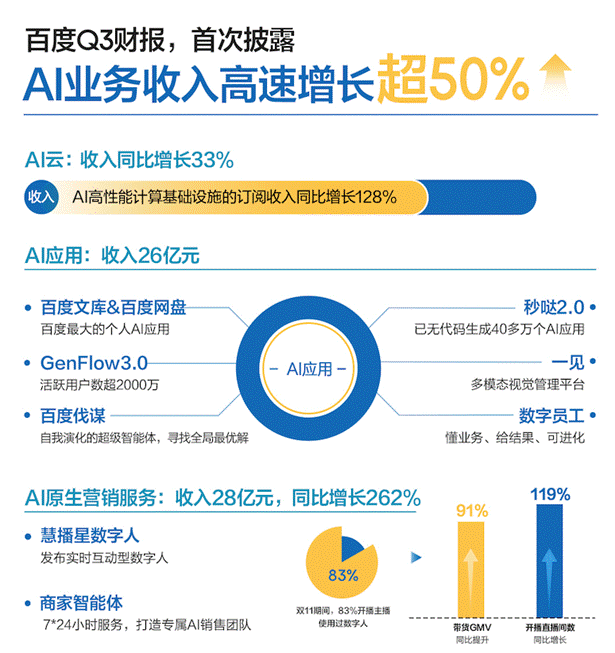
Core Insights - The company has disclosed its AI business revenue for the first time, showing an overall year-on-year growth of over 50% and total AI investments exceeding 100 billion yuan since March 2023 [1][3] - The Q3 financial report indicates that Baidu's AI transformation has entered a substantial harvest phase, supported by its strategic focus on full-stack technology [3][18] - Baidu's AI business is segmented into three main areas: AI Cloud, AI Applications, and AI Native Marketing Services, providing a clearer view of its revenue structure [4][18] AI Cloud Performance - AI Cloud revenue in Q3 grew by 33% year-on-year, with the AI high-performance computing infrastructure subscription revenue surging by 128% [4][18] - Baidu has maintained its position as the leader in China's AI public cloud market for six consecutive years, with significant adoption among state-owned enterprises and financial institutions [7] AI Applications and Marketing Services - AI Applications revenue reached 2.6 billion yuan in Q3, primarily driven by a subscription model that ensures stable revenue [8][18] - AI Native Marketing Services saw a remarkable 262% year-on-year increase in revenue, with digital humans and intelligent agents being key growth drivers [9][18] Search and Autonomous Driving Innovations - The AI transformation of Baidu's search business has led to nearly 70% of mobile search results being AI-generated, resulting in a 6% increase in search request volume [11][18] - The autonomous driving service "LuoBo Kuaipao" achieved 3.1 million service instances in Q3, marking a 212% year-on-year growth [12][18] Technological Advancements - Baidu's AI business growth is supported by a comprehensive stack of technologies, including chips, large models, and cloud services [15][18] - The latest Kunlun chips and the Wenxin large model series are positioned to meet the demands of large-scale AI applications [16][18] Market Position and Future Outlook - Baidu is well-positioned to capitalize on the rapid growth of the AI market, with significant opportunities in large models, autonomous driving, and AI cloud services [21] - The company's strategic focus on technology-driven growth is expected to continue driving its success in the AI sector [21]
【明日主题前瞻】内需消费的重要增长点,冰雪产业市场规模快速增长
Xin Lang Cai Jing· 2025-11-19 12:01
Group 1: Ice and Snow Industry Growth - The ice and snow industry in China is expected to reach a market size of 980 billion yuan in 2024, with a year-on-year growth of 10.8%, and is projected to exceed 1 trillion yuan in 2025 [2] - The industry is transitioning from niche sports consumption to mainstream consumption, with travel combined with skiing becoming a new leisure and vacation trend [2] - Companies like Xue Ren Group are leading in manufacturing ice and snow equipment, while Changbai Mountain is upgrading its tourism offerings to include more diverse recreational experiences [2] Group 2: Baidu's AI Business Performance - Baidu reported a total revenue of 31.2 billion yuan for Q3 2025, with core revenue at 24.7 billion yuan, and for the first time disclosed AI business revenue, which grew over 50% year-on-year [3] - AI cloud revenue increased by 33%, while AI application revenue reached 2.6 billion yuan, and AI native marketing service revenue surged by 262% to 2.8 billion yuan [3] - The domestic AI industry is expected to enter a sustainable growth cycle, driven by the demand for self-sufficient technology and advancements in AI chips [3] Group 3: Semiconductor and Memory Market Trends - Xiaomi indicated that the current rise in memory prices is a long-term trend driven by increased demand for HBM due to AI, rather than traditional market fluctuations [4] - The storage industry has entered an accelerated upward cycle, with expectations of significant profit growth for domestic storage module companies by the second half of 2025 [4] - Companies like Shikong Technology are focusing on semiconductor memory products, including memory bars and solid-state drives, with advanced testing capabilities [5] Group 4: Commercial Space and Rocket Technology - Tianbing Technology successfully completed key tests for its "one rocket, 36 satellites" capability, marking a significant milestone in China's commercial space sector [6] - The year 2025 is seen as a pivotal year for validating reusable rocket technology, with several private companies planning their first flights [6] - Companies like Shanghai Port Bay are supporting satellite launches and contributing to satellite internet constellation development [7] Group 5: Lithium Carbonate Supply and Demand - Strong demand has led to a monthly shortage of lithium carbonate, with supply at approximately 115,000 tons and demand at 128,000 tons, resulting in a shortfall of about 13,000 tons [8] - The market outlook for energy storage is optimistic, with significant agreements indicating a sustained growth cycle for China's energy storage industry over the next 3-5 years [8] - Companies like Jiangte Electric have developed an integrated industry chain for lithium salt production, with significant production capacity planned for the coming years [9] Group 6: Liquid Cooling Industry Potential - The liquid cooling industry is expected to experience explosive growth driven by AI demand and supportive policies, with new data centers required to meet specific energy efficiency standards [10] - The penetration rate of liquid cooling technology in global data centers is projected to rise from 10% in 2024 to over 30% by 2025 [10] - Companies like Invid and Keda are positioned to benefit from the growing demand for liquid cooling solutions in data centers [11] Group 7: Solid-State Battery Development - CATL is committed to investing in all-solid-state batteries, with expectations for small-scale production by 2027 [12] - The solid-state battery industry is experiencing rapid advancements, supported by national policies and emerging application demands [12] - Companies like Xian Dao Intelligent are leading in providing comprehensive solutions for solid-state battery production, with increasing orders and customer engagement [12]

豪赌千亿,百度“换血”
2 1 Shi Ji Jing Ji Bao Dao· 2025-11-19 11:46
Core Insights - Baidu's Q3 2024 earnings report highlights a significant shift towards AI, with total revenue of 31.2 billion yuan and core revenue of 24.7 billion yuan, alongside a 50% growth in AI-related income [2][3] - The company has invested over 100 billion yuan in AI over the past 10 quarters, indicating a strong commitment to AI development [2] - Baidu's traditional search advertising business is facing challenges, while the company is making aggressive investments in AI [2] AI Transformation - Baidu's search engine is undergoing a radical transformation, with 70% of mobile search results generated by AI as of October [3] - This shift represents a fundamental restructuring of Baidu's business model, moving beyond traditional search to an AI-driven approach [3] AI Monetization - The "AI native marketing services" segment generated 2.8 billion yuan in Q3, reflecting a 262% year-over-year increase, indicating successful monetization of AI capabilities [4] - Baidu's strategy focuses on B2B sales and performance-based outcomes, contrasting with competitors like Google and OpenAI [4] Cloud Services Growth - Baidu's intelligent cloud revenue reached 4.2 billion yuan, a 33% increase, with AI high-performance computing subscription revenue growing by 128% [5] - The company is leveraging its self-developed Kunlun chip to address the demand for AI computing power in the cloud market [5] Autonomous Driving Expansion - Baidu's autonomous driving service, Apollo Go, saw a 212% increase in order volume in Q3, with over 17 million cumulative service orders [6] - The service is expanding internationally, with operations in Switzerland and Abu Dhabi, and is approaching profitability in select cities [6] Market Challenges - Despite impressive growth in AI, Baidu faces challenges in capital market patience and valuation adjustments, as AI revenue growth is not yet sufficient to offset declines in core advertising [7] - The competitive landscape is intensifying, with rapid technological advancements from competitors like Google, highlighting the ongoing challenges in the AI sector [7]
通信行业周报:光模块上游芯片紧缺,朱雀三号首飞在即-20251119
Guoyuan Securities· 2025-11-19 11:05
Investment Rating - The report maintains a "Recommended" rating for the telecommunications industry, citing sustained high prosperity driven by AI, 5.5G, and satellite communications [2][6]. Core Insights - The overall market performance for the week (November 10-16, 2025) saw the Shanghai Composite Index decline by 0.18%, the Shenzhen Component Index by 1.40%, and the ChiNext Index by 3.01%. The telecommunications sector, represented by the Shenwan Communications Index, experienced a decline of 4.77% [2][12]. - Within the telecommunications sub-sectors, communication engineering and services had the highest increase at 1.57%, while communication network equipment and devices faced the largest decline at 6.98% [2][15]. - Notable individual stock performances included "Online and Offline" with a rise of 46.55%, followed by Zhongfutong at 30.69% and Meilixin at 11.87% [2][17]. Summary by Sections Market Overview - The telecommunications sector is experiencing a high demand for core chips, which is becoming a bottleneck for the performance expansion of domestic and international module manufacturers. The supply-demand balance for optical chips is expected to remain tight until the first half of 2026, maintaining high product prices [3]. - Huawei is set to release a groundbreaking AI technology on November 21, which could significantly improve the utilization efficiency of computing resources from the current 30%-40% to 70%, enhancing the penetration of domestic computing chips in the market [3]. Satellite Industry - The upcoming launch of the "Zhuque-3" reusable rocket is anticipated to be a milestone for China's space capabilities, aiming to reduce launch costs to below 20,000 RMB per kilogram, comparable to SpaceX's Falcon 9 [4]. Key Announcements - Meta Platforms plans to invest over $600 billion in AI infrastructure in the U.S. over the next three years, aiming to enhance its computing capabilities and support local economies [19]. - China successfully launched 13 low-orbit satellites for internet connectivity, marking a significant achievement in its commercial space endeavors [22]. - The Ministry of Industry and Information Technology (MIIT) is accelerating the construction of manufacturing pilot platforms, focusing on AI and quantum technology [25]. Company Highlights - CoreWeave reported a significant increase in customer order backlog, reaching $55.6 billion, nearly double from the previous quarter, despite a slight downward adjustment in revenue guidance due to delays in third-party data center construction [27]. - Baidu announced the launch of its next-generation Kunlun chips, aimed at optimizing large-scale inference and multi-modal model training [28]. - LightCounting reported that optical module suppliers are actively expanding capacity in response to increased demand from cloud computing companies [30].



无人驾驶创造新质就业 武大等高校构建无人驾驶与人工智能专业人才培养体系
Shang Hai Zheng Quan Bao· 2025-11-19 10:37
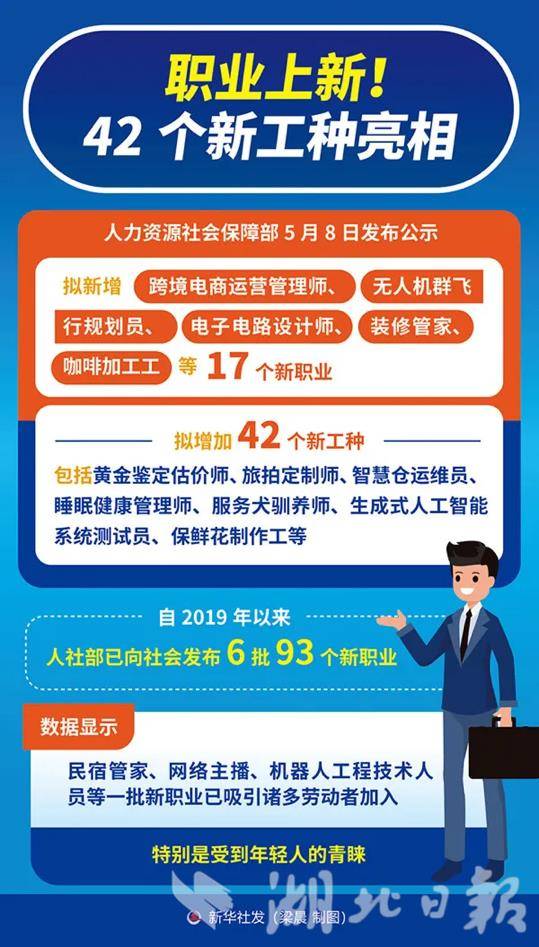
Core Insights - The integration of autonomous driving vehicles into educational institutions aims to cultivate talent in the fields of autonomous driving and artificial intelligence, addressing the industry's demand for skilled professionals [1] - The article by Mo Rong emphasizes that artificial intelligence's impact on employment is limited in terms of job replacement but significantly alters job structures, creating new employment opportunities in emerging industries [1] - Autonomous driving technology is not merely replacing traditional driving jobs but is redefining work paradigms, leading to the emergence of new roles such as intelligent networked vehicle safety officers and data engineers [1] Industry Developments - Autonomous driving is deeply integrated with core technologies such as artificial intelligence, 5G, and big data, serving as a driving force for the transformation and upgrading of traditional industries [3] - The demand for new professions related to artificial intelligence is increasing, with 17 new job categories directly linked to AI, including intelligent networked vehicle testers and maintenance personnel [3] - Job demand in the autonomous driving sector is rising, with positions like intelligent driving R&D engineers and safety officers becoming highly sought after, and traditional drivers are being prioritized for recruitment to facilitate skill transitions [3]
融了11轮,合肥明星公司要IPO了
投中网· 2025-11-19 10:09
Core Viewpoint - Deepway is positioned to become a leading player in the new energy heavy truck market, similar to "NIO" in the electric vehicle sector, with significant backing from Baidu and local government support [5][8][19]. Company Overview - Deepway, founded in 2020, focuses on new energy heavy trucks and intelligent road freight solutions, with its headquarters in Hefei, a city known for its investment in technology [6][12]. - The company has established a strong partnership with Baidu, which holds a 17.28% stake and provides critical autonomous driving technology through a unique "white box" model [10][11]. Market Position and Growth - By 2025, Deepway is projected to rank first in the global new energy heavy truck market, having delivered approximately 6,400 units and serving 311 customers [7][14]. - The company reported revenues of 4.26 billion yuan in 2023, with a year-on-year growth of 97.6% [17]. Financial Performance - Despite rapid revenue growth, Deepway has incurred cumulative losses of 1.702 billion yuan over three and a half years, with significant investments in R&D [16][17]. - The company’s total assets and liabilities have increased significantly, indicating a high debt ratio [17]. Strategic Initiatives - Deepway is accelerating the construction of a smart factory to reduce manufacturing costs and is expanding its international market presence, targeting regions like the Middle East and Southeast Asia [18][19]. - The company aims for overseas sales to account for over 50% of its total by 2028, with a goal of exceeding 60% by 2030 [18]. Investment and Financing - Deepway has completed multiple rounds of financing, raising a total of 1.96 billion yuan, with investments from various notable institutions and local government funds [22]. - The company is positioned to leverage the growing demand for new energy heavy trucks in China, which saw a 198% year-on-year increase in sales from January to September 2023 [22]. Future Outlook - If Deepway successfully goes public, it could become the first smart driving heavy truck stock in Hong Kong, enhancing its brand and capital appeal while opening new opportunities in the intelligent new energy heavy truck sector [23].