BIDU(BIDU)

Search documents
Consumers are ready for robotaxis. James Peng of Pony AI wants to make sure they're riding in his
Fortune· 2026-03-26 07:00
Core Insights - The article discusses the rapid adaptation of consumers to robotaxis in China, highlighting a specific user who utilizes the service for napping, indicating changing behaviors as self-driving technology becomes more prevalent [1] Company Overview - Pony AI is a leading Chinese robotaxi startup, currently operating 1,200 taxis with plans to expand to 3,000 by the end of the year, aligning with the growth trajectory of competitors like Waymo [4] - The company has expanded its operations beyond China, providing around 26 rides per car per day, totaling over 25,000 daily rides, with plans to enter European markets [5][17] - Pony AI's revenue reached $60.8 million in the first nine months of 2025, marking a 54% year-on-year increase, although the company reported a net loss of $152.2 million during the same period due to high R&D expenses [15] Industry Dynamics - The Chinese robotaxi market is projected to capture approximately 6% of the total taxi and ride-hailing market, potentially generating $40 billion annually in fare revenue [9] - Structural advantages in China, such as a strong manufacturing base and government support, have made it an ideal environment for the development of autonomous vehicles [6][8] - A 2023 survey indicated that 85% of Chinese drivers are comfortable with robotaxis operating without human supervision, compared to only 39% in the U.S., suggesting a higher acceptance of autonomous technology among Chinese consumers [7][18] Technological and Operational Insights - Pony AI employs creative solutions to operational challenges, such as using gig workers to assist with tasks like closing doors left open by passengers [3] - The company positions itself as a "virtual driver," focusing on providing the technology and software for robotaxis while partners manage the physical fleet [18][20] - The company has established partnerships with global players, including Uber and Toyota, to enhance its operational capabilities and market reach [17] Future Outlook - The company aims to scale rapidly and increase the number of robotaxis in operation, emphasizing the economic and societal value of autonomous vehicles [20] - Despite challenges in the U.S. market due to regulatory concerns, Pony AI continues to focus on R&D activities and maintains a presence in Silicon Valley [21]



异动盘点0326 | 黄金股再度下跌,猪肉概念股集体走低;太空概念概念股全线上扬,AI应用软件股Braze大涨19.87%
贝塔投资智库· 2026-03-26 04:01
Group 1: Stock Market Movements - China Merchants Energy (01138) fell over 5%, currently down 4.09%, as the company assesses safety conditions regarding its vessels in the Strait of Hormuz [1] - Shenzhen Expressway (00548) dropped over 9%, currently down 7.86%, after reporting 2025 revenue of approximately 9.264 billion yuan, a 0.2% year-on-year increase, and a net profit of about 1.149 billion yuan, up 0.38% [1] - Television Broadcasts (00511) rose nearly 3% after announcing a 2025 revenue of 3.192 billion HKD, a 2.02% decrease, and a shareholder loss of 491 million HKD [2] - Chaoyun Group (06601) increased over 6%, currently up 4.07%, reporting a revenue of 1.988 billion yuan, a 9.24% year-on-year growth, and a net profit of 224 million yuan, up 9.98% [2] - Golden stocks fell again, with companies like Zijing Mining (02899) and Shandong Gold (01787) experiencing declines of 3.09% and 4.02% respectively, as spot gold prices dipped below 4500 USD [3] Group 2: Company Earnings and Forecasts - GSK Group (01285) surged over 40%, currently up 31.87%, after announcing an expected net profit of between 101.4 million and 111.1 million yuan for the year ending December 31, 2025, representing a year-on-year increase of approximately 210% to 230% [4] - Aoda Holdings (09929) fell over 12%, currently down 16.19%, reporting a revenue of 66.258 million HKD, a 27.75% decrease, and a net loss of 18.856 million HKD [5] - Peijia Medical (09996) rose nearly 4%, reporting a revenue of 713 million yuan, a 15.82% year-on-year increase, and a narrowed net loss [3] Group 3: Market Trends and Sector Performance - The pork concept stocks collectively declined, with COFCO Joycome (01610) down 3.57% as the average trading price of lean pigs fell below 10 yuan/kg, marking a 15-year low [3] - Semiconductor stocks saw a strong start, with Arm Holdings (ARM.US) rising 16.38% after announcing its entry into chip manufacturing, aiming for 15 billion USD in annual revenue within five years [8] - AI application software stocks collectively rose, with Braze (BRZE.US) increasing by 19.87% [8]


字节腾讯百度集体入局漫剧App,谁能成就下一个超级内容入口?
创业邦· 2026-03-25 03:50
Core Viewpoint - The article discusses the rapid evolution and competition in the internet content industry, particularly focusing on the emergence of independent comic drama (漫剧) apps from major players like ByteDance, Baidu, and Tencent, highlighting their strategies and market positioning [4][6][74]. Group 1: Industry Overview - The comic drama industry has experienced explosive growth, technological advancements, and a restructuring of its landscape, with numerous production companies entering the field [4]. - Major internet companies have launched independent comic drama apps, marking the beginning of a competitive arms race in this sector [4][6]. Group 2: ByteDance's Strategy - ByteDance's Hongguo Comic Drama app is designed to appeal to users familiar with its short drama counterpart, featuring a similar interface and operational strategies [10][13]. - The app heavily integrates content from its existing platforms, including a significant amount of AI-generated comic dramas, which dominate its content offerings [30][32]. - The platform's ranking system emphasizes AI-generated content, reflecting a strategic alignment with current industry trends and monetization policies [32][35]. Group 3: Baidu's Approach - Baidu's comic drama apps, Qimao and Youman, are positioned as preparatory deployments, with Qimao focusing on signaling its entry into the comic drama space [36][38]. - Youman offers a more comprehensive product framework, integrating resources from Baidu's extensive IP library, while Qimao serves as a signal of Baidu's commitment to the comic drama market [40][66]. - Baidu aims to leverage its technological capabilities and creator incentives to attract more production partners, enhancing its ecosystem [68][69]. Group 4: Tencent's Positioning - Tencent's Huolong Comic Drama app uniquely incorporates a community aspect, differentiating it from competitors by emphasizing user engagement [74][75]. - The app's ranking system is innovative, focusing on "heat influence" rather than just view counts, and it actively promotes new content to maintain user interest [79][83]. - Tencent's strategy includes aggressive partnerships and creator incentives, aiming to build a robust content library and attract diverse creators [104][108]. Group 5: Competitive Landscape - The competition among these major players is characterized by a focus on ecosystem building, technological integration, and strategic partnerships, indicating a significant shift in the content creation and distribution landscape [112][114].


Robotaxi:开启万亿级城市出行新纪元
HUAXI Securities· 2026-03-25 03:33
Investment Rating - The report suggests a positive investment outlook for the Robotaxi industry, highlighting significant growth potential and key players in the market [3]. Core Insights - The Robotaxi market is projected to exceed $2 trillion by 2030, driven by advancements in technology, supportive policies, and decreasing costs [2][20]. - Major players like Tesla, Baidu, and WeRide are accelerating their operations, with Tesla leading the way in commercial deployment [2][34]. - The report identifies a turning point for the Robotaxi industry, with improvements in technology, favorable policies, and a shift towards profitability for operators [2]. Summary by Sections What is Robotaxi? - Robotaxi represents a specific application of autonomous driving technology, with varying levels of automation from L2 to L4 [5][9]. Market Space - The global Robotaxi market is expected to reach approximately $2.3 trillion by 2030, based on assumptions of urbanization and travel patterns [20][22]. Tesla's Leadership - Tesla is a key player in the Robotaxi space, utilizing a pure vision-based approach and extensive real-world data to enhance its autonomous driving capabilities [28][32]. Baidu's Business Model - Baidu's Robotaxi service, "Luo Bo Kua Pao," has proven its business model in Wuhan, achieving profitability and expanding its operations to multiple cities [41][44]. Beneficiary Stocks - Beneficiary stocks in the Robotaxi sector include leading companies in autonomous driving, chassis control, lidar, domain controllers, and smart driving chips [3].


盘前必读丨银行密集发布贵金属风险提示;理想汽车宣布10亿美元股票回购计划
Di Yi Cai Jing Zi Xun· 2026-03-25 00:01
Group 1: Economic Events and Policies - The People's Bank of China will conduct a 500 billion MLF operation with a one-year term on March 25, 2026, to maintain liquidity in the banking system [1] - The China Development Forum highlighted the importance of "Token" as a value anchor in the smart era, linking technology supply with business demand [1] Group 2: Banking and Investment Insights - Several Chinese banks, including Bank of China and Industrial and Commercial Bank of China, issued risk warnings regarding the volatile precious metals market, advising clients to enhance risk awareness and manage their investment positions [2] - Goldman Sachs' chief China equity strategist noted a significant increase in international investors' interest in Chinese stocks, with only about 10% of surveyed clients considering the Chinese stock market "non-investable," down from approximately 40% two years ago [5] Group 3: Energy Sector Developments - Philippine President Marcos declared a national energy emergency to address energy supply issues stemming from Middle Eastern conflicts, implementing measures to stabilize energy supply for key sectors [3] - The shipping traffic through the Strait of Hormuz has decreased by 95% since the outbreak of the conflict, significantly impacting global energy transportation [3] Group 4: Corporate Announcements and Financial Performance - Ideal Auto announced a share repurchase plan, authorized to buy up to $1 billion of its Class A common stock and/or American Depositary Shares by March 31, 2027 [5] - Hainan Mining reported a 38.99% year-on-year decline in net profit for 2025 and proposed a dividend of 0.8 yuan per share [8] - South China Power signed an EPC contract worth 827 million yuan for a coal power project in Inner Mongolia [8]


3月25日热门中概股涨跌不一 理想汽车涨3.62%,禾赛科技跌14.16%
Xin Lang Cai Jing· 2026-03-24 20:20
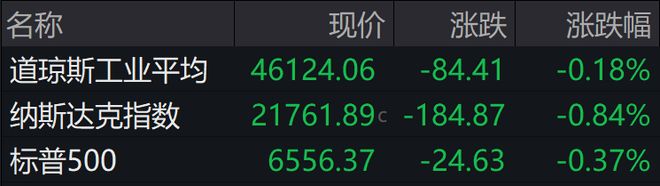
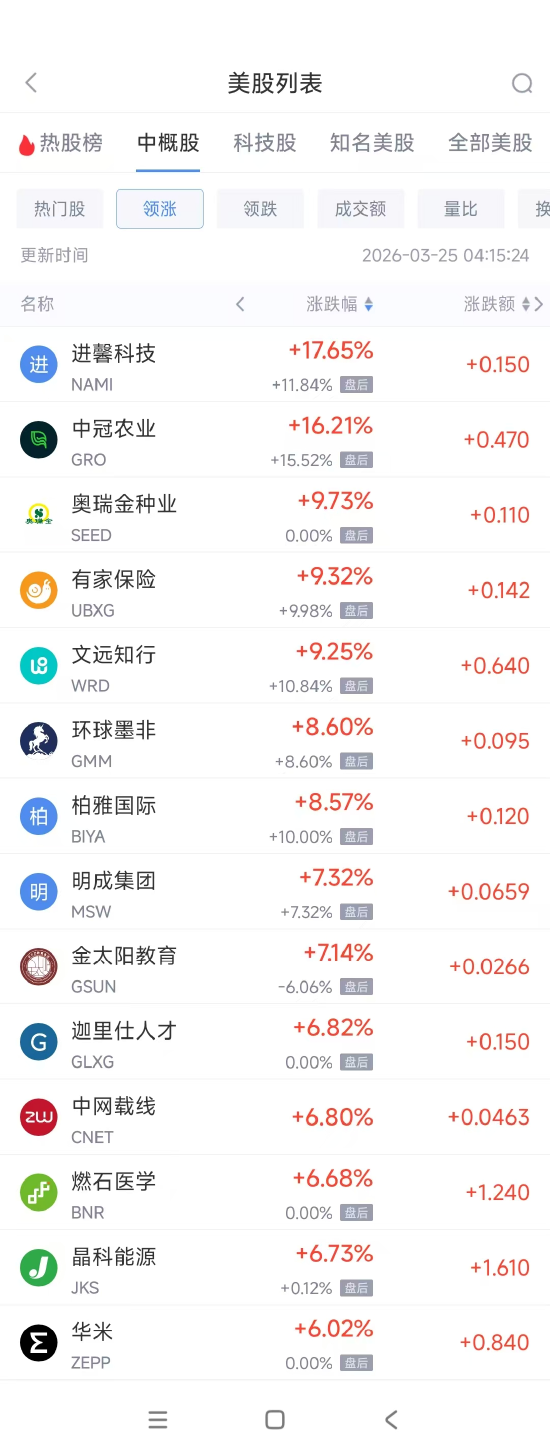
Group 1 - The Nasdaq Golden Dragon China Index (HXC) closed down by 0.43% on March 25, indicating mixed performance among Chinese concept stocks [1][8] - Among the rising stocks, notable gains included TSMC up 1.42%, Pinduoduo up 1.91%, and Li Auto up 3.62% [1][8] - Declining stocks included Alibaba down 0.47%, Netease down 1.09%, and Bilibili down 3.38% [1][8] Group 2 - The U.S. stock market saw declines on Tuesday, with technology stocks leading the drop, as all three major indices partially retraced gains from Monday [2][9] - The Dow Jones Industrial Average fell by 84.41 points, or 0.18%, closing at 46,124.06 points; the Nasdaq dropped by 184.87 points, or 0.84%, to 21,761.89 points; and the S&P 500 decreased by 24.63 points, or 0.37%, to 6,556.37 points [2][9]


计算机行业跟踪报告:AI算力相关产品服务有望延续涨价趋势,Tokens使用有望量价齐升
Wanlian Securities· 2026-03-24 09:19
Investment Rating - The industry investment rating is "in line with the market," indicating that the industry index is expected to fluctuate within a range of -10% to +10% relative to the market over the next six months [25]. Core Insights - The report highlights that AI computing-related products and services are expected to continue their price increase trend, with a simultaneous rise in the volume and price of Tokens usage. Major cloud service providers are announcing price hikes, suggesting a sustained high demand for AI computing services [2][10]. - Alibaba's cloud revenue reached 43.284 billion yuan, maintaining a growth rate of over 30% from the previous quarter, with AI-related product revenue achieving triple-digit growth for ten consecutive quarters. The company aims for annual revenue from cloud and AI commercialization to exceed 100 billion USD within five years [3][21]. - The report emphasizes the importance of monitoring leading companies' ecological layouts in AI applications, the sustained high demand for computing power, and the investment opportunities arising from price increases in AI computing-related products [10][11]. Summary by Sections Industry Dynamics - On March 16, Alibaba established the Alibaba Token Hub (ATH) to focus on creating, delivering, and applying Tokens, which includes various AI application divisions [3][16]. - On March 17, Alibaba launched the world's first enterprise-level AI native work platform, "Wukong," designed to enhance operational efficiency for businesses [3][20]. - On March 18, Alibaba Cloud announced price adjustments for AI computing and storage services, with increases ranging from 5% to 34% due to rising global AI demand and supply chain costs [3][21]. - Baidu Smart Cloud also announced price hikes for AI computing and storage products, with increases of up to 30% [3][22]. Market Performance Review - The report notes that the Shenwan Computer Industry Index underperformed compared to the CSI 300 and ChiNext Index, with a decline of 4.74% last week, ranking 20th among 31 primary industries [12][14]. Industry Valuation - As of March 20, 2026, the PE-TTM for the Shenwan Computer Industry was 189.07 times, indicating a high valuation compared to the historical average of 158.11 times from 2023 to 2025 [15].
互联网平台热搜价值研究报告
Ai Rui Zi Xun· 2026-03-24 05:04
Investment Rating - The report does not explicitly state an investment rating for the industry [1]. Core Insights - The report highlights the evolution of hot search lists as a product of user behavior and platform algorithms, reflecting societal concerns and interests [10][13]. - It emphasizes the importance of hot search lists as a primary tool for users to discover trending topics, breaking personal information bubbles and saving time in content consumption [21][22]. - The report identifies key platforms such as Weibo, Douyin, and Toutiao as major players in the hot search ecosystem, each with distinct characteristics and user engagement patterns [30][36]. Summary by Sections 01 Development History of Online Media Hot Search Lists - The emergence of hot search lists is linked to the evolution of information acquisition methods, driven by user behavior and platform algorithms [10][11]. - The hot search lists have transitioned from a nascent concept to a mature ecosystem over 15 years, with regulatory frameworks evolving to address content governance [13][15]. 02 Analysis of User Demand for Hot Content - Hot search lists are the primary means for users to discover trending topics, with 77.6% of users relying on them [22]. - Users engage with hot search lists to stay updated on current events, save time, and find common ground with others [21][22]. 03 Key Hot Search Products and Data Analysis - The report compares major platforms, noting that Weibo is perceived as the primary source for hot search content, followed by Douyin and Toutiao [30][36]. - Each platform has unique attributes: Weibo focuses on public discourse, Douyin emphasizes entertainment, and Toutiao offers in-depth news aggregation [38][46]. 04 Typical Hot Search Case Analysis - Hot search content serves as a reflection of public sentiment and societal issues, with various types of content emerging from organized and spontaneous user interactions [53][54]. - The report categorizes hot search content into several types, including political events, celebrity news, and social issues, highlighting their impact on public discourse [55][56].


为什么大厂必须抢郭达雅?
36氪· 2026-03-23 13:42
Core Viewpoint - DeepSeek is facing significant challenges following the departure of key researcher Guo Daye, whose contributions to the development of AI models, particularly in code intelligence and reasoning, have been substantial [4][85]. Group 1: Guo Daye's Contributions - Guo Daye has published over 37,000 citations, indicating a high level of academic influence compared to peers [7]. - His h-index is 37 and i-10 index is 46, showcasing stable academic output and impactful publications [8]. - Guo was a core contributor to significant projects like CodeBERT and DeepSeekMath, which have advanced the field of code understanding and reasoning [21][28]. Group 2: Potential Future Directions - Guo Daye's expertise in code intelligence and mathematical reasoning could significantly enhance ByteDance's capabilities if he joins, particularly in developing a new iteration of their code generation models [46][48]. - If he were to join Baidu, his skills would align well with the recent upgrades to Wenxin Kuai Ma, which focuses on multi-agent collaboration in code generation [58][60]. - His experience with GRPO (Group Relative Policy Optimization) could be pivotal for enhancing reasoning capabilities in large models, which is a strategic focus for ByteDance [51][52]. Group 3: DeepSeek's Current Situation - DeepSeek has not released a major version update since DeepSeek-R1 in January 2025, and the anticipated DeepSeek-V4 has faced multiple delays [68][76]. - The core selling point of V4 is its enhanced programming capabilities, which heavily rely on Guo Daye's expertise [80]. - The company is under pressure to demonstrate that it can maintain innovation and technical progress despite the loss of a key talent [85].

国内云厂商涨价潮背后:有人提价,有人降价,各有盘算
雷峰网· 2026-03-23 10:06
Core Viewpoint - The article discusses the recent price increases in the cloud computing industry, driven by rising costs and unprecedented demand for computing power due to AI applications. This marks a significant shift from previous price wars to a systematic transmission of cost pressures to the market [2][3]. Group 1: Price Increase Dynamics - On March 18, 2023, Alibaba Cloud announced a price increase, signaling a broader trend among cloud providers to pass on cost pressures after years of price competition [2][4]. - The surge in AI applications has led to an exponential increase in computing power demand, while supply constraints in GPU capacity, data centers, and electricity have made it difficult to keep up [3][11]. - Major cloud providers, including AWS and Google Cloud, have already raised prices, with AWS increasing prices for certain GPU services by 15% earlier in January 2023 [12][13]. Group 2: Different Strategies Among Cloud Providers - Cloud providers are adopting different strategies in response to the same cost pressures: some are selectively raising prices on AI-related services, while others are implementing broad price increases or maintaining current pricing to capture market share [4][16]. - The "Precision Pricing" group, represented by Alibaba Cloud, Tencent Cloud, and Baidu Cloud, focuses on raising prices for AI training products while keeping basic services stable to avoid losing customers [18][21]. - The "Comprehensive Pricing" group, exemplified by UCloud, has opted for widespread price increases across core products, reflecting a more aggressive approach to profit recovery [26][28]. - Some providers, like JD Cloud, have chosen not to raise prices, instead offering discounts to attract cost-sensitive customers, indicating a strategic decision to differentiate themselves in a competitive market [30][31]. Group 3: Market Implications - The article highlights that the cloud market is experiencing a strategic shift, where price increases are not uniform but rather reflect individual company strategies based on their market position and customer base [17][31]. - The timing of price adjustments, such as Alibaba Cloud's decision to implement changes after a specific date, is designed to encourage customers to place orders before the increase takes effect, potentially boosting short-term revenue [22][23]. - The competitive landscape is evolving, with companies needing to balance profitability with market share, as any misstep in pricing strategy could lead to customer attrition to competitors [16][21].