
BMW(BMWYY)

Search documents
汽车早餐 | 吉利控股开启轮值总裁制度,戴庆担任首任轮值总裁;理想汽车回应李想年薪6.39亿元;丰田预计新财年净利润将减少超三成
Zhong Guo Qi Che Bao Wang· 2025-05-09 01:37
Group 1: Automotive Trade and Market Performance - In March 2025, the total import and export value of automotive goods reached $23.82 billion, a month-on-month increase of 32.1%, but a year-on-year decrease of 0.2% [1] - In April 2025, the retail sales of passenger cars in China reached 1.791 million units, a year-on-year increase of 17%, while cumulative retail sales for the year reached 6.918 million units, up 9% year-on-year [2] - The retail sales of new energy vehicles in April 2025 were 922,000 units, a year-on-year increase of 37%, with a penetration rate of 52.3% [2] Group 2: Company Financials and Projections - Toyota expects a 34.9% year-on-year decline in net profit for the fiscal year 2025 due to U.S. tariff policies, estimating a sales loss of up to ¥180 billion (approximately $1.25 billion) for April and May [3] - BMW Group reported Q1 2025 total revenue of €33.758 billion, a year-on-year decrease of 7.8%, with a net profit of €2.173 billion, down 26.4% [6] - Lucid delivered 3,109 vehicles in Q1 2025, maintaining its annual production forecast of nearly 20,000 vehicles [5] Group 3: Corporate Developments and Innovations - Rivian announced a $120 million investment to strengthen its supply chain by building a supplier park near its factory in Normal, Illinois [7] - Geely Holding has implemented a rotating presidency system, with former COO Dai Qing as the first rotating president, aimed at enhancing management efficiency and fostering collaboration [10] - The new model of Zhiji Auto, the L6, has received 24,000 pre-sale orders, with a price range of ¥219,900 to ¥289,900 [11] Group 4: Regulatory and Safety Issues - Volvo is recalling over 413,000 vehicles in the U.S. due to potential issues with rearview camera images not displaying [4] - CATL announced that its Tianxing series batteries have passed the new national standard tests, becoming one of the first commercial power batteries to meet the GB 38031-2025 safety requirements [12] - SAIC-GM Wuling expects solid-state batteries to be available in vehicles by 2027, indicating progress in battery technology [13]




欧美多家车企发季度财报,巨额利润被关税抹去
Huan Qiu Shi Bao· 2025-05-08 22:38
Group 1: Company Performance and Forecasts - BMW confirmed its 2025 performance outlook, expecting a stable pre-tax profit compared to the previous year, with an operating profit margin of 5% to 7% in its automotive business, despite warning of a "significant" impact from U.S. tariffs on its Q2 performance [1] - Mercedes-Benz maintained its pre-tariff performance expectations but indicated that if current U.S. tariff policies continue, its annual performance would be "significantly below" previous years [1] - Ford announced a withdrawal of its 2025 performance forecast, citing potential pre-tax profit decline of approximately $1.5 billion due to U.S. tariff policies [2] Group 2: Industry Impact and Supply Chain Concerns - The automotive industry is facing supply chain disruptions and price increases due to U.S. tariff policies, with dealers experiencing inventory shortages; for instance, a dealer in New Jersey received only 18 vehicles instead of the usual 100 to 120 [3] - Toyota projected a 34.9% year-on-year decline in net profit for the fiscal year 2025, attributing this to the impact of U.S. government tariff policies [3] - Ford listed seven risk factors related to U.S. tariffs, including potential industry-wide supply chain disruptions and retaliatory tariffs from other countries [2]


宝马集团:美英经济协议标志着降低贸易壁垒迈出了令人欣喜的第一步。开放的市场和国际合作对汽车行业竞争力至关重要。
news flash· 2025-05-08 17:52
Group 1 - The core viewpoint of the article is that the economic agreement between the US and UK represents a significant first step towards reducing trade barriers, which is seen as a positive development for the automotive industry [1] - The automotive industry emphasizes that open markets and international cooperation are crucial for maintaining competitiveness [1]
奔驰宝马奥迪,拿什么守住自己的豪华?
汽车商业评论· 2025-05-08 14:36
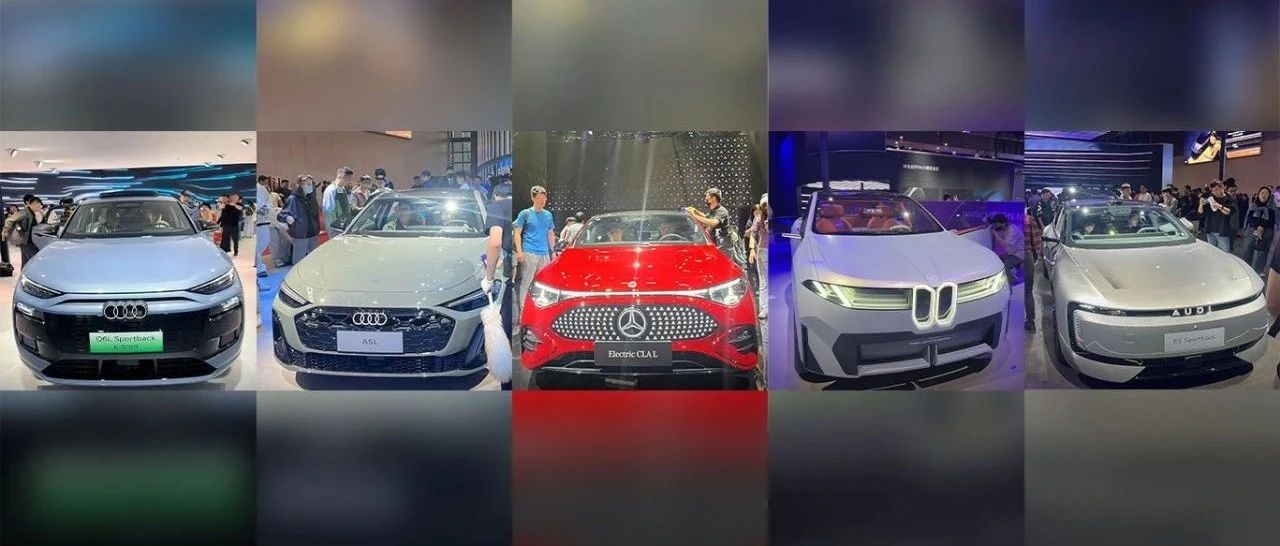
Core Viewpoint - The luxury car market in China is experiencing significant challenges for German brands BMW, Mercedes-Benz, and Audi (BBA), as they face declining sales and increased competition from domestic brands that offer higher configurations at lower prices. The definition of luxury is evolving, and BBA must adapt to maintain their brand value and consumer willingness to pay a premium for their products [2][3]. Group 1: Market Challenges - In 2024, BBA's sales in China have declined, indicating a generational gap in product competitiveness compared to domestic brands [3]. - Despite price reductions, BBA has struggled to retain market share, highlighting the need for improved product strength and innovation [3]. - The luxury brand definition emphasizes technological innovation, consumer desires beyond functionality, and the willingness to pay a premium, which BBA must address [2]. Group 2: Product Development and Strategy - BBA has introduced new models at the 2025 Shanghai Auto Show, reflecting over two years of internal development focused on new platforms, electronic architectures, and integrated driving technologies [3][19]. - Volkswagen Group is shifting its strategy in China, moving away from a "global model" approach to a more localized development strategy, leveraging local partnerships and suppliers [21][19]. - BMW and Mercedes-Benz continue to follow a "global model" strategy, with their German headquarters leading product development while incorporating local market needs [19][24]. Group 3: Technological Innovations - Volkswagen's ID. AURA, developed on a new electric platform, represents a significant technological advancement tailored for the Chinese market [7]. - Audi's A5L features Huawei's intelligent driving technology, marking a collaboration that reflects the brand's adaptation to local market demands [9][11]. - BMW's new generation models emphasize driving control and user experience, with innovations such as a panoramic HUD display and a focus on driver-centric design [24][25]. Group 4: Competitive Positioning - BBA's ability to reclaim market share and brand value will depend on their product strength and the ability to differentiate from domestic competitors [3][5]. - The introduction of new models with advanced technologies is crucial for BBA to maintain their luxury status and attract consumers willing to pay a premium [3][19]. - The distinct strategies of BBA highlight their individual brand identities and approaches to the evolving Chinese automotive market [28][29].

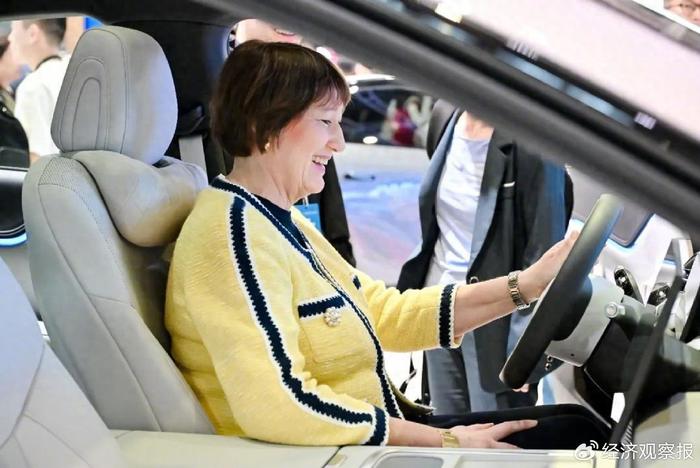
VDA主席穆希雅:深化中德产业合作正当时
Jing Ji Guan Cha Bao· 2025-05-08 08:36
Core Insights - The 2025 Shanghai International Auto Show serves as a significant platform to observe changes in the global automotive landscape, highlighting the deepening cooperation between China and Germany in the automotive industry [1][18] - The German automotive industry association (VDA) emphasizes the importance of strategic collaboration in emerging fields such as assisted driving, AI cabins, and green manufacturing, where both Chinese and German companies have distinct advantages [3][12] Industry Trends - The auto show attracted nearly 1,000 exhibitors from 26 countries, with over 70% of the displayed vehicles being new energy models, marking a record high [5] - Key themes of the show included electrification, intelligence, and software-defined vehicles, showcasing China's transition from a follower to a competitor in the next-generation automotive sector [5][12] - German automakers are adapting to the competitive landscape in China through enhanced localization strategies, with companies like Volkswagen and BMW unveiling new models and technologies tailored for the Chinese market [7][10][12] Market Dynamics - VDA data indicates that Chinese brands hold less than 1% market share in Germany, while German brands maintain approximately 20% market share in China, reflecting a significant asymmetry in trade [13] - The structural tension in Sino-German automotive relations is characterized by deep interdependence and competition, with both sides seeking to leverage their strengths in technology and market access [12][18] Policy and Cooperation - The VDA advocates for dialogue and rule-based solutions to address structural differences and maintain stable global supply chains, opposing EU tariffs on Chinese electric vehicles [14][15] - A strategic cooperation agreement was signed between Chinese and German automotive associations to build a credible data space for the global automotive industry, focusing on supply chain transparency and carbon footprint tracking [17] - Over two-thirds of German automotive companies plan to increase investments in China, reflecting the country's attractiveness as the largest single automotive market [17][18]



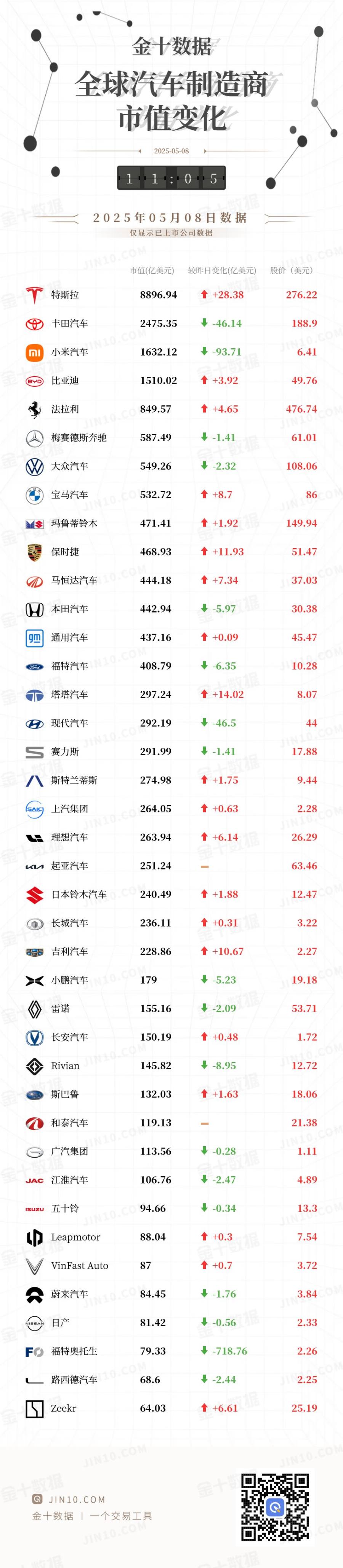
金十图示:2025年05月08日(周四)全球汽车制造商市值变化
news flash· 2025-05-08 03:13
金十图示:2025年05月08日(周四)全球汽车制造商市值变化 | 宝马汽车 | 532.72 | 1 +8.7 | | | --- | --- | --- | --- | | MS 玛鲁蒂铃木 | 471.41 | 1 +1.92 | 149.94 | | 保时捷 | 468.93 | + +11.93 | 51.47 | | 马恒达汽车 S | 444.18 | 1 +7.34 | 37.03 | | ( 本田汽车 | 442.94 | + -5.97 | 30.38 | | qm 通用汽车 | 437.16 | 1 +0.09 | 45.47 | | 福特汽车 | 408.79 | -6.35 | 10.28 | | 塔塔汽车 910 | 297.24 | ↑ +14.02 | 8.07 | | 19 现代汽车 | 292.19 | + -46.5 | 44 | | 赛力斯 | 291.99 | + -1.41 | 17.88 | | 斯特兰蒂斯 | 274.98 | + +1.75 | 9.44 | | (SAIC) 上汽集团 | 264.05 | 1 +0.63 | 2.28 | | 理想汽车 | ...




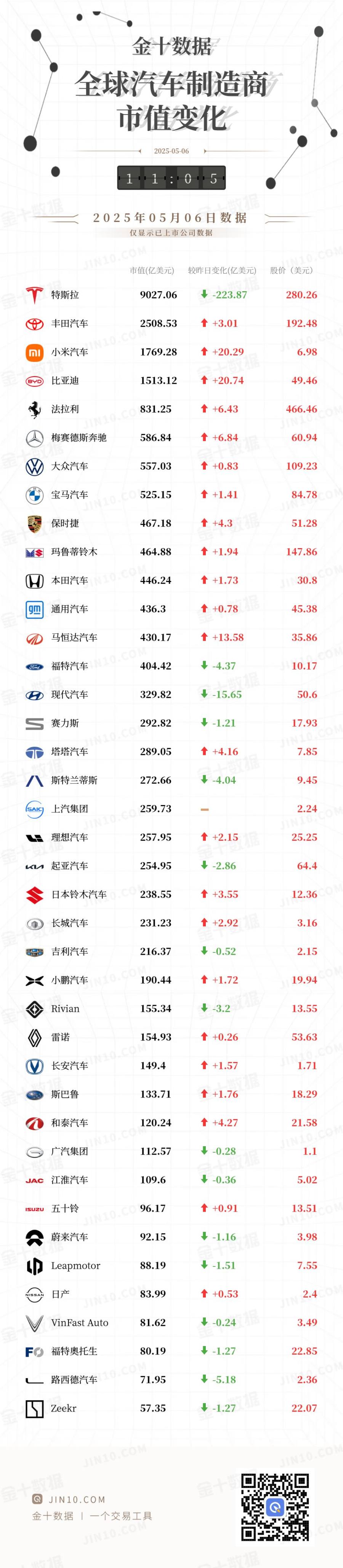
金十图示:2025年05月06日(周二)全球汽车制造商市值变化
news flash· 2025-05-06 03:11
金十图示:2025年05月06日(周二)全球汽车制造商市值变化 3 7 71410.COM 金十数据 | 一个交易工具 JIN10.COM 1. 6. 6. 1. 1. 1. 1. 2 | 宝马汽车 | 525.15 | 1 +1.41 | 84.78 | | --- | --- | --- | --- | | 保时捷 | 467.18 | 1 +4.3 | 51.28 | | > 玛鲁蒂铃木 | 464.88 | 1 +1.94 | 147.86 | | ( 本田汽车 | 446.24 | 1 +1.73 | 30.8 | | 通用汽车 | 436.3 | 1 +0.78 | 45.38 | | 马恒达汽车 S | 430.17 | 1 +13.58 | 35.86 | | 福特汽车 | 404.42 | + -4.37 | 10.17 | | 19 现代汽车 | 329.82 | + -15.65 | 50.6 | | 赛力斯 IT | 292.82 | + -1.21 | 17.93 | | 塔塔汽车 | 289.05 | 1 +4.16 | 7.85 | | 斯特兰蒂斯 | 272.66 | -4.0 ...



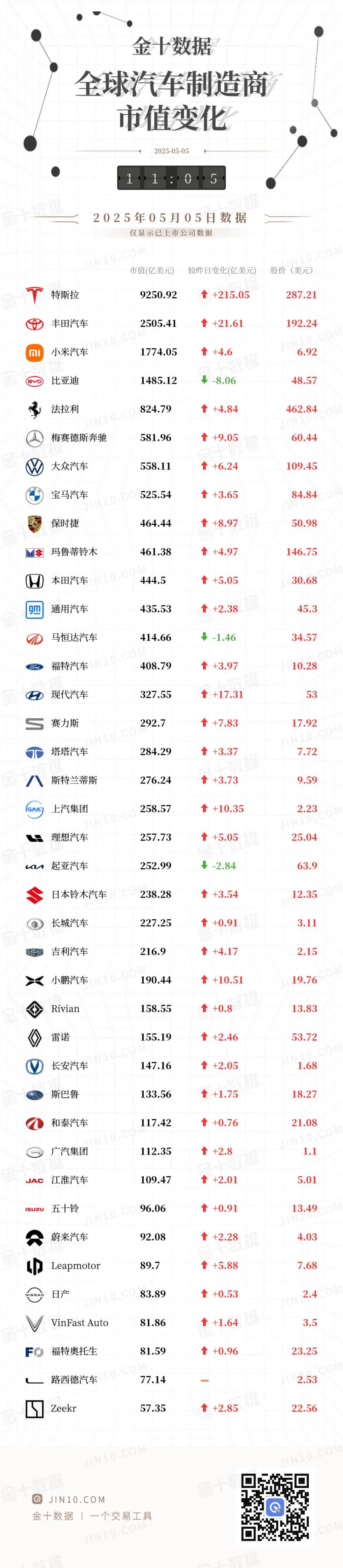
金十图示:2025年05月05日(周一)全球汽车制造商市值变化
news flash· 2025-05-05 03:12
金十图示:2025年05月05日(周一)全球汽车制造商市值变化 @ JIN10.COM 金十数据 | 一个交易工具 JIN10.COM t with and and the comments of the count | 宝马汽车 | 525.54 | 1 +3.65 | 84.84 | | --- | --- | --- | --- | | 保时捷 | 464.44 | 1 +8.97 | 50.98 | | > 玛鲁蒂铃木 | 461.38 | 1 +4.97 | 146.75 | | ( 本田汽车 | 444.5 | 1 +5.05 | 30.68 | | gm 通用汽车 | 435.53 | 1 +2.38 | 45.3 | | 马恒达汽车 S | 414.66 | + -1.46 | 34.57 | | 福特汽车 | 408.79 | 1 +3.97 | 10.28 | | 19 现代汽车 | 327.55 | ↑ +17.31 | 53 | | 赛力斯 II | 292.7 | 1 +7.83 | 17.92 | | 塔塔汽车 | 284.29 | 1 +3.37 | 7.72 | | 斯特兰蒂斯 ...
宝马中国宣布接入DeepSeek,宝马妥协了?
3 6 Ke· 2025-05-02 02:21
Core Viewpoint - BMW China is embracing local AI technology by integrating DeepSeek, marking a significant step in its digital transformation strategy and enhancing its AI capabilities in the Chinese market [1][3][6] Group 1: BMW's AI Integration - BMW has announced the integration of DeepSeek into its operations, which will enhance the BMW Intelligent Personal Assistant and improve human-machine interaction in new models starting from Q3 2025 [1][2] - The collaboration with DeepSeek follows BMW's earlier partnership with Alibaba to develop AI language models, showcasing BMW's commitment to local AI ecosystem development [1][3] Group 2: Strategic Importance of Local AI - This move signifies BMW's recognition of the importance of local AI technologies and its willingness to adapt to the rapidly evolving Chinese automotive market [3][4] - BMW's previous initiatives, such as the launch of a 360-degree AI strategy and the development of intelligent systems like "Car Expert" and "Travel Companion," reflect its ongoing efforts to enhance its smart vehicle offerings [3][4] Group 3: Challenges and Opportunities - Despite its historical strengths in manufacturing and brand image, BMW faces challenges in keeping pace with the increasing demand for smart and connected vehicles [4][5] - The partnership with DeepSeek is seen as a strategic decision to accelerate BMW's digital transformation and leverage the advanced technologies and innovative models from Chinese tech companies [4][6]

对话宝马集团董事长齐普策:融入中国,需要“慢思考”与“快进化”
吴晓波频道· 2025-05-01 15:32
Core Viewpoint - The article emphasizes the transformation of the automotive industry in China, highlighting BMW's commitment to innovation and collaboration with local partners as it adapts to the rapidly changing market landscape [4][5][10]. Group 1: BMW's Strategy in China - BMW has established itself as a significant player in China, with over 7 million users, and views China as its largest market and innovation hub [9][10]. - The company has integrated local technological advancements, such as AI and collaboration with Chinese firms like Huawei and Alibaba, to enhance its product offerings [11][20]. - BMW's "Home in China" strategy reflects its deep commitment to the Chinese market, aiming to co-create technology and drive innovation alongside local enterprises [10][11]. Group 2: Future of Automotive Industry - The automotive industry is undergoing a significant transformation, moving beyond mere technological advancements to a systematic integration of these technologies into products [15][20]. - BMW is focused on balancing innovation with sustainability and quality, ensuring that its vehicles remain a worthwhile investment for consumers [21][25]. - The introduction of the "New Generation" models signifies BMW's commitment to electric and digital innovations while maintaining its core values of driving pleasure and safety [25][26]. Group 3: Globalization and Cooperation - BMW's leadership emphasizes the importance of international cooperation, asserting that global interdependence is crucial for innovation and market success [33][34]. - The company maintains a diverse powertrain strategy, offering multiple driving options to cater to varying consumer preferences across different markets [30][31]. - BMW's experience serves as a model for other Chinese companies aspiring to expand globally, highlighting the necessity of embracing globalization despite current geopolitical challenges [33][34].