
Deutsche Bank AG(DB)

Search documents
Brazil's Ambipar secures court protection amidst Deutsche Bank debt dispute
Reuters· 2025-09-25 13:47
Brazilian waste management company Ambipar has secured a preliminary injunction from a Rio de Janeiro state court temporarily preventing the accelerated maturity of its debt, according to a decision s... ...


Deutsche Bank to launch new private markets fund in Q3 2025
Yahoo Finance· 2025-09-25 10:42
Deutsche Bank, in partnership with DWS and Partners Group, has revealed plans to introduce a private markets fund for its qualified private clients. Slated for release in the third quarter of 2025, the fund is designed to facilitate entry into private markets for investors in the European Economic Area and Switzerland. The fund will be structured as an evergreen offering under the European Long-Term Investment Fund (ELTIF) 2.0 regulation, aiming to provide clients with an investment vehicle compared to t ...
New World Development secures up to $758 million loan from Deutsche Bank
Reuters· 2025-09-25 10:19
Core Viewpoint - Hong Kong property developer New World Development has secured a term loan facility of up to HK$5.9 billion (approximately $758.62 million) from Deutsche Bank [1] Group 1: Company Information - New World Development is a property developer based in Hong Kong [1] - The company has successfully obtained a significant loan facility to support its operations [1] Group 2: Financial Details - The term loan facility amounts to HK$5.9 billion, which is equivalent to $758.62 million [1]


外资大行增聘、中资加薪留人 港股IPO热潮引爆金融人才争夺战
智通财经网· 2025-09-25 06:11
智通财经APP获悉,据媒体消息,为满足日益增长的银行和理财服务需求,多家国际大型银行已将高层 管理人员调派至香港,德银、摩根大通、渣打、花旗集团、星展银行等已开始在香港增聘人手。中金公 司、中信证券等中资券商最近亦出招挽留人才。另外,猎头公司Links International的金融服务主管指, 与去年相比,今年收到委托填补的职位数量增加30%至40%,主因是香港IPO及并购活动增加。 而早年减薪的内地金融券商,市传最近为留住人才,亦出招挽留人才。中金公司为高级投资银行家增设 新职级,新增职位包括高级董事总经理及总监。另中信证券则拟为旗下香港附属公司中信里昂证券职员 增薪,部分初级助理月薪加幅15至30%。 今年以来,港股IPO市场认购盛况空前,"超额认购王"纪录屡创新高。德勤预计,今年前三季度,香港 将迎来66只新股上市,集资总额达1823亿港元。新股数量较去年同期的45只增长47%,集资额较去年同 期的556亿港元大幅上升228%。德勤在报告中指出,预计今年最后一个季度,香港新股市场将延续强劲 势头,2025年全年香港将迎来超过80宗新股上市,总集资额介于2500亿至2800亿港元之间。 德勤中国华南区 ...


Deutsche Bank raises S&P 500 target to 7,000, Trump threatens ABC over Kimmel return
Youtube· 2025-09-24 17:43
Market Overview - US stocks are experiencing a record-setting rally, with the Dow up about 42 points, while the S&P 500 and Nasdaq have shown slight declines [3][105] - The energy sector is leading gains, with the XLE ETF up 1.5%, driven by rising oil prices due to supply concerns [5][6] - Deutsche Bank raised its year-end target for the S&P 500 to 7,000, citing resilient earnings despite inflation risks [7][8] Micron Technology - Micron reported a 46% year-over-year revenue increase and provided an optimistic forecast, driven by strong AI demand [20] - Despite positive results, Micron's stock is wavering as investors had already factored in expected performance, leading to selling on the news [21][22] - Analysts have raised price targets for Micron, with Rosenblad Securities setting the highest target at $250, indicating a potential 12% upside [59][60] Energy Sector - The energy sector is gaining traction, with investors showing interest in energy stocks amid rising oil prices and geopolitical tensions [5][6] - The XLE ETF's performance reflects a broader trend of investor preference for energy stocks, which have been highlighted as attractive investments [6][19] Telecom and Media - The return of Jimmy Kimmel has sparked discussions about the implications for media and telecom companies, particularly regarding political pressures and FCC independence [36][38] - Concerns are raised about the potential for political influence over telecom regulations, which could negatively impact the sector [39][41] Federal Reserve and Economic Outlook - The Federal Reserve's independence is under scrutiny, with implications for monetary policy and market reactions to political pressures [43][47] - Economic data expected later in the week could provide further direction for the markets, with a focus on the potential for continued growth in the financial sector [106][108] Financial Sector - The financial sector is navigating a new rate environment following the Fed's recent interest rate cuts, with banks experiencing a lack of loan demand [70][72] - Analysts suggest that banks with exposure to the mortgage market may be more attractive in the current climate, as capital return stories gain traction [71][72] - The potential for increased M&A activity in the banking sector is being discussed, although concerns about overpaying for targets remain [75][76] European Banking - European banking ETFs have significantly outperformed US banks, driven by stabilization in net interest income and growth in non-interest income [92][94] - Analysts remain bullish on European banking, expecting continued strong performance into the next year [95] AI and Technology Investments - The AI sector is seeing substantial investments, with companies like Nvidia and Oracle making significant moves in the space [27][32] - The interconnectedness of AI companies and chipmakers raises questions about potential vulnerabilities in the market [27][30] Housing Market - US new home sales unexpectedly jumped by over 20% in August, indicating a strong recovery in the housing market [67] - This growth suggests that home builders are successfully attracting buyers with aggressive sales incentives [67]



再创新高!黄金看涨逻辑未改 金价逼近3800美元大关
Zhi Tong Cai Jing· 2025-09-24 00:13
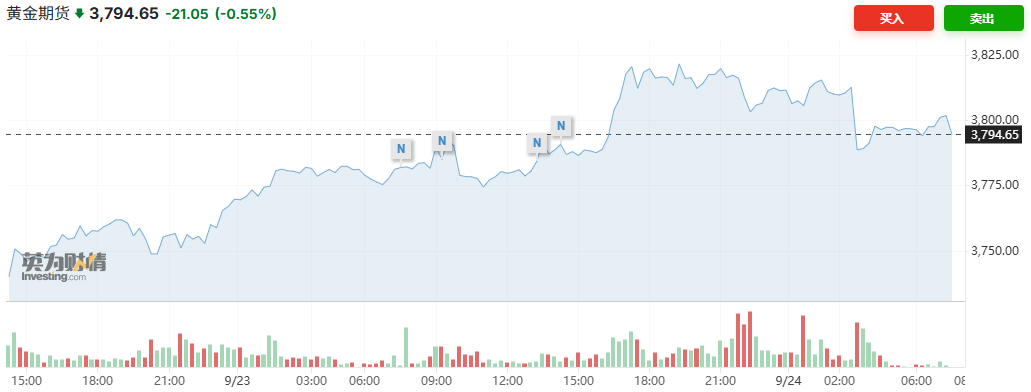
Core Viewpoint - Gold futures prices have surged to nearly $3,800 per ounce, reaching a historical high due to market expectations of further interest rate cuts by the Federal Reserve, leading to strong inflows of safe-haven funds [1][3]. Group 1: Market Performance - Gold futures for September delivery rose by 1.1% to $3,780.60 per ounce, marking the third consecutive day of record highs [1]. - Silver futures for September delivery increased by 0.9% to $44.192 per ounce, also achieving its highest level since May 2, 2011 [1]. - Year-to-date, gold has risen by 40%, representing the most significant annual increase since 1979 [4]. Group 2: Federal Reserve Outlook - Federal Reserve Chairman Jerome Powell hinted at potential rate cuts by the end of the year, citing severe economic conditions and inflation risks [3]. - Market expectations indicate a 93% probability of a 25 basis point rate cut in October and a 77% probability in December [3][4]. Group 3: Investment Trends - Current demand for gold is driven by U.S. government policy uncertainty, concerns over the dollar, and geopolitical instability [5]. - Major Wall Street banks have raised their gold price forecasts following the recent highs, with Deutsche Bank predicting an average price of $4,000 per ounce in 2024 [6]. - UBS has adjusted its gold price forecast to $3,800 per ounce by the end of 2025 and $3,900 by mid-2026, citing weak U.S. labor data and anticipated Fed rate cuts [6]. - JPMorgan expects spot gold prices to exceed $4,000 per ounce in Q1 2026, supported by cyclical and structural factors [7].
每日机构分析:9月23日
Xin Hua Cai Jing· 2025-09-23 14:18
Group 1 - Eurozone inflation is on a downward trend, increasing the likelihood of the European Central Bank (ECB) cutting interest rates again in 2025, with core inflation expected to fall below 2% due to slowing wage growth and declining commodity prices [1] - Bridgewater Associates warns of high government debt in the US and UK, leading to economic strain and social polarization, with UK productivity stagnating since the mid-2000s [1] - Deutsche Bank strategists predict a continued weak dollar, as investors shift away from US assets amid a new easing cycle from the Federal Reserve and concerns over its independence [2] Group 2 - German manufacturing is facing challenges, with a decline in manufacturing PMI to 48.5 indicating increased contraction, despite a rise in services PMI to 52.5 [2] - Malaysia's fiscal deficit target for 2025 is expected to remain at 3.8%, benefiting from lower Brent crude prices and a stronger ringgit, with inflation expectations adjusted down to 1.5% [2] - The H-1B visa reform in the US may reduce the outflow of Indian talent, benefiting India's economy, but could also lead to decreased remittances from the US, putting downward pressure on the Indian rupee [3]


争夺欧洲富豪!德银(DB.US)加入私募市场“抢钱大战”
智通财经网· 2025-09-23 09:41
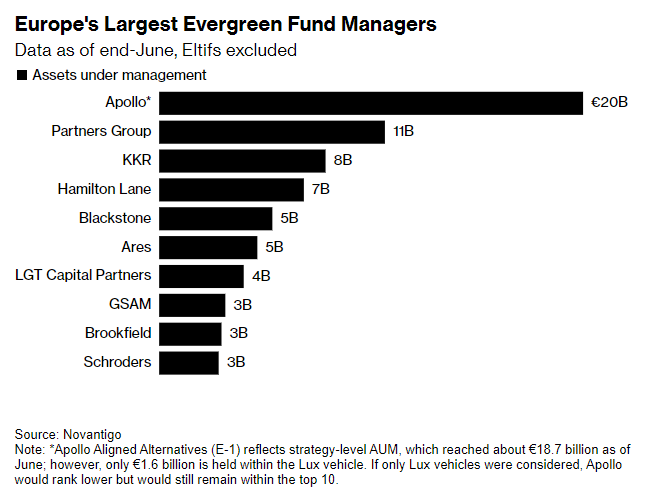
Core Viewpoint - Deutsche Bank is accelerating its efforts to tap into the private market investment channels for wealthy clients in Europe, aiming to leverage the significant potential of high-net-worth individuals in the region [1][2]. Group 1: Fund Launch and Structure - Deutsche Bank, in collaboration with its asset management subsidiary DWS Group and Swiss private equity firm Partners Group, is set to launch a perpetual private market fund aimed at high-net-worth clients, expected to open in Q3 of this year [1]. - The fund will be managed by Partners Group and will invest in various sectors, including products offered by the Zurich-listed company and other non-public market investment opportunities [1]. - The minimum investment required from clients is €10,000 (approximately $11,800), with an initial asset management size projected between €100 million and €1 billion [1]. Group 2: Market Potential and Growth - Deutsche Bank's executive Alessandro Caironi indicated that the fund could evolve into a significant component of their private asset portfolio, with potential market opportunities reaching billions of euros in the coming years, possibly even up to $10 billion [2]. - The European private market has become a competitive space for Wall Street institutions and global asset management firms, especially following regulatory reforms that have lowered the barriers for individual investors to access private markets [2]. Group 3: Industry Trends and Insights - The number of perpetual funds targeting high-net-worth individuals in Europe has surged due to these regulatory changes, which allow for more flexible subscription and redemption mechanisms [5]. - Major firms like Blackstone and KKR are increasing their presence in the European private market, while BlackRock is also expanding its wealth management efforts in the region after acquiring several private asset companies [5]. - Bain & Company projects that the global private market assets under management will reach $65 trillion over the next decade, more than doubling from the end of 2012 [6]. - Deutsche Bank suggests that high-net-worth clients should allocate up to 24% of their investment portfolios to private markets, although current allocations among European individual investors remain significantly below this level [6].
德银、中金等机构:黄金新高、钴价或涨等观点梳理
Sou Hu Cai Jing· 2025-09-23 09:15
Group 1 - Deutsche Bank indicates that the continuous rise in gold prices reflects underlying panic in the stock market [1] - Credit Suisse states that comments regarding a "150 basis point rate cut" in Milan have minimal impact, with the market choosing to vote with its feet [1] - ING holds a neutral view on US Treasuries in the short term, while looking for opportunities to short 10-year Treasuries [1] Group 2 - CICC reports that the trend of deposit migration continues, but the pace has slowed [1] - Huatai Securities notes that the semiconductor equipment market in China is experiencing an "east rising, west declining" trend in the second half of the year [1] - CITIC Securities points out that the Democratic Republic of Congo has announced cobalt export quotas, which may lead to a strong increase in cobalt prices [1] Group 3 - CITIC Jinpu is optimistic about robots becoming a main line for technology growth allocation [1] - CITIC Securities reminds that the road testing for all-solid-state batteries has begun, and attention should be paid to their improvement and vehicle pressure [1] - CITIC Jinpu expects global investment in power grids to exceed $400 billion by 2025, indicating sustained high prosperity [1] Group 4 - Galaxy Securities believes that positive factors for banks are continuously accumulating, with mid-term performance expected to improve, signaling a potential turning point [1] - Galaxy Securities continues to favor computing-related PCB, domestic computing, IP licensing, and chip inductors in the second half of the year [1] - Everbright Securities states that the domestic engineering machinery market in August is "not dull in the off-season," with significant recovery in the non-excavator category [1]

X @Bloomberg
Bloomberg· 2025-09-23 08:10
Industry Trend - Deutsche Bank is increasing efforts to provide wealthy European clients access to private markets [1] - This move fuels a global competition to leverage a substantial pool of affluent individual investors in Europe [1]