Alphabet(GOOGL)

Search documents
Warren Buffett Sold Apple to Buy This Stock
Yahoo Finance· 2026-01-15 16:00
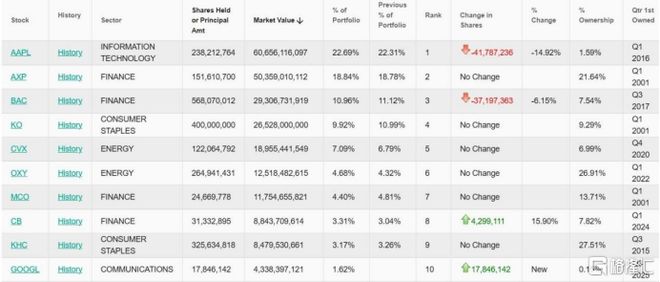
Core Insights - Warren Buffett's investments continue to influence the market despite his exit, with Berkshire Hathaway holding $267 billion in investments at the end of Q3 [1] - Notable trades include the sale of 41.7 million Apple shares and the purchase of 17.8 million Alphabet shares, indicating a strategic shift in the portfolio [3][4] Investment Strategy - Berkshire Hathaway has reduced its stake in Apple by 74% over the past two years, yet Apple remains the largest holding at 22% of the total portfolio [3][8] - The acquisition of Alphabet shares, which now represent 2% of the portfolio, reflects a growing interest in tech stocks, particularly as Alphabet reaches a $4 trillion valuation [4][8] Company Performance - Alphabet's stock has seen significant growth, with a 70% increase over the past year and over 12,000% returns since its IPO in 2004 [4] - Alphabet's Q3 revenue rose 16% to $102 billion, with earnings per share increasing by 35% to $2.87 [8] Strategic Partnerships - Apple has partnered with Alphabet to enhance its artificial intelligence features, including updates to Siri, leveraging Google's Gemini and cloud technology [7] - This collaboration signifies a growing trust in Alphabet's AI capabilities and has contributed to Alphabet's valuation milestone [7][8]


If I Could Own Only 1 Quantum Computing Stock in 2026, This Would Be It
Yahoo Finance· 2026-01-15 15:50
Core Insights - The quantum computing sector is experiencing significant excitement, particularly for companies like Rigetti and IonQ, but they face financial challenges and high cash burn rates [5][3] - Alphabet is highlighted as the most attractive long-term investment in quantum computing due to its strong balance sheet and substantial cash flow [8][9] Financial Performance - Rigetti and IonQ have raised significant capital through equity issuance, with Rigetti raising $350 million and IonQ raising $2 billion in 2025 [2] - Rigetti reported a negative free cash flow of $67.6 million over the last year, while IonQ's cash burn accelerated to $263.6 million due to aggressive acquisitions [3] Market Position and Potential - Both Rigetti and IonQ are currently generating minimal revenue while investing heavily in research and development, leading to substantial cash burn [3] - Quantum computing is still in its early stages, with practical applications being years away, despite some systems currently in use [4] Technological Advancements - Alphabet's Willow chip has achieved significant milestones, completing a benchmark test in under five minutes that would take supercomputers an estimated 10 septillion years [10] - Alphabet is making progress in quantum computing, with successful execution of the Quantum Echoes algorithm, although practical applications are still years away [11] Investment Valuation - Alphabet trades at a reasonable valuation of about 29.5 times earnings, compared to IonQ and Rigetti, which trade at 91 and 408 times sales respectively [13] - The potential for pure-play stocks like Rigetti and IonQ exists, but they may become irrelevant over the next decade, while Alphabet is expected to remain a key player [13]

TPU vs GPU 全面技术对比:谁拥有 AI 算力最优解?
海外独角兽· 2026-01-15 12:06
Core Insights - The article emphasizes that the Total Cost of Ownership (TCO) is highly dependent on the specific use case, suggesting that TPU is preferable for training and latency-insensitive inference, while GPU is better for prefill and latency-sensitive inference scenarios [3][4][5] - The fundamental difference between the 3D Torus and Switch Fabric (NVSwitch/Fat-tree) interconnect systems lies not in speed but in their assumptions about traffic patterns [4][5] - Google's historical TCO advantage established through TPU has been significantly weakened in the v8 generation [6] TCO Analysis - TPU v7 offers a cost advantage of 45-56% in training scenarios, based on the assumption that TPU's Model FLOPs Utilization (MFU) is 5-10 percentage points higher than that of GPUs [4][16] - In inference scenarios, GPUs (GB200/GB300) outperform TPU v7 by approximately 35-50% during the prefill phase due to their FP4 computational advantage [4][18] - The TCO comparison shows that TPU v8's cost efficiency has decreased, with the TCO ratio dropping from 1.52x for GB200/TPUv7 to 1.23x for VR200/TPUv8p [6] Interconnect Architecture - The 3D Torus architecture assumes predictable and orchestrated communication patterns, maintaining high MFU in large-scale training tasks, while Switch Fabric accommodates uncertain traffic patterns [5][38] - TPU Pods utilize a 3D Torus topology for high bandwidth and low latency communication, with a maximum cluster size limited by the number of OCS ports [31][34] Performance Bottlenecks - In training, the bottleneck typically arises from computational power and scale-out communication bandwidth, while in inference, the prefill phase is limited by computational power and the decode phase is constrained by memory bandwidth [12][22] - The performance requirements differ across training and inference scenarios, with TPU needing FP8 and scale-out bandwidth for training, while GPU requires FP4 and scale-up bandwidth for inference [12][13] Software Optimization - TPU's software optimizations aim to mitigate its inherent weaknesses in handling irregular traffic, transforming unpredictable workloads into stable data flows [46][47] - The introduction of SparseCore in TPU is designed to enhance its capability to handle dynamic all-to-all routing, acknowledging the need for communication-computation decoupling similar to NVSwitch [48] Competitive Landscape - Google TPU v8 adopts a dual-supplier strategy to reduce costs, collaborating with Broadcom and MediaTek for different SKUs, which impacts the overall design and production timeline [49][50] - Nvidia's Rubin architecture aggressively enhances performance and TCO for inference, with significant improvements in FP4 computational power and HBM bandwidth, positioning it as a strong competitor against TPU [51][52]



Clearway Signs Portfolio of Power Purchase Agreements with Google Totaling Nearly 1.2 GW Across Three States
Globenewswire· 2026-01-15 12:00
Core Insights - Clearway Energy Group has executed three new long-term power purchase agreements (PPAs) with Google, totaling 1.17 GW of carbon-free energy projects in Missouri, Texas, and West Virginia [1][2] Group 1: Agreements and Investments - The new agreements will provide carbon-free energy to support Google's data centers for up to 20 years, with an investment exceeding $2.4 billion in energy infrastructure [2] - Construction on the projects, which will exceed 1 GW, is set to begin this year, with the first sites expected to be operational in 2027 and 2028 [3] Group 2: Partnership and Community Impact - The new agreements expand upon an existing 71.5 MW PPA in West Virginia, bringing the total partnership capacity to 1.24 GW [3] - The projects are expected to generate significant local benefits, including tax revenue for schools and hospitals, hundreds of construction jobs, and community initiatives like Clearway's Adopt-a-School program [4] Group 3: Company Overview - Clearway Energy Group's portfolio includes over 13 GW of gross generating capacity across 27 states, with a focus on clean energy solutions [5] - The company operates a diverse range of energy assets, including 2.8 GW of flexible dispatchable power generation and 10.3 GW of battery energy storage [5]


Gemini盘活了谷歌全家桶,“原生”自带你10年的记忆
3 6 Ke· 2026-01-15 11:38
Core Insights - Google is transforming the concept of a personal assistant, akin to "JARVIS" from science fiction, into a reality with the launch of the "Personal Intelligence" feature powered by the Gemini3 model [1] Group 1: Product Features - The Personal Intelligence feature connects data pools from four major Google applications: Gmail, Photos, YouTube, and Search, allowing AI to access and integrate information across these platforms [2][3] - This integration enables the AI to create a comprehensive personal life map by linking emails, memories from photos, and video viewing habits, thus addressing the issue of AI not understanding individual users [3] - A natural language correction mechanism is built into the system to rectify any misinterpretations of personal data, making it easier for users to manage their data models [5] Group 2: Competitive Landscape - Google and Apple have announced a collaboration to integrate the Gemini model into Apple's intelligence system, although their implementation strategies differ significantly [6] - Google's approach is cloud-native, leveraging extensive data centers for processing, while Apple's strategy is a hybrid model that prioritizes local processing with cloud support only when necessary [6][8] - The competition in AI is shifting from model comparisons to building ecosystem barriers, with companies aiming to connect independent applications into a cohesive intelligent platform [9][12] Group 3: Industry Trends - Other tech giants, such as Alibaba and ByteDance, are also pursuing similar strategies to integrate AI into their existing applications, aiming to create comprehensive service ecosystems [11] - The future of the industry suggests that the true competitive advantage will lie in the ownership of private contextual data rather than just technological capabilities [12]
谷歌开启AI购物意向截流战,电商格局要变天?
格隆汇APP· 2026-01-15 11:15
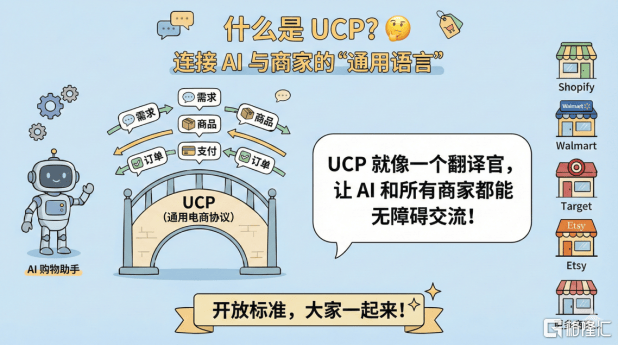
Core Viewpoint - Google has launched the Universal Commercial Protocol (UCP) to standardize interactions between AI agents and retailers, aiming to transform AI shopping from a niche experience into a fundamental industry standard, akin to the HTTP protocol for the internet [4][9][10]. Group 1: UCP Overview - UCP is an open-source protocol that provides a unified standard for product discovery, ordering, payment, and after-sales service, allowing different platforms and merchants to be accessed by a common AI agent [5]. - The protocol enables consumers to complete shopping through natural language across various platforms, moving the decision-making process from individual platforms to AI agents [5][11]. Group 2: Comparison with Previous Protocols - UCP builds on the earlier Agent Commerce Protocol (ACP) introduced by OpenAI, which had limitations in its closed ecosystem, restricting access to specific merchants [7][9]. - UCP aims to democratize AI shopping by breaking down entry points and leveraging Google's vast user base of 3 billion, allowing purchases across multiple interfaces like Gemini, Android, and YouTube [13][19]. Group 3: Enhanced Capabilities - UCP connects to Google's Shopping Graph, which contains 50 billion data points, enabling AI agents to understand dynamic inventory, size recommendations, and trending accessories, thus enhancing the shopping experience [14][15]. - The protocol also improves after-sales service by allowing AI agents to handle returns, delivery modifications, and logistics tracking, evolving from a temporary guide to a personal shopping assistant [18]. Group 4: Market Implications - In the short term, UCP is expected to drive significant traffic to participating merchants by utilizing Google's ecosystem, potentially leading to a surge in sales [20][22]. - However, there is a concern that this could lead to the dilution of brand identity, as AI agents prioritize hard metrics over emotional connections, reducing brands to mere data points in a comparison list [24][25]. Group 5: Competitive Landscape - Amazon is identified as the most affected competitor, facing challenges from Google's strategy to intercept traffic before it reaches Amazon, leveraging partnerships with traditional retailers [28][30]. - In response, Amazon is enhancing its AI shopping capabilities through Alexa, aiming to secure user engagement at the initial shopping thought stage [34][35]. Group 6: Domestic Market Dynamics - In the domestic market, Alibaba is actively pursuing AI shopping integration across its ecosystem, while ByteDance faces strategic challenges due to conflicting business models between content-driven commerce and efficiency-focused AI shopping [39][41]. - Alibaba's recent app updates have led to rapid user growth, while ByteDance's hesitation reflects the complexities of balancing its existing content ecosystem with emerging AI shopping trends [43][45]. Group 7: Future Outlook - Both Google and OpenAI are in the early stages of implementing their shopping experiences, with full functionality expected to roll out in the near future [47]. - The true commercial potential will be realized once these technologies are fully operational and consumer acceptance is established, indicating a significant market opportunity in the evolving landscape of AI-driven commerce [48].


谷歌开启AI购物意向截流战,电商格局要变天?
Sou Hu Cai Jing· 2026-01-15 10:41
Core Insights - Google launched the Universal Commercial Protocol (UCP) to standardize interactions between AI agents and retailers, aiming to automate the entire shopping process from product discovery to post-purchase support [1][3][4] Group 1: UCP Overview - UCP is an open-source protocol that allows AI shopping agents to interact with various platforms and merchants, providing a unified standard for product discovery, ordering, payment, and after-sales service [1][3] - The protocol aims to redefine AI shopping from a limited experience to a comprehensive industry standard, similar to how the HTTP protocol defined the internet [3][4] Group 2: Advantages of UCP - UCP enables seamless shopping experiences across multiple platforms, allowing users to make purchases through various Google services, including Gemini chat, Android search, and YouTube [4][6] - The protocol connects to Google's Shopping Graph, which contains 50 billion data points, allowing AI agents to understand dynamic inventory, size recommendations, and trending accessories, enhancing the shopping experience [4][6] Group 3: Impact on Retailers - UCP provides a dual-edged sword for retailers, offering increased sales through Google's vast user base while simultaneously risking brand dilution as AI agents take over the decision-making process [7][9] - Retailers, especially mid-sized ones, may experience a surge in traffic and sales due to UCP, but they could also face challenges in maintaining brand identity as AI agents prioritize efficiency over emotional connections [10][12] Group 4: Competitive Landscape - Amazon is positioned as a significant competitor, facing challenges from Google's strategy to redirect traffic before it reaches Amazon, effectively disrupting the traditional shopping flow [15][17] - In response, Amazon is enhancing its Alexa AI shopping capabilities to retain user engagement and ensure that customers turn to its platform first for shopping inquiries [17][18] Group 5: Domestic Market Dynamics - In the domestic market, Alibaba is aggressively pursuing AI shopping integration, aiming to establish itself as the first to implement a comprehensive AI shopping interface [19] - Conversely, ByteDance faces strategic challenges due to its content-driven business model conflicting with the efficiency-driven nature of AI shopping, leading to hesitance in adopting similar protocols [20][21] Group 6: Future Outlook - Both Google and GPT are in the early stages of implementing their shopping experiences, with significant user growth and functionality expected in the near future [22][23] - The true commercial potential of AI shopping will only be realized once these technologies are fully operational and consumer acceptance is established, indicating a transformative shift in the retail landscape [25]
维基百科运营方与微软、元宇宙平台公司达成人工智能内容训练合作协议
Xin Lang Cai Jing· 2026-01-15 10:35
Core Insights - Wikipedia has announced partnerships with major tech companies including Microsoft, Meta, and Amazon, marking a significant step in monetizing its content reliance by these firms [1][4] - The Wikimedia Foundation has signed agreements with several companies, including AI startups Perplexity and Mistral AI, in addition to existing partnerships [1][4] Industry Context - Wikipedia's content is crucial for training AI models, encompassing over 65 million entries in more than 300 languages, serving as a primary data source for tech giants developing generative AI chatbots and smart assistants [2][5] - The increasing demand for Wikipedia's free content for AI training has led to rising server demands and costs for the non-profit organization, which primarily relies on small public donations for funding [2][5] Business Model Evolution - The Wikimedia Foundation is promoting its enterprise service, which allows tech companies to pay for content training access and offers customized data services based on large-scale training needs [2][5] - Ryan Becker, president of Wikimedia Enterprise, emphasized the necessity for tech companies to financially support Wikipedia, recognizing the importance of transitioning from free access to commercial partnerships [6] Leadership Changes - The Wikimedia Foundation has appointed Bernadette Meehan, former U.S. ambassador to Chile, as the new CEO, effective January 20 [3][6]

AI基础设施投资达3万亿美元,盈利前景仍不明朗
Sou Hu Cai Jing· 2026-01-15 10:22
Core Insights - The construction boom of data centers driven by artificial intelligence continues, but concerns about potential industry collapse due to over-speculation and rising investment demands are increasing [2] - Moody's report estimates that at least $3 trillion will be needed in investments by the end of this decade to keep up with expected capacity expansion levels [2] - Major challenges for new data center development include power supply issues, local opposition, skilled labor shortages, and rising costs of construction materials and key equipment [5] Investment Projections - The six major U.S. cloud service providers are projected to have capital expenditures nearing $400 billion in 2025, expected to reach $500 billion in 2026 and $600 billion in 2027 [3] - Global total investment in data centers is expected to peak in 2029 and then decline starting in 2030 [3] Challenges in Development - New data center projects face increasing resistance primarily due to power supply issues and public concerns over resource consumption [3] - Developers are under pressure to shorten construction timelines to meet the demands of large-scale tenants, which conflicts with high demand for skilled labor and materials [3][5] Tenant Behavior - Some tenants are now willing to take on delivery risks they previously avoided, including waiving power and utility availability requirements from completion conditions [4] - OpenAI's increasing presence in the AI ecosystem poses growing credit risks, as its financing relies heavily on long-term lease agreements with major cloud service providers [4]



巴菲特警告!AI堪比“数字核武”,现金并非“好资产”
Ge Long Hui· 2026-01-15 10:07
Group 1 - Warren Buffett compares the risks of artificial intelligence (AI) to nuclear weapons, emphasizing the unpredictability of AI's future even among top experts [1][2] - Buffett has previously warned about the dual nature of AI, highlighting its potential for both good and harm, and this caution is reflected in Berkshire Hathaway's investment principles [2] - Berkshire Hathaway's cash reserves reached a record high of $381.7 billion by the end of Q3 2025, but Buffett has struggled to find large, reasonably priced acquisition targets [6][7] Group 2 - Despite the significant cash reserves, Buffett has expressed that cash is a poor long-term asset, indicating a preference for investments that align with valuation logic [6][7] - Berkshire Hathaway's recent acquisition of Occidental Petroleum's chemical division for $9.7 billion is noted as the largest deal since the $11.6 billion acquisition of Alleghany Insurance in 2022, but it remains small compared to the cash reserves [7] - The transition to a post-Buffett era is underway with Abel officially taking over as CEO on January 1, 2026, raising questions about the company's future appeal and leadership dynamics [8][9]