
Intel(INTC)

Search documents
英特尔完成向英伟达出售价值50亿美元的普通股
Jin Rong Jie· 2025-12-29 11:59
Core Insights - Intel has completed the sale of 214.8 million shares of common stock to Nvidia for a total of $5 billion, with the stock priced at $23.28 per share [1] Group 1 - The transaction was executed based on a securities purchase agreement dated September 15 [1]


Intel Finalizes $5 Billion Private Placement with Nvidia, Deepening AI Partnership
Stock Market News· 2025-12-29 11:38
Core Insights - Intel Corporation has completed a $5 billion private placement with NVIDIA Corporation, involving the purchase of 214,776,632 shares at $23.28 per share [2][8] - This transaction signifies a deeper strategic alliance between Intel and NVIDIA, focusing on the development of advanced AI infrastructure and personal computing products [4][5] Financial Details - The private placement was finalized on December 26, 2025, following an agreement dated September 15, 2025 [2][8] - The investment is expected to enhance Intel's balance sheet and provide capital for ongoing research and development, particularly in AI initiatives and its foundry business [5] Strategic Implications - The collaboration aims to accelerate innovation in the artificial intelligence sector, which is crucial for the future growth of both companies [4][5] - The partnership could lead to optimized hardware and software solutions, benefiting the broader technology ecosystem [5]


有色板块再创高点
Yang Zi Wan Bao Wang· 2025-12-28 23:21
Group 1 - Victory Energy (001331) has achieved an 11-day continuous rise, indicating strong market interest and potential volatility in its stock price [1] - Jia Mei Packaging (002969) has also seen significant price movement with 9 out of 11 days of gains, suggesting a similar trend of investor speculation [1] - The overall market showed a slight increase with the Shanghai Composite Index rising 0.1% and recording an 8-day upward trend, while trading volume increased to 2.16 trillion yuan, up 235.7 billion yuan from the previous trading day [1] Group 2 - The copper and aluminum sectors are performing strongly, with Jiangxi Copper (600362) hitting a new high since January 2008, and other companies like Zijin Mining (601899) and Luoyang Molybdenum (603993) also reaching historical peaks [1] - The market is experiencing rapid rotation of hotspots, with over 3,400 stocks declining, indicating a challenging environment for many investors [1] - The global metal futures market has resumed a "surge" mode, with COMEX gold, silver, and copper futures all reaching historical highs, reflecting strong demand and market dynamics [1] Group 3 - Fenglong Co. (002931) announced that after a change in control, the company will continue to focus on its original business, with no immediate plans for major changes or asset restructuring [2] - Victory Energy (001331) indicated that if its stock price continues to rise, it may apply for a trading suspension for verification, highlighting potential risks for investors [3] - Jia Mei Packaging (002969) also warned that if its stock price experiences further abnormal increases, it may seek a trading suspension, emphasizing the disconnect between stock price and fundamental performance [4] Group 4 - The U.S. stock market saw slight declines across major indices, with the Nasdaq down 0.09% and Tesla falling over 2%, indicating mixed performance among large tech stocks [5] - Despite the declines, the weekly performance showed positive trends for major indices, with the Nasdaq gaining 1.22% and the S&P 500 up 1.4%, suggesting resilience in the broader market [5]



Wi-Fi 8,史上最大变革?
半导体行业观察· 2025-12-28 02:49
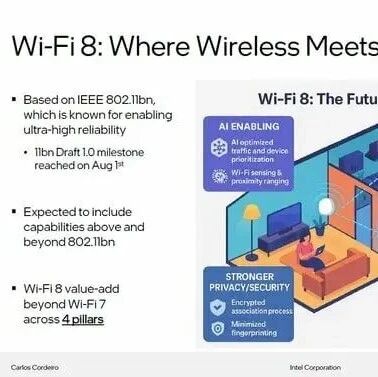
Core Viewpoint - Wi-Fi 8 is set to revolutionize network connectivity by intelligently adapting to local environments, providing stable and reliable network services, and addressing common issues like network congestion and speed lags [1][4]. Group 1: Technological Advancements - Wi-Fi 8 will not significantly increase theoretical peak data rates compared to Wi-Fi 7 but will enhance practical performance through refined features [1]. - The new technology will focus on improving reliability, reducing latency, and incorporating stronger intelligent capabilities [4]. - Wi-Fi 8 will introduce seamless roaming technology, reducing device switching latency to single-digit milliseconds and eliminating data packet loss during transitions between access points [4]. Group 2: User Experience Enhancements - In environments with multiple users, Wi-Fi 8 will optimize Quality of Service (QoS) to prioritize low-latency traffic, ensuring fair and efficient use of spectrum resources among high-performance and low-configuration devices [5]. - The technology will enable devices to sense their environment, allowing for features like automatic session switching between devices and gesture recognition [6]. Group 3: Technical Specifications - Wi-Fi 8 will support more intermediate modulation modes, significantly improving transmission rates for users with medium signal strength [7]. - It will utilize Low-Density Parity-Check (LDPC) coding, doubling the codeword length compared to Wi-Fi 7, enhancing error correction capabilities and extending signal transmission distances [7]. - The technology will implement a prioritized version of Enhanced Distributed Channel Access (EDCA) to ensure high-priority data packets are transmitted first, even in congested networks [7]. Group 4: Security Features - Wi-Fi 8 will enhance security with new control frame encryption to prevent spoofing attacks and will support the IEEE P802.11bi standard for improved protection of management frames [8]. Group 5: Compatibility and Market Readiness - Wi-Fi 8 will maintain backward compatibility with Wi-Fi 5, 6, and 7 devices, although older devices will not benefit from the new features [9]. - Intel plans to wait for certification standards to be established before launching Wi-Fi 8 products to ensure interoperability among devices from different manufacturers [9].
玻璃基板,量产前夜
半导体行业观察· 2025-12-28 02:49
Core Viewpoint - The semiconductor industry is shifting from process competition to packaging innovation, with glass substrates emerging as a key material to overcome performance bottlenecks in advanced packaging [1][2]. Group 1: Industry Dynamics - Major companies like Samsung, Intel, AMD, and Nvidia are actively exploring glass substrates for next-generation chip development, indicating a strategic focus on this material [1]. - Recent developments include Japan's Rapidus exploring glass substrate technology and Samsung's plans to establish a joint venture with Sumitomo Chemical for glass substrate production [1][2]. Group 2: Advantages of Glass Substrates - Glass substrates offer significant advantages over traditional organic substrates and silicon interposers, including lower dielectric loss, excellent thermal stability, and high flatness [3][4]. - The electrical performance of glass substrates is superior, with signal transmission loss at 10GHz being only 0.3dB/mm, and dielectric loss reduced by over 50% compared to organic substrates [4]. - Glass substrates can achieve a thermal expansion coefficient (CTE) of 3-5ppm/°C, matching silicon chips and reducing warpage by 70% during thermal cycling [4]. Group 3: Types of Glass Substrates - Glass substrates are categorized into glass interposers and glass core substrates, each serving different roles in advanced packaging scenarios [3][6]. - Glass interposers are primarily used in 2.5D packaging, enabling high-density interconnections between multiple chips [6]. - Glass core substrates are aimed at 3D packaging and chiplet integration, providing a stable solution for increasing chip sizes and I/O counts [8]. Group 4: Industry Competition - The competition in the glass substrate market is intensifying, with companies like Intel, Samsung, TSMC, and new entrants like Rapidus and Absolics making significant investments and strategic moves [12][14][20]. - Intel has invested over $1 billion in developing glass substrate technology and aims for large-scale application by 2026-2030 [12][13]. - Samsung is pursuing a dual-line strategy, focusing on both rapid commercialization and long-term technological breakthroughs in glass substrates [14][15]. Group 5: Challenges and Barriers - The glass substrate industry faces challenges in scaling production, with many companies still in the early stages of development and validation [34][39]. - Key technical challenges include the efficiency and yield of TGV (Through Glass Via) processes, high-density wiring, and bonding reliability [35][41]. - Cost remains a significant barrier, with the production costs of glass substrates being substantially higher than traditional organic substrates, limiting their application in price-sensitive markets [39][40]. Group 6: Domestic Developments - Domestic companies in China are actively pursuing opportunities in the glass substrate market, leveraging their expertise in glass processing and precision manufacturing [23][30]. - Companies like BOE and Wog Glass are making strides in developing glass substrates for semiconductor packaging, with plans for mass production and technological advancements [24][25]. - The establishment of industry alliances and collaborations between academia and industry is fostering innovation and addressing common technical challenges in the glass substrate sector [30][31].



台积电才是英特尔的 “救命稻草”,不是英伟达!
是说芯语· 2025-12-28 00:33
Core Viewpoint - The collaboration between Intel and Nvidia marks a significant development in the semiconductor industry, with both companies aiming to design custom x86 chips for data centers and client markets, alongside Nvidia's $5 billion investment in Intel [5][7]. Group 1: Market Impact - Intel's stock price has seen a notable increase following the announcement of the partnership, indicating renewed investor confidence in Intel's potential within the semiconductor sector [5]. - The collaboration is expected to help Intel regain market share in data centers and personal computers, where it has been losing ground to competitors like AMD [7][8]. - Intel's share in the server processor market has dropped below 63%, with projections indicating further declines to around 55% by 2025 and potentially below 50% by 2028, while AMD's share is expected to rise to 40% [9]. Group 2: Competitive Landscape - The partnership allows Intel to customize x86 CPUs for Nvidia, integrating NVlink to enhance AI data center capabilities, which could help Intel reclaim its position in the market [8]. - In the consumer CPU market, AMD has begun to surpass Intel, particularly in desktop CPUs, while Intel's traditional stronghold in laptop CPUs faces challenges due to insufficient performance in recent product launches [11][12]. - Intel's ambition to become a major player in the foundry business faces hurdles, as Nvidia's investment has not translated into foundry orders, which are crucial for Intel's value proposition to the U.S. government [13][18]. Group 3: Technological Challenges - Intel's manufacturing technology has lagged behind TSMC, with the latest 18A process yielding only 55% efficiency compared to TSMC's 65% for its N2 process [14][13]. - The semiconductor industry is experiencing a supply shortage, particularly for advanced chips, which presents an opportunity for Intel to position itself as an alternative to TSMC [15][17]. Group 4: Strategic Positioning - Intel's future is increasingly tied to U.S. government interests, which complicates its operational independence and may hinder its ability to innovate effectively [20][21]. - The company's leadership faces challenges in navigating the political landscape while striving for technological advancement and market competitiveness [22].
英特尔申请用于具有凸块间距缩放的过孔形成的具有保护层的嵌入式桥专利,过孔接触焊盘
Jin Rong Jie· 2025-12-27 09:43
Group 1 - The core point of the article is that Intel has applied for a patent for a device involving a protective layer and embedded bridge with bump pitch scaling, indicating ongoing innovation in semiconductor technology [1] Group 2 - The patent application is titled "Embedded Bridge with Protective Layer for Via Formation with Bump Pitch Scaling" and was published under the number CN121215621A [1] - The application date for the patent is May 2025, suggesting future developments in Intel's technology roadmap [1] - The patent abstract describes a device that includes a substrate and components within the substrate, which feature pads, indicating a focus on advanced manufacturing techniques [1]
Intel CEO Lip-Bu Tan Calls 2025 'Defining Year' As Stock Soars 79%, Nvidia And SoftBank Deals Fuel Turnaround Despite Trump Conflict - Intel (NASDAQ:INTC), NVIDIA (NASDAQ:NVDA)
Benzinga· 2025-12-27 08:30
Core Insights - Intel's CEO Lip-Bu Tan emphasized that 2025 will be a pivotal year for the company, driven by significant AI funding and a stock rally amidst political scrutiny [1][2]. Company Developments - Tan described 2025 as a "defining year," highlighting internal changes, renewed execution discipline, and increased confidence from customers and partners [2]. - Under Tan's leadership, Intel is focusing on a "New Intel," with employees uniting to support this vision [3]. - Tan's background in venture capital has facilitated major funding commitments, including $5 billion from Nvidia and $2 billion from SoftBank, enhancing Intel's financial position [4]. Political and Legal Challenges - Tan's tenure has faced controversy due to reports of his connections to Chinese companies with potential military ties, leading to calls for his resignation from President Trump [5]. - The U.S. government restructured CHIPS Act funding into a $5.7 billion equity investment, securing a 10% stake in Intel to prevent a breakup of its foundry division [6]. - Intel is involved in a legal dispute with Taiwan Semiconductor Manufacturing Company (TSMC) over allegations that a former executive leaked trade secrets [7][8]. Financial Performance - Intel reported third-quarter revenue of $13.65 billion, exceeding Wall Street expectations of $13.14 billion, with adjusted earnings of 23 cents per share, significantly above the forecast of 1 cent [9]. - The company's overall revenue increased by 3% year-over-year during the quarter [9]. - Intel's stock has surged approximately 79.03% year-to-date, indicating renewed investor confidence despite short-term performance challenges [10].
英特尔展示超大芯片封装技术
半导体行业观察· 2025-12-27 01:33
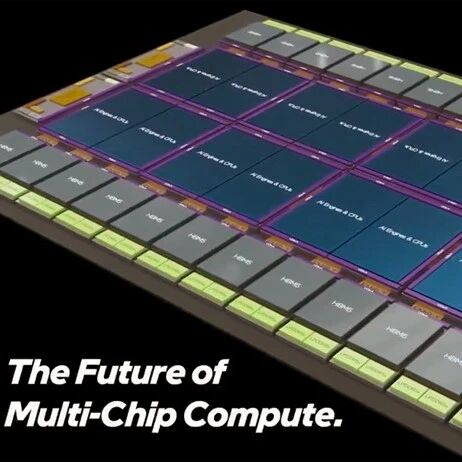
Core Viewpoint - Intel is pioneering a multi-chip design consisting of 47 chips, specifically targeting artificial intelligence and high-performance computing applications with its Ponte Vecchio computing GPU, which currently holds the record for the most chips in a design. The company plans to introduce an even more advanced multi-chip package that integrates at least 16 compute units and 24 HBM5 memory stacks on eight basic chips, with a size that can expand to 12 times that of the largest AI chips on the market, surpassing TSMC's 9.5 times [1][2]. Group 1 - The proposed multi-chip package features 16 large compute units manufactured using Intel's advanced 14A and 14A-E process technologies, which include 1.4nm features and enhanced capabilities [1]. - The foundational chips utilize 18A-PT technology (1.8nm) to perform additional computations or provide substantial SRAM cache for the main compute chips, showcasing Intel's innovative design [2]. - Intel's Foveros Direct 3D technology represents the pinnacle of its packaging innovation, utilizing ultra-high-density bonding techniques to maximize bandwidth and power for the top chips [2]. Group 2 - Intel suggests using a custom HBM5 module connected via a UCIe-A based EMIB-T interface instead of standard JEDEC-compliant HBM5 stacks, aiming for higher performance and capacity [3]. - The entire package can accommodate PCIe 7.0, optical engines, incoherent structures, 224G SerDes, dedicated accelerators for security, and even LPDDR5X memory to enhance DRAM capacity [3]. - Intel has showcased two conceptual designs: a "medium scale" design with four compute units and 12 HBM memory, and an "extreme scale" design with 16 compute units and 24 HBM5 stacks, with the latter being the focus of the article [7]. Group 3 - The extreme packaging concept is expected to emerge by the end of this decade, positioning Intel to compete closely with TSMC, which also plans to launch similar products around 2027-2028 [7]. - Achieving this extreme design within a few years poses significant challenges for Intel, particularly in ensuring that components do not deform during installation and can manage heat effectively over time [7]. - The size of these processors could reach up to 10,296 square millimeters, necessitating advanced thermal management solutions [7].
美股三大指数收盘微跌 英伟达涨超1%
Xin Lang Cai Jing· 2025-12-26 23:39
Market Overview - On December 26, US stock indices closed slightly lower, with the Nasdaq down 0.09%, the Dow Jones down 0.04%, and the S&P 500 down 0.03% [1] - Major tech stocks showed mixed performance, with Tesla dropping over 2%, while Nvidia rose over 1% and Netflix increased nearly 1% [1] Individual Stock Performance - Xpeng Motors saw a significant increase, rising over 6%, while NIO gained nearly 4% [1] - Alibaba and Baidu both experienced gains of over 1%, while Bawang Tea dropped by 2.54% [1]




