
Intel(INTC)

Search documents
Stock market today: Dow, S&P 500, Nasdaq stall after volatile week as Intel earnings fall short
Yahoo Finance· 2026-01-22 23:41
Group 1: Market Overview - US stocks experienced a decline, with the Dow Jones Industrial Average retreating approximately 0.5%, the S&P 500 falling nearly 0.2%, and the Nasdaq Composite dipping below the flat line [1][7] - The S&P 500 is set for back-to-back weekly losses as investor sentiment shifts following a brief period of gains [3] Group 2: Intel's Financial Performance - Intel reported a disappointing first quarter guidance, resulting in a quarterly loss as it struggled to meet demand for server chips used in AI data centers, leading to a nearly 15% drop in its shares [2][11] - The company's overall revenue for the third quarter declined 10% year over year to $2.6 billion, missing Wall Street estimates of $2.7 billion, although adjusted profits rose to $1.77 per share, surpassing analysts' expectations of $1.27 [10][11] Group 3: Booz Allen Hamilton's Growth - Booz Allen Hamilton's stock rose 7% in premarket trading as the company indicated a reacceleration of contracts following government cost-cutting efforts [8] - The company's sales backlog increased by 2% year over year to $38 billion in the third quarter, with the CEO expressing optimism about growth prospects in both national security and civil business sectors [9] Group 4: Emerging Market Trends - Emerging-market stocks and currencies are experiencing significant inflows as investors seek to diversify away from US assets, with the MSCI Emerging Markets Index on track for its longest winning streak since May [20][22] - Asian technology shares are driving the rally, while other regions are also showing strong performance, with the MSCI EM Latin America Index closing at its highest since April 2018 [21] Group 5: Natural Gas Market - US natural gas futures saw a decline after a record-breaking three-day rally, dropping as much as 7.6% to $4.660 per million British thermal units, despite a previous surge of 63% [25][26]

Stock market today: Dow leads S&P 500, Nasdaq waver after volatile week as Intel earnings fall short
Yahoo Finance· 2026-01-22 23:41
US stocks wavered on Friday, after chipmaker Intel's (INTC) disappointing financial outlook and a turbulent week stoked by President Trump's heated pursuit of Greenland. The Dow Jones Industrial Average (^DJI) retreated roughly 0.6%. The S&P 500 (^GSPC) hovered above the flat line, and the Nasdaq Composite (^IXIC) rose 0.3%. Intel posted worse-than-expected first quarter guidance late Thursday, weighing on tech sentiment. The chip giant swung to a quarterly loss as it struggled to meet demand for its se ...
美股科技股拉升,特斯拉涨超4%,英特尔盘后跌近10%,中概股普涨,阿里涨超5%,金银铂创历史新高
2 1 Shi Ji Jing Ji Bao Dao· 2026-01-22 23:39
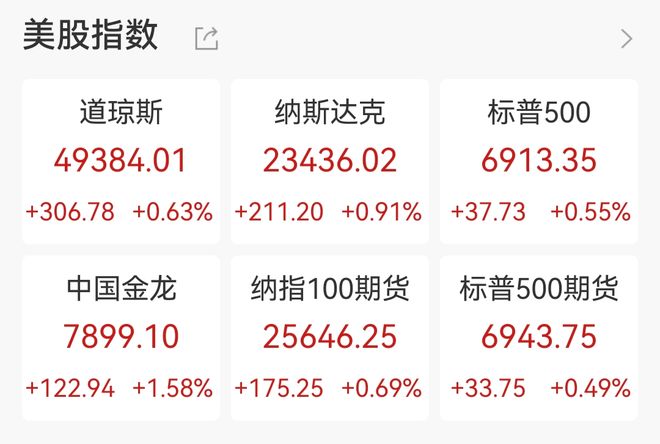
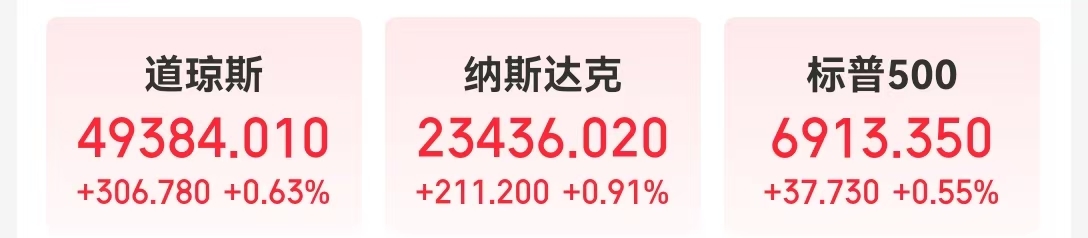
记者丨张嘉钰 编辑丨江佩佩 1月23日,美股三大指数收盘集体上涨,道指涨0.63%,纳指涨0.91%,标普500指数涨0.55%。 美国当天公布的一系列宏观数据整体偏强。地缘政治担忧消散,叠加美国经济数据强劲,提振风险偏 好。美股主要股指连续第二个交易日上涨,完全收复本周早些时候的失地。降息预期减弱下,短期美债 承压。2年期美债收益率上行2.5个基点,10年期收益率则持平于昨日尾盘。美元下挫0.5%,逼近98关 口。 | 美股指数 | | | | --- | --- | --- | | 道琼斯 | 纳斯达克 | 标普500 | | 49384.01 | 23436.02 | 6913.35 | | +306.78 +0.63% +211.20 +0.91% +37.73 +0.55% | | | | 中国金龙 | 纳指100期货 | 标普500期货 | | 7899.10 | 25646.25 | 6943.75 | | +122.94 +1.58% +175.25 +0.69% +33.75 +0.49% | | | 特斯拉涨超4%,据智通财经,全球首富、特斯拉CEO埃隆·马斯克最新表示,特斯拉可能会在明年 ...


美股收高,热门中概股普涨,金银再创新高
Di Yi Cai Jing Zi Xun· 2026-01-22 23:37
Market Overview - The market sentiment improved significantly after President Trump temporarily withdrew tariff threats against European countries, leading to a rebound in U.S. stock indices [2][4] - As of Thursday's close, the Dow Jones Industrial Average rose by 306.78 points (0.63%) to 49,384.01, the S&P 500 increased by 37.73 points (0.55%) to 6,913.35, and the Nasdaq Composite gained 211.20 points (0.91%) to 23,436.02 [2] Sector Performance - Small-cap stocks showed particularly strong performance, with the Russell 2000 index rising by 0.76% to a record closing high, indicating a recovery in market risk appetite [3] - Major tech stocks performed robustly, with Meta up 5.66%, Tesla up 4.15%, and Nvidia up 0.83%. Other notable movements included Apple up 0.28%, Microsoft up 1.58%, and Amazon up 1.31% [3] - The semiconductor sector continued its rebound, with Micron Technology up 2.18% and AMD up 1.57% [3] Earnings Reports - Intel's stock plummeted over 12% in after-hours trading following its earnings report, which indicated a first-quarter revenue forecast of $11.7 billion to $12.7 billion, below market expectations [3] - Despite the weak guidance, Intel's fourth-quarter performance exceeded expectations, with revenue of $13.67 billion and earnings per share of $0.15, both surpassing market forecasts [3] Economic Data - U.S. macroeconomic data remained robust, with the November Personal Consumption Expenditures (PCE) price index rising 2.8% year-over-year, aligning with market expectations [6] - The third-quarter GDP growth rate was revised up to 4.4%, marking the fastest growth since the third quarter of 2023 [7] - Initial jobless claims rose slightly to 200,000, which was below expectations, indicating stability in the job market [7] Commodity Market - The commodity market showed mixed results, with international oil prices declining; Brent crude fell by $1.18 to $64.06, and WTI crude dropped by $1.26 to $59.36 [8] - Precious metals continued to perform strongly, with spot gold rising by $2.22 to a historical high of $4,939.41 per ounce, and COMEX gold futures also reaching a new high [8]

美股科技股拉升,特斯拉涨超4%,英特尔盘后跌近10%,中概股普涨,阿里涨超5%,金银铂创历史新高
21世纪经济报道· 2026-01-22 23:35
Core Viewpoint - The US stock market indices experienced a collective rise, driven by strong macroeconomic data and reduced geopolitical concerns, leading to increased risk appetite among investors [1]. Group 1: US Stock Market Performance - On January 23, the Dow Jones increased by 0.63% to 49,384.01, the Nasdaq rose by 0.91% to 23,436.02, and the S&P 500 gained 0.55% to 6,913.35 [2]. - Major technology stocks saw significant gains, with the "Big Seven" tech index rising by 1.47%. Notable individual stock performances included Microsoft and Amazon both rising over 1%, Meta increasing by 5.7%, Oracle by over 2%, and Tesla by over 4% [2]. Group 2: Intel's Financial Performance - Intel's stock fell nearly 10% after reporting Q4 revenue of $13.67 billion, a 4.1% year-over-year decline, which was slightly above market expectations of $13.43 billion. The adjusted EPS for Q4 was $0.15, compared to $0.13 in the previous year, exceeding the forecast of $0.09 [3]. - For Q1, Intel projected an adjusted EPS of $0.00, below the market expectation of $0.08, and revenue guidance of $11.7 billion to $12.7 billion, compared to the market estimate of $12.56 billion [3]. Group 3: Commodities Market - The Nasdaq China Golden Dragon Index rose by 1.59%, with many popular Chinese concept stocks increasing, including Alibaba and XPeng both up over 5% [4]. - Gold prices surged by 2.22% to a record high of $4,939.41 per ounce, while silver rose by 3.55% to $96.36 per ounce, also reaching a historical peak [4]. - The geopolitical risk premium has decreased, contributing to a drop in oil prices, with WTI crude falling below $60 [4]. Group 4: US Economic Data - On January 22, several macroeconomic data points were released, showing a Q3 2025 annualized GDP growth rate of 4.4%, slightly above the expected 4.3% [5]. - The core PCE index for Q3 2025 was reported at an annualized increase of 2.9%, matching expectations, while the overall PCE index rose by 2.8%, below the anticipated 3.5% [5]. - The probability of a 25 basis point rate cut by the Federal Reserve in January is at 5%, with a 95% chance of maintaining current rates [5].

中国资产大涨 阿里巴巴涨超5%!美国公布重磅数据 特斯拉市值一夜增超4100亿元!国际金价银价同创历史新高
Mei Ri Jing Ji Xin Wen· 2026-01-22 23:21
Group 1: Market Performance - US stock markets closed higher on January 22, with the Dow Jones up 0.63%, Nasdaq up 0.91%, and S&P 500 up 0.55% [1] - Technology stocks saw significant gains, with Meta rising 5.7%, Oracle up over 2%, and Tesla increasing by over 4% [2][3] Group 2: Tesla Developments - Tesla's market value increased by $59.6 billion (approximately 415.6 billion RMB) in one night [3] - CEO Elon Musk announced that Tesla may start selling its humanoid robot "Optimus" to the public by the end of next year, with the robots currently performing simple tasks in factories [4] - Musk predicts that by the end of 2026, these robots will be capable of completing more complex tasks [5] Group 3: Intel Financials - Intel reported fourth-quarter revenue of $13.67 billion, a year-over-year decrease of 4.1%, with adjusted earnings per share of $0.15, up from $0.13 the previous year [6] - The company expects first-quarter adjusted earnings per share of $0.00, with revenue projected between $11.7 billion and $12.7 billion [6] Group 4: Economic Indicators - The US third-quarter GDP annualized growth rate was revised to 4.4%, slightly above the expected 4.3% [9] - Initial jobless claims for the previous week were reported at 200,000, below the expected 210,000 [8]

英特尔称,存储芯片价格上涨,可能会在2026年伤害到个人电脑(PC)市场
Jin Rong Jie· 2026-01-22 23:18
Core Viewpoint - Intel indicates that rising prices of memory chips may negatively impact the personal computer (PC) market by 2026 [1] Group 1 - Intel has reported an increase in memory chip prices [1] - The potential impact of these price increases could harm the PC market in the coming years [1]
英特尔盘后跌超13%,2025年第四季度营收同比减少4%
Xin Lang Cai Jing· 2026-01-22 23:17
英特尔股价盘后跌超13%。 当地时间1月22日,英特尔公布2025年全年营收为529亿美元,与上年持平。2025年第四季度营收137亿 美元,同比减少4%,市场预估134.3亿美元;第四季度调整后每股收益0.15美元,上年同期0.13美元, 预估0.09美元。 英特尔预计2026年第一季度调整后每股收益0.00美元,市场预估0.08美元;预计第一季度营收117亿美元 至127亿美元,市场预估125.6亿美元。 ...
Intel(INTC) - 2025 Q4 - Earnings Call Transcript
2026-01-22 23:02
Financial Data and Key Metrics Changes - Fourth quarter revenue was $13.7 billion, marking the fifth consecutive quarter of revenue above guidance, driven by strong growth across all businesses, particularly in AI infrastructure [18][20] - Non-GAAP gross margin for Q4 was 37.9%, approximately 140 basis points ahead of guidance, while full year non-GAAP gross margin was 36.7%, up 70 basis points year-over-year [18][20] - Non-GAAP earnings per share for Q4 was $0.15, exceeding guidance of $0.08, driven by higher revenue and stronger gross margins [19][20] - Operating cash flow for Q4 was $4.3 billion, with positive adjusted free cash flow of $2.2 billion [20] Business Line Data and Key Metrics Changes - Intel Products' Q4 revenue was $12.9 billion, up 2% sequentially, with Client Computing Group (CCG) revenue at $8.2 billion, down 4% quarter-over-quarter despite a 16% growth in AI PC units [22][23] - Data Center and AI (DCAI) revenue was $4.7 billion, up 15% sequentially, reflecting strong demand for traditional server compute [24] - Custom ASIC business grew over 50% in 2025, reaching an annualized revenue run rate greater than $1 billion in Q4 [24] Market Data and Key Metrics Changes - The total addressable market (TAM) for client consumption was estimated to be greater than 290 million units in 2025, marking two consecutive years of growth [23] - Demand for traditional servers remains strong, with a focus on ramping available capacity to support the uptick in data center demand [9][24] Company Strategy and Development Direction - The company aims to capitalize on AI-driven trends by strengthening its client franchise and advancing its data center, AI accelerator, and ASIC strategies [6][12] - A focus on simplifying the organization and reducing bureaucracy to improve efficiency and accelerate decision-making has been emphasized [4][6] - The long-term ambition is to rebuild Intel as a compute platform of choice for the next era of AI-driven computing, supported by world-class engineering and a renewed culture of execution [12][15] Management's Comments on Operating Environment and Future Outlook - Management expressed optimism about the significant growth opportunities presented by AI across all business lines, despite acknowledging supply constraints that limited growth [6][15] - The company is committed to improving yield and efficiency in manufacturing to better support customer demand [15][16] - Management anticipates a strong year of growth for DCAI in 2026, with expectations of improved supply beginning in Q2 [28][29] Other Important Information - The company has strengthened its balance sheet, ending 2025 with $37.4 billion in cash and short-term investments [21] - The completion of strategic partnerships and investments, including a $5 billion investment from NVIDIA, has bolstered the company's financial position [20][21] Q&A Session Summary Question: Supply constraints and yield improvements - Management indicated that improving yields and throughput are key drivers for increasing supply, with expectations for improvements in Q2 [34][35] Question: Gross margin expectations - Management noted that gross margin is expected to decline in Q1 due to lower revenue and the impact of new product introductions, but improvements are anticipated as supply increases [40][41] Question: Server prospects and market share - Management emphasized the importance of the data center and AI strategy, focusing on the introduction of new products like Diamond Rapids and Coral Rapids to capture market share [55][56] Question: External foundry revenue expectations - Management expects to begin seeing revenue from external foundry efforts in 2027, with significant customer engagement already underway [76][79]
Intel(INTC) - 2025 Q4 - Earnings Call Transcript
2026-01-22 23:02
Financial Data and Key Metrics Changes - Fourth quarter revenue was $13.7 billion, marking the fifth consecutive quarter of revenue above guidance, driven by strong growth across all businesses, particularly in AI infrastructure [18][22] - Non-GAAP gross margin for Q4 was 37.9%, approximately 140 basis points ahead of guidance, while full year non-GAAP gross margin was 36.7%, up 70 basis points year-over-year [18][20] - Non-GAAP earnings per share for Q4 was $0.15, exceeding guidance of $0.08, attributed to higher revenue and stronger gross margins [18] - Operating cash flow for Q4 was $4.3 billion, with positive adjusted free cash flow of $2.2 billion [19] Business Line Data and Key Metrics Changes - Client Computing Group (CCG) revenue was $8.2 billion, down 4% quarter-over-quarter, despite a 16% growth in AI PC units [22][23] - Data Center and AI (DCAI) revenue was $4.7 billion, up 15% sequentially, reflecting strong demand for traditional server compute [24] - Intel Foundry revenue was $4.5 billion, up 6.4% sequentially, with an operating loss of $2.5 billion due to the early ramp of Intel 18A [25][26] Market Data and Key Metrics Changes - The total addressable market (TAM) for client consumption was estimated to be greater than 290 million units in 2025, marking two consecutive years of growth [23] - The custom ASIC business grew more than 50% in 2025, reaching an annualized revenue run rate greater than $1 billion in Q4 [24] - The demand for traditional servers remains strong, with a focus on ramping available capacity to support the uptick in demand [9][10] Company Strategy and Development Direction - The company aims to capitalize on AI-driven trends by strengthening its client franchise and advancing its data center, AI accelerator, and ASIC strategies [6][12] - A focus on simplifying the organization and reducing bureaucracy to improve efficiency and accelerate decision-making has been emphasized [4] - The long-term ambition is to rebuild Intel as a compute platform of choice for the next era of AI-driven computing [12] Management's Comments on Operating Environment and Future Outlook - Management expressed optimism about the significant growth opportunities presented by AI across all business lines, despite acknowledging supply constraints [6][15] - The company is committed to improving yield and throughput to better support customer demand, with expectations for improvements in Q2 2026 [16][28] - Management remains transparent about challenges and areas needing improvement, particularly in meeting market demand [15] Other Important Information - The company is focused on building a world-class wafer and advanced packaging foundry, with significant investments in IP and yield improvement [13][14] - The engagement with external customers for the foundry business is active, with expectations for volume production starting in 2028 [80] Q&A Session Summary Question: Supply constraints and yield improvements - Management indicated that improving yields and throughput are key drivers for increasing supply, with expectations for improvements in Q2 [35][36] Question: Gross margin expectations - Management noted that gross margin is expected to decline in Q1 due to lower revenue and the impact of new product costs, with a focus on improving cost structures throughout the year [41][42] Question: Server prospects and market share - Management highlighted the importance of the 16-channel Diamond Rapids and Coral Rapids in driving market share, with a focus on meeting demand from hyperscalers [56][57] Question: Foundry business success metrics - Management defined success in the foundry business as building trust and consistency with customers, with expectations for significant revenue from advanced packaging opportunities [48][53] Question: Server CPU TAM and supply constraints - Management indicated that the demand is largely an x86 phenomenon, with expectations for supply improvements throughout the year [84][86]