Intel(INTC)

Search documents
As Trump Says He Is ‘Proud’ of Intel, Should You Buy INTC Stock?
Yahoo Finance· 2026-01-12 19:17
Core Viewpoint - Intel's stock surged 10% following a meeting between CEO Lip-Bu Tan and President Trump, who expressed government support for the company, which has seen its stock more than double since a federal investment of $8.9 billion last August [1][4]. Group 1: Company Performance - Intel's stock has more than doubled since the federal government acquired a 10% stake at $20.47 per share, with shares closing at $45.55 [1][4]. - The company is experiencing a critical inflection point under new CEO Lip-Bu Tan, who is implementing aggressive cultural transformation amid severe supply constraints [6]. Group 2: Government Support and Market Context - The U.S. government has expressed pride in being a shareholder of Intel, which aligns with its push for domestic semiconductor manufacturing [1][4]. - The federal investment has already generated unrealized profits exceeding $10 billion, indicating strong market confidence [4]. Group 3: Competitive Landscape - The broader semiconductor sector has rallied alongside Intel, with companies like Broadcom, ASML, and Micron also seeing stock increases [5]. - Intel faces competitive challenges from AMD and ARM-based alternatives, which have been eroding its market share [6]. Group 4: Product Development - Intel's immediate challenge is to ramp up production of Panther Lake, its first major product built on the 18A manufacturing process, with initial shipments expected by year-end and broader availability in Q1 of 2026 [7].

Analyzing Intel In Comparison To Competitors In Semiconductors & Semiconductor Equipment Industry - Intel (NASDAQ:INTC)
Benzinga· 2026-01-12 15:00
Core Insights - The article provides a comprehensive evaluation of Intel in the Semiconductors & Semiconductor Equipment industry, comparing its performance against major competitors to identify investment opportunities and risks [1] Company Overview - Intel is a leading digital chipmaker focused on microprocessors for personal computers and data centers, holding a significant market share in both PC and server markets [2] - The company aims to revitalize its chip manufacturing business, Intel Foundry, while developing advanced products within its Intel Products segment [2] Financial Metrics - Intel's current Price to Earnings (P/E) ratio is 759.17, which is 10.44 times higher than the industry average, indicating a premium pricing in the market [5] - The Price to Book (P/B) ratio stands at 2.04, significantly lower than the industry average, suggesting potential undervaluation [5] - The Price to Sales (P/S) ratio of 3.75 is also below the industry average, indicating that the stock may be undervalued based on sales performance [5] - Intel's Return on Equity (ROE) is 3.98%, which is 1.69% below the industry average, indicating inefficiencies in profit generation [5] - The company's EBITDA is $7.85 billion, which is 0.2 times below the industry average, suggesting lower profitability [5] - Gross profit is reported at $5.22 billion, indicating a performance that is 0.15 times below the industry average [5] - Revenue growth for Intel is at 2.78%, significantly lower than the industry average of 34.59%, indicating a slowdown in sales expansion [5] Debt to Equity Ratio - Intel has a debt-to-equity (D/E) ratio of 0.44, which is lower than its top four peers, indicating a stronger financial position and a favorable balance between debt and equity [8] Comparative Performance - In comparison to its peers, Intel's high P/E ratio suggests potential overvaluation, while its low P/B and P/S ratios indicate undervaluation relative to competitors [9] - Intel lags behind its peers in ROE, EBITDA, gross profit, and revenue growth, signaling weaker financial performance and growth prospects within the sector [9]


美股低开,中概股逆势走强
Di Yi Cai Jing Zi Xun· 2026-01-12 14:56
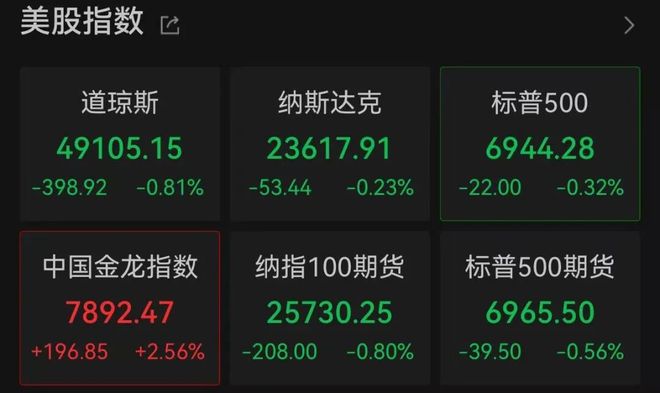
Market Overview - The three major U.S. stock indices opened lower on January 12, with the Dow Jones down 0.81%, the Nasdaq down 0.23%, and the S&P 500 down 0.32% [1][2]. Index Performance - Dow Jones: 49,105.15, down 398.92 points (-0.81%) [2] - Nasdaq: 23,617.91, down 53.44 points (-0.23%) [2] - S&P 500: 6,944.28, down 22.00 points (-0.32%) [2] - China Golden Dragon Index: 7,892.47, up 196.85 points (+2.56%) [2] - Nasdaq 100 Futures: 25,730.25, down 208.00 points (-0.80%) [2] - S&P 500 Futures: 6,965.50, down 39.50 points (-0.56%) [2] Sector Performance - Technology stocks experienced a broad decline, with Intel falling over 3% and Nvidia down nearly 1% [2]. - Banking stocks collectively dropped, with American Express down over 4% and JPMorgan Chase down more than 2% [2]. Chinese Stocks - Chinese stocks surged against the trend, with the China Golden Dragon Index rising over 2% [2]. - Notable performers included Kingsoft Cloud, which rose over 16%, Zhihu up over 15%, Alibaba up nearly 5%, Xpeng up over 4%, and Baidu up over 3% [2].



Intel Stock Gets a Price-Target Raise. Why Wall Street Doesn't Trust the Gains.
Barrons· 2026-01-12 14:26
The chip stock has rallied hard following President Donald Trump's praise for its CEO. Analysts still see issues for the company. ...
AI日报丨报告称2026年中国科技巨头指数将首超美股七巨头,英特尔股价大涨超10%
美股研究社· 2026-01-12 13:52
Group 1 - The article emphasizes the rapid development of artificial intelligence (AI) technology, which is creating extensive opportunities in various sectors [3] - Shanghai is focusing on "AI + manufacturing" as a key strategy to drive growth in the next decade, with initiatives aimed at enhancing industrialization through innovative conferences and collaborations [5] - Tsinghua University has developed an AI-driven high-throughput drug virtual screening platform, DrugCLIP, which significantly accelerates new drug screening by a million times and aims to collaborate with industry partners for drug discovery [6] Group 2 - A report indicates that by 2026, the Chinese technology giant index is expected to surpass the profitability of the "seven giants" of the US stock market for the first time since 2022, reflecting a positive outlook for AI-related companies in China [8] - The storage market has entered a "super bull market" phase, with prices expected to rise by 40%-50% in Q4 2025 and Q1 2026, driven by increasing demand from AI and server capacities [9] - Intel's stock surged over 10% following a meeting between its CEO and former President Trump, resulting in a significant increase in the value of the US government's investment in Intel [11]

英特尔:18A芯片出货量预示着牛市行情才刚刚开始
美股研究社· 2026-01-12 13:52
Core Viewpoint - Intel's stock has significantly outperformed the S&P 500 since January 2025, with a 106.76% increase compared to the S&P 500's 15.83% [1][2]. Financial Performance - As of January 9, 2026, Intel's stock price reached $45, with a market capitalization of $205 billion. Analysts believe Intel is in the early stages of a bull market, especially with the recent shipment of its 18A chip products [2][3]. - Intel's financial situation has improved under new management, showing signs of recovery with a return to profitability in Q3 2025 [4]. Management Actions - Since Lip-Bu Tan became CEO, Intel has actively cut costs and raised funds from the U.S. government, Nvidia, and SoftBank. Tan's compensation is primarily stock options, motivating him to maintain momentum [3]. Product Development - Intel has successfully shipped its first products using the 18A manufacturing process, which may enhance its contract manufacturing capabilities and attract more customer orders from companies like Google, AMD, and Apple [5]. - Analysts expect Intel to become more focused and engaged under the new management, potentially leading to more customer transactions [5]. Valuation Estimates - Analysts estimate the value of Intel's foundry business to be between $100 billion and $500 billion, and the CPU business between $180 billion and $240 billion, totaling $280 billion to $740 billion [6][9]. - The high-end valuation assumes Intel captures a significant portion of TSMC's North American sales, while the low-end valuation reflects a more modest market presence [10]. Market Potential - Analysts believe that if Intel can produce chips with performance comparable to TSMC, it could gain market share, especially with U.S. government support encouraging companies to procure from Intel [5][11]. - Despite a current P/E ratio of 120, analysts see substantial upside potential, estimating that Intel could still achieve significant market value growth [13]. Investment Outlook - Analysts rate Intel as a strong buy, indicating that the market is just beginning to recognize its value, with the shipment of the 18A chip acting as a catalyst for stock price increases [14].
Intel (INTC) Soars 10.8%: Is Further Upside Left in the Stock?
ZACKS· 2026-01-12 13:50
Group 1: Stock Performance - Intel shares increased by 10.8% to close at $45.55, with trading volume significantly higher than usual [1] - The stock has gained 4.1% over the past four weeks [1] Group 2: Product Development - Intel is experiencing strong demand for AI PCs, with the upcoming Intel Core Ultra series 3 processor (Panther Lake) and Xeon 6+ (Clearwater Forest) set to launch in Q3 2025 [2] - Both products will be manufactured in a new factory in Chandler, AZ, utilizing Intel's most advanced semiconductor process, 18A [2] Group 3: Product Features - Panther Lake is designed for a wide range of consumer and commercial AI PCs, gaming devices, and edge solutions [3] - Clearwater Forest is an E-core server processor aimed at helping businesses scale workloads and reduce energy costs, with a launch planned for the first half of 2026 [3] Group 4: Financial Expectations - Intel is expected to report quarterly earnings of $0.08 per share, reflecting a year-over-year decline of 38.5%, with revenues projected at $13.38 billion, down 6.2% from the previous year [4] - The consensus EPS estimate for Intel has remained unchanged over the last 30 days, indicating a potential lack of upward momentum in stock price without earnings estimate revisions [5] Group 5: Industry Context - Intel holds a Zacks Rank of 3 (Hold) within the Semiconductor - General industry [6] - Amtech Systems, another company in the same industry, saw a 6.7% increase in stock price, closing at $13.92, with a monthly return of 18.7% [6]
【招商电子】CES 2026跟踪报告:AI赋能依旧是主旋律,聚焦穿戴/IoT、智能车、机器人等新品创新
招商电子· 2026-01-12 12:03
Core Viewpoint - CES 2026 showcased significant advancements in AI-driven consumer electronics, with a focus on wearable devices, automotive technology, robotics, and IoT innovations, highlighting the integration of AI across various sectors [2][5][6]. Group 1: Wearable/IOT - AI glasses and camera headphones remain focal points in wearable technology, with over 50 companies participating, primarily from mainland China, emphasizing design improvements and multi-modal interactions [2][10]. - Headphone innovations shifted from audio performance to a combination of sound quality, AI integration, and multi-modal capabilities, with products featuring cameras and environmental awareness [2][13]. - New IoT categories, including smart imaging devices and AI home products, are gaining traction, with many startups entering the market [2][16]. Group 2: Automotive - AI is driving a comprehensive upgrade in automotive technology, with high-level autonomous driving expected to scale commercially [3][19]. - NVIDIA introduced the Alpamayo series of open-source AI models, enhancing the development of autonomous driving capabilities [3][19]. - Major automotive companies like Geely and Great Wall showcased their AI systems, while international brands are partnering with AI giants to enhance their offerings [3][24][26]. Group 3: Robotics - The robotics sector is evolving from household and service robots to humanoid collaboration, with significant participation from electronic companies [4][34]. - Innovations in household robots include advanced cleaning capabilities and a broader range of applications, while humanoid robots are becoming more sophisticated in interaction and movement [4][34]. - Chinese electronic companies are increasingly showcasing key components and technologies in robotics at CES 2026 [4][34]. Group 4: PC/Smartphone - Lenovo launched its first personal super intelligent system, Lenovo Qira, and announced a partnership with NVIDIA for AI infrastructure [4][36]. - Chip manufacturers like Intel, Qualcomm, and AMD are upgrading their products to enhance AI performance and user experience in PCs [4][39]. - The focus on AI integration in smartphones and PCs is expected to drive innovation and market growth in the coming years [4][39].






Stocks Set to Open Lower Amid Fed Fears, U.S. Inflation Data and Big Bank Earnings Awaited
Yahoo Finance· 2026-01-12 11:24
Market Performance - Wall Street's major equity averages ended positively, with the S&P 500 reaching a new record high [1] - Data storage companies saw significant gains, with Sandisk (SNDK) up over +12% and Seagate Technology Holdings (STX) rising more than +6% [1] - Chip stocks advanced, led by Intel (INTC) which surged over +10% following supportive comments from President Trump [1] - Vistra (VST) and Oklo (OKLO) also experienced notable increases of over +10% and +7% respectively after securing power supply agreements with Meta Platforms [1] - Qualcomm (QCOM) faced a decline of over -2% after a downgrade by Mizuho [1] Economic Indicators - The U.S. Labor Department reported a nonfarm payroll increase of 50K in December, below the expected 66K, while the unemployment rate fell to 4.4%, better than the anticipated 4.5% [4] - Average hourly earnings rose by +0.3% month-over-month and +3.8% year-over-year, surpassing expectations [4] - The University of Michigan's preliminary consumer sentiment index improved to 54.0 in January, exceeding expectations of 53.5 [4] Federal Reserve Insights - Richmond Fed President Tom Barkin noted modest job growth and a low-hiring environment, emphasizing the need for vigilance regarding unemployment and inflation risks [5] - San Francisco Fed President Mary Daly described the current phase as "fine-tuning" rather than making large policy changes [5] - U.S. rate futures indicate a 94.3% probability of no rate change and a 5.7% chance of a 25 basis point rate cut at the upcoming Fed meeting [5] Upcoming Economic Data - The U.S. consumer inflation report for December is anticipated to influence expectations for future rate cuts by the Fed [6] - Other significant data releases include U.S. retail sales for November and various indices related to manufacturing and job claims [6] Corporate Earnings - The fourth-quarter earnings season is set to begin, with major banks like JPMorgan Chase (JPM), Bank of America (BAC), and Wells Fargo (WFC) reporting this week [8] - Other notable companies scheduled to report include Morgan Stanley (MS), Goldman Sachs (GS), and Delta Air Lines (DAL) [8] International Market Developments - The Euro Stoxx 50 Index declined by -0.18% amid concerns over Fed independence and President Trump's proposed cap on credit card interest rates [10] - The Eurozone's Sentix Investor Confidence Index improved to -1.8, better than the expected -5.1 [11] - China's Shanghai Composite Index reached a new 10-year high, driven by advancements in AI and expectations of policy support [12]


都在发力CPO
半导体芯闻· 2026-01-12 10:23
Core Insights - There is growing interest in Co-Package Optics (CPO) as a promising candidate for reducing power consumption and increasing bandwidth between server packages, especially in the context of large-scale server deployments in artificial intelligence [1] - The ISSCC 2025 conference in San Francisco showcased multiple papers related to CPO technology, highlighting its relevance in the industry [1] Group 1: Broadcom's Tomahawk 5 - Broadcom introduced the Tomahawk 5 (TH5) - Bailly, which boasts a power efficiency of 6 pJ/b and a bandwidth of 51.2 Tbps, claiming it has been in mass production since 2023 [2] - Samples of TH5-Bailly have been provided to customers, although a widespread market release date has not been disclosed [2] Group 2: Intel's Direct-Drive Optical Engine - Intel presented a paper on a direct-drive optical engine based on a 0.9 pJ/b 108 Gb/s PAM4 VCSEL, which aims to improve bandwidth and power efficiency by using PAM4 modulation instead of NRZ [4] - The use of 3D-printed polymer waveguides instead of mechanical optical interfaces allows for a significant reduction in size, achieving a footprint of 11x8 mm compared to 4x6 mm and a height reduction from 3.5 mm to 1 mm [4] Group 3: Ehsan Afshari's MicroLED Research - Ehsan Afshari from the University of Michigan discussed using microLEDs instead of lasers for low-power, high-bandwidth D2D communication, emphasizing the benefits of parallel optical links [11] - His demonstration chip, built on TSMC N16 technology, achieved a bandwidth of 1.2 Tbps with a power consumption of less than 1 pJ/bit, targeting inter-chip or inter-package communication rather than long-distance [19] Group 4: Future of CPO Technology - Despite differing target markets, Broadcom, Intel, and Ehsan Afshari's research all focus on low power consumption and high bandwidth [21] - NVIDIA's CPO products, Quantum-X Photonics and Spectrum-X, are expected to be available in the second half of 2025, indicating a growing market for CPO technology [21][22] - The development of large server clusters, like "Stargate," will continue to drive efforts in enhancing performance while reducing power consumption, with CPO technology playing a crucial role [22]