Morgan Stanley(MS)

Search documents
美国三季度GDP数据让华尔街转向!美银、高盛齐推“经济过热”交易
Jin Shi Shu Ju· 2025-12-24 03:56
Core Viewpoint - The recent U.S. GDP data for Q3 shows a surprising growth of 4.3%, significantly exceeding expectations, with consumer spending increasing by 3.5%, leading to a consensus on Wall Street regarding an "overheating economy" [2] Economic Growth and Inflation - Analysts are shifting focus from recession risks to expectations of strong growth and high inflation in the U.S. for the coming year [2] - Glenmede's Michael Reynolds highlights factors such as tariff policies, fiscal stimulus, labor market changes, AI-related productivity, and potential deregulation as contributors to above-trend growth prospects through 2026 [2] - Bank of America anticipates strong growth next year, with inflation remaining above target, supported by factors like Fed rate cuts and AI investments [3] Investment Strategies - Bank of America identifies commodities, particularly oil and energy, as preferred investments for the "overheating economy" scenario, suggesting that commodities will perform well in 2026 [5] - Goldman Sachs notes that cyclical assets typically perform well during economic expansions and could benefit from the macro environment next year [4] Sector-Specific Insights - Goldman Sachs points to housing and consumer-facing markets, including non-essential consumer goods and retail stocks, as areas of optimism, indicating that cyclical assets are rebounding [6] - Morgan Stanley views non-essential consumer goods as fitting the "overheating" investment narrative, with the sector's revenue growth exceeding expectations [6] - Small-cap stocks are seen as attractive, with expectations of accelerated earnings and pricing power as the market moves toward 2026 [7]


M&As Are Heating Up: 3 Investment Bank Stocks to Benefit in 2026
ZACKS· 2025-12-23 16:56
Core Insights - The global merger and acquisition (M&A) cycle is experiencing a significant upswing, with 2025 marking a structural inflection point as companies and financial sponsors seek to offset slowing organic growth and secure competitive advantages, particularly in technology and AI [1][2] M&A Activity Overview - Global M&A activity surged 41% year over year to $4.81 trillion in 2025, the second-highest total on record, with 70 megadeals exceeding $10 billion [2] - Regulatory shifts under the Trump administration have created a more favorable environment for consolidation, easing approval processes [3] Outlook for 2026 - Large-scale M&As in 2026 are expected to focus on de-conglomeration and "buy-and-build" strategies, benefiting mid-market activity [5] - A 3% increase in deal volume is forecasted for 2026, with private equity-backed deals projected to rise due to undeployed capital and improved exit opportunities [7][6] Investment Banking Performance - Morgan Stanley's investment banking revenues rose 15% to $5.2 billion in the first nine months of 2025, supported by a healthy M&A pipeline [10][12] - Goldman Sachs advised on over $1 trillion in announced M&A volumes in 2025, maintaining a leadership position in global M&As [18] - Raymond James' investment banking fees increased by 26% in fiscal 2025, driven by a robust pipeline and active M&A market [24] Earnings Estimates - Morgan Stanley's earnings per share estimates for 2025 and 2026 are $9.88 and $10.41, reflecting year-over-year increases of 24.3% and 5.4% respectively [14] - Goldman Sachs' earnings per share estimates for 2025 and 2026 are $48.96 and $55.15, indicating growth of 20.8% and 12.6% respectively [20] - Raymond James' earnings per share estimates for fiscal 2026 and 2027 are $11.95 and $13.66, suggesting growth of 12.1% and 14.2% respectively [25]



GS or MS: Which IB Stock Should You Buy on Solid 2026 Prospects?
ZACKS· 2025-12-23 14:51
Core Insights - The article discusses the competitive landscape between Goldman Sachs (GS) and Morgan Stanley (MS) in the investment banking sector, particularly in light of the recovery in global mergers and acquisitions (M&As) and the evolving macroeconomic environment [2][26]. Group 1: Goldman Sachs - Goldman Sachs is a leading player in M&A, trading, and capital markets, with a 19% year-over-year increase in investment banking revenues for the first nine months of 2025, driven by a resurgence in global M&A activity [3][5]. - The company has made strategic moves to exit non-core consumer banking and focus on asset and wealth management, including acquisitions like Innovator Capital Management and Industry Ventures [5][6]. - Goldman plans to expand its private credit portfolio to $300 billion by 2029 and anticipates high-single-digit annual growth in private banking and lending revenues [6]. Group 2: Morgan Stanley - Morgan Stanley has diversified its revenue streams by focusing on asset and wealth management, which has provided stability during fluctuations in the investment banking business [7][10]. - The company's investment banking performance improved in 2025, supported by optimism surrounding interest rate cuts and a favorable operating environment [8][9]. - Morgan Stanley's client assets reached $8.9 trillion by September 2025, with a significant contribution from its wealth and asset management businesses, which accounted for over 55% of total net revenues [10]. Group 3: Financial Performance and Valuation - Over the past six months, Goldman Sachs shares increased by 35.8%, while Morgan Stanley shares rose by 32.3%, both outperforming the Zacks Investment Bank industry and the S&P 500 Index [11][15]. - Goldman is trading at a 12-month forward price-to-earnings (P/E) ratio of 16.34X, while Morgan Stanley's P/E ratio is 17.29X, indicating that Goldman is relatively less expensive [15][17]. - Morgan Stanley offers a higher dividend yield of 2.23% compared to Goldman's 1.78%, and its return on equity (ROE) of 16.4% surpasses Goldman's 15.29%, reflecting more efficient use of shareholder funds [17][18]. Group 4: Future Outlook - The Zacks Consensus Estimate projects a 10.8% year-over-year revenue increase for Goldman in 2025, with earnings expected to grow by 20.8% [19]. - In contrast, Morgan Stanley's revenue is expected to rise by 13.4% in 2025, with earnings anticipated to increase by 24.3% [24]. - Goldman is viewed as a safer bet for value investors due to its attractive valuation, while Morgan Stanley presents greater upside potential driven by stronger projected growth and strategic diversification efforts [25][26].

欧美银行股年内大涨!是迟到的修复,还是新周期开端?
Di Yi Cai Jing· 2025-12-23 13:17
Core Viewpoint - The future performance of European and American bank stocks will increasingly depend on the sustainability of earnings rather than further valuation expansion [4]. Group 1: European Bank Stocks - European bank stocks have shown significant recovery in 2025, with the STOXX Europe 600 Banks index rising approximately 65% year-to-date, making it one of the best-performing sectors in Europe [1]. - Analysts suggest that the rise in European bank stocks is more of a structural recovery rather than a typical cyclical rebound, as their valuation levels were significantly lower than their U.S. counterparts prior to this increase [2]. - The negative impact of the prolonged low-interest-rate environment on European banks' profitability has been a key factor suppressing their valuations [2]. - Major European banks have seen substantial stock price increases, with Deutsche Bank up about 97%, HSBC up approximately 48%, BNP Paribas up around 35%, and UBS up about 30% year-to-date [2]. Group 2: American Bank Stocks - American bank stocks have demonstrated more stable performance in 2025, with notable increases such as Citigroup up about 68%, Goldman Sachs up approximately 57%, and JPMorgan Chase up around 35% [5]. - The core strength of the U.S. banking system lies in its profitability and diversified business structure, which helps mitigate traditional credit cycle fluctuations [5]. - The valuation recovery for U.S. banks began earlier than for European banks, with the market already pricing in expectations of an economic soft landing and interest rate cuts [5]. Group 3: Future Outlook - For 2026, the consensus is shifting from "valuation recovery" to "earnings verification," with European banks needing to see a substantial recovery in credit demand and a reduction in geopolitical risks to maintain their strong performance [6]. - In the U.S., the focus will be on the Federal Reserve's policy path, with large banks expected to maintain capital returns if interest rate cuts are gradual and the economy achieves a soft landing [6]. - The bank stock market in 2026 is expected to be more selective, requiring investors to pay closer attention to earnings quality, risk management, and structural differences between markets [6].



AI正在扼杀金融业岗位?专家:只是炒作
财富FORTUNE· 2025-12-23 13:05
Core Viewpoint - The article discusses the impact of artificial intelligence (AI) on the financial industry, highlighting that while AI has the potential to automate many jobs, the current wave of layoffs in banks is more a result of over-hiring during the pandemic and economic uncertainty rather than AI itself [1][2]. Group 1: AI and Job Market Dynamics - Jamie Dimon, CEO of JPMorgan, indicated that AI could significantly affect job categories, similar to past technological revolutions [1]. - A report from Citigroup found that 54% of financial jobs have a high potential for automation, the highest among all industries [1]. - Experts suggest that the layoffs in the banking sector are largely a distraction from other economic issues, such as weak consumer demand and past hiring mistakes [2]. Group 2: Employment Trends in Banking - Despite headlines about layoffs, the overall employment in the banking and financial sector remains stable, with some banks even increasing their workforce [4]. - For instance, Bank of America reduced its workforce by only 4 employees, while JPMorgan added 2,000 employees [4]. - Experts predict that banks will delay hiring and rely on AI to improve efficiency until they are forced to increase labor costs [4]. Group 3: MBA Graduates and Job Opportunities - Top MBA programs still show strong employment rates, with 92% of Columbia Business School graduates and 86% of NYU Stern graduates securing jobs [5]. - However, there is a noted decline in job placement rates among elite MBA programs since 2021, indicating a tightening job market [6]. Group 4: Job Security and Risks in Finance - Not all financial jobs are equally vulnerable to automation; roles requiring critical thinking and low tolerance for error, such as consulting and compliance, are less likely to be automated [7]. - Conversely, positions in accounting and marketing are expected to face significant challenges due to AI advancements [8]. - Approximately 76% of banks anticipate increasing their technology staff due to AI, while 73% of bank employees' tasks may be affected by generative AI [7].

全球宏观:年末风险偏好升温-Global Macro Commentary-December 22 Risk-On Into Year-End
2025-12-23 02:56
Summary of Key Points from the Conference Call Industry Overview - The commentary focuses on global macroeconomic trends, particularly in the currency and bond markets, as well as geopolitical influences on oil prices. Core Insights and Arguments 1. **Currency Movements**: - USD/JPY retraced down to 157 as Japan's Ministry of Finance (MoF) reiterated potential foreign exchange (FX) intervention, indicating a proactive stance on currency stability [6][7][12] - The DXY index decreased by 0.3%, reflecting a general weakening of the dollar against risk-sensitive currencies like AUD, NZD, and GBP [6][11] 2. **Bond Market Dynamics**: - US rates experienced a modest sell-off, with a bear-flattening bias observed (2-year rates increased by 2 basis points, while 30-year rates rose by 1 basis point) [6] - The 2-year UST auction showed weak demand, tailing by 0.3 basis points, which may indicate investor caution ahead of upcoming auctions [6][7] 3. **Equity Market Performance**: - US equities continued their rally, with the S&P 500 gaining 0.6%, although defensive sectors like Consumer Staples lagged [6][11] - Japanese equities also saw a positive response, with the Nikkei index rising by 1.8% amid a risk-on sentiment [6] 4. **Geopolitical Influences**: - Oil prices rose nearly 3% to over $62 per barrel due to geopolitical tensions surrounding Venezuelan oil shipments, highlighting the impact of external factors on commodity prices [7][11] 5. **Central Bank Commentary**: - ECB Executive Board Member Schnabel indicated that rate hikes are not expected in the near term, which led to a slight rebound in front-end bunds [7][12] - Fed Governor Miran expressed concerns about a potential recession if rates are not lowered, suggesting a possible 25 to 50 basis point cut at the next meeting [7][12] Additional Important Insights 1. **Inflation Expectations**: - Inflation risks remain a focal point, with comments from various Fed officials suggesting that further rate cuts will depend on economic data, particularly regarding inflation trends [7][12] 2. **Emerging Markets**: - In Thailand, the Bank of Thailand proposed maintaining the 2026 inflation target at 1-3%, although it is expected to miss this target due to rising oil prices [8] 3. **Market Sentiment**: - The overall market sentiment is characterized by a robust risk appetite as the year-end approaches, which is influencing both equity and bond markets positively [6][11] 4. **Economic Data Releases**: - Upcoming economic data releases, including US GDP and employment figures, are anticipated to provide further insights into economic health and potential market movements [17] This summary encapsulates the key points discussed in the conference call, providing a comprehensive overview of the current macroeconomic landscape and its implications for various markets.
高盛重申中国股市到2027年可能上涨38%
Xin Lang Cai Jing· 2025-12-23 00:32
Group 1 - Goldman Sachs analysts predict a 14% growth in Chinese corporate earnings in 2026 and 12% in 2027, which could boost the performance of the Chinese stock market [2][5] - The report indicates a potential 10% valuation re-rating during the "hope to growth" cycle, with a possible 38% increase in the Chinese stock market by 2027 [2] - The MSCI China Index constituents' performance is expected to increase by approximately 1.5% annually until 2030, driven by growth in overseas revenue for listed companies [2] Group 2 - Foreign investment in Chinese assets has seen significant inflows, with a total of $83.1 billion in net inflows into ETFs investing in Chinese assets since 2025, primarily in the technology sector [4] - The technology sector received the most foreign capital inflow, amounting to $9.5 billion, mainly from the US and Europe [4] - Recent reports from multiple foreign institutions, including UBS and Morgan Stanley, indicate a positive outlook for Chinese assets in 2026, driven by earnings growth, innovation acceleration, and attractive valuations [5]

美股三连阳,中概股普涨,阿特斯太阳能涨近11%,黄金白银再创新高,原油大反弹
2 1 Shi Ji Jing Ji Bao Dao· 2025-12-22 23:32
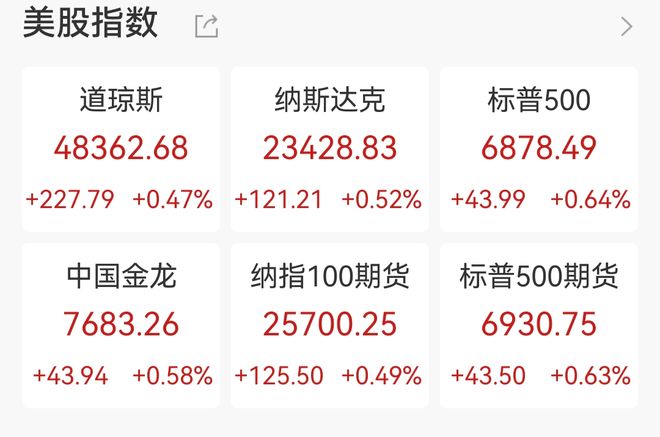
Market Performance - US stock market opened higher and closed with gains, with all three major indices rising for three consecutive days. The S&P 500 index increased by 0.64%, the Nasdaq by 0.52%, and the Dow Jones by 0.47% [1] - The Dow Jones closed at 48,362.68, the Nasdaq at 23,428.83, and the S&P 500 at 6,878.49 [2] Sector Performance - Large technology stocks showed mixed results, with the Tech Giants Index rising by 0.41%. Notable gains included Tesla and Nvidia, both up over 1%, while Apple fell by more than 1% [2] - Chip stocks mostly rose, with Micron Technology up over 4% and Microchip Technology up over 2%. Intel, however, fell by over 1% [3] - Bank stocks saw a broad increase, with JPMorgan Chase rising nearly 2%, Goldman Sachs up 0.6%, and Citigroup up over 2%, reaching a 17-year high [3] Chinese Stocks - The Nasdaq China Golden Dragon Index rose by 0.58%, marking three consecutive days of gains. Notable performers included Canadian Solar up nearly 11% and iQIYI, Qifu Technology, and Trip.com all up over 2% [5] - Analysts from Goldman Sachs predict a 14% growth in Chinese corporate earnings by 2026 and a 12% growth in 2027, which may boost the performance of Chinese stocks [5] Commodity Market - International oil prices saw an increase, with light crude oil futures for February 2026 rising by 2.64% to $58.01 per barrel, and Brent crude oil futures up 2.65% to $62.07 per barrel [5] - Precious metals experienced significant gains, with spot gold reaching a historical high of $4,449.18 per ounce, and COMEX gold futures rising by 2.16% to $4,482.30 per ounce [6] - The gold market has seen a surge of over 60% this year, while silver prices have increased by over 130% [6] - Analysts from Goldman Sachs expect gold prices to rise further, with a baseline scenario of $4,900 per ounce next year, indicating a bullish outlook for the precious metals market [6]


Morgan Stanley drops tech stocks to buy list for 2026
Yahoo Finance· 2025-12-22 17:33
Core Viewpoint - Wall Street is becoming more selective regarding expected stock market gains, particularly focusing on AI chips as a critical component of the tech sector, albeit with caution regarding future growth rates [1][2][5]. Group 1: Market Performance and Expectations - The demand for computing power is increasing rapidly, keeping semiconductors central to market narratives for the third consecutive year [4]. - The S&P 500 has shown impressive total returns of 26.3% in 2023, 25% in 2024, and over 16% in 2025, leading to an approximate cumulative gain of 86% since 2023 [4]. - Morgan Stanley projects the S&P 500 to reach 7,800 by the end of 2026, attributing this to "earnings grind" rather than speculative bubble dynamics [8]. Group 2: AI and Semiconductor Focus - Morgan Stanley emphasizes that while AI remains a strong investment theme, expectations should be tempered, avoiding assumptions of uninterrupted growth in AI spending [5][7]. - The firm is maintaining its focus on established chip leaders and identifying areas where market expectations may be mispriced as it approaches 2026 [6][11]. Group 3: Investment Recommendations - Morgan Stanley's tech stock buy list for 2026 includes: - AI processors: Nvidia, Broadcom [12] - Data-center connectivity: Astera Labs - Memory: Micron - Equipment & manufacturing: Applied Materials, Taiwan Semiconductor - Analog chips: NXP Semiconductors, Analog Devices [13]. - The bank anticipates solid bottom-line expansion driven by AI gains without necessitating skyrocketing valuations [9].


中国股票,大利好!外资,爆买!
券商中国· 2025-12-22 15:11
Core Viewpoint - Foreign capital is reassessing Chinese assets, with significant inflows into the technology sector and optimistic forecasts for corporate earnings growth in China [2][4][10]. Group 1: Earnings Growth Predictions - Goldman Sachs analysts predict a 14% growth in Chinese corporate earnings in 2026 and a 12% growth in 2027, which is expected to boost the performance of the Chinese stock market [4][10]. - The report indicates that the MSCI China Index constituents' performance could increase by approximately 1.5% annually until 2030 due to growth in overseas revenue [5]. Group 2: Foreign Capital Inflows - As of December 20, 2025, global investments in Chinese asset ETFs have seen a net inflow of $83.1 billion, with the technology sector receiving the most significant inflow of $9.5 billion, primarily from the US and Europe [9]. - Domestic ETFs accounted for $78.6 billion of the inflow, while foreign ETFs saw a net inflow of about $4.5 billion [9]. Group 3: Sector-Specific Insights - The technology sector is highlighted as a key area for foreign investment, with six out of the top ten foreign inflow ETFs being technology-focused, each receiving over $2 billion [9]. - Analysts from various institutions, including UBS and Morgan Stanley, express confidence in the recovery of Chinese technology stocks, indicating that the growth momentum is still in its early stages [10]. Group 4: Global Investor Sentiment - Global investors are increasingly interested in exploring investment opportunities in China, particularly in the technology and AI sectors, recognizing their strong growth potential [6]. - Clients from emerging markets, including Mexico and Chile, are actively investing in Chinese assets, viewing the technology sector as crucial for long-term growth and diversification [6].