Nissan Motor(NSANY)

Search documents
日系三大车企6月在华销量出炉:日产止跌,本田继续承压
Ju Chao Zi Xun· 2025-07-14 03:03
Group 1: Toyota - Toyota's sales in June reached 157,700 units, a year-on-year increase of 3.7% [2] - Cumulative sales for the first half of the year totaled 742,000 units, reflecting a year-on-year growth of 8.63% [2] - Toyota's strong performance is attributed to its continuous investment in electrification and intelligent technology, as well as a diverse product lineup [2] Group 2: Nissan - Nissan sold 53,800 vehicles in June, marking a year-on-year increase of 1.9%, ending a 15-month streak of declining sales [2] - Cumulative sales for the first half of the year were 279,600 units, a year-on-year decline of 21.02% [2] - The recovery in Nissan's sales is likely due to adjustments in product strategy and marketing, including new models that better meet Chinese consumer demands [2] Group 3: Honda - Honda's sales in June fell by 15.2% to 58,500 units, continuing a 17-month decline [3] - Cumulative sales for the first half of the year were 315,200 units, a year-on-year decrease of 24.2% [3] - Challenges for Honda include intensified market competition, slow product updates, and a lag in the transition to electric vehicles, impacting its competitiveness [3] Group 4: Overall Market Trends - The performance of the three major Japanese automakers in China shows a clear divergence, with Toyota maintaining growth, Nissan showing signs of recovery, and Honda facing significant pressure [2][3] - Future success in the Chinese market for these automakers will depend on their speed and effectiveness in transitioning to electrification and intelligent technologies [3]



跨国车企在华经营模式出现转变
Jing Ji Ri Bao· 2025-07-11 22:15
Group 1 - The core viewpoint of the articles highlights a significant shift in the operational strategies of multinational automotive companies in China, focusing on collaboration and innovation in the electric vehicle sector [1][2] - Renault Group's Ampere signed a partnership agreement with Chinese private equity firms to explore investment opportunities in the electric vehicle ecosystem, emphasizing a model of "technological innovation + industrial capital empowerment + international validation" [1] - Nissan and Dongfeng Motor Group established a new company with a registered capital of 1 billion RMB, focusing on exporting complete vehicles and components, particularly electric models, indicating a new paradigm for joint ventures in global markets [1] Group 2 - Historically, multinational car manufacturers played a crucial role in modernizing China's automotive industry, leveraging their technology and brand strength to enhance market presence [2] - However, the rise of domestic brands in the electric vehicle market has led to a rapid decline in market share for joint venture brands, with domestic brands capturing 68.5% of the passenger car market in the first half of the year, down from nearly 70% for joint ventures [2] - The importance of the Chinese automotive market extends beyond market share; it is pivotal for the global strategies of these companies, as China is now the largest automotive market and a leader in technological innovation [2] Group 3 - The traditional product development model of multinational companies, which was led by headquarters with localized execution in China, is becoming inadequate to meet local consumer demands [3] - There is a pressing need for these companies to shift their global R&D and decision-making centers to China to enhance responsiveness and innovation, thereby reducing costs and improving efficiency [3] - The market focus is transitioning from primarily serving the Chinese market to addressing both domestic and international markets, leveraging global marketing networks [3] Group 4 - The supply chain dynamics are changing as the electric and intelligent vehicle revolution reconfigures the global automotive supply chain, with a significant shift towards embracing China's supply chain capabilities [3] - Multinational companies are encouraged to integrate with China's supply chain, which has developed core technologies and cost advantages, to enhance their global competitiveness [3]
Nissan Halts US Production for Canada Amid Rising Tariff Row
ZACKS· 2025-07-11 15:11
Core Viewpoint - Nissan Motor Co., Ltd. has temporarily halted production of three vehicle models in the U.S. for the Canadian market due to escalating trade tensions and tariffs between the U.S. and Canada [1][2][9] Production Impact - The affected models include the Pathfinder and Murano SUVs, and the Frontier pickup, with production stopped in Tennessee and Mississippi [1][3] - The production pause is a response to a tariff dispute initiated by the Trump administration's 25% tax on auto imports, which led Canada to impose its own tariffs on American-made vehicles [2][4] Economic Viability - Nissan confirmed that the new tariffs have made it economically unviable to continue exporting these models to Canada, leading to an indefinite hold on production for the Canadian market [3][4] - Approximately 80% of Nissan's Canadian sales come from vehicles produced in Mexico and Japan, indicating a reliance on non-U.S. production for Canadian sales [4] Financial Challenges - Nissan is facing broader financial stress, reporting a net loss of $4.5 billion for the fiscal year ending in March and dealing with nearly $4.8 billion in debt due this year [5][9] - The disruption in production highlights deeper financial and operational challenges for the company, despite Canada representing a relatively small portion of its global business [5] Market Uncertainty - The future of U.S.-Canada trade talks remains uncertain, raising questions about whether the tariff situation will ease and if other automakers will take similar production steps [4]

据日经新闻:日产将向本田供应在美国密西西比工厂生产的皮卡车。
news flash· 2025-07-11 09:05
Group 1 - Nissan will supply pickup trucks produced at its Mississippi plant to Honda [1]
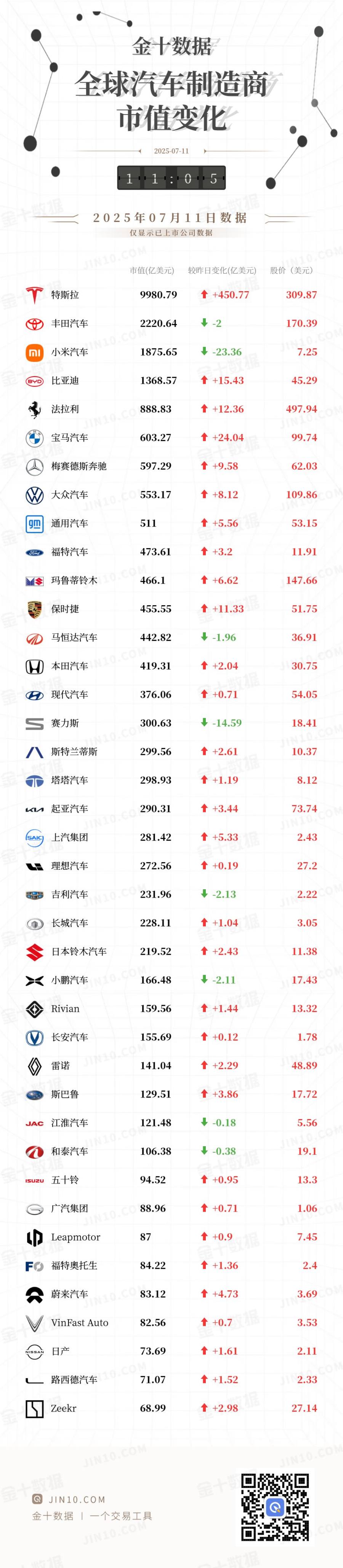
金十图示:2025年07月11日(周五)全球汽车制造商市值变化
news flash· 2025-07-11 03:12
Group 1 - The global automotive manufacturers' market capitalization has shown significant changes as of July 11, 2025, with Volkswagen leading at a market value of $553.17 billion, reflecting an increase of 8.12% [1][3]. - General Motors follows closely with a market capitalization of $511 billion, up by 5.56% [1][3]. - Ford Motor Company has a market value of $473.61 billion, marking a 3.2% increase [1][3]. Group 2 - Notable increases in market value were observed for Porsche, which rose by 11.33% to reach $455.55 billion [1][3]. - Mahindra & Mahindra's market capitalization decreased by 1.96%, settling at $442.82 billion [1][3]. - Honda's market value increased by 2.04% to $419.31 billion [1][3]. Group 3 - Hyundai's market capitalization is reported at $376.06 billion, with a slight increase of 0.71% [1][3]. - The market value of SAIC Motor Corporation is $281.42 billion, reflecting a 5.33% increase [1][3]. - Li Auto's market capitalization stands at $272.56 billion, with a marginal increase of 0.19% [1][3]. Group 4 - NIO's market value is $83.12 billion, showing a significant increase of 4.73% [4]. - VinFast Auto has a market capitalization of $82.56 billion, with a slight increase of 0.7% [4]. - Nissan's market value is reported at $73.69 billion, reflecting an increase of 1.61% [4].



市场消息:日产汽车将通过美元和欧元债券发行筹集45亿美元。
news flash· 2025-07-10 15:40
Group 1 - Nissan Motor plans to raise $4.5 billion through the issuance of dollar and euro bonds [1]
7月10日电,日产汽车将通过发行美元和欧元债券筹集45亿美元资金。
news flash· 2025-07-10 15:39
智通财经7月10日电,日产汽车将通过发行美元和欧元债券筹集45亿美元资金。 ...
日产汽车将通过发行美元和欧元债券筹集45亿美元资金。
news flash· 2025-07-10 15:37
Group 1 - The company, Nissan Motor, plans to raise $4.5 billion through the issuance of dollar and euro bonds [1]
电力设备新能源2025年7月暨中期投资策略:光伏硅料行业有望加快产能整合,固态电池产业化持续推进
Guoxin Securities· 2025-07-10 14:51
Group 1: Photovoltaic Silicon Material Industry - The photovoltaic silicon material industry is expected to accelerate capacity consolidation, with the Ministry of Industry and Information Technology emphasizing the need for high-quality development in the solar industry [1] - By 2027, the industry is projected to enter a stable development phase, with significant advantages in the silicon material segment due to differences in capacity costs and financial strength among companies [1] - Key companies to watch include GCL-Poly Energy, Xinte Energy, Tongwei Co., and TBEA [1] Group 2: Solid-State Battery Industry - The solid-state battery industry is witnessing continuous advancements, with equipment from Winbond Technology successfully delivered to major domestic clients [2] - Material production is ramping up, with significant capacity in oxide electrolytes and expectations for sulfide electrolytes to achieve ton-level shipments by 2025 [2] - Companies of interest in this sector include Xiamen Tungsten, Tianqi Lithium, and others involved in the solid-state battery supply chain [2] Group 3: Offshore Wind Power Development - The central government is promoting the orderly development of offshore wind power, with a focus on enhancing the marine economy and encouraging private investment [3] - Goldwind Technology has secured over 7.7GW of international orders for 2024, with significant revenue growth reported for its international subsidiary [3] - Key players in the wind power sector include Goldwind Technology, Oriental Cable, and Dajin Heavy Industry [3] Group 4: Data Center Investment - Global data center investments are accelerating, with Amazon planning to invest AUD 20 billion (approximately USD 13.1 billion) in Australia and SK Telecom collaborating with Amazon Web Services for a significant data center project in South Korea [4] - The deployment of NVIDIA's GB300 AI systems is underway, indicating a growing demand for AI computing resources [4] - Companies to monitor in the AIDC power equipment sector include Jinpan Technology, Xinte Electric, and others [4] Group 5: Key Company Earnings Forecasts - The report provides earnings forecasts and investment ratings for several companies, with Goldwind Technology rated "Outperform" and projected to have an EPS of 1.28 in 2025 [5] - Jinpan Technology and other companies also received "Outperform" ratings, indicating positive market sentiment [5] Group 6: Industry Performance Overview - The electric power equipment sector outperformed the market in June, with a 6.68% increase compared to a 2.5% rise in the CSI 300 index [13] - The sector's PE ratio at the end of June was 30.3, reflecting a slight recovery in valuations [13] - The report highlights that the electric power equipment industry has shown strong performance across various sub-sectors, including lithium battery materials and wind power [23]