Starbucks(SBUX)

Search documents
星巴克的“自残式”改革
Hu Xiu· 2025-07-30 23:41
Core Insights - Starbucks recently reported a significant profit drop of $558 million, attributed to a costly and proactive overhaul initiated by CEO Howard Schultz [1][10] - The company's core issue lies in its brand identity, which has been compromised due to rising prices and intensified competition from various coffee vendors [2][4] - The transformation strategy involves a substantial investment aimed at restoring the unique customer experience that justifies premium pricing [11][12] Financial Performance - The $558 million profit decrease is seen as a repayment for past neglect of core customer experiences and brand value [10] - The operating profit margin has dropped nearly 7 percentage points (680 basis points) as a direct result of the transformation costs [15] - Current stock valuation reflects market expectations of a successful turnaround, with a price-to-earnings ratio of approximately 35, higher than competitors like McDonald's and Chipotle [45][46] Strategic Initiatives - The company is shifting from a high-price model to one focused on increasing customer traffic and loyalty through enhanced service experiences [14] - Significant investments are being made in employee training and operational improvements, including simplifying the menu and enhancing in-store experiences [18][15] - The strategy emphasizes a "behavior reset" among employees to improve customer interactions and satisfaction [22][21] Market Challenges - Starbucks faces a dual challenge of maintaining efficiency while providing personalized customer experiences across its vast network of stores [30][34] - The reliance on digital tools has led to a decrease in personal interactions, prompting a need to balance efficiency with customer engagement [39][40] - The potential impact of unionization on labor costs poses a significant risk to the company's operational expenses and flexibility [52][55] Future Outlook - Market expectations suggest that by fiscal years 2026 or 2027, Starbucks' profits should recover significantly, contingent on the success of its transformation efforts [48][49] - The success of the transformation hinges on the ability to convert employee training and improved service into tangible sales growth and customer loyalty [68][70] - Investors are advised to monitor key performance indicators closely, including same-store sales and customer traffic, to gauge the effectiveness of the ongoing changes [70]

京东“七鲜小厨”首店日均订单超过1000单
Sou Hu Cai Jing· 2025-07-30 22:49
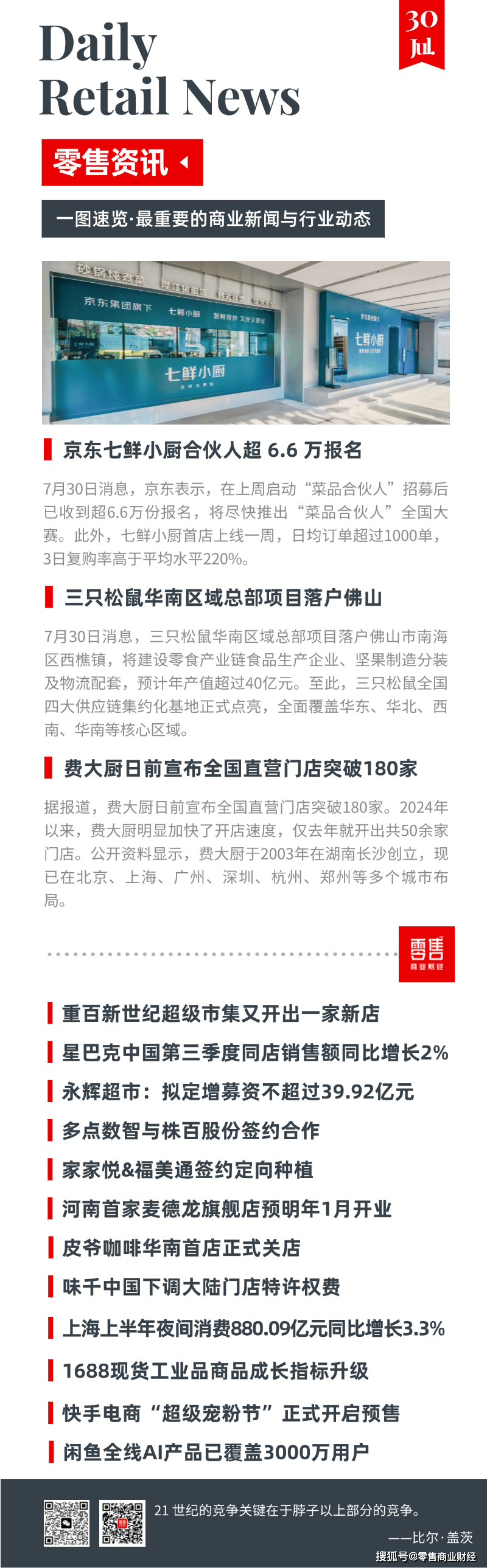
Group 1 - JD reported over 66,000 applications for its "Dish Partner" recruitment initiative, with the first store of Seven Fresh Kitchen achieving over 1,000 daily orders and a 220% higher repurchase rate than average within a week [6] - Three Squirrels established its South China regional headquarters in Foshan, aiming for an annual output value exceeding 4 billion yuan through the development of a snack industry supply chain [8] - Fei Dazhu announced it has surpassed 180 directly-operated stores nationwide, significantly accelerating its store opening pace with over 50 new stores launched last year [9] Group 2 - Chongqing Department Store's New Century Supermarket opened its 9th store in Yubei, showing significant customer traffic growth and improved efficiency metrics, validating the potential of its fresh discount store model [10] - Starbucks reported an 8% year-on-year revenue increase in China for Q3 2025, reaching $790 million, with same-store sales up 2% and a total of 7,828 stores [10] - Yonghui Supermarket plans to raise up to 3.992 billion yuan through a private placement to upgrade stores, enhance logistics, and supplement working capital [11] Group 3 - Multi-point Intelligence signed a cooperation agreement with Zhuba Co. in Zhuzhou, marking the start of a digital transformation project in the retail sector [14] - Jiajiayue Group partnered with Fumeitong for directional planting, ensuring quality control from farm to table for garlic products [16] - Metro's first flagship store in Henan is set to open in January 2026, with a total investment of 1.5 billion yuan [19] Group 4 - Peets Coffee closed its first store in South China located in Shenzhen after nearly four years of operation [20] - Ajisen China temporarily reduced its franchise fees in mainland China from 3,500 yuan to 2,500 yuan per month, effective until the end of 2026 [21] - Shanghai's night-time consumption reached 88 billion yuan in the first half of 2025, a 3.3% year-on-year increase, with dining, retail, and cultural entertainment contributing 78% [22] Group 5 - 1688 announced an upgrade to its industrial product growth system to enhance procurement efficiency for merchants [23] - Kuaishou e-commerce launched the "Super Pet Fan Festival" pre-sale, providing support for merchants through traffic incentives and consumer subsidies [24] - Xianyu's AI products have reached 30 million users, with 138 million items listed using AI and a total GMV exceeding 1.4 billion [25]





陆家嘴财经早餐2025年7月31日星期四
Wind万得· 2025-07-30 22:47
Group 1 - The Central Committee of the Communist Party of China emphasized the need for stable and flexible economic policies, focusing on active fiscal policies and moderate monetary policies to support technology innovation, consumption, small and micro enterprises, and stabilize foreign trade [2][4] - The government plans to allocate approximately 90 billion yuan for childcare subsidies, with local governments required to open applications by August 31 [2] Group 2 - The Federal Reserve maintained the federal funds rate target range at 4.25% to 4.5%, indicating that it is too early to predict a rate cut in September due to uncertainties surrounding tariffs and inflation [3] - The U.S. economy showed strong performance with a second-quarter GDP growth of 3%, significantly exceeding market expectations [13] Group 3 - The A-share market showed mixed results, with the Shanghai Composite Index rising by 0.17% while the Shenzhen Component and ChiNext Index fell by 0.77% and 1.62% respectively [6] - Hong Kong's Hang Seng Index dropped by 1.36%, with significant declines in the new energy vehicle sector [6] Group 4 - Foxconn announced a strategic alliance with TECO Electric & Machinery through a share swap to enter the trillion-yuan AI data center market [7] - New Oriental's revenue for the fourth fiscal quarter reached $1.243 billion, a year-on-year increase of 9.4%, but net profit decreased by 73.7% [7] Group 5 - Major announcements from listed companies included CATL reporting a 33.02% increase in net profit for the first half of the year and a proposed dividend of 10.07 yuan per share [9] - XGIMI projected a staggering 2062% increase in net profit for the first half of the year [9] Group 6 - The Ministry of Civil Affairs reported a 20.5% decline in marriage registrations for 2024, with a marriage rate of 4.3‰ [4] - The divorce rate was reported at 2.5‰, with 3.513 million divorce registrations [4] Group 7 - The National Health Commission called for enhanced risk assessment and preventive measures against the Chikungunya virus [5] - Shanghai's housing authority plans to initiate a comprehensive urban renewal project by 2026 [5]






Starbucks CEO on business in China and competition from local brands
CNBC Television· 2025-07-30 18:30
China Market - The company sees an opportunity for tens of thousands more stores in China [1] - The brand has high regard in China, with tremendous opportunity to grow new stores and organically within existing stores [1] - The company created the coffee category in China and now needs to figure out how to compete and continue to grow that category [3] - The company is finding the right partner for its China businesses [1] US Market - The company's big point of difference in the US is the cafe experience [3] - The company needs to continue to give great access for mobile order, drive-thru, and the in-cafe experience [3] - Customer service and connection between barista and customer are rewarded with more business and brand esteem [4] Financial Performance - Comps were up 2%, driven by 6 points of transaction growth in the most recent quarter [2]

Starbucks CEO Brian Niccol: The company had been 'mismanaged for a couple of years'
CNBC Television· 2025-07-30 17:30
People may not remember the turnaround, legendary turnaround that York traded at Chipotle. Where are you versus Chipotle. I know that's tough comparisons to Odius, but what a turn that was.You see anything coming like that here. You know, look, here's what what I believe is uh I'm happy to say we're definitely ahead of schedule on fixing the operational uh foundation. That's what gave us the confidence to go ahead and put it into all stores this year.And uh you know my experiences have been over and over ag ...
Starbucks COO on why hospitality is the answer to the company's challenges
CNBC Television· 2025-07-30 16:30
Given all of the value offerings right now across the restaurant sector, quite frankly, uh, within coffee, Lucken is now offering $2 ice coffees and lattes. Why is hospitality the answer to the challenges that Starbucks is facing right now. Look, we have 7,700 drive-throughs in America.We've got a a digital business, which is 31% which is doing really healthy. We we have the third place. We going to get ready to go into Uplifts, which will start to remodel and bring the comfort back into the experience.That ...

Could China's Luckin coffee threaten Starbucks in the U.S.?
CNBC Television· 2025-07-30 16:00
How should we think about the emergence of Lucken and its emergence here in the US. >> Well, what's interesting about Luck, you only have a couple of stores open so far in New York, right. What's interesting about it is that is primarily a mobile pickup based concept, right.It's distinct from Starbucks, which is telling you sort of coming into stores that employee connection is is still important. Lucken doesn't necessarily have that, right. So, I think our view would be that that isn't a broader threat to ...

Starbucks Q3 Earnings Miss Estimates, Revenues Rise Y/Y, Stock Up
ZACKS· 2025-07-30 15:45
Core Insights - Starbucks Corporation (SBUX) reported mixed results for the third quarter of fiscal 2025, with earnings per share (EPS) missing estimates while net revenues exceeded expectations [1][4] - The company made a one-time investment impacting EPS by 11 cents, and the overall performance reflected progress in its turnaround strategy [1][3] Financial Performance - EPS for the quarter was 50 cents, missing the Zacks Consensus Estimate of 65 cents by 23.1%, and down 46.2% from 93 cents in the prior-year quarter [4] - Net revenues reached $9.46 billion, beating the consensus mark of $9.3 billion by 1.7%, and increased 3.8% from $9.11 billion in the prior-year quarter [4] - Global comparable store sales declined 2% year over year, with a 2% decrease in comparable transactions partially offset by a 1% increase in average tickets [5] Segment Analysis - North America segment net revenues were $6.93 billion, up 2% year over year, with comparable store sales also declining 2% [7] - International segment net revenues increased 9% year over year to $2.01 billion, with comparable store sales at breakeven compared to a 7% decline in the prior-year quarter [8] - Channel Development segment net revenues rose 10% year over year to $483.8 million, driven by contributions to the Global Coffee Alliance [10] Margin and Cost Analysis - Non-GAAP operating margin contracted 660 basis points to 10.1% year over year, primarily due to investments in the "Back to Starbucks" initiative and inflation [6] - Operating margin in North America fell 770 basis points to 13.3%, while the International segment's margin contracted 200 basis points to 13.6% [8][9] - The Channel Development segment's operating margin decreased 860 basis points to 45.1% due to higher global product costs [11] Cash and Dividend Information - As of the end of the fiscal third quarter, the company had cash and cash equivalents of $4.17 billion, up from $3.29 billion at the end of fiscal 2024 [12] - Management declared a quarterly cash dividend of 61 cents per share, payable on August 29, 2025 [13]
Starbucks COO on what 'Green Apron Service' means
CNBC Television· 2025-07-30 15:30
What is a Green Apron moment in an ideal world. What do those interactions look like. It's when you walk through that door, you're greeted with a smile. You're greeted again at the handoff with a perfect cup of coffee, whatever beverage you decide to order, and you're met with that connection.And the idea behind it is that it it's the human element that we all crave. It doesn't have to be overbearing, over the top, but it's a simple hello, the thank you, make a moment, right. If it wasn't right, very basic ...

Newmark Arranges $435 Million Refinancing for Iconic Starbucks Center Headquarters in Seattle's SoDo District
Prnewswire· 2025-07-30 15:12
Core Insights - Newmark Group, Inc. has successfully arranged a $435 million refinancing for Starbucks Center, a significant office property in Seattle, on behalf of Nitze-Stagen & Co., Inc. and Daniels Real Estate [1][2] - The refinancing is expected to enhance the operational excellence of Starbucks Center, which serves as the headquarters for Starbucks Corporation and symbolizes the brand's heritage [2][3] - Starbucks has committed to a new 20-year lease extension, ensuring its presence at Starbucks Center through 2038, and has invested over $300 million in the property [3] Company Overview - Newmark Group, Inc. is a leading commercial real estate advisor and service provider, generating over $2.8 billion in revenues for the twelve months ended March 31, 2025, and operating from 165 offices globally with approximately 8,100 professionals [6] - Nitze-Stagen & Co., Inc. is a multi-generational real estate investment and management firm known for its adaptive reuse projects in the Puget Sound Region [4] - Daniels Real Estate, LLC is recognized for its architectural contributions to Seattle's skyline and focuses on adaptive reuse projects, preserving iconic buildings in the area [5]