Starbucks(SBUX)

Search documents
星巴克的“自残式”改革
虎嗅APP· 2025-07-31 09:50
以下文章来源于东针 ,作者东叔频道 东针 . 欢迎来到东针知识频道。我们专注与大家分享有价值的思考、商业新知和关于世界的看法,看见有价值 的可能,不停学习,向内丰满。 本文来自微信公众号: 东针 ,作者:东叔频道,题图来自:AI生成 星巴克最近交出了一份很难看的成绩单:利润暴跌了5.58亿美元。但这背后,其实是CEO尼科尔在进 行一场主动的、代价高昂的"大翻修"。 星巴克的核心问题出在它的"金字招牌"上。 过去,星巴克之所以能卖得比别的咖啡贵,很大程度上是因为它卖的不只是一杯咖啡,更是一种"第 三空间"的体验——一个舒适、有格调、能让人放松或工作的地方。人们愿意为这种独特的氛围和服 务多付钱。 然而,这几年情况变了。 一方面,物价普遍上涨,消费者对价格更敏感了; 另一方面,星巴克面临的竞争前所未有的激烈,从精品咖啡馆到快餐店 (麦当劳、Dunkin') 再到 便利店 (7-11) ,都在争夺咖啡市场。 而且,星巴克自身的服务体验也出了问题:店里人手不足导致排队时间变长、咖啡品质不稳定、过度 依赖手机点单让店里少了人情味……结果就是,消费者越来越觉得星巴克咖啡"不值那个价"了,它的 品牌吸引力,或者说"溢价能力 ...


20家资本竞逐星巴克中国:最新业绩回暖,“择偶”条件大曝光
3 6 Ke· 2025-07-31 08:08
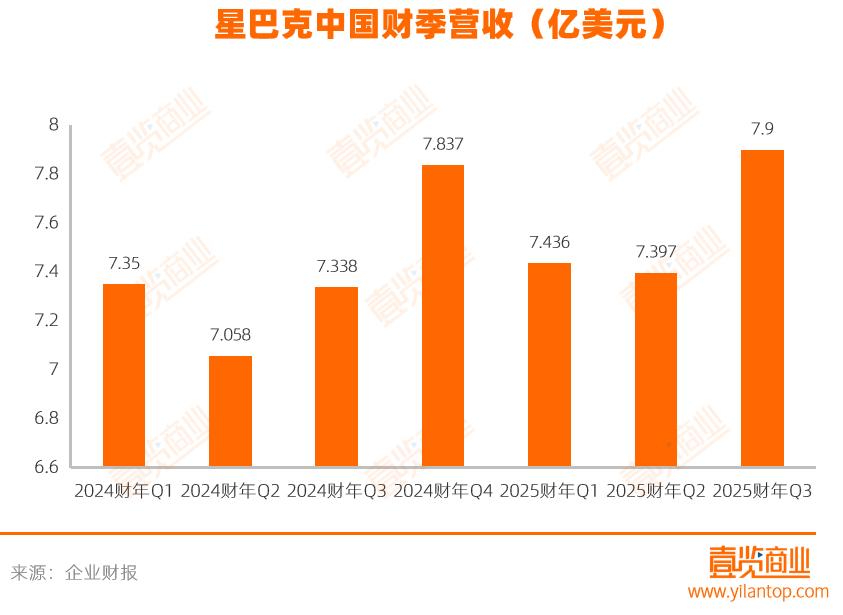
Core Viewpoint - Starbucks China has experienced a performance rebound, with Q3 FY2025 showing an 8% year-on-year revenue growth to $790 million and a 2% increase in same-store sales, marking a significant recovery from a previous 14% decline in Q3 FY2024 [1][4]. Group 1: Same-Store Sales and Revenue Growth - Same-store sales in Starbucks China have returned to growth after four consecutive quarters of decline, with a 2% year-on-year increase in the latest quarter [2][4]. - The growth is attributed to a 6% increase in same-store transaction volume, despite a 4% decline in same-store average ticket price [5][6]. - Product innovation, integrated marketing activities, and the expansion of delivery services have been key drivers of this growth [6][8]. Group 2: Market Expansion and Store Strategy - As of Q3 FY2025, Starbucks China has a total of 7,828 stores, with a net increase of 522 stores year-on-year, including 70 new stores in the latest quarter [9][10]. - The company has focused on expanding into lower-tier cities, with 50% of new stores in FY2024 located in third-tier cities and below [10][11]. - Localized strategies, such as introducing region-specific products and culturally themed store designs, have enhanced customer engagement and sales performance in new markets [11][13]. Group 3: Capital Movements and Partnership Strategy - Starbucks China is actively seeking strategic partners, with over 20 potential partners expressing interest in acquiring a stake in the business [14][15]. - The company aims to retain a significant equity stake, potentially around 30%, while looking for partners that share its mission and can operate efficiently in the local market [14][15]. - Notable potential partners include Hillhouse Capital, KKR, and Meituan, all of which have experience in the food and beverage sector [14][15]. Group 4: Competitive Landscape and Challenges - Despite the positive financial results, Starbucks China faces challenges from a competitive market, with local brands aggressively expanding and driving prices down [17][19]. - Competitors like Luckin Coffee and others are rapidly increasing their store counts, intensifying the competition in both lower-tier and higher-tier markets [18][19]. - The company must navigate these pressures while maintaining its brand positioning and adapting to market pricing dynamics [19].
抢钱的咖啡,瑞幸单季度冲至123.6亿营收,CEO豪言:海外照样能卷
3 6 Ke· 2025-07-31 03:47
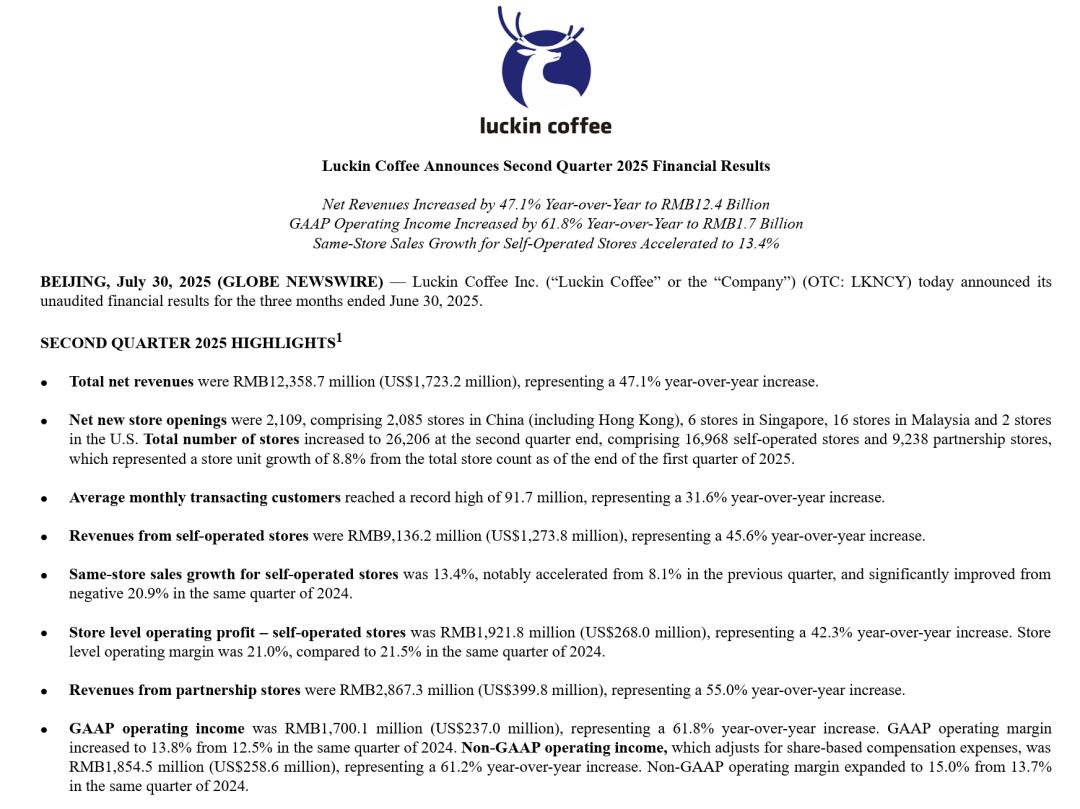
Group 1: Financial Performance - In Q2 2025, the company achieved total net revenue of 12.359 billion RMB, a year-on-year increase of 47.1%, setting a new quarterly record [1] - Net profit reached 1.25 billion RMB, reflecting a year-on-year growth of 44% [1] - Same-store sales growth for self-operated stores rose to 13.4% due to scale effects [1] Group 2: Store Expansion Strategy - The company continued its aggressive store opening strategy, adding 2,109 new stores in a single quarter, bringing the total to over 26,206 stores [1] - However, this rapid expansion has led to a decline in same-store sales, which fell by 16.7% in 2024, compared to a 21% increase the previous year [4][6] - Management remains optimistic about future growth, emphasizing the importance of scale, efficiency, and supply chain advantages [4][6] Group 3: International Expansion Challenges - The company has faced difficulties in replicating its domestic success in international markets, such as Singapore, where only 51 stores have been opened since April 2023 [7][9] - High operational costs and intense competition in overseas markets have hindered profitability [9][10] - Despite these challenges, the company is expanding into new markets, including Malaysia and the United States, with a total of 89 overseas stores as of mid-2025 [10][12] Group 4: Competitive Landscape - The company has significantly outpaced Starbucks in terms of store count and revenue growth in China, with over 26,117 stores compared to Starbucks' approximately 7,758 [13] - Starbucks has responded to the competitive pressure by adjusting its pricing strategy, indicating the impact of the company's low-price approach [13] - The ongoing competition highlights the need for the company to maintain its growth momentum while addressing potential long-term sustainability issues [13]
X @The Wall Street Journal
The Wall Street Journal· 2025-07-31 03:13
Market Strategy - Luckin Coffee chose a location in New York City less than 200 feet from a Starbucks, indicating a direct competitive strategy [1] - China's biggest coffee chain is expanding into the US market [1]
同店连跌六季、利润腰斩,星巴克凭什么盘后大涨近5%?
Jin Rong Jie· 2025-07-31 02:31
Core Insights - Starbucks reported its Q3 FY2025 earnings, showing revenue exceeding expectations but profits under pressure, with global same-store sales declining for the sixth consecutive quarter [1][2][3] Financial Performance - Q3 core financial data indicates earnings per share (EPS) of $0.50, significantly below the expected $0.65, and net profit of $558 million, down 47% year-over-year from $1.05 billion, impacted by restructuring costs and one-time investments [2] - Revenue reached $9.5 billion, a 4% year-over-year increase, surpassing market expectations of $9.31 billion, indicating resilience in core business [3] Same-Store Sales Analysis - Global same-store sales fell by 2%, worse than the expected decline of 1.3%, marking the sixth consecutive quarter of decline [4] - North America same-store sales decreased by 2%, better than the anticipated decline of 2.5%, with transaction volume down 3% but average ticket price up 1% [4][5] - China achieved a 2% increase in same-store sales, marking its first positive growth in a year and a half, with transaction volume up 6% but average ticket price down 4% [4][9] Market Insights - The U.S. market, which accounts for 70% of Starbucks' revenue, showed improvement with a same-store sales decline of 2%, better than the previous quarter's -4% [5] - Starbucks is focusing on "rebuilding the soul of the store" through initiatives like the "Green Apron Service" and restoring seating in stores, with an additional $500 million planned for labor, training, and service experience upgrades in the U.S. [6] Strategic Outlook - CEO Brian Niccol emphasized the company's commitment to enhancing customer experience and retaining substantial equity in the Chinese market, despite interest from over 20 institutions in acquiring stakes [9] - The company plans to launch new products and revamp its app and membership system by FY2026, with an investor day scheduled for Q2 2026 to disclose further financial targets [11] Market Sentiment - Despite recent downgrades from some analysts, several institutions maintain "buy" or "overweight" ratings, reflecting a growing confidence in the company's transformation efforts [10] - The focus is shifting from short-term financial metrics to long-term recovery potential as the company works on rebuilding brand strength and customer experience [12]
投资界24h | 一家AI公司估值破万亿;关于政府投资基金,发改委征求意见;20多家投资机构要买星巴克中国
Sou Hu Cai Jing· 2025-07-31 00:45
Group 1: AI Company Valuation - An AI company, Anthropic, is set to raise $5 billion in funding led by Iconiq Capital, which will increase its valuation to $170 billion, nearly tripling from $61.5 billion four months ago [1] Group 2: Government Investment Fund Guidelines - The National Development and Reform Commission is seeking public opinion on guidelines to prevent homogenization and the crowding-out effect on social capital in government investment funds [1][2] - The guidelines emphasize avoiding blind following in emerging industries and prohibit the establishment of duplicate funds in the same industry by the same government [3] Group 3: Starbucks China Interest - Starbucks reported third-quarter revenue of $9.46 billion, exceeding analyst expectations, and confirmed interest from over 20 potential investors in its China operations [4] Group 4: IPO Activities - Shenghong Technology plans to issue H-shares for listing on the Hong Kong Stock Exchange, leveraging its status as a supplier to Nvidia [4] - Hanhigh Group successfully listed on the Shenzhen Stock Exchange with an opening surge of over 200%, achieving a market value of 22 billion yuan [5] Group 5: Investment Funds and Collaborations - Dassault Systèmes collaborates with Kaihui Fund and Shanghai Jing'an Industrial Guidance Fund to establish a digital industrial fund [6][7] - Sichuan Hongwen Digital Culture Equity Investment Fund has successfully completed registration, marking its operational launch [8] Group 6: Corporate Financial Performance - Microsoft reported fourth-quarter revenue of $76.441 billion, a year-over-year increase of 18%, with net profit rising 24% to $27.233 billion [9] Group 7: Recent Financing Events - Yikole Biotechnology received a strategic investment of 450 million yuan from Guotou Ju Li [10] - Guangya Hongdao announced a strategic investment of 280 million yuan from Kunlun Beigong Green Venture Capital [11] - RoboScience completed nearly 200 million yuan in angel round financing, led by JD.com [12]

星巴克中国在华业绩回来了
3 6 Ke· 2025-07-31 00:30
Core Insights - Starbucks China has shown a recovery in performance, with Q3 revenue reaching $9.5 billion (approximately RMB 68.2 billion), exceeding market expectations and reflecting a 4% year-on-year growth [1] - The company reported a net profit of $558.3 million, a significant decline of 47.1% year-on-year, while North American same-store sales fell by 2% due to a 4% drop in comparable transaction volume, although average ticket prices increased by 2% [1] - In the Chinese market, Starbucks achieved revenue of $790 million (approximately RMB 5.67 billion), marking an 8% year-on-year increase and continuing three consecutive quarters of growth [1] Revenue and Profitability - The same-store sales metric, a key indicator of store profitability, experienced a crucial turnaround with a 2% growth in the last fiscal quarter, marking the first increase in six quarters [3] - The growth in same-store sales was primarily driven by a significant 6% year-on-year increase in transaction volume, despite a slight 4% decrease in average ticket price [6] Store Expansion and Market Strategy - As of the end of Q3, Starbucks China had a total of 7,828 stores, a net increase of 522 stores (7% year-on-year), moving closer to the goal of operating 9,000 stores by 2025 [6] - The company opened 70 new stores and entered 17 new county-level markets, with new stores contributing above-average same-store sales within two years [6] Factors Driving Improvement - The improvement in performance is attributed to several factors, including a flexible pricing strategy that involved a significant price reduction of over 10% on non-coffee products, effectively broadening the customer base and attracting younger consumers [9] - Product innovation has been tailored to local demands, with 78 new products launched in FY2024, including a coffee bean themed around the Chinese New Year, developed by local baristas [9] - Enhanced marketing strategies, including collaborations with popular brands and celebrities, have driven significant engagement and sales growth [9] Delivery and Competition - The growth in same-store sales is also linked to the booming delivery market, with Starbucks actively participating in promotional activities on platforms like JD.com and Meituan, leading to increased consumer demand [10][12] - Despite the recovery, Starbucks faces intense competition from local brands and is focusing on localizing operations and forming strategic partnerships to strengthen its market position [14] Strategic Partnerships - Starbucks is exploring strategic partnerships to capture future growth opportunities in the Chinese market, with over 20 potential partners being evaluated [15] - The company emphasizes that these partnerships are not primarily for funding but to ensure a stronger brand presence in China, requiring partners to share similar values and possess strong local operational capabilities [15] Conclusion - The recent performance recovery of Starbucks China is a result of multi-faceted strategies involving product, pricing, marketing, delivery, and membership enhancements, reflecting agility in responding to local competition [15] - The pursuit of strategic partnerships may mark a new starting point for Starbucks in the competitive Chinese coffee market [16]
政治局会议定调下半年经济工作;特朗普宣布8月1日起对进口半成品铜等产品征收50%关税;持用中国护照可免签或落地签前往全球90多个国家地区丨早报
Di Yi Cai Jing· 2025-07-31 00:09
Group 1 - The Political Bureau of the Central Committee of the Communist Party of China held a meeting to assess the current economic situation and set the direction for economic work in the second half of the year, emphasizing the need for sustained macroeconomic policy efforts and timely enhancements [2] - The meeting highlighted the importance of effectively releasing domestic demand potential, deepening reforms, stabilizing foreign trade and investment, and ensuring social welfare [2] Group 2 - The U.S. President announced a 50% tariff on imported semi-finished copper products starting August 1, which includes various copper products and their derivatives [3] - The announcement indicates that copper input materials and scrap copper will not be subject to the same tariffs [3] Group 3 - Starbucks reported a 3.8% year-on-year increase in total revenue for Q3 2025, amounting to $9.456 billion, while net profit fell by 47.1% to $558 million [30] - The CEO addressed rumors regarding the sale of equity in China, stating that the company is seeking strategic partners while aiming to retain a significant stake in its Chinese operations [30] Group 4 - Vanke A announced that Shenzhen Metro Group will provide a loan of up to 869 million yuan, which will be used to repay bond principal and interest [29] - The loan is secured by the company's investment properties and other assets, with a repayment period until July 2, 2028 [29]



8点1氪|演唱会偷情事件男主以侵犯隐私起诉Coldplay;日本政府对200多万人发出海啸避难指示;各地产假延长至158天及以上
3 6 Ke· 2025-07-31 00:02
Group 1: Company Developments - Xiwanda has submitted a listing application to the Hong Kong Stock Exchange, with Goldman Sachs and CITIC Securities as joint sponsors [1] - Starbucks CEO Brian Niccol mentioned that over 20 potential buyers have shown interest in acquiring the company's stake in the China market [3] - Starbucks reported third-quarter revenue of $9.5 billion, with same-store sales down 2%, and net profit of $558.3 million, significantly lower than expected [4][15] - Meta Platforms reported second-quarter revenue of $47.52 billion, a 22% year-over-year increase, with net profit of $18.337 billion, up 36% [13] - Adidas reported second-quarter revenue of €5.95 billion, a 2.2% year-over-year increase, with net profit of €369 million, up 94% [14] Group 2: Financial Performance - CATL achieved a net profit of 30.512 billion yuan in the first half of the year, a 33.02% year-over-year increase, with revenue of 178.886 billion yuan, up 7.27% [16] - Luckin Coffee reported second-quarter net revenue of 12.36 billion yuan, a 47% year-over-year increase, with net profit of 1.25 billion yuan, up 44% [16] - Prada's first-half net revenue reached €2.74 billion, an 8% year-over-year increase, with net profit of €386 million [17] - Airbus reported first-half revenue of €29.610 billion, with a net profit of €1.525 billion [17] Group 3: Market Trends - Ryanair announced it will cease operations at three French airports due to high ticket taxes imposed by the French government, which increased by 180% [6] - Mercedes-Benz warned of a significant decline in annual revenue due to tariffs affecting car and truck sales, with expectations of lower sales in 2025 compared to last year [10]


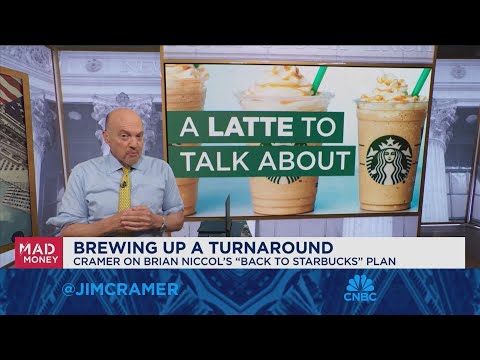
Jim Cramer recaps Starbucks' Q3 numbers
CNBC Television· 2025-07-30 23:47
Company Performance & Strategy - Starbucks' stock experienced volatility after the earnings report, initially tumbling, then rising, and finally settling flat [1][2] - Headline numbers were weaker than expected, but overall results were encouraging due to turnaround efforts [2] - Brian Nickel's hiring as CEO led to a 25% stock jump, based on his turnaround success at Chipotle [3] - Starbucks is focused on solving the throughput problem with a goal of processing orders in less than four minutes and improving the in-store experience [5] - The company's Green Apron service model, aimed at improving the in-store experience, is being scaled up across US stores ahead of schedule [13][16] Financial Results & Analysis - Global same-store sales were down 2%, while Wall Street expected a 13% decline [7] - Starbucks earned 50 cents per share, while Wall Street expected 65 cents, but one-off items impacted earnings [7][8] - Excluding one-off items, earnings per share would have been 61 cents [8] Regional Performance - North America performed better than expected, with the US in line with expectations [10] - China showed improvement with same-store sales up 2%, driven by a 6% increase in transactions [10] - The rest of the international business had flat comps, while Wall Street expected a 22% increase [11] Strategic Considerations - Starbucks is evaluating options for its Chinese business, with significant interest from over 20 parties, but aims to retain a meaningful stake [18] - The company is focused on winning the morning day part and ensuring correct staffing levels throughout the day [15]