TSMC(TSM)

Search documents
25%上行空间可期!台积电(TSM.US)绩前小摩唱多:2026年Q1及全年指引料强劲 基本面驱动估值重塑
智通财经网· 2026-01-12 09:03
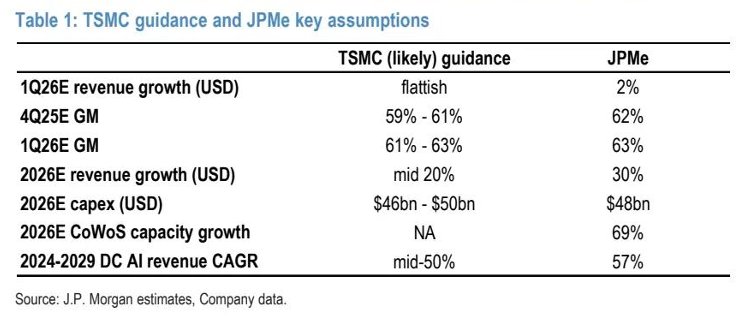
Core Viewpoint - TSMC is expected to provide strong guidance for Q1 2026 and the full year during its Q4 2025 earnings announcement, with a target price of 2100 TWD reflecting a 25% upside from the recent closing price [1] Group 1: Financial Performance and Guidance - TSMC's revenue for Q4 2025 is projected to reach 1.046 trillion TWD, representing a year-on-year growth of 20% and a quarter-on-quarter increase of 6% [1] - For the full year 2025, TSMC's revenue is expected to be 335 billion TWD, showing a year-on-year growth of 20.4% and a quarter-on-quarter decline of 2.5% [1] - The gross margin for Q4 2025 is anticipated to exceed the company's guidance of 59%-61%, with Morgan Stanley predicting a gross margin of 62% [1] Group 2: Q1 2026 Expectations - For Q1 2026, TSMC is expected to provide guidance for revenue growth that is flat, while Morgan Stanley anticipates a 2% increase in USD terms [2] - The gross margin for Q1 2026 is projected to be between 61%-63%, with Morgan Stanley's expectation set at 63% [3] Group 3: Long-term Projections - For the full year 2026, TSMC is expected to provide guidance for revenue growth in the mid-20% range, while Morgan Stanley forecasts a 30% increase in USD terms [3] - Capital expenditures for 2026 are projected to be between $46 billion and $50 billion, with Morgan Stanley estimating $48 billion [2] - The compound annual growth rate (CAGR) for data center AI revenue from 2024 to 2029 is expected to be in the mid-50% range, with Morgan Stanley's estimate at 57% [2][3]


AI需求火爆带飞台积电(TSM.US)业绩!Q4净利润有望激增27%创新高
智通财经网· 2026-01-12 06:40
智通财经APP获悉,得益于对人工智能(AI)基础设施似乎永无止境的需求,全球最大AI芯片制造商台积 电(TSM.US)2025年第四季度净利润预计将激增27%、创下历史新高。根据LSEG SmartEstimate对19位 分析师的调查,台积电预计在截至2025年12月31日的三个月里将实现净利润4752亿新台币(约合150.2亿 美元)。只要公布的实际净利润数据高于4523亿新台币,都将标志着创下季度净利润的最高纪录,并实 现连续第八个季度的利润增长。 台积电在上周公布了好于市场预期的2025年第四季度营收数据——跃升约20%至1.05万亿新台币(约合 331亿美元),好于市场预期的1.02万亿新台币。市场研究公司IDC的高级研究经理Galen Zeng表示,台积 电2025年第四季度营收的增长得益于台积电3纳米制程产能的充分利用,这由使用苹果A19芯片的iPhone 17系列以及持续的强劲AI需求所推动。 此外,目前尚不清楚美国总统特朗普的关税政策将对台积电产生多大影响。中国台湾地区对美国的出口 商品面临20%的关税,但芯片除外。 自ChatGPT引发AI浪潮以来,台积电一直是最大受益者之一,这得益于其在 ...
三星晶圆厂,终于要翻身?
3 6 Ke· 2026-01-12 05:43
Core Insights - Samsung's foundry business is a crucial foundation for its overall operations, having started in 2005 with minimal revenue compared to TSMC, but achieved significant milestones by adopting advanced technologies [1][2] - Despite initial successes, Samsung faced setbacks due to aggressive strategies that led to quality issues and loss of trust among fabless clients, resulting in a decline in market share [2][3] - The company is now focusing on a strategic overhaul, emphasizing stability and yield improvement in its 2nm process technology, which is seen as a critical step for recovery [4][5] 2nm Process Development - Samsung is betting all resources on the 2nm process starting in 2024, shifting its strategy to prioritize stability and yield improvement over aggressive market positioning [4] - The new 2nm process utilizes an upgraded MBCFET architecture, which significantly enhances transistor performance and reduces power consumption compared to traditional FinFET technology [4][5] - Initial yield rates for the 2nm process were low but have improved significantly, reaching 50%-60% by 2025, which is essential for commercial viability [6] Capacity Expansion - Samsung plans to establish a 2nm production line in its Hwaseong S3 factory, aiming for a monthly output of 7,000 wafers by Q1 2025, with further expansions planned in the U.S. [7] - The company is developing multiple versions of the 2nm process to cater to different market needs, including high-performance computing and automotive electronics [7] Strategic Shift to Physical AI - Samsung is strategically pivoting towards the emerging physical AI market, where it sees greater opportunities compared to the highly competitive data center AI segment dominated by TSMC [8][9] - The company aims to leverage its flexible pricing and supply strategies to attract clients in the cost-sensitive physical AI sector, particularly in automotive applications [9][10] Client Ecosystem Diversification - Samsung is restructuring its client base to include a wider range of customers, from large tech giants to small fabless companies, to adapt to the changing AI semiconductor market [11][12] - The company has successfully secured automotive semiconductor orders, which not only boost revenue but also validate its capabilities in the physical AI domain [10][13] Competitive Differentiation - Samsung is focusing on differentiated strategies to compete with TSMC, particularly in mature process markets and advanced packaging technologies [15][16] - The company's vertical integration allows it to offer comprehensive solutions that reduce total cost of ownership (TCO) for clients, enhancing its competitive edge in emerging markets [17][18] Conclusion - Samsung's transformation story reflects its efforts to adapt to technological setbacks and market dynamics, with recent successes in automotive semiconductors and a diversified client ecosystem indicating progress [18]
人工智能需求推动台积电第四季度利润有望飙升 27%
Xin Lang Cai Jing· 2026-01-12 04:42
全球最大的先进人工智能芯片制造商台积电预计第四季度净利润将增长 27%,创下历史新高,原因是 对人工智能基础设施的需求似乎难以满足。根据LSEG SmartEstimate从19位分析师那里汇编的数据,全 球最大的合约芯片制造商、英伟达和苹果的主要供应商台湾积体电路制造股份有限公司在截至12月31日 的三个月里预计将实现净利润4,752亿(150.2亿美元)。台积电是亚洲最有价值的上市公司,市值约 1.38万亿美元,是韩国竞争对手三星电子的两倍多。该公司定于周四发布财报,并将在 GMT 上午 6: 00 举行的财报电话会议上提供第一季度和全年业绩指引。 责任编辑:王永生 全球最大的先进人工智能芯片制造商台积电预计第四季度净利润将增长 27%,创下历史新高,原因是 对人工智能基础设施的需求似乎难以满足。根据LSEG SmartEstimate从19位分析师那里汇编的数据,全 球最大的合约芯片制造商、英伟达和苹果的主要供应商台湾积体电路制造股份有限公司在截至12月31日 的三个月里预计将实现净利润4,752亿(150.2亿美元)。台积电是亚洲最有价值的上市公司,市值约 1.38万亿美元,是韩国竞争对手三星电子的两 ...
TSMC Q4 profit poised to soar 27% as AI demand drives growth
Reuters· 2026-01-12 04:42
Core Viewpoint - TSMC is projected to achieve a 27% increase in fourth-quarter net profit, reaching a record high, driven by strong demand for AI chips [1] Company Summary - TSMC is recognized as the world's largest manufacturer of advanced artificial intelligence chips [1] - The anticipated growth in net profit reflects the company's ability to capitalize on the growing market for AI technology [1]

Dow Jones Futures Fall As Fed Chief Powell Under Criminal Probe; JPMorgan, Goldman, Delta, Taiwan Semi Ahead
Investors· 2026-01-12 03:52
Group 1 - The document does not contain any relevant information regarding companies or industries [2][3][5][6]


美国商务部长:台积电追加1000亿美元投资,是因为违反DEI条款!
Sou Hu Cai Jing· 2026-01-12 02:50
Core Viewpoint - TSMC is under pressure to increase its investment in the U.S., with a recent announcement of an additional $100 billion investment to build new facilities, bringing the total investment to $165 billion [2][3]. Group 1: Investment Plans - TSMC announced an additional investment of $100 billion in March 2025 to build three advanced process wafer fabs, two advanced packaging plants, and a research center in the U.S. [2] - The total investment in the U.S. will reach $165 billion, including a prior commitment of $65 billion for three advanced process wafer fabs in Arizona [2]. Group 2: DEI Compliance - U.S. Secretary of Commerce Howard Lutnick indicated that TSMC must comply with DEI (Diversity, Equity, and Inclusion) clauses in their agreement, which includes hiring a blind contractor and employing transgender and lesbian engineers [2][3]. - Lutnick criticized TSMC for not meeting DEI requirements, particularly regarding the gender diversity of engineers in their Taiwanese facilities [2]. Group 3: Political Context - Lutnick mentioned that the Trump administration negotiated with TSMC, offering to overlook DEI violations if TSMC increased its investment by $100 billion [3]. - The Biden administration provided approximately $6.6 billion in subsidies to support TSMC's U.S. operations, but TSMC's announced investment was only $65 billion, raising concerns about the adequacy of the investment [4]. Group 4: Future Projections - Lutnick expressed confidence that TSMC's total investment in the U.S. could exceed $200 billion, potentially creating 30,000 jobs [4].

花旗:将台积电目标价从1800新台币上调至2450新台币。
Jin Rong Jie· 2026-01-12 02:14
本文源自:金融界AI电报 花旗:将台积电目标价从1800新台币上调至2450新台币。 ...
Here Are My Top 10 Artificial Intelligence (AI) Stocks for 2026
The Motley Fool· 2026-01-12 02:11
Core Viewpoint - The AI sector is experiencing significant growth, and there are numerous investment opportunities available, particularly in specific stocks that are well-positioned for the future [1]. Group 1: Key Companies in AI Investment - **Nvidia** is identified as the top AI stock for 2026, central to AI infrastructure with its GPUs, which are the leading option for parallel processing [2]. The company anticipates global data center capital expenditures to reach $3 trillion to $4 trillion by 2030, indicating strong future performance [3]. - **Broadcom** focuses on application-specific integrated circuits (ASICs) rather than general-purpose GPUs, which can outperform GPUs for specific tasks at a lower cost, suggesting significant growth potential in this segment [4][6]. - **AMD** is gaining traction in the GPU market, forecasting a compound annual growth rate (CAGR) of over 60% in its data center division revenues over the next three to five years, indicating a strong investment opportunity [7][8]. - **Taiwan Semiconductor** is the leading third-party chip manufacturer, essential for the AI buildout, making it a neutral investment option as it benefits from the overall growth in AI technology [9][10]. - **Alphabet** has shown unexpected success with its large language model, Gemini, and is expected to maintain momentum due to its strong advertising business [11][12]. - **Meta Platforms** is investing in AI capabilities for its social media platforms and exploring new products like AI-enabled glasses, which could provide new revenue streams [13][14]. - **Amazon** is expected to perform better in 2026, driven by growth in Amazon Web Services (AWS), which supports AI model training and operations [15]. Group 2: Emerging and Smaller Companies - **SoundHound AI** combines generative AI with voice recognition technology, showing rapid growth potential if widely adopted [16][17]. - **Nebius** is a data center operator focused on the AI market, with an expected revenue run rate of $551 million in Q3 2025, projected to reach $7 billion to $9 billion by the end of 2026, indicating substantial upside potential [18][19]. - **Applied Digital** operates a data center model that leases space to clients, providing long-term visibility into earnings through 15-year leases, representing a less risky investment with significant growth potential [20][21].




芯片行业,再破纪录
半导体行业观察· 2026-01-12 01:31
Core Viewpoint - The global semiconductor market is experiencing a significant growth phase driven by AI, with sales reaching a historical high of $75.3 billion in November 2025, marking a month-over-month increase of 3.5% and a year-over-year increase of 29.8% [1][4]. Group 1: Regional Performance - The Asia-Pacific region is the strongest growth driver, with a year-over-year increase of 66.1% and a month-over-month increase of 5%, reflecting full manufacturing capacity and ongoing supply chain restructuring [2][3]. - The Americas market shows a year-over-year increase of 23% and a month-over-month increase of 3%, driven by strong demand for AI computing power and data center investments [1][3]. - The Chinese mainland market maintains steady growth with a year-over-year increase of 22.9% and a month-over-month increase of 3.9% [1][2]. - The European market experiences moderate growth with an 11.1% year-over-year increase and a 1.2% month-over-month increase [2]. - Japan is the only major market showing a decline, with a year-over-year decrease of 8.9% and a month-over-month decrease of 0.1%, attributed to weak demand in consumer electronics and automotive sectors [1][3]. Group 2: Market Dynamics - The growth in semiconductor sales is not driven by a single product line but rather by a synchronized expansion across all major semiconductor categories, indicating a long-term expansion phase centered around AI [1][3]. - Logic chips benefit from increased demand for AI training and inference, while high-bandwidth memory (HBM) faces supply constraints, driving up prices and shipment volumes [3][4]. - The automotive sector is seeing a significant increase in semiconductor usage due to the electrification trend, marking a new growth curve for the industry [9]. Group 3: Future Projections - The World Semiconductor Trade Statistics (WSTS) forecasts global semiconductor sales to reach $975.4 billion by 2026, representing a year-over-year increase of 22.5% [5]. - The long-term growth of the semiconductor industry is driven by five core dynamics: ongoing AI computing arms race, sustained capital expenditure in data centers, structural high margins from HBM supply constraints, recovery in consumer electronics, and the rise of automotive intelligence [5][6][7][8][9]. Group 4: Key Beneficiaries and Challenges - Key beneficiaries include NVIDIA, TSMC, Samsung, SK Hynix, and Broadcom, which are positioned to capitalize on the growing demand for AI and advanced semiconductor technologies [10]. - Companies like Intel and Micron face challenges due to ongoing transitions and slower competitive positioning in the HBM market, while Japanese semiconductor firms struggle with weak end-demand [10].