UBS(UBS)

Search documents
CVS Health upgraded by UBS on strong execution, margin improvement
Proactiveinvestors NA· 2025-08-18 19:41
Group 1 - Proactive provides fast, accessible, informative, and actionable business and finance news content to a global investment audience [2] - The news team covers medium and small-cap markets, as well as blue-chip companies, commodities, and broader investment stories [3] - Proactive focuses on sectors such as biotech and pharma, mining and natural resources, battery metals, oil and gas, crypto, and emerging digital and EV technologies [3] Group 2 - Proactive is committed to adopting technology to enhance workflows and content production [4] - The company utilizes automation and software tools, including generative AI, while ensuring all content is edited and authored by humans [5]


UBS Group to Miss Workforce Reduction Goal Post CS Takeover
ZACKS· 2025-08-18 15:55
Core Insights - UBS Group AG is falling behind its workforce reduction target of 85,000 employees by the end of the Credit Suisse integration in 2026 [1] - The bank has only cut 1,300 jobs per quarter since early 2024, resulting in over 105,000 employees as of June 30, 2025 [2] - UBS has reduced nearly 14,000 positions since acquiring Credit Suisse in March 2023, but the pace of cuts has slowed [2] Workforce Reduction Challenges - A decline in voluntary attrition, which typically sees around 7% of staff leave annually, has made it difficult for UBS to reduce headcount without large-scale layoffs [3] - The ongoing integration of Credit Suisse, including migrating over 1 million retail clients, is delaying deeper cuts until the process is expected to complete by March 2026 [4] - Workforce reductions are anticipated to occur gradually through natural attrition, early retirement schemes, and absorption of external roles into existing teams [5] Cost-Cutting Efforts - UBS continues to advance on broader cost-cutting targets, aiming to wind down its non-core and legacy portfolio, releasing over $6 billion of capital by the end of 2026 [6] - The non-core and legacy business divisions have achieved a 62% reduction in risk-weighted assets (RWA) by the second quarter, ahead of the original plan [6] - The company aims to reduce non-core and legacy RWA to below $8 billion by the end of 2025 and $1.6 billion by the end of 2026, with $9.1 billion in cost savings achieved since the end of 2022, representing around 70% of its $13 billion target by 2026 [7] Overall Assessment - Despite lagging in headcount reduction, UBS's steady progress on cost savings and balance sheet efficiency indicates it remains on track to achieve broader integration goals [8] - The cautious approach prioritizes stability during the Credit Suisse migration, with the potential for more aggressive measures post-integration [8] Market Performance - UBS shares have gained 18.1% in the past six months, compared to a 26% rise in the industry [9]

新恒汇十大流通股东格局生变:巴克莱银行等新进


Xin Lang Cai Jing· 2025-08-18 11:44
股东名称持股数量(股)持股变化(股)占流通股比例变动比例巴克莱银行82.96万新进1.82%新进高盛公司 75.18万新进1.65%新进华泰金融控股(香港)有限公司-中国宏泽基金59.43万新进1.31%新进摩根士丹利 国际57.97万新进1.27%新进瑞银集团54.76万新进1.2%新进中金公司52.61万新进1.16%新进中国国际金融 香港资产管理有限公司-CICCFT10(R)43.21万新进0.95%新进中信证券资产管理(香港)有限公司-客户 资金35.85万新进0.79%新进中国国际金融香港资产管理有限公司-CICCFT8(QFII)35.27万新进0.77%新 进国泰海通35.24万新进0.77%新进 前十大流通股东累计持有532.48万股,累计占流通股比11.7% 。 风险提示:市场有风险,投资需谨慎。本文为AI大模型基于第三方财汇数据库自动发布,任何在本文 出现的信息(包括但不限于个股、评论、预测、图表、指标、理论、任何形式的表述等)均只作为参 考,不构成个人投资建议。受限于第三方数据库质量等问题,我们无法对数据的真实性及完整性进行分 辨或核验,因此本文内容可能出现不准确、不完整、误导性的内容 ...
特朗普施压美联储“降息太慢” 瑞银警示罢免鲍威尔或引爆市场风险
Zhi Tong Cai Jing· 2025-08-18 06:53
Group 1 - Concerns about the independence of the Federal Reserve have been raised due to President Trump's criticism of its interest rate cuts, which could lead to increased risk premiums on U.S. Treasury bonds and weaken confidence in the dollar [1][2] - UBS predicts that the Federal Reserve will lower interest rates by 100 basis points by June 2026, driven by labor market and inflation data rather than political pressure [1][2] - Trump's dissatisfaction with the Federal Reserve's pace of rate cuts has heightened uncertainty regarding its leadership and policy direction, although UBS believes a direct challenge to the Fed's autonomy is unlikely [1][2] Group 2 - If the Federal Reserve Chair were to be dismissed, it could trigger significant market reactions and raise questions about the long-term credibility of U.S. monetary policy [3] - UBS maintains that high-quality bonds, including U.S. Treasuries, remain attractive investments despite concerns over the Fed's independence, as they offer stable returns in a potentially declining interest rate environment [2][3] - The historical context of the Federal Reserve's independence, established by the 1951 Treasury-Fed Agreement, suggests that political challenges to its autonomy have not succeeded in the past [2]
瑞银Q2减持美股科技巨头 真金白银押注纳斯达克100指数回调
智通财经网· 2025-08-15 10:55
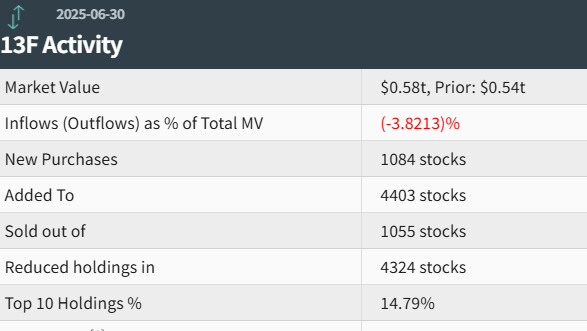
Core Insights - UBS Group reported a total market value of approximately $580 billion in U.S. equities for Q2 2025, reflecting a 7% increase from the previous quarter's $540 billion [1][2] - The firm added 1,084 new stocks, increased holdings in 4,403 stocks, reduced holdings in 4,324 stocks, and completely sold out of 1,055 stocks during the quarter [1][2] - The top ten holdings accounted for about 14.79% of UBS's total market value in Q2 [1][2] Holdings Adjustments - UBS exhibited a cautious approach towards technology stocks, particularly in light of the AI-driven market surge, opting to take profits from major tech companies [3][5] - Microsoft became UBS's largest holding, with approximately 31.6 million shares valued at about $15.7 billion, representing 2.72% of the portfolio, despite a slight decrease of 3.95% in shares held [3][5] - NVIDIA ranked second with around 96.2 million shares valued at approximately $15.2 billion, accounting for 2.63% of the portfolio, down by 5.16% [3][5] - Apple was the third-largest holding, with about 54.1 million shares valued at around $11.1 billion, making up 1.92% of the portfolio, reflecting a 10.86% decrease [3][5] Sector Focus - The fourth-largest holding was Amazon, with approximately 35.9 million shares valued at about $7.9 billion, representing 1.36% of the portfolio, down by 4.52% [4][5] - Broadcom was fifth, holding about 25.5 million shares valued at approximately $7 billion, accounting for 1.22% of the portfolio, down by 7.53% [4][5] - The sixth to tenth largest holdings included Meta, SPY ETF, JPMorgan Chase, QQQ put options, and Google, all reflecting a trend of reduced positions in major tech stocks [4][5] Strategic Moves - UBS's strategy in Q2 involved significant profit-taking from tech giants while increasing protective positions in the Nasdaq 100 index, indicating a defensive stance against potential market corrections [5][6] - The top five purchases included QQQ put options, NVIDIA put options, SPY call options, Netflix, and Alcon call options, while the top five sales included SPY put options, Apple, UnitedHealth, SPY ETF, and UBS stock [6][7][8]



瑞银:在美的集团的持股比例升至5.02%
Ge Long Hui· 2025-08-15 09:40
格隆汇8月15日丨香港交易所信息显示,瑞银集团在美的集团的持股比例于08月11日从4.37%升至 5.02%。 ...
瑞银集团在美的集团的持股比例于8月11日从4.37%升至5.02%
Mei Ri Jing Ji Xin Wen· 2025-08-15 09:31
每经AI快讯,8月15日,香港交易所信息显示,瑞银集团在美的集团(000333)的持股比例于8月11日 从4.37%升至5.02%。 ...
本以为首个撑不住的是乌克兰,没想到是瑞士,瑞士金融业近乎完蛋
Sou Hu Cai Jing· 2025-08-15 08:09
Core Viewpoint - Switzerland is facing an unprecedented economic crisis due to the U.S. government's decision to impose high tariffs on Swiss exports, leading to significant capital outflows and a loss of investor confidence in the Swiss financial system [3][12]. Group 1: Historical Decisions and Trust Crisis - In February 2022, the Swiss Federal Council made a historic decision to freeze $8.23 billion in Russian assets, breaking its long-standing tradition of neutrality and participating in sanctions against Russia [7]. - This decision sparked a trust crisis among investors, leading to a significant withdrawal of funds from Swiss banks, particularly after the Swiss government intercepted humanitarian goods destined for Iran [7]. - The signing of a financial data exchange agreement with the U.S. in June 2024 further eroded the traditional banking secrecy in Switzerland, prompting wealthy clients to relocate their assets to jurisdictions like Hong Kong and Dubai [7]. Group 2: Collapse of Swiss Financial Institutions - In 2023, Credit Suisse, a 167-year-old bank, was acquired by UBS for only 3 billion Swiss francs after its market value plummeted by 97% [10]. - Over a span of 10 months, $120 billion in capital fled from Swiss banks, with significant inflows into private banks in Singapore, which saw an increase of $300 billion in assets under management [10]. - UBS itself faced challenges, including a drop in stock price by 60% from its 2023 peak due to allegations of assisting Russian oligarchs in asset transfers [10]. Group 3: Impact of U.S. Tariffs - On August 7, 2025, the Trump administration announced a 39% tariff on Swiss goods, significantly higher than tariffs faced by the EU, leading to predictions of a 0.7% decline in Swiss GDP if key industries like pharmaceuticals were affected [12]. - The tariff policy is expected to trigger a wave of unemployment and economic recession in Switzerland, exacerbating the existing financial crisis [12]. - Many Swiss companies are relocating production and R&D to countries like Singapore and Ireland in response to the economic pressures [16]. Group 4: Shift in Wealth Management - The turmoil in the Swiss financial system has led to a shift in global wealth management, with Singapore's private banking clientele increasing by 48% in 2025, largely due to capital moving from Switzerland [18]. - The private banking sector in Switzerland, which once accounted for 12% of its GDP, is now facing systemic collapse [18]. - Singapore's stock market capitalization is projected to exceed $1 trillion by 2030, as reforms attract global capital [18]. Group 5: Swiss National Bank's Response - In response to the crisis, the Swiss National Bank has engaged in "silent actions" to stabilize the Swiss franc by increasing foreign exchange reserves, which reached a record high of 716 billion Swiss francs in July 2025 [22]. - The International Monetary Fund (IMF) has indicated that Switzerland will be the most severely impacted European country by U.S. tariffs, particularly amid global supply chain restructuring [22].

本以为第一个倒下的是乌克兰,没想到是瑞士,瑞士金融业近乎完蛋
Sou Hu Cai Jing· 2025-08-15 08:08
Core Viewpoint - The unexpected impact of the Russia-Ukraine war has led to a significant crisis in Switzerland's banking sector, which was previously considered a safe haven for global wealth [1][3][15]. Group 1: Switzerland's Banking Industry - Switzerland's banking industry was historically viewed as a secure and private place for wealth, attracting global elites due to its long-standing tradition of neutrality and confidentiality [4][6]. - The war prompted Switzerland to freeze Russian assets, a move that shocked many wealthy individuals who believed their funds were safe, leading to a significant outflow of capital to other financial hubs like Singapore and Dubai [6][12]. - The decision to support Western sanctions against Russia has undermined Switzerland's core competitive advantage of neutrality, causing a loss of trust among wealthy clients [8][10]. Group 2: Financial Performance and Future Outlook - By the end of 2024, several Swiss financial institutions reported sharp declines in profits, with Credit Suisse experiencing a loss of 162 million Swiss francs, leading to its acquisition by UBS, symbolizing a collapse of the Swiss financial model [13][18]. - The future for Switzerland's financial sector appears bleak, with two potential paths: fully aligning with Western financial systems or redefining its neutrality in emerging sectors like digital currency and green finance [18][19]. - The era of unconditional trust in Swiss banks has ended, transforming them from a secure vault for the wealthy into a regular banking center that requires more justification and assurance [19].

瑞银示警:美股要跌!现在就是标普年内高点,年底看6100点
美股研究社· 2025-08-14 10:01
以下文章来源于智通财经APP ,作者智通编选 智通财经APP . 智通财经APP,连线全球资本市场。内容合作/内容举报请联系李先生: Tel: +86-15121009144 Email:zhitongcolumn@163.com 来源 | 智通财经APP 8月12日,瑞银在全球策略报告《微观信心,宏观逆风:标准普尔 500 指数走向何方?》中,将 2025 年底标准普尔指数目标从 5500 点上调至 6100 点,2026 年底目标从 6100 点上调至 6800 点。 瑞银表示,目标上调反映出,美国经济及企业健康状况在近期好于预期。关税方面的最糟情景并未出现,对财政支持的信心以及美元走弱缓解 了对盈利的冲击,利差处于低位,资金流动也持续提供支撑。 (1)科技及相关公司盈利惊喜超预期 —— 这可能推动标准普尔 500 指数升至 7200 点; (2)受关税影响的公司利润率在关税提高的情况下仍能维持; (3)关税对美国通胀的影响比瑞银预期的要小得多; (4)尽管实际可支配收入受损,消费者仍持续消费; (5)在美国本土生产回流、外国直接投资以及新技术应用的推动下,美国资本支出和工业生产回升; (6)美联储为应对 ...