Yageo (YAGOY)

Search documents
又一家美国巨头因关税压力涨价!多家美国消费品公司称涨价不可避免
Di Yi Cai Jing· 2025-08-01 03:58
Group 1 - Procter & Gamble reported a net sales of $84.284 billion for fiscal year 2025, a year-on-year increase of 0.29%, and a net profit of $16.065 billion, up 7.29% year-on-year [1] - The company indicated that the overall sales volume remained stable due to price increases driven by cost pressures from tariffs and other factors [1][2] - Procter & Gamble's CFO noted that despite significant investments in local production, some materials still need to be imported, leading to ongoing tariff pressures [1] Group 2 - Procter & Gamble plans to raise prices on about 25% of its products in the U.S. by approximately 5% starting in August to offset new tariff costs [2] - Other consumer goods companies, such as Hasbro, have also acknowledged the inevitability of price increases due to tariff-related costs, with potential profit reductions of $60 million to $180 million [3] - Nike has already increased prices on certain footwear and apparel due to tariffs, while Skechers warned that high tariffs could significantly impact its business operations and lead to price hikes and reduced sales [4] Group 3 - Adidas expects to see an increase in product costs by €200 million in the U.S. due to tariffs, reflecting the broader impact of tariff policies on the industry [4]

“中国巨头遇上欧洲传统企业”,德媒热议京东将收购德国电商
Huan Qiu Shi Bao· 2025-07-31 22:35
Core Viewpoint - Ceconomy, a German electronics retail company, announced a €2.2 billion acquisition deal with Chinese e-commerce giant JD.com, aiming to enhance its growth and transform into a leading omnichannel consumer electronics platform in Europe [1][1][1] Group 1: Acquisition Details - JD.com plans to acquire Ceconomy shares at €4.6 per share through its subsidiary JD Germany Holding [1][1] - Ceconomy operates well-known retail brands MediaMarkt and Saturn, with approximately 1,000 stores across multiple European countries [1][1] Group 2: Strategic Implications - The agreement is intended to leverage JD.com's advanced technology, leading omnichannel retail experience, and logistics capabilities to drive Ceconomy's business growth [1][1] - The deal signifies a shift in the balance of power within the retail industry, highlighting the intersection of a Chinese giant with a traditional European enterprise [1][1]

狂砸4643亿,跨国巨头,正疯抢中国创新药
3 6 Ke· 2025-07-30 07:58
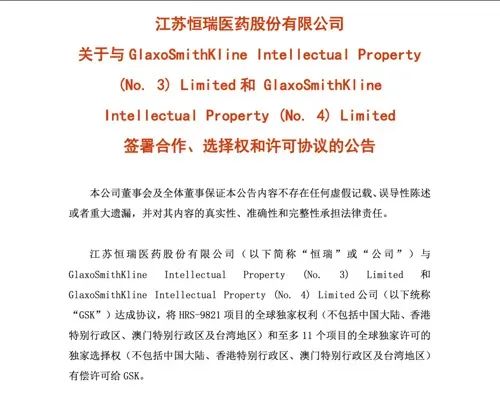
Core Viewpoint - The announcement of HRS-9821 project licensing to GlaxoSmithKline (GSK) by Heng Rui Medicine signifies a growing trend of multinational pharmaceutical companies acquiring innovative drugs from Chinese firms, reflecting a competitive landscape in the Chinese pharmaceutical market [1][5][19]. Group 1: Licensing and Financial Details - Heng Rui Medicine will receive a $500 million upfront payment from GSK, with potential milestone payments reaching up to $12 billion based on successful development, registration, and sales [2]. - The licensing agreement excludes regions such as mainland China, Hong Kong, Macau, and Taiwan, indicating a strategic focus on international markets [1]. - The deal has positively impacted Heng Rui Medicine's stock prices in both A-shares and Hong Kong stocks [4]. Group 2: Market Trends and Acquisitions - In the first half of the year, multinational pharmaceutical companies invested approximately 464.3 billion yuan ($64.5 billion) in acquiring Chinese innovative drugs, indicating a surge in interest [6][19]. - The "buy-buy-buy" strategy adopted by these companies highlights a shift towards acquiring rather than developing new drugs internally [7][20]. - Notable transactions include Pfizer's acquisition of a PD-1/VEGF bispecific antibody from 3SBio for $12.5 billion, marking a record for domestic innovative drug deals [8][10]. Group 3: Characteristics of Transactions - The average transaction amounts are substantial, with many exceeding $1 billion, and the largest deals surpassing $6 billion [15]. - Major pharmaceutical companies involved in these transactions include Pfizer, Roche, and AstraZeneca, all ranked among the top ten global pharmaceutical firms [16]. - The focus of these acquisitions is on high-tech areas such as oncology, autoimmune diseases, and metabolic disorders, showcasing the advanced nature of the Chinese pharmaceutical pipeline [17]. Group 4: Rationale Behind Acquisitions - The high risk and long development timelines associated with innovative drug development make acquisitions a more attractive option for multinational companies [20][22]. - Acquiring innovative drugs allows these companies to quickly fill gaps in their pipelines and respond to competitive pressures in the market [25][27]. - The trend of increasing external procurement from Chinese companies has risen from 10% in 2020 to 29% in 2023, indicating a growing recognition of the value of Chinese innovation [17][19]. Group 5: Advantages of Chinese Innovative Drugs - Chinese innovative drugs are perceived as high-quality and cost-effective compared to similar products in developed markets, making them appealing to multinational companies [36][40]. - The lower costs associated with drug development in China, estimated to be 20-30% of those in the U.S., further enhance the attractiveness of these assets [40]. - The increasing number of new drug approvals and ongoing research pipelines in China positions the country as a significant player in the global pharmaceutical landscape [36][38].



中国巨量铷矿发现,价值逼近百亿!日本焦虑:为何总被中国领先?
Sou Hu Cai Jing· 2025-07-27 11:15
Core Insights - A significant discovery of 175,000 tons of rubidium ore in Guangdong, China, has attracted global attention, marking a pivotal moment for the global mining market [1] - The market value of rubidium ore is estimated to approach 10 billion RMB per ton, highlighting its rarity and high demand [1] - This discovery positions China as one of the richest countries in rubidium resources, intensifying resource pressure on Japan, which has long relied on imports [1][5] Industry Implications - Rubidium's value stems from its extensive applications in military, aerospace, and medical fields, making it a critical resource in high-tech industries [3] - The discovery represents a historical opportunity for China, enhancing its resource development and technological innovation capabilities, and providing strong support for its military, medical, and aerospace sectors [5][7] - China's geological experts and advanced technology played a crucial role in this discovery, showcasing the country's growing strength in resource development and its potential for economic benefits and industrial growth [7]
亏损300亿关厂解难题,这家跨国巨头为何选择这条“单向车道”?
Zhong Guo Qi Che Bao Wang· 2025-07-22 02:13
Core Viewpoint - Nissan is planning to close its flagship factory in Zama, Kanagawa Prefecture by the end of the fiscal year 2027, transferring production to its Kyushu plant in Fukuoka to reduce costs and capacity as part of a broader restructuring effort [2][3] Group 1: Financial Challenges - The Zama factory currently employs approximately 2,400 workers, and Nissan is attempting to cut costs to address its rapidly deteriorating financial and operational situation [3] - Nissan reported a fiscal year loss of 670.9 billion yen (approximately 4.5 billion USD) as of March, a significant decline from a profit of 426.6 billion yen in the previous fiscal year [5] - The company is facing increased competition in the global market, declining sales in certain regions, and high restructuring costs, which have contributed to its financial struggles [5] Group 2: Restructuring Plans - Under the new CEO Ivan Espinosa, Nissan plans to reduce its global workforce by about 15%, which equates to nearly 20,000 jobs, and consolidate its 17 factories into 10 [6] - The annual production capacity is expected to decrease from 3.5 million units to 2.5 million units as part of these restructuring efforts [6] - Previous merger talks with Honda were abandoned, and Nissan is now seeking funding support and strategic partnerships [6] Group 3: Technological Advancements - To achieve a turnaround, Nissan must focus on technological breakthroughs, particularly in solid-state battery development, which could provide a significant competitive advantage in the electric vehicle market [7] - The company needs to increase investment in research and development for battery materials and structural innovations to enhance energy density, safety, and charging performance [7] Group 4: Market Strategy - Industry experts suggest that Nissan should abandon its "global car" strategy and adopt a regionally customized product approach, particularly focusing on the North American market's demand for electric pickup trucks [8] - The company should prioritize the development of electric pickup models that meet local consumer needs, emphasizing practicality, comfort, and competitive pricing [8] Group 5: Ecosystem and Collaboration - Nissan is encouraged to restructure its ecosystem through supply chain and alliance innovations to enhance competitiveness [8] - The company should actively seek partnerships to share resources and co-develop advanced electric platform technologies, potentially collaborating with tech firms to address software deficiencies [8][9]


链博会上的健康革命:跨国巨头押注中国,本土创新外溢全球
Hua Xia Shi Bao· 2025-07-21 08:00
Core Viewpoint - The third China International Supply Chain Promotion Expo showcased a "Healthy Life Chain" that highlights the integration of research, manufacturing, and services in the global healthcare industry, particularly in relation to the Chinese market [1][2]. Group 1: Localization and Ecosystem Development - The expo featured a "Healthy Life Chain" section with major companies like Sanofi, AstraZeneca, Medtronic, and others, emphasizing the shift from "capacity landing" to "ecosystem co-construction" [2]. - Medtronic has been operating in China for 36 years, introducing over 700 innovative products and developing a close-knit ecosystem with nearly 7,000 supply chain partners [2][3]. - Medtronic's Lantern cardiac pacing catheter, developed in collaboration with Chinese clinicians, is the first cardiac pacing product manufactured in China for global service [3]. Group 2: Investment and Production Capacity - Sanofi plans to invest €1 billion in a new production base in Beijing, focusing on end-to-end localization of insulin products to meet the growing demand from diabetes patients in China [3][4]. - Sanofi's flu vaccine production process is fully localized, ensuring traceability and safety through comprehensive quality management [4]. Group 3: Sustainability and Innovation - The healthcare industry accounts for approximately 5% of global carbon emissions, making climate change a critical issue for transformation [6]. - AstraZeneca has reduced its carbon emissions in China by about 80% over the past five years through systematic advancements in green R&D, production, and supply chain [6]. - AstraZeneca is also leading a multi-party renewable energy procurement plan in China, aiming for an annual carbon reduction of 250,000 tons and significantly lowering green electricity costs [6]. Group 4: Advancements in Biomanufacturing - Huaxi Bio's participation in the expo reflects its evolution towards a focus on autonomous, sustainable biomanufacturing supply chains, showcasing a model for the synthetic biology industry [7]. - The Tianjin pilot platform, with an investment exceeding 1 billion yuan, aims to enhance fermentation success rates by 40% through AI technology [7]. - Huaxi Bio's pilot results have achieved "zero defects" in raw materials passing FDA audits, marking a significant milestone for Chinese manufacturing in global pharmaceutical quality standards [7].
“中国巨轮”加速驶入A股!“两船”合并获证监会批复
Ge Long Hui A P P· 2025-07-18 16:41
Core Viewpoint - The largest absorption merger in A-share history is progressing, with the world's largest shipbuilding listed company emerging [1] Group 1: Merger Details - The China Securities Regulatory Commission (CSRC) has approved the absorption merger of China Shipbuilding Industry Corporation (CSIC) and China Shipbuilding Heavy Industry Company (CSIC) [2][3] - As of July 18, the total market capitalization of the two companies is 152.4 billion and 106.9 billion respectively, both exceeding 100 billion [2][3] - The share exchange ratio is set at 1:0.1335, meaning one share of China Shipbuilding Heavy Industry can be exchanged for approximately 0.1339 shares of China Shipbuilding [5][6] Group 2: Financial Performance - The combined net profit for the first half of the year for both companies is expected to reach between 4.3 billion and 4.9 billion, representing a year-on-year growth of approximately 121% to 152% [8] - China Shipbuilding's net profit is projected to be between 2.8 billion and 3.1 billion, an increase of 98.25% to 119.49% year-on-year, while China Shipbuilding Heavy Industry's net profit is expected to be between 1.5 billion and 1.8 billion, showing a growth of 181.73% to 238.08% [8] Group 3: Market Position - Post-merger, the total assets of China Shipbuilding will exceed 400 billion, with operating revenue surpassing 130 billion [9] - The total order backlog for both companies is 62.63 million deadweight tons, significantly higher than major competitors [9][10] - The merger positions the new entity as a global leader in terms of asset scale, revenue, and order volume [10] Group 4: Industry Context - The merger is the first major restructuring project following the new "National Nine Articles" policy, indicating a trend of increased activity in the A-share merger and acquisition market [8] - The merger is expected to facilitate rapid absorption of scarce technologies and market resources, driving industry upgrades and advancements in critical sectors [11]



称为中能股份王国巨介绍买家未获佣金 港商杨家诚起诉追讨12亿港元及3亿股股份
Mei Ri Jing Ji Xin Wen· 2025-07-17 13:41
Core Viewpoint - Carson Yeung, former owner of Birmingham City Football Club, is suing Wang Guoju for 1.2 billion HKD in commission related to a natural gas field project and for the unauthorized sale of 300 million shares of China Energy Holdings [1][2]. Group 1: Legal Dispute - The lawsuit claims that Wang Guoju failed to pay a commission of 1.2 billion HKD, which is 12% of the net proceeds from the sale of the natural gas project, amounting to 10 billion HKD [2]. - Yeung alleges that he transferred 300 million shares of China Energy Holdings to Wang Guoju for safekeeping, and that Wang Guoju has neither returned the shares nor paid the commission [2][3]. - The agreement stipulated that if Wang Guoju did not pay the commission, he was to return the shares immediately [2]. Group 2: Company Background - China Energy Holdings has been involved in a conditional sale agreement related to the natural gas project, with payments totaling approximately 1.249 billion HKD made to a related entity [3]. - Wang Guoju was the controlling shareholder of China Energy Holdings, holding 62.13% of the shares in 2017, which later decreased to 26.68% by 2024 [4][5]. - In 2024, China Energy Holdings reported a revenue of 300 million HKD, a decrease of 9.6% year-on-year, primarily due to technical issues affecting gas production [5].
跨国巨头再撤离!联合利华(UL.US)剥离委内瑞拉冰淇淋业务
智通财经网· 2025-07-11 03:54
Group 1 - Unilever has sold its ice cream business in Venezuela to Mack de Colombia CA, effective from July 3, involving the Tio Rico brand and related facilities, with financial details undisclosed [1] - The decision to partner with Mack was based on their professional capabilities, corporate values, and long-term business development plans, ensuring a smooth transition for employees, customers, and partners [1][2] - Venezuela's economic environment is facing multiple challenges, including high inflation and currency market imbalances, which have severely restricted business operations [1] Group 2 - The sale reflects the survival difficulties of the private sector in Venezuela under complex economic conditions and indicates a strategic adjustment trend among multinational companies amid geopolitical fluctuations and inflation pressures [2] - Unilever continues to operate its personal care brands like Dove in the Chinese market, indicating no exit from that sector, while maintaining a diverse product portfolio for Venezuelan consumers [2] - The divestment of non-core assets allows Unilever to focus on its core business, while Mack's entry into the ice cream sector presents an interesting case for future operational strategies and market performance [2]

特朗普威胁对金砖国家加征新关税,拉夫罗夫提及美国巨额债务
Sou Hu Cai Jing· 2025-07-08 06:09
Group 1 - The BRICS summit in Rio de Janeiro is seen as a platform for member countries to deepen trade relations without relying on the US dollar, which is perceived as an "anti-American policy" by Washington [1] - Trump expressed his discontent on social media, stating that any country joining the "anti-American route" of BRICS will face an additional 10% tariff [3] - Russian Foreign Minister Lavrov highlighted a significant increase in the number of countries with high government debt-to-GDP ratios, from 22 to nearly 60 [3] Group 2 - Lavrov pointed out that countries are spending more on debt repayment than on economic investment, with the US being a notable example, having a debt exceeding $37 trillion [4] - The credibility of the US dollar as a reliable payment method has been undermined, with its recent performance against major currencies being the worst in half a century [5] - The ongoing debate over raising the US debt ceiling may lead to the emergence of a third major political party in the US, an initiative proposed by Elon Musk [5]