
ZTO EXPRESS(ZTO)

Search documents
ZTO Express Down 18.7% Y/Y: Will the Plunge Continue Throughout 2025?
ZACKS· 2025-09-23 18:36
Core Insights - ZTO Express shares have declined 18.7% over the past year, underperforming the transportation-services industry's 14.5% decline [1][9] Financial Performance - ZTO Express is facing increasing pressure on its bottom line due to rising expenses, with a 14.2% year-over-year increase in total cost of revenues in 2024 and a 21.5% increase in the first half of 2025, primarily driven by higher sorting hub operating costs [4] - The Zacks Consensus Estimate for ZTO's 2025 earnings has been revised downward by 4.52% in the past 60 days, with a 2.35% downward revision for 2026, indicating a lack of confidence from brokers [7] Market Guidance - ZTO Express has lowered its 2025 parcel volume guidance to a range of 38.8 billion to 40.1 billion, reflecting a year-over-year growth of 14-18%, down from a previous guidance of 40.8 billion to 42.2 billion, which indicated a growth of 20-24% [5][9] Competitive Landscape - The domestic express delivery market is highly competitive, with major players like SF Express and STO Express, which may further pressure ZTO's stock price if competition intensifies [6] Industry Context - ZTO belongs to an industry currently ranked 206 out of 248 groups by Zacks, placing it in the bottom 16% of Zacks industries, suggesting that the overall industry performance significantly impacts stock price movements [10]

上海快递涨价,多个站点已收到通知,不影响个人寄件价格
21世纪经济报道· 2025-09-23 12:16
Core Viewpoint - The recent price increase in the express delivery industry, driven by policy and cost pressures, is spreading from core e-commerce areas to broader regions, aiming to curb long-standing low-price competition and improve service quality to retain consumer satisfaction [1][4][10]. Group 1: Price Increase Trends - Major express companies, including Jitu, Zhongtong, and Yuantong, have raised prices in Shanghai by 0.2 to 0.4 yuan per order, reflecting a broader trend initiated in regions like Zhejiang and Guangdong [1]. - The price adjustments primarily target low-priced e-commerce orders below cost, while personal parcel rates remain unaffected [1][4]. - The price increase is expected to enhance station profitability and courier income, with estimates suggesting a potential monthly revenue increase of approximately 1.5 million yuan for some stations [4]. Group 2: Industry Performance Metrics - In the first eight months of the year, the express delivery industry achieved a record volume of 1,282 billion packages, a year-on-year increase of 17.8%, while total revenue reached 958.37 billion yuan, reflecting a decline of 9.2% [2]. - The average price per delivery has decreased significantly, with major companies like Yunda and Yuantong reporting declines in per-package revenue due to intense competition [5]. Group 3: Cost Pressures and Market Dynamics - The express delivery sector faces rising costs, including increased wages for couriers and higher transportation and packaging expenses, leading to financial strain on many franchise operators [5][6]. - The shift from a volume-driven strategy to a quality-focused approach is evident, as companies like Zhongtong adjust their growth forecasts downward to prioritize service quality and profitability [6]. Group 4: Regional Price Variation and Market Response - Price adjustments have been uneven across regions, with core areas like Guangdong and Zhejiang implementing changes while non-core regions maintain existing pricing strategies [9]. - The autonomy of franchise operators in setting prices can lead to variations that undermine the intended effects of price increases, highlighting the need for a balance between headquarters policies and franchisee interests [9]. Group 5: Implications of Price Increases - The rise in delivery fees has led to the cancellation of shipping insurance by some merchants, particularly in high-return sectors like apparel, which may impact sales conversion rates [10]. - The potential reduction in reverse logistics volume due to the cancellation of shipping insurance could affect overall revenue for express stations, as reverse shipments are a significant source of additional income [10].


快递涨价“连续剧”更新!上海收件价格上调,商家默默取消运费险
2 1 Shi Ji Jing Ji Bao Dao· 2025-09-23 11:16
Core Viewpoint - The recent price increases in the express delivery industry, driven by policy and cost pressures, are spreading from core e-commerce areas to a broader range, aiming to curb long-standing low-price competition while the sustainability of these price hikes depends on service quality satisfaction among consumers [1][2][3]. Group 1: Price Increases and Market Dynamics - Major express companies in Shanghai have raised collection prices by 0.2 to 0.4 yuan per order, with similar actions observed in Zhejiang and Guangdong [1]. - The price adjustments primarily target low-priced orders below cost, while personal parcel prices remain unaffected [1][2]. - The price floor management in various regions has effectively curbed vicious low-price competition, leading to a stabilization in single-order revenue [2]. Group 2: Financial Impact on Companies - The price increase is expected to enhance station profitability and courier income, with estimates suggesting an additional 1.5 million yuan in monthly revenue for some stations if single-order income rises by 0.1 yuan [3]. - The express delivery industry has seen a record volume of 1,282 billion packages in the first eight months of the year, with a revenue of 9,583.7 billion yuan, marking a 17.8% and 9.2% year-on-year growth respectively [3]. Group 3: Cost Pressures and Competitive Landscape - The industry faces rising costs, including increased wages for couriers and higher transportation and packaging expenses, leading to some franchisees operating at a loss [4]. - The average price for express services has decreased by nearly 8% year-on-year, with major companies experiencing declines in single-order revenue [4]. Group 4: Regional Variations and Strategic Shifts - Price increases have been more pronounced in e-commerce core regions like Guangdong and Zhejiang, while non-core areas maintain previous pricing strategies [5]. - The ability of franchisees to set prices independently has led to some circumventing the price hikes, indicating a need for balance between headquarters policies and franchisee interests [6]. Group 5: Broader Implications of Price Changes - The rise in express fees has led to the cancellation of freight insurance, particularly affecting high-return sectors like clothing, which may impact sales conversion rates [6]. - The cancellation of freight insurance could also reduce the volume of reverse logistics, which has been a significant revenue source for express stations [6]. Group 6: Future Outlook and Challenges - Experts suggest that while price increases may improve profit margins, the effectiveness in curbing low-price competition remains uncertain, as consumer price sensitivity could affect order volumes [7].


全国多地快递费涨价 “反内卷”初见成效
Jing Ji Guan Cha Wang· 2025-09-23 03:47
Core Viewpoint - Major express delivery companies in China have collectively raised prices in various regions, indicating a shift away from low-price competition and a move towards stabilizing the industry after years of price wars [1][2][5] Price Adjustments - Five major express companies, including Jitu, Zhongtong, Yuantong, Shentong, and Yunda, announced price increases in Shanghai, with a rise of 0.2 to 0.4 yuan per package [1] - Since August, multiple regions such as Guangdong, Zhejiang, and Jiangsu have also implemented price hikes, with Guangdong raising the minimum price by 0.4 yuan and Zhejiang adjusting prices by 0.2 to 0.5 yuan [2][3] Industry Context - The express delivery industry has been struggling with low-price competition, leading to a consensus among major players to stop price wars since 2021 [1][5] - A report from招商证券 indicates that from January to May 2025, the national express business volume is expected to grow by 20.1% to 788 billion packages, but the average price per package is projected to drop by 8.2% to 7.5 yuan, highlighting the "volume increase, price drop" trend [1] Regulatory Influence - The State Post Bureau has been actively opposing "involution" in the industry, emphasizing the need for fair competition and the elimination of low-price chaos [5][6] - Following a meeting on July 29, express companies were encouraged to adopt unified pricing strategies to mitigate low-price competition [2][3] Early Signs of Recovery - The "anti-involution" measures have shown initial success, with several A-share express companies reporting an increase in average revenue per package in August [5][6] - For instance, Shentong's average revenue per package rose to 2.06 yuan, a year-on-year increase of 3% and a month-on-month increase of 4.6% [5] Future Outlook - Experts predict that there is potential for further price increases in the Zhejiang region before the "Double Eleven" shopping festival, with expected hikes of 0.15 to 0.2 yuan per package [4] - The overall trend suggests that the price recovery in the express delivery sector may continue, supported by seasonal demand and operational optimizations [6]
快递业“反内卷”在行动竞争焦点从拼价格转向比服务
Zhong Guo Zheng Quan Bao· 2025-09-22 20:15
Core Viewpoint - The domestic express delivery industry is shifting from price competition to service value, with multiple companies announcing price increases in various regions since mid-September [1][2][3]. Price Adjustments - Major express companies such as Zhongtong, Yuantong, Yunda, and Jitu have announced price increases starting September 22 in Shanghai, following similar announcements in Liaoning and other regions [2][3]. - The overall price increase ranges from 0.1 to 0.4 yuan per order, with some areas setting minimum prices for deliveries [2]. - This price adjustment follows earlier increases in Guangdong and Zhejiang, where the minimum price was raised by 0.4 yuan, and further increases are expected before the "Double Eleven" shopping festival [2][3]. Industry Trends - Over 10 regions have initiated "anti-involution" actions, indicating a trend from core e-commerce areas to central and northeastern regions [3]. - The National Postal Administration reported that in the first half of 2025, the total express delivery volume reached 956.4 billion pieces, a year-on-year increase of 19.3%, while revenue reached 718.78 billion yuan, up 10.1% [3]. Market Stability - Despite the price increases, the overall volume of deliveries remains stable, with companies reporting improved revenues [4]. - The express delivery market is expected to see a gradual implementation of price increases based on local conditions, with minimal impact on clients [4]. Service Value Enhancement - Companies are focusing on enhancing service quality and employee welfare to shift the competitive focus from price to value [5][6]. - The industry is encouraged to move away from a reliance on low prices and adopt a more balanced approach to competition, supported by regulatory frameworks [5][6].

异动盘点0922|优必选涨超4%,黄金股多数上涨;联邦快递涨超2%,特斯拉涨超2%
贝塔投资智库· 2025-09-22 04:00
Market Updates - UBTECH (09880) rose over 4% after signing a global strategic cooperation agreement with Cloud Intelligence Technology on September 21, with initial orders expected to be fulfilled [1] - Changfei Fiber Optics (06869) fell over 2% as shareholders reduced their holdings by a total of 10% in H-shares, with no significant impact on financial data from the hollow-core fiber [1] - Gold stocks mostly increased, with Lingbao Gold (03330) up over 4%, Zhaojin Mining (01818) up over 3%, China Silver Group (00815) up over 4%, and Shandong Gold (01787) up over 3%. The Federal Reserve's interest rate cut is expected to support a fluctuating upward trend in gold prices [1] - Yihuatong (02402) surged over 18% after partnering with Toyota to establish a fuel cell company and announcing the termination of the acquisition of Xuyang Hydrogen Energy [1] - WuXi AppTec (02268) increased over 6% after finalizing a subscription agreement that will raise WuXi Biologics' stake to over 50% [1] - Hong Kong Broadband (01310) dropped over 3% after announcing a share placement by its controlling shareholder, China Mobile Hong Kong, to restore public shareholding [1] - Huiju Technology (01729) rose over 10% following a strategic cooperation agreement with OpenAI to develop a revolutionary AI device for consumers [1] Shipping Sector - Shipping stocks experienced significant declines, with China Merchants Energy (01138) down over 6%, Seaspan (01308) down over 5%, Orient Overseas International (00316) down over 4%, and China Merchants Industry Holdings (01919) down over 4%. The Shanghai Shipping Exchange reported weak demand for Chinese export container transport, leading to continued adjustments in ocean freight rates [2] US Market Highlights - Pony.ai (PONY.US) increased by 18.55% as the CFO announced expectations to achieve key profit targets by early 2026 [3] - FedEx (FDX.US) rose 2.32% with projected revenue growth of up to 6% this year, exceeding analyst forecasts [3] - JD.com (JD.US) saw a 0.86% increase, with the iPhone 17 series achieving record sales within the first minute of pre-sale [3] - XPeng Motors (XPEV.US) rose 1.74%, reporting a 137% year-on-year increase in overseas deliveries from January to August [3] - ZTO Express (ZTO.US) fell 0.96%, with analysts noting a significant rebound in express delivery prices in August [3] - WeRide (WRD.US) surged 10.23% after its autonomous bus Robobus received Belgium's first federal-level L4 autonomous driving test license [3] - Tesla (TSLA.US) rose 2.21% as Baird upgraded its rating to "outperform," with expectations for significant stock price increases [4] - Apple (AAPL.US) increased by 3.20% following the successful launch of the iPhone 17 series on September 19 [4] - Quantum Song (QSG.US) rose 13.22%, with the chairman announcing a focus on the trendy toy sector [4]



伊金霍洛旗:打造绿色低碳智慧物流新标杆
Yang Guang Wang· 2025-09-22 02:22
Core Insights - The Erdos Airport Logistics Distribution Center is a key component of the Erdos Airport Logistics Park, focusing on building a green, low-carbon, and intelligent logistics system supported by digital supply chain platforms [1][3] Group 1: Infrastructure and Investment - The logistics center covers a total area of 104,000 square meters with an investment of 790 million yuan, featuring eight standardized warehouses and supporting facilities [1] - The center incorporates green technologies, including a rooftop CdTe photovoltaic system with a total capacity of 1.36 MW, and utilizes graphene electric heating and pure electric delivery vehicles [1] Group 2: Logistics Strategy and Operations - The logistics park aims to enhance logistics efficiency by integrating dispersed logistics resources and attracting enterprises in five core sectors: new energy equipment logistics, mining spare parts logistics, complete vehicle logistics, express logistics, and cold chain logistics [2][4] - The logistics hub is designed to facilitate a "gathering first, then distributing" model to achieve economies of scale [2] Group 3: Regional Connectivity and Economic Impact - The logistics park is strategically located at the intersection of major transportation networks, enhancing its role as a logistics hub connecting various regions, including the Beijing-Tianjin-Hebei, Yangtze River Delta, and Pearl River Delta [2][3] - The park is positioned as a "gateway node" for Erdos to connect with international markets, contributing to regional economic growth and serving as a logistics hub for the Belt and Road Initiative [3] Group 4: Industry Collaboration and Future Development - The logistics park has successfully attracted leading companies in various sectors, including Envision Energy and Chery Automobile, enhancing its operational capabilities [4] - Future plans include accelerating the construction of a national-level airport logistics hub in the western region, driven by leading enterprises and technological innovation [4]
全国多地快递市场相继迎来涨价 但对个人寄递影响有限
Cai Jing Wang· 2025-09-22 01:04
Core Viewpoint - The express delivery industry is signaling a shift away from price wars towards rational competition, driven by increased regulatory oversight and industry consensus [1][2]. Group 1: Price Adjustments - Major express companies in Shanghai announced a price increase effective September 22, 2025, to combat low-price disruptions and ensure stable service [1]. - Other regions, including Zhejiang, Guangdong, and Fujian, have also initiated price hikes, with minimum prices rising from 1.1 yuan to 1.2 yuan and 1.4 yuan respectively [1]. Group 2: Industry Challenges - The express delivery sector has been plagued by low-price competition, leading to a 20.1% increase in business volume but an 8.2% decrease in average price per package, resulting in a "volume increase, price drop" scenario [2]. - Many frontline express outlets have been operating at a loss due to this low-price competition, hindering the industry's healthy operation [2]. Group 3: Regulatory Environment - The State Post Bureau has emphasized the need for enhanced industry regulation and has opposed "involutionary" competition, aiming to improve service quality and contribute to a unified national market [2]. Group 4: Revenue Recovery - A preliminary recovery in single-package revenue has been observed, with companies reporting improvements: Shentong Express at 2.06 yuan, YTO Express at 2.15 yuan, and Yunda at 1.92 yuan [2]. - Companies are also focusing on cost reduction through operational optimization and automation, targeting price adjustments primarily at e-commerce special items and large clients [3]. Group 5: Future Outlook - The industry faces the challenge of ensuring that price increases are justified and sustainable, balancing profitability with market tolerance [3]. - Long-term solutions will require industry consolidation and a transformation in competitive models to establish a healthy competitive landscape [3].

又一地通知:9月22日起上调
Chang Jiang Ri Bao· 2025-09-20 15:33
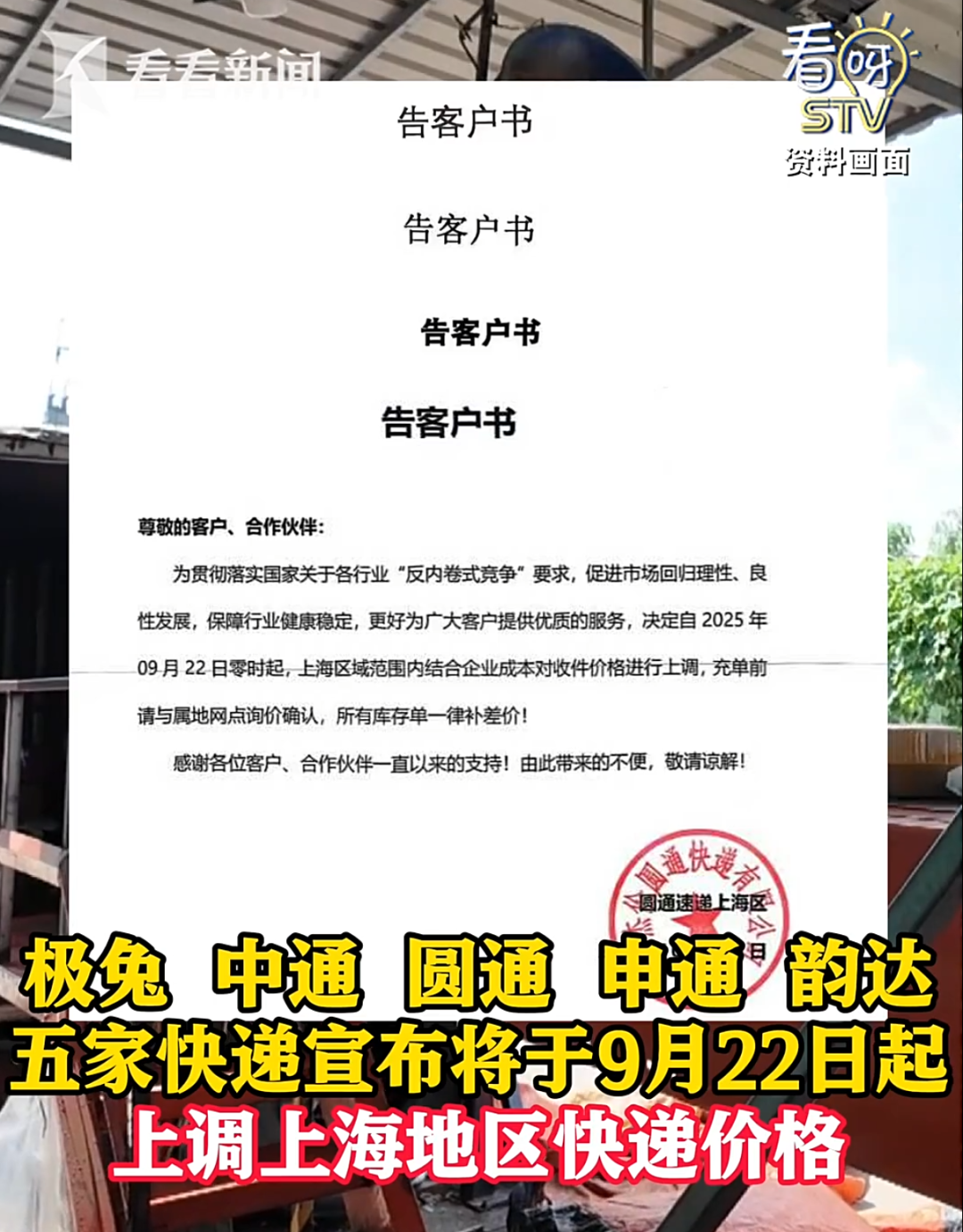
Core Viewpoint - Major express delivery companies in Shanghai, including Jitu, Zhongtong, YTO, Shentong, and Yunda, announced plans to raise delivery prices starting September 22, although the specific increase amounts have not yet been disclosed [1]. Group 1: Price Increase Announcements - Multiple express companies in Shanghai have issued announcements regarding price hikes effective September 22 [1]. - Some customer service representatives from express companies indicated they have not yet received official notifications about the price increase [4]. - Certain employees from express companies confirmed they have received "price increase notifications," but details on the amount and timing remain unclear [4]. Group 2: Industry Insights - A representative from Yunda stated that the price increase notifications were sent by local branches rather than the headquarters, which does not impose uniform price controls [6]. - An industry insider confirmed that there is an ongoing attempt to raise prices nationwide, with recent increases reported in Heilongjiang, Tianjin, Shandong, and Liaoning [6]. - The insider emphasized that a nationwide price increase is necessary to create a fair and orderly competitive environment, warning that significant price disparities could lead to opportunistic behaviors by resellers [6]. Group 3: Previous Price Adjustments - In August, several express companies in Guangdong and Zhejiang raised prices for e-commerce clients, with Guangdong being a key area for price adjustments [6]. - The price increase in Guangdong ranged from 0.3 to 0.7 yuan per item, with a minimum price set at 1.4 yuan per order [6]. - The region is noted for contributing the highest volume of deliveries while maintaining very low prices, with previous rates as low as 0.8 yuan for nationwide delivery [6].
全球股市:美联储降息,“三巫日”期权到期引关注
Sou Hu Cai Jing· 2025-09-19 14:24
Group 1 - Global stock markets are attempting a rebound, with US markets expected to close the week steadily following the Federal Reserve's potential quick rate cuts, pushing markets to new highs [1] - Major US stock index futures showed slight increases, with the Dow futures up 0.08%, S&P 500 futures up 0.12%, and Nasdaq futures up 0.11%, while the S&P 500 index reached a historical high [1] - European stock markets saw a modest rise, with the pan-European STOXX 600 index increasing by 0.3% to 556.72 points, driven by a 1.1% gain in interest-sensitive banking stocks [1] Group 2 - Asian stock markets declined, particularly after the Bank of Japan announced the sale of a large ETF holding while maintaining a policy interest rate of 0.5% [1] - The Federal Reserve's first rate cut of 25 basis points since December last year has strengthened risk assets, with the probability of another 25 basis point cut in October rising to 89.8% [1] - Despite the upcoming $500 billion "triple witching" options expiration, US stocks are not expected to show significant volatility, with traders focusing on the next non-farm payroll report [1] Group 3 - Notable individual stock movements included FedEx rising over 5% pre-market due to better-than-expected Q1 earnings, and NIO increasing by 2% as it plans to launch a special edition ET9 [1] - Other companies like ZTO Express and XPeng Motors also saw pre-market gains, with ZTO up 1.4% and XPeng up over 1%, driven by positive delivery growth figures [1] - Morgan Stanley highlighted risks from AI company earnings, while Bank of America noted continued upside potential for the "Magnificent Seven" stocks in the US market [1]


