
中国星网

Search documents
钧达股份:卡位能源系统+整星制造,打造首家A+H商业卫星上市公司-20260327
Changjiang Securities· 2026-03-27 02:45
Investment Rating - The investment rating for the company is "Buy" and is maintained [11] Core Insights - The company, Junda Co., specializes in TOPCon solar cells and has a high overseas shipment ratio, ensuring profitability above industry standards. Recently, it has decisively transformed into commercial aerospace by laying out satellite energy systems (perovskite tandem + CPI film) and satellite manufacturing [3][6] - Junda Co. is the first company to achieve dual listing (A+H shares) in the commercial satellite sector, which helps supplement capital while accelerating global expansion [9][18] Summary by Relevant Sections Energy Systems and CPI Film - The transition of satellites from military and research to commercial applications emphasizes economic considerations. Current technology primarily uses gallium arsenide cells, but silicon is expected to become the next generation due to cost advantages, while perovskite is anticipated to be the ultimate technology due to its higher specific power [7][20] - Junda Co. collaborates with Shangyi Optoelectronics to accelerate the development and production of CPI films and perovskite-silicon tandem products, with Shangyi being a rare domestic producer of satellite batteries [7][34] Satellite Manufacturing - The satellite sector is categorized into scientific, technical, and application satellites, each serving distinct functions. The demand for communication satellites is expected to surge, with over 200,000 satellites planned for launch by 2030-2035, marking a peak in satellite launches [8][49] - Junda Co. holds a 60% stake in Xuntian Qianhe, a leading satellite manufacturing company, which has already launched 7 satellites and is constructing a new facility to support larger-scale production [8][9] Globalization and Capital Enhancement - Junda Co. is a leading player in the global renewable energy sector and has established a dual listing on both A-share and H-share markets. The H-share listing, set for May 2025, is expected to significantly enhance the company's capital and accelerate its global expansion efforts [9][18]

钧达股份(002865):卡位能源系统+整星制造,打造首家A+H商业卫星上市公司
Changjiang Securities· 2026-03-26 09:32
Investment Rating - The investment rating for the company is "Buy" and is maintained [12] Core Insights - The company, Junda Co., Ltd., specializes in TOPCon solar cells and is a leading player in the industry, with a high proportion of overseas shipments ensuring profitability above industry standards. Recently, the company has decisively transformed into commercial aerospace by laying out satellite energy systems (perovskite tandem + CPI film) and satellite manufacturing [4][7] - Junda is the first company to achieve dual listing in A and H shares, which helps supplement capital while accelerating global expansion. As of Q1-Q3 2025, overseas sales accounted for 51% of total sales, with higher prices for overseas solar cells compared to domestic ones [10][4] Summary by Sections Energy Systems and CPI Film - The transition of satellites from military and research uses to commercial applications is driven by economic considerations. In space photovoltaics, gallium arsenide cells are currently the main technology, but silicon is expected to become the next generation due to cost advantages, while perovskite is anticipated to be the ultimate technology due to its higher specific power [8][24] - Junda collaborates with Shangyi Optoelectronics to accelerate the development and production of CPI films and perovskite-silicon tandem products, with Shangyi being a rare domestic producer of satellite batteries [8][39] Satellite Manufacturing - Satellites are categorized into scientific, technical experimental, and application satellites, each serving distinct functions. The demand for communication satellites is significant, with over 200,000 satellites expected to be launched between 2030 and 2035, marking a peak in launches [9][52] - Junda strategically entered satellite manufacturing by holding a 60% stake in Xuntian Qianhe, a leading satellite manufacturing company in China, which has already launched 7 satellites and is constructing a new facility for larger-scale production [9][10] Globalization and Capital Enhancement - Junda's dual listing has significantly improved its capital adequacy, with the H-share listing facilitating capital supplementation and accelerating global expansion. The company has seen a notable increase in overseas sales, which are crucial for its profitability [10][4]
商业航天发展驶入快车道-如何把握布局机会
2026-03-01 17:23
Summary of Key Points from the Conference Call on Commercial Aerospace Development Industry Overview - The commercial aerospace industry is experiencing accelerated development due to intensified global competition for space resources, particularly in low Earth orbit satellite frequencies, with SpaceX maintaining a leading position [1][4] - China is set to launch its second-generation satellites, with significant increases in launch frequency and capacity expected in 2026, marking a pivotal year for the industry [1][5] Core Insights and Arguments - The establishment of a Commercial Aerospace Department by the National Space Administration indicates that commercial aerospace will be a key focus during the 14th Five-Year Plan [1][7] - The market is opening up further as China applies for frequency resources for over 200,000 satellites, which is expected to create substantial market opportunities [1][8] - The domestic satellite manufacturing and rocket launch sectors are anticipated to enter a phase of rapid growth, particularly from 2027 to 2028, driven by increased launch services for major satellite constellations [5][6] Key Developments and Trends - The commercial aerospace sector has seen a recent stabilization after a period of adjustment, with ongoing infrastructure development in Hainan and other regions [2][13] - The domestic satellite launch capacity is currently constrained, but several private rocket companies are expected to achieve successful launches, alleviating this bottleneck [3][10] - The rapid iteration of reusable rocket technology is crucial for cost reduction and operational efficiency, with significant milestones expected in 2026 [11][25] Investment Opportunities and Risks - Investment focus should be on the upstream sectors of satellite manufacturing and rocket launch services, as downstream operations face challenges due to regulatory constraints and lack of publicly traded entities [27] - The anticipated IPOs of key players in the commercial aerospace sector, such as Blue Arrow Aerospace and others, are expected to enhance market interest and investment potential [28] Additional Important Insights - The competitive landscape is evolving, with SpaceX's advancements in satellite deployment and launch capabilities prompting other nations to accelerate their own commercial aerospace initiatives [4][15] - The development of low Earth orbit constellations is seen as a strategic necessity for national security and economic growth, with implications for China's own aerospace ambitions [21][22] - The integration of satellite communication technologies into emerging sectors like 6G and IoT is expected to drive further investment and innovation in the commercial aerospace industry [14][19] Conclusion - The commercial aerospace sector is positioned for significant growth, driven by technological advancements, policy support, and increasing market demand, making it a focal point for investment in 2026 [30]

京津冀GDP连跨六个万亿台阶 建设具全球影响力国际科技创新中心
Zhong Guo Xin Wen Wang· 2026-02-26 11:26
Economic Growth - The economic output of the Beijing-Tianjin-Hebei region has increased from 5.95 trillion yuan in 2014 to nearly 12 trillion yuan by 2025, crossing six trillion yuan milestones [2][12] - The GDP growth rate for the region in 2025 is projected at 5.4%, surpassing the national average by 0.4 percentage points [2][12] - The individual GDP contributions for Beijing, Tianjin, and Hebei are expected to be 52,073 billion yuan, 18,540 billion yuan, and 49,305 billion yuan, with respective growth rates of 5.4%, 4.8%, and 5.6% [2][12] Industrial Transformation - The industrial structure has shifted from 4.7:27.7:67.6 in 2020 to 4.1:25.8:70.1 by 2025, with the tertiary sector exceeding 70% [3] - The added value of the region's industrial sector is expected to grow by 6.6% in 2025, with high-tech manufacturing leading the way [3] - The production of integrated circuits has surged by 74.3% since 2020, and the output of industrial robots has increased significantly [3] Collaborative Development - The Beijing-Tianjin cooperation has seen significant investment, with over 290 billion yuan in projects from Beijing to Tianjin during the "14th Five-Year Plan" period [6] - The Tianjin Binhai New Area has enhanced its capacity to attract major projects, with a focus on technology and innovation [6] - The establishment of the "Beijing CBD-Tianjin Port Collaborative Service Center" aims to streamline services for businesses [6] Innovation and R&D - R&D expenditure in the region is projected to reach 4.2% of GDP by 2024, an increase of 0.4 percentage points since 2020 [8] - The number of invention patents is expected to reach 141,000 by 2025, nearly doubling since 2020 [8] - The region has seen a significant increase in specialized enterprises, with over 2,000 "little giant" companies established [8] Public Services and Quality of Life - The region has created 7.75 million new urban jobs over the past five years, with per capita disposable income increasing across all three areas [10] - Healthcare services have improved, with a 25.2% increase in medical insurance settlements for residents from Tianjin and Hebei in Beijing [10] - Collaborative efforts in education have strengthened, with numerous partnerships between schools in the region [11]
AI海报丨数据超亮眼!京津冀协同发展12年,活力满满向前行
Xin Lang Cai Jing· 2026-02-26 10:22
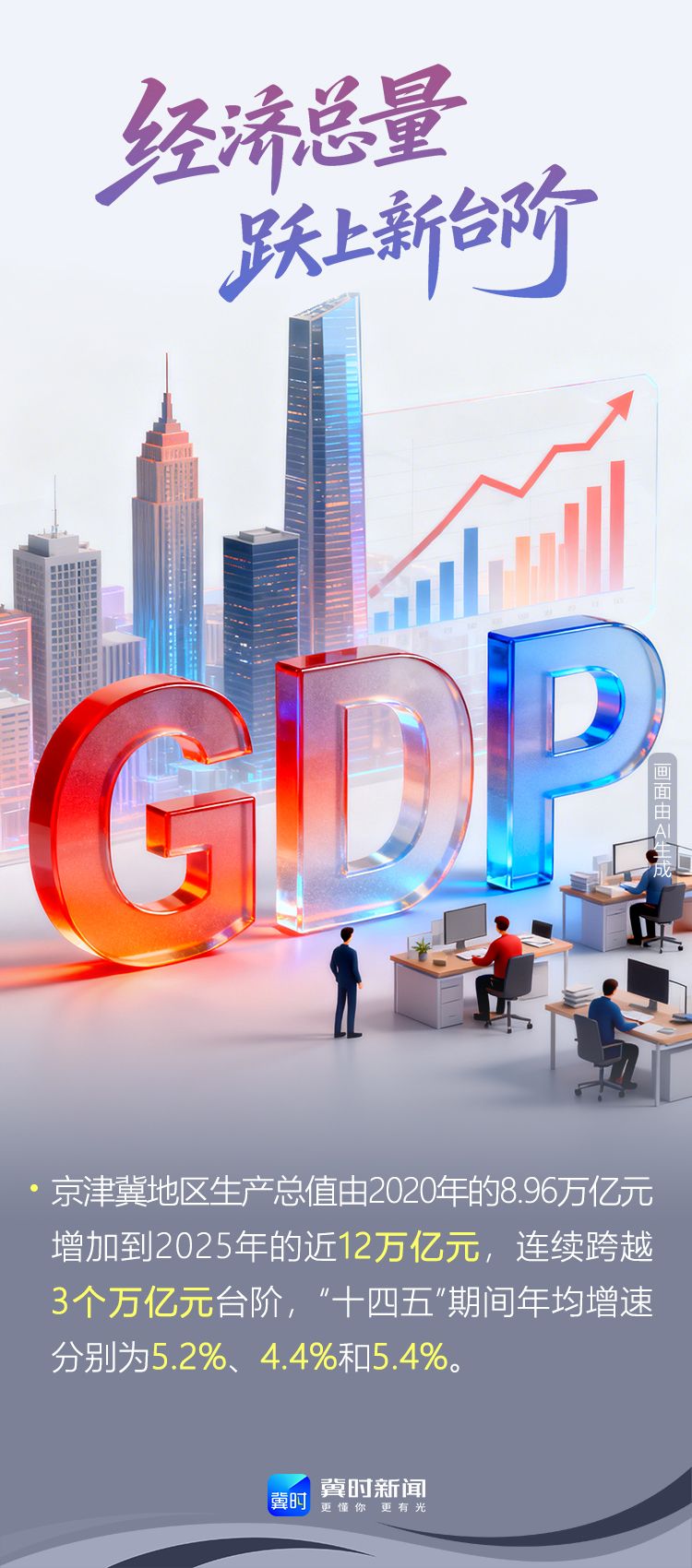
今年是京津冀协同发展战略提出12年。12年来,京津冀地区生产总值稳步攀升,交通、产业、生态等一体 化纵深推进,雄安新区承接疏解项目建设进入"快车道",三地优势互补、成果共享,携手迈向高质量发展 新征程。 · 京津冀地区生产总值由2020年的8.96万亿元 增加到2025年的近12万亿元,连续跨越 3个万亿元台阶,"十四五"期间年均增速 分别为5.2%、4.4%和5.4%。 翼时新闻 冀时 "十四五"期间,雄安新区进入大规模建设与 承接北京非首都功能疏解并重阶段,每年 保持2千亿元投资规模。 · 2025年,雄女犹区回正贫产投资同比 增长14%。 冀 寶时新闻 1-18-18-18 · 中国星网、中国中化、中国华能总部等 标志性疏解项目迁驻运营。 · "四纵三横"高速公路网全面形成,5300多栋 楼宇拔地而起。 · 278项京雄"同城化"政务服务应用场景 全面落地。 · 首批4所疏解高校雄安校区加速建设, 第二批5所疏解高校确定选址,高水平开办 中小学、幼儿园60所,新增学位5.5万个。 安同纵深刻 A HIMBERTY THE FILE IN THE RESEARCE THE FILL FOR THE 111 ...

资金流入,新两翼“比翼齐飞”
Xin Jing Bao· 2026-02-26 02:25
Core Insights - The Beijing Urban Sub-center and Xiong'an New Area are being developed as key components of the Beijing-Tianjin-Hebei coordinated development strategy, with significant investments driving their growth [9][10] - The Beijing Urban Sub-center has maintained an annual fixed asset investment exceeding 100 billion yuan, while Xiong'an New Area has sustained an investment scale of 200 billion yuan each year [2][10] Investment and Development - The Beijing Urban Sub-center has accumulated over 960 billion yuan in fixed asset investment since its construction began in 2016, with a continuous annual investment exceeding 100 billion yuan for five consecutive years [2] - In 2024, the investment composition in the Beijing Urban Sub-center is projected to be 26% from government and 74% from social capital, indicating a shift towards increased private investment [2] - Xiong'an New Area has achieved a cumulative investment exceeding 1 trillion yuan, with an average annual GDP growth rate of 17.1% since the "14th Five-Year Plan" [10] Infrastructure and Urban Development - Major infrastructure projects in the Beijing Urban Sub-center include the completion of the Beijing Tongzhou Station, which is part of a comprehensive transportation hub expected to enhance connectivity [2][3] - The development of cultural and tourism projects, such as the Universal Resort and various cultural landmarks, has significantly contributed to the urban landscape and local economy [3][4] Policy and Regulatory Framework - The introduction of the "Beijing Urban Sub-center Regulations" marks a significant milestone, providing a legal framework to clarify the development goals and support policies for the area [5] - The regulations aim to attract quality enterprises and talent to the urban sub-center, promoting high-level construction and development [5] Collaborative Development - The collaboration between Tongzhou District and the North Three Counties has led to the establishment of a national forest park and numerous joint projects, enhancing ecological and economic integration [6][7] - The "Tongbei Demonstration Zone" has made significant progress in transportation, healthcare, and education, improving resource sharing and quality of life for residents [7][8] High-Tech Industry Growth - High-tech enterprises are increasingly attracted to Xiong'an New Area, benefiting from favorable policies and a growing ecosystem for innovation [12][13] - Companies are shifting their focus from individual growth to collaborative development within the industrial ecosystem, fostering a community of shared success [13]
创新高地 创业热土
Xin Lang Cai Jing· 2026-02-25 22:05
Core Insights - Xiong'an New Area has made significant progress in nearly 9 years, with key projects advancing, a comprehensive highway network established, and over 5,300 buildings constructed, supported by a favorable business environment [1][2] Group 1: Business Environment - Xiong'an provides a "nanny-style" service for businesses relocating from Beijing, allowing for a seamless online application process for cross-province migration [1][3] - The area has implemented a streamlined approval system, reducing the approval time for projects to within 12 working days [1][2] Group 2: Infrastructure and Services - Major state-owned enterprises, including China Star Network and China National Chemical Corporation, have officially settled in Xiong'an, with over 400 branches established [2] - The "15-minute living circle" in Xiong'an encompasses various essential services, including education, healthcare, and recreational facilities, all within walking distance [2] Group 3: Talent Attraction and Retention - Policies have been detailed to ensure that relocated personnel receive educational, medical, and housing benefits comparable to those in Beijing, with equal rights for renters and buyers [3][4] - The "Xiong'an Talent Plan" aims to attract high-end talent through innovative employment structures and resource sharing with Beijing [3][4] Group 4: Future Development - The year 2026 is highlighted as a pivotal year for enhancing Xiong'an's capabilities, with new opportunities arising from national planning initiatives aimed at high-quality urban development [4]

未知机构:20260224复盘宏观1本月MLF操作开-20260225
未知机构· 2026-02-25 03:25
Summary of Conference Call Records Industry Overview Macro Environment - The central bank conducted MLF operations amounting to 600 billion, with a net injection of 300 billion, totaling 900 billion in medium to long-term funds for the month, including previous reverse repos [1] - 20 Japanese entities have been added to the export control list, and Japan plans to deploy missiles on an island 110 kilometers from Taiwan within five years [1] - The Trump administration is considering imposing new national security tariffs on six industries, potentially including large batteries, cast iron and iron fittings, plastic pipes, industrial chemicals, and equipment for power grids and telecommunications [1] Artificial Intelligence - Meta plans to purchase sufficient AMD chips to provide up to 6 gigawatts of computing power for its data centers over the next five years [1] - The release of Vera Rubin may be delayed by 2 to 4 months due to HBM4 from SK Hynix [1] - Nubia will launch a new "AI new species" smartphone at the World Mobile Communication Conference from March 2 to 5, positioning itself as a pioneer in AI smartphones [1] Semiconductor Industry - Japanese TDK has been placed on a watchlist; its MLCC market share exceeds 20%, presenting opportunities for domestic alternatives [2] - Shenghe Microelectronics has become the first company to pass the Sci-Tech Innovation Board review in the Year of the Rabbit [2] - Citron announced a short position on SanDisk via X [2] Chemical Industry - The U.S. has classified phosphorus and glyphosate herbicides as critical strategic materials [3] Military Industry - Reports suggest that Iran is purchasing supersonic anti-ship missiles [4] Key Insights and Arguments - The macroeconomic environment is characterized by significant monetary policy actions and geopolitical tensions, particularly involving Japan and the U.S. [1] - The AI sector is witnessing substantial investments and innovations, with major companies like Meta and Nubia leading the charge [1] - The semiconductor market is under scrutiny, with potential shifts towards domestic production in response to geopolitical pressures [2] - The chemical sector is adapting to new classifications of strategic materials, which may influence pricing and availability [3] - Military developments indicate ongoing arms acquisitions, which could impact regional security dynamics [4] Additional Important Information - The trading volume today reached 22,021 billion, with an increase of 2,194 billion, indicating a stable market despite geopolitical pressures [4] - Sectors such as oil, building materials, and chemicals are leading gains, driven by commodity price movements [4] - The market sentiment is cautious, with investors favoring stability over high-risk opportunities, although there are still numerous niche opportunities available [4]
京津冀经济总量 5年连跨3个万亿元台阶
Xin Lang Cai Jing· 2026-02-25 00:30
Core Insights - The "14th Five-Year Plan" period has shown significant achievements in the coordinated development of the Beijing-Tianjin-Hebei region, with GDP projected to increase from 8.96 trillion yuan in 2020 to nearly 12 trillion yuan by 2025, achieving an average annual growth rate of 5.2%, 4.4%, and 5.4% respectively [1][2] Group 1: Economic Development - The total area of the Beijing-Tianjin-Hebei region is 216,000 square kilometers, with a permanent population exceeding 100 million, providing a strong foundation for deep integration and collaborative progress [1] - The region has seen a reduction of 150 square kilometers in urban construction land and the exit of over 3,000 general manufacturing enterprises, optimizing economic structure and spatial layout [1] - Xiong'an New Area has entered a phase of large-scale construction, maintaining an annual investment scale of 200 billion yuan, with major companies like China Star Network and China National Chemical relocating there [1] Group 2: Infrastructure and Environmental Improvements - During the "14th Five-Year Plan" period, 710 kilometers of new railway operating mileage have been added, achieving a basic realization of a "1-1.5 hour traffic circle" among major cities [2] - The region's air quality has improved, and the water ecosystem is being restored, with shallow and deep groundwater levels rising by 3.29 meters and 7.67 meters respectively compared to the end of the "13th Five-Year Plan" [2] - The Yongding River has achieved continuous water flow for five consecutive years, indicating significant ecological progress [2] Group 3: Innovation and Industrial Collaboration - Collaborative innovation and industrial cooperation are key supports for high-quality development in the Beijing-Tianjin-Hebei region, with technology contract transaction amounts from Beijing to Tianjin and Hebei exceeding 320 billion yuan, growing at an average annual rate of 23%, which is 1.7 times higher than during the "13th Five-Year Plan" [2] - Over 10,000 branches of enterprises from Zhongguancun have been established in Tianjin and Hebei, indicating a strong trend of industrial collaboration [2]
京津冀地区生产总值近12万亿元
Xin Lang Cai Jing· 2026-02-24 23:26
Core Insights - The Beijing-Tianjin-Hebei region is projected to see its GDP grow from 8.96 trillion yuan in 2020 to nearly 12 trillion yuan by 2025, with annual growth rates of 5.2%, 4.4%, and 5.4% for the three areas respectively [1][2] Economic Growth and Industrial Transformation - The industrial structure of the region is shifting, with the proportion of the tertiary industry increasing from 67.6% in 2020 to 70.1% in 2025, indicating a significant transition towards service-oriented sectors [2] - The added value of industrial enterprises above designated size is expected to grow by 6.6% year-on-year by 2025, with high-tech manufacturing leading the charge [2] - The production of integrated circuits is projected to increase by 74.3% compared to 2020, while the output of industrial robots is expected to grow exponentially [2] Collaborative Development and Innovation - By 2025, Tianjin is expected to receive 184.78 billion yuan in industrial project investments from Beijing and Hebei, accounting for 52.1% of all industrial project investments [3] - The number of national advanced manufacturing clusters in the region is set to increase from 2 in 2022 to 7 by 2025, showcasing enhanced industrial collaboration [3] - The total value of technology contracts in the region is projected to reach 1.4 trillion yuan by 2025, 1.8 times that of 2020, with Beijing's technology contracts to Tianjin and Hebei exceeding 320 billion yuan [3] Infrastructure and Urban Development - The urban sub-center in Tongzhou is expected to see an average GDP growth rate exceeding 6% during the 14th Five-Year Plan, with significant infrastructure projects being completed [4] - Xiong'an New Area is entering a phase of large-scale construction, maintaining an annual investment scale of 200 billion yuan, with numerous central enterprises relocating to the area [4] Transportation and Environmental Improvements - The region has added 710 kilometers of railway during the 14th Five-Year Plan, with total operational railway mileage reaching 10,394.9 kilometers [5] - The air quality and water ecosystem in the region are improving, with groundwater levels rising significantly compared to the end of the 13th Five-Year Plan [6] Social Welfare Enhancements - By 2025, the number of insured individuals from Tianjin and Hebei seeking medical treatment in Beijing is expected to increase by 25.2% year-on-year [6] - Collaborative educational initiatives are being established, with 314 quality schools in Beijing partnering with 496 schools in Hebei [6]