
华硕

Search documents
对话英特尔吉姆·约翰逊:AI PC将往何处走
3 6 Ke· 2026-01-13 03:59
Core Insights - The rise of AI PCs, capable of independently processing AI tasks, is becoming increasingly significant as the cost of computing power for large models continues to rise [2][3] - Intel's CEO, Pat Gelsinger, announced the launch of the third-generation Core Ultra processor using Intel 18A technology at CES 2026, which is expected to enhance performance and efficiency in AI PCs [2][4] - The integration of CPU, GPU, and NPU in Intel's AI PC processors allows for more local processing of AI tasks, attracting interest from consumers and cloud computing companies [3][4] Group 1: AI PC Development - As of January 2026, over 100 million AI PCs equipped with Intel processors have been shipped globally, with their combined computing power equivalent to that of 40 data centers [4] - Intel has partnered with over 200 independent software vendors (ISVs) to develop more than 500 AI applications based on AI PCs, indicating a growing ecosystem [4][10] - The AI PC is seen as a resource that is currently undervalued, with potential to alleviate financial pressures on software companies by allowing local processing of AI tasks [3][4] Group 2: Technological Advancements - The Intel 18A process technology improves energy efficiency by 15% and increases chip density by 30%, allowing for more features to be integrated into smaller chip areas [7][10] - The third-generation Core Ultra processor is designed to achieve 40% better performance at the same power consumption compared to previous generations [7] - AI PCs are expected to enhance user experiences in various applications, including gaming, by providing smoother performance through AI-generated frames [9][10] Group 3: Collaboration with Cloud Services - Intel is exploring the collaboration between AI PCs and cloud services, with the aim of providing users with greater control, lower costs, and improved privacy [20][21] - The current strategy involves a static allocation of tasks between local and cloud resources, with ongoing efforts to create a more dynamic system [18][20] - Applications that benefit from the collaboration include content creation tools, where local processing can enhance performance and reduce reliance on cloud resources [19][20] Group 4: Future Directions - The company aims to drive the large-scale deployment of AI PCs in 2026, focusing on optimizing applications to enhance user experience [9][20] - Intel is committed to supporting developers by providing tools and frameworks that facilitate the integration of AI capabilities into existing software [12][22] - The company recognizes the importance of local AI capabilities and is actively working to strengthen its partnerships with OEMs and ODMs, particularly in the Chinese market [23]



全球最大的液冷展会来了|2026深圳国际液冷产业展会及论坛
Sou Hu Cai Jing· 2026-01-13 01:51
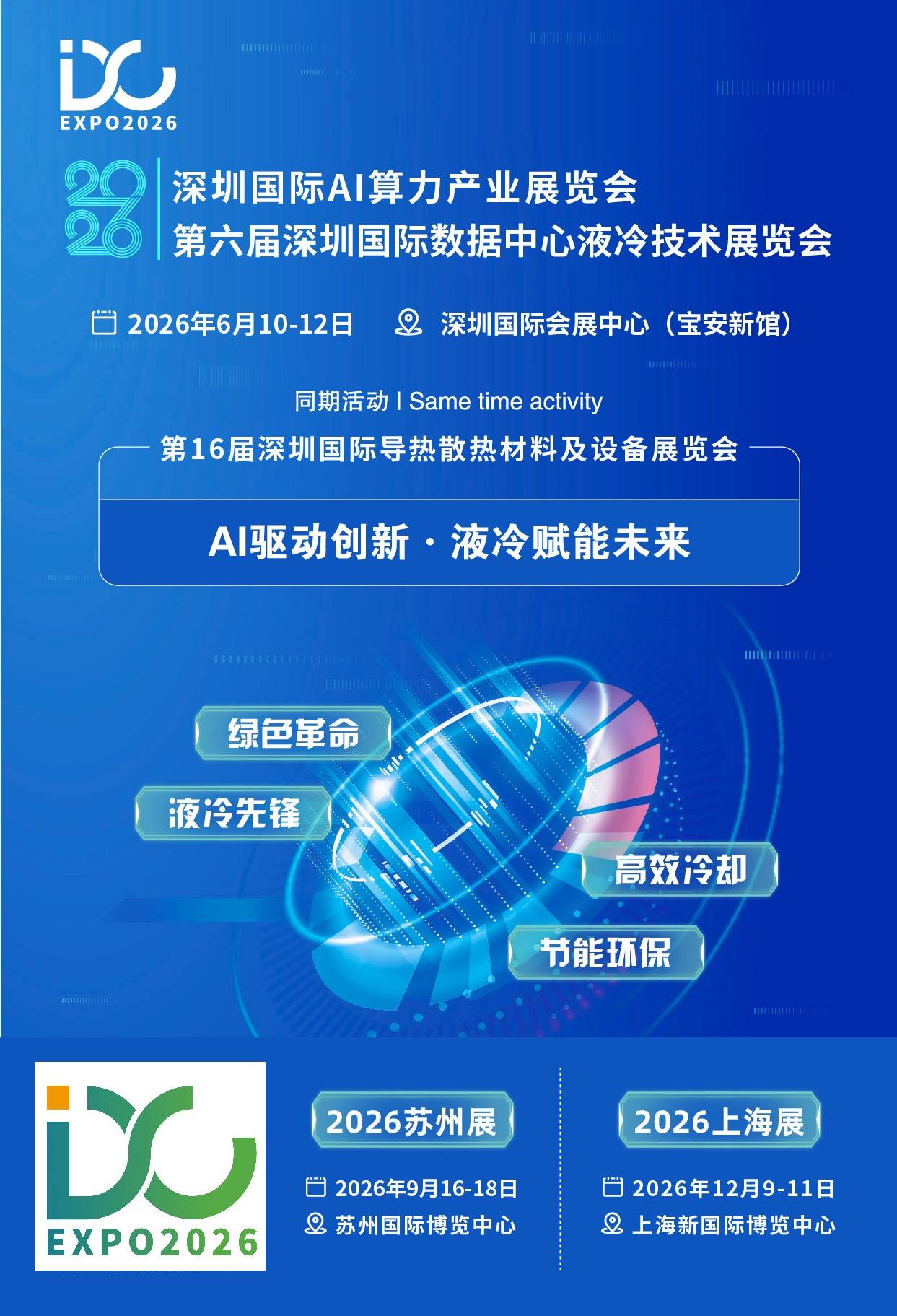
Group 1 - The 2026 Shanghai International Liquid Cooling Industry Exhibition will take place from December 9-11, 2026, at the Shanghai New International Expo Center [3] - The 2026 China (Shenzhen) International Liquid Cooling Industry Technology Exhibition is scheduled for June 10-12, 2026, at the Shenzhen International Convention and Exhibition Center [3] - The 2026 Suzhou Exhibition will occur from September 16-18, 2026, at the Suzhou International Expo Center [5] Group 2 - The rapid growth of big data has increased the demands on data center servers, necessitating higher power density in server cabinets [14] - Liquid cooling technology is becoming essential for data center efficiency, especially with the rise of 5G, edge computing, and AI applications [14][18] - The exhibitions aim to showcase the latest products and technologies in the liquid cooling industry, attracting professional audiences from data centers, power, electronics, edge computing, AI, and renewable energy sectors [14] Group 3 - The 2026 IDC exhibition is expected to cover an area of 15,000 square meters and will feature participation from major organizations such as the National Supercomputing Center in Shenzhen and Tencent [18] - Various technical exchange activities will be held during the IDC 2026 exhibition, focusing on industry hot topics and promoting diversified marketing strategies [19] - The exhibition will include a wide range of products covering cooling liquids, refrigerants, and various cooling devices, showcasing over a thousand new products across the entire industry chain [56] Group 4 - Shenzhen Angpai Technology Co., Ltd. is currently in the A-share IPO guidance stage, with plans to expand production capacity and R&D investment to capture market growth in liquid cooling [66] - The company has a registered capital of 90 million RMB and aims to leverage its professional R&D team and partnerships with universities to enhance its technological capabilities [66][68] - Angpai Technology's product offerings include liquid cooling module design, thermal management system integration, and innovative compressor technologies, with a focus on high reliability and efficiency [71][72]
Omdia:2025年全球PC出货增长9%,内存与存储供应紧张或影响2026年表现
Jin Rong Jie· 2026-01-13 01:30
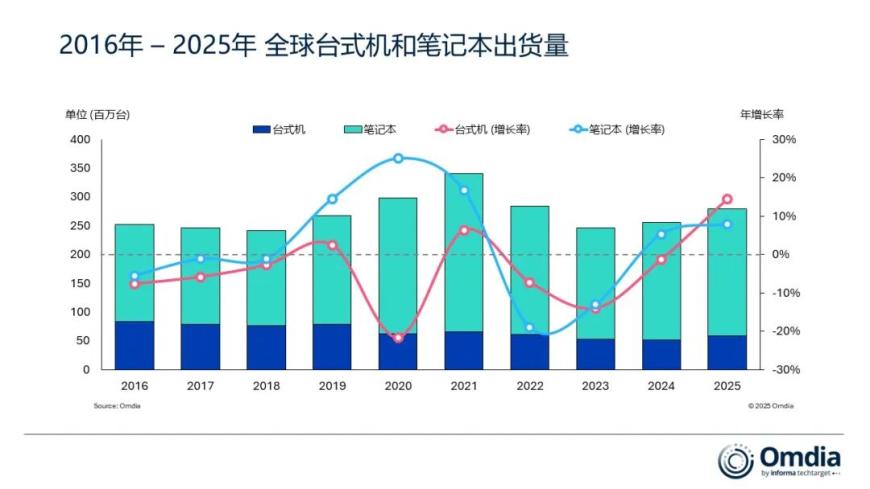
Core Insights - The global PC market is projected to see a total shipment of 75 million units in Q4 2025, marking a year-on-year growth of 10.1%, leading to an annual total of 279.5 million units, a 9.2% increase from 2024 [1][8] Group 1: Market Performance - In Q4 2025, notebook shipments (including mobile workstations) reached 58.6 million units, with an annual total of 220.4 million units, reflecting an 8% year-on-year growth [1] - Desktop shipments (including desktop workstations) in Q4 2025 totaled 16.2 million units, with an annual total of 59 million units, showing a significant year-on-year increase of 14.4% [1] - Lenovo continues to lead the PC market with a Q4 2025 shipment of 71 million units, a 14.4% increase year-on-year, and an annual total of 71 million units, up 14.6% [6] - HP ranks second with Q4 shipments of 15.4 million units, achieving growth both quarter-on-quarter and year-on-year [6] - Dell achieved a strong Q4 performance with a 26% year-on-year growth, resulting in an annual shipment of 42 million units, a 7% increase from 2024 [6] - Apple, maintaining the fourth position, became the fastest-growing vendor with an annual shipment of 28 million units, reflecting a 16.4% year-on-year growth [6] Group 2: Supply Chain and Pricing Dynamics - Despite the positive market outlook for 2025, there are concerns regarding tightening supply of memory and storage, leading to upward price pressures starting mid-2025 [3] - By December 2025, PC manufacturers began to anticipate price increases due to supply shortages, which are expected to impact 2026 shipment forecasts [3] - The cost of mainstream PC memory and storage increased by 40% to 70% from Q1 to Q4 2025, resulting in cost pressures being passed on to customers [3] - The demand for device replacements in 2026 remains strong, but supply-side pressures are expected to be more pronounced, affecting the ability to meet demand [3] - A survey indicated that 57% of B2B channel partners expect growth in PC business for 2026, suggesting a healthy market demand environment [3]



Omdia:2025年全球PC出货量达到2.795亿台 同比增长9.2%
Zhi Tong Cai Jing· 2026-01-13 01:29
Group 1: Market Overview - Omdia's latest research indicates that total shipments of desktops, laptops, and workstations will reach 75 million units in Q4 2025, representing a year-on-year growth of 10.1% [1] - The total PC shipment for 2025 is projected to be 279.5 million units, an increase of 9.2% compared to 2024 [1][8] - In Q4 2025, laptop shipments (including mobile workstations) are expected to hit 58.6 million units, with an annual total of 220.4 million units, reflecting an 8% year-on-year growth [1] Group 2: Supply Chain and Pricing Dynamics - Despite the positive outlook for the PC market in 2025, there are concerns about tightening supply of memory and storage, leading to upward price pressures starting mid-year [3] - By December 2025, PC manufacturers began to anticipate price increases due to supply shortages, which are expected to impact 2026 shipment forecasts [3] - The cost of mainstream PC memory and storage has risen by 40% to 70% from Q1 to Q4 2025, resulting in cost pressures being passed on to customers [3] Group 3: Company Performance - Lenovo continues to lead the PC market, with Q4 2025 shipments reaching 7.1 million units, a year-on-year increase of 14.4%, and an annual total of 71 million units, up 14.6% [6] - HP ranks second, with Q4 2025 shipments of 1.54 million units, showing growth both quarter-on-quarter and year-on-year [6] - Dell achieved a strong Q4 performance with a 26% year-on-year growth, totaling 4.2 million units for the year, a 7% increase from 2024 [7]
Omdia:2025年全球PC出货增长9%,内存与存储供应紧张或影响2026年表现,联想继续领跑全球市场,戴尔第四季度表现亮眼
Canalys· 2026-01-13 01:02
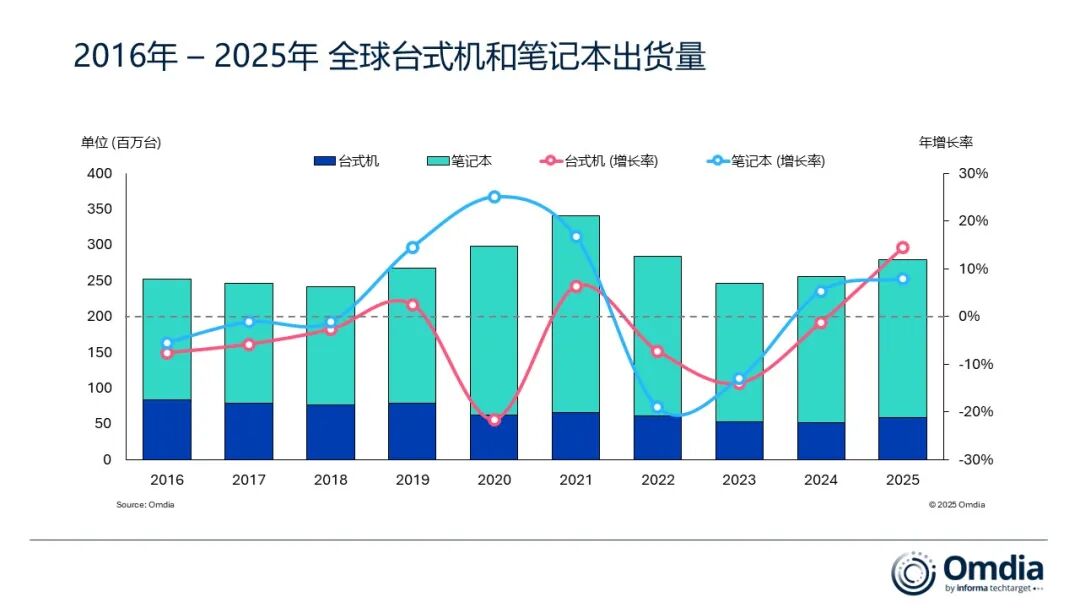
Core Insights - Omdia's latest research indicates that the total shipment of desktops, laptops, and workstations will reach 75 million units in Q4 2025, representing a year-on-year growth of 10.1%. This will result in an annual PC shipment of 279.5 million units in 2025, a 9.2% increase from 2024 [1][2]. Shipment Performance - In Q4 2025, laptop shipments (including mobile workstations) will total 58.6 million units, with an annual total of 220.4 million units, achieving an 8% year-on-year growth for 2025 [2]. - Desktop shipments (including desktop workstations) will reach 16.2 million units in Q4, with an annual total of 59 million units, reflecting a 14.4% year-on-year increase [2]. Market Dynamics - Despite the positive outlook for the PC market in 2025, there will be tightening supply of memory and storage starting mid-year, leading to upward price pressures. By December 2025, PC manufacturers are expected to release price increase forecasts due to supply shortages impacting 2026 shipment expectations [4]. - The cost of mainstream PC memory and storage has risen by 40% to 70% from Q1 to Q4 2025, which will ultimately affect customer pricing. The industry is shifting towards higher-end products while streamlining mid to low-end configurations to protect profit margins [4]. Vendor Performance - Lenovo continues to lead the PC market, with Q4 2025 shipments reaching 7.1 million units, a year-on-year increase of 14.4%, and an annual total of 71 million units, up 14.6% [8]. - HP ranks second, with Q4 shipments of 1.54 million units, showing growth both quarter-on-quarter and year-on-year. Dell achieved a strong Q4 performance with a 26% year-on-year growth, totaling 4.2 million units for the year, a 7% increase from 2024 [8]. - Apple remains in fourth place and is the fastest-growing vendor for the year, with annual shipments of 28 million units, reflecting a 16.4% year-on-year growth. Asus ranks fifth, maintaining its position in both quarterly and annual rankings, with Q4 shipments of 530,000 units and an annual total of 20 million units, benefiting from a 7% growth in the holiday quarter [8]. Market Share Analysis - In Q4 2025, Lenovo holds a market share of 25.8%, HP at 20.6%, Dell at 16.7%, Apple at 9.4%, and Asus at 7.1%. The total shipment for the quarter is 74.8 million units, a 10.1% increase from Q4 2024 [9]. - For the entire year of 2025, Lenovo's market share is 25.4%, HP at 20.6%, Dell at 15.0%, Apple at 9.9%, and Asus at 7.2%, with total shipments reaching 279.5 million units, a 9.2% increase from 2024 [10].

从AI眼镜到脑机接口 智能终端升级大有可为
Shang Hai Zheng Quan Bao· 2026-01-12 18:36
Core Insights - The news highlights the rapid development and investment in AI technologies, particularly in AI glasses, AI phones, and brain-computer interfaces, driven by policy support, technological breakthroughs, and market demand [1][2][4][6] AI Glasses - The 2026 International Consumer Electronics Show (CES) focuses on AI glasses, emphasizing lightweight design, strong interactivity, and full-scene applications as key trends [2] - Major companies are set to launch several AI glasses products in 2026, including Google's Project Aura and Apple's AI glasses, with IDC predicting a shipment volume of 4.508 million smart glasses in China, a 77.7% year-on-year increase [2] - The industry is witnessing increased orders, with companies like Visionary Technology and Huanxu Electronics ramping up production to meet rising demand for AI glasses [3] AI Phones - AI phones are expected to activate a new wave of device upgrades, with multiple Android manufacturers planning to release AI phones in early 2026 [4] - The evolution of AI phones is marked by a shift from mere computational upgrades to a fundamental restructuring of underlying systems, akin to past revolutions in computing and mobile operating systems [4] - The demand for AI phones is driving growth in the upstream supply chain, with companies like Bowei Alloy anticipating significant orders for components needed in high-end AI phone models [4] Brain-Computer Interfaces - The brain-computer interface sector is gaining momentum, with companies like Neuralink planning large-scale production starting in 2026 and Qiangnao Technology recently securing approximately 2 billion yuan in funding [6] - Government policies are increasingly supporting the development of brain-computer interfaces, with initiatives in cities like Beijing and Shanghai aimed at fostering innovation and establishing key enterprises in the sector [6] - Domestic companies are making significant technological advancements, such as Hanwei Technology's breakthroughs in non-invasive flexible brain-computer interface materials and collaborations with medical institutions [6]
美光高管解读:为何投入巨大,内存短缺在2028年前难以改善?
美股IPO· 2026-01-12 12:56
Core Viewpoint - The demand for AI data centers has reshaped the DRAM market, accounting for 50%-60% of the market, which is the core reason for the current supply shortage [1][5]. Group 1: Supply and Demand Dynamics - The current supply shortage in the memory market is not due to manufacturers adjusting customer structures but is driven by the explosive demand from AI data centers and increasing manufacturing complexity [3][4]. - The structural change in DRAM demand, with AI-related needs rising from 30%-40% to 50%-60%, indicates that the entire industry faces a "capacity shortage" rather than a single manufacturer's resource allocation issue [5][6]. Group 2: Production Challenges - The main bottleneck in DRAM production is not the number of devices but the fragmentation of product specifications, which leads to production inefficiencies due to frequent switching between different designs [7][8]. - Manufacturers are focusing on reducing the variety of chip specifications to maximize output, as the demand for different capacities (8GB, 12GB, 16GB) increases [7][8]. Group 3: Future Outlook - The significant improvement in memory supply is not expected until around 2028, despite high capital expenditures in the industry [4][6]. - New production lines, such as Micron's ID1 facility in Idaho, will take time to ramp up and achieve stable output, with substantial changes in supply-demand dynamics likely occurring only after 2028 [8].


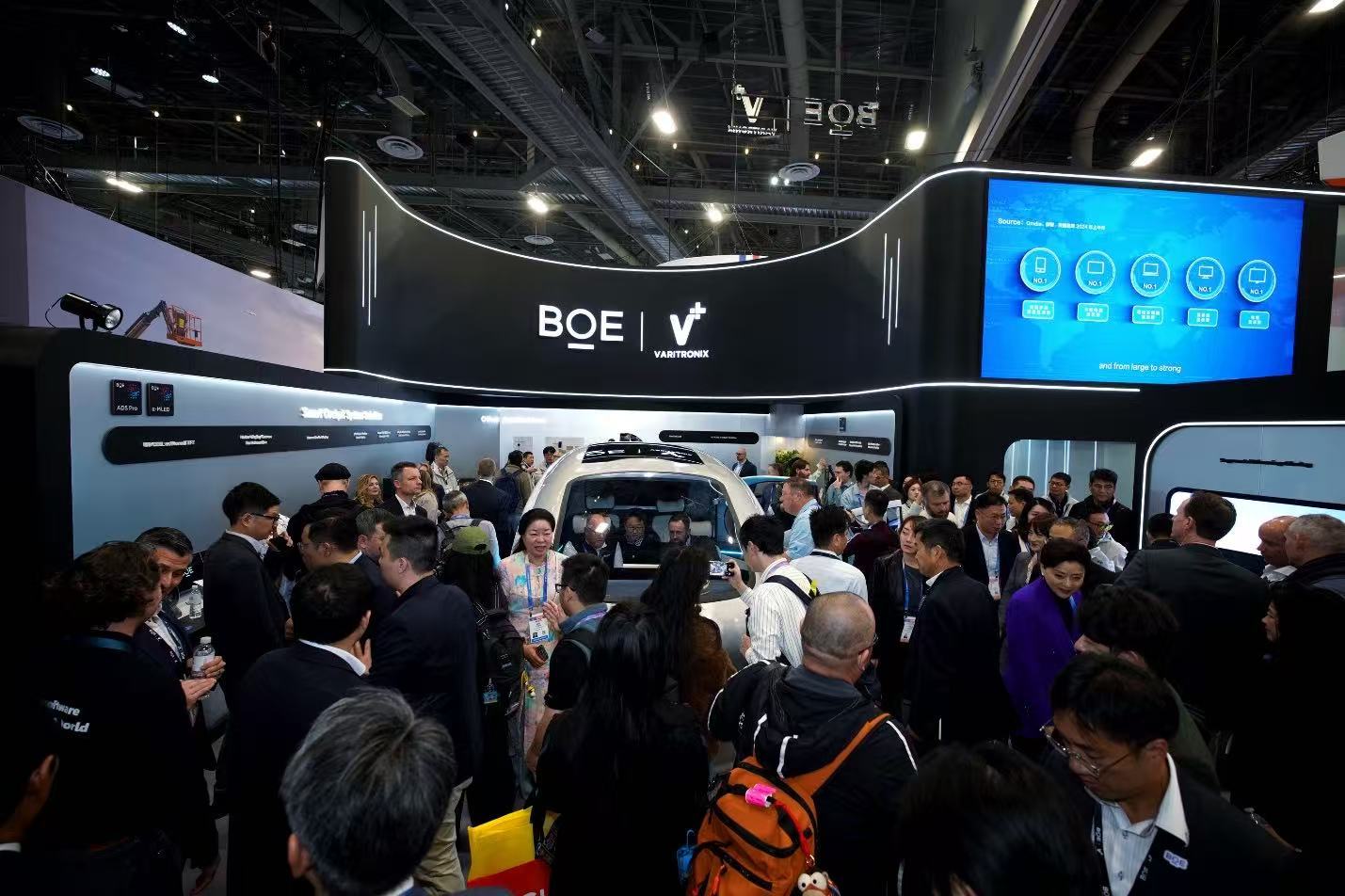
京东方首发HERO 2.0智能座舱 科技创新助力智能出行
Ke Ji Ri Bao· 2026-01-12 11:49
Group 1 - The core focus of the article is on the innovations showcased by BOE (京东方) at CES 2026, particularly in the fields of automotive intelligence and green technology [1][3] - BOE presented over 60 advanced display technologies and IoT solutions, aiming to foster collaborative innovation and ecological win-win scenarios with over 40 global partners [1] - The introduction of the HERO 2.0 smart cockpit marks a significant advancement in interactive experiences, emphasizing audio-visual enhancements and connectivity between vehicles and homes [1][3] Group 2 - HERO 2.0 incorporates AI technology for smart voice and gesture control, achieving a complex command recognition rate of 98% [3] - The cockpit features a central control screen that allows users to manage various functions such as sunroof control, food ordering, and home monitoring, facilitating "car-home" and "car-business" connectivity [3] - The world's first smart, independent vehicle amplifier with real-time AI sound quality restoration technology offers a high-fidelity audio experience, while the digital broadcasting system ensures quality audio and image transmission even without 4G or 5G signals [3]

美光高管解读:为何投入巨大,内存短缺在2028年前难以改善?
Xuan Gu Bao· 2026-01-12 11:21
Core Insights - Micron executives indicate that despite significant investments, the memory shortage issue will not improve until 2028 [1] - The current supply constraints are driven by a surge in AI data center demand combined with increasing complexity in memory manufacturing [1] - The structural change in DRAM demand, particularly from data centers and AI, has risen from 30%-40% to 50%-60% of the total DRAM market [2] Group 1: Industry Challenges - The memory supply issue is not unique to Micron but is an industry-wide constraint affecting all major memory manufacturers [2] - The shift in demand prioritization towards AI does not equate to consumer neglect; rather, it reflects a temporary supply mismatch due to the expanding total addressable market (TAM) [2] - Micron emphasizes that simply increasing production capacity will not alleviate the shortage, as the main bottleneck is the fragmentation of product specifications leading to production inefficiencies [3] Group 2: Production and Capacity - The production bottleneck arises from the need for frequent switching between different product designs, which reduces effective output [3] - Micron is working to minimize the variety of chip specifications to maximize output efficiency [3] - New capacity from Micron's ID1 wafer fab in Idaho is expected to come online in mid-2027, but significant scale production will take additional time, likely pushing substantial supply changes to 2028 [4]
PC厂商撑不住了,集体涨价!两天涨了400多元,有人干脆不买了
Mei Ri Jing Ji Xin Wen· 2026-01-12 10:12
Group 1 - The rapid development of AI has led to significant price increases in memory, hard drives, and graphics cards, with memory prices soaring to the extent that a box of 100 memory sticks was valued at 4 million yuan, comparable to the price of a house in Shanghai [1] - Many brands of laptops and smartphones have unexpectedly raised their prices since the beginning of the year, reflecting a broader trend in the consumer electronics market [2] - Major PC manufacturers, including HP, Acer, Asus, and Dell, have collectively announced price increases for their products due to rising memory costs, with Dell's commercial computer prices increasing by 10% to 30% [3] Group 2 - Xiaomi's new smartphone, the Xiaomi 17 Ultra, has seen a price increase of 500 yuan compared to its predecessor, primarily due to rising memory costs, with other brands like Redmi and OPPO also adjusting their prices, some by as much as 20% [4] - IDC predicts that the average selling price of smartphones will rise to $465 by 2026, with total market revenue reaching $578.9 billion, marking a historical high [4] - The cost of memory semiconductors in smartphones has increased from 10%-15% to over 20%, with mid-range phones seeing storage costs approaching 30%, leading some budget models into negative profit margins [4] Group 3 - In contrast to other consumer electronics, AI glasses have not experienced widespread price increases due to rising storage costs, with recent government policies including smart glasses in subsidy programs [5] - Some AI glasses, like the XREAL One AR glasses, have even seen price reductions, with the XREAL 1S priced $50 lower than its predecessor [6] - The storage requirements for AI glasses are not as high as for smartphones, which may influence pricing strategies and profit margins in this segment [6]

