
广达

Search documents
两路径布局!科技业加快供应链多元化态势
Jing Ji Ri Bao· 2025-08-27 23:45
Core Insights - The technology industry is accelerating supply chain diversification in response to changing U.S. tariff policies [1] - There are two main trends: server production is shifting to the U.S. and Mexico, while smartphone and PC manufacturing remains concentrated in Asia to control costs [1] - The U.S. market for servers, smartphones, and PCs is projected to generate $565 billion in 2024, accounting for over half of the tech hardware revenue [1] Group 1 - Server production has been migrating since 2018, with a focus on U.S. and Mexican manufacturing for products aimed at the U.S. market [1] - Major Taiwanese ODMs, including Foxconn, Quanta, Wistron, and Inventec, have established production bases in the U.S. to meet customer demands and mitigate tariff pressures [1] - TSMC's expansion of advanced chip production in Arizona further reinforces this trend towards localized manufacturing [1] Group 2 - AI servers are strategically positioned to largely avoid the impact of U.S. tariffs, with many manufacturers establishing cross-regional operational networks [1] - Components and subsystems are primarily produced in Asia, with final assembly occurring in Taiwan or Mexico, the latter benefiting from tariff exemptions under the USMCA [1] - The preference for U.S. assembly is growing due to simplified assembly processes and enhanced customer support efficiency, particularly for high-priced AI servers [2]
Meta撒钱攻AI冲上1.5兆元 广达、晟铭电迎大单
Jing Ji Ri Bao· 2025-08-27 23:42
Group 1 - Meta's CEO Mark Zuckerberg proposed a significant investment of $50 billion in Louisiana for AI data center infrastructure, which is five times the originally planned investment of $10 billion [1] - The Louisiana data center, named Hyperion, is expected to have strong computing capabilities to support digital infrastructure loads, including AI [1] - The investment is anticipated to benefit Taiwanese companies, particularly Quanta (2382) and Cheng Ming Electric, which are expected to collaborate on the project [1] Group 2 - A 1,000-watt AI data center is estimated to cost around $10 billion, and Meta plans to invest hundreds of billions to build multiple large AI data centers as part of its core strategy for "super intelligence" and "super computing" [2] - Meta will introduce a new generation of ASIC project AI servers named Santa Barbara, aiming to replace the existing Minerva servers, with a target of building 6,000 cabinets by the end of this year to next year [2] - The Santa Barbara servers are expected to have significant upgrades, with a thermal design power (TDP) exceeding 180 kW, requiring highly customized cabinets, sidecars, and water cooling components [2]

生成式AI无过热迹象!小摩:明年AI资本支出增速至少 20%!
智通财经网· 2025-08-26 08:59
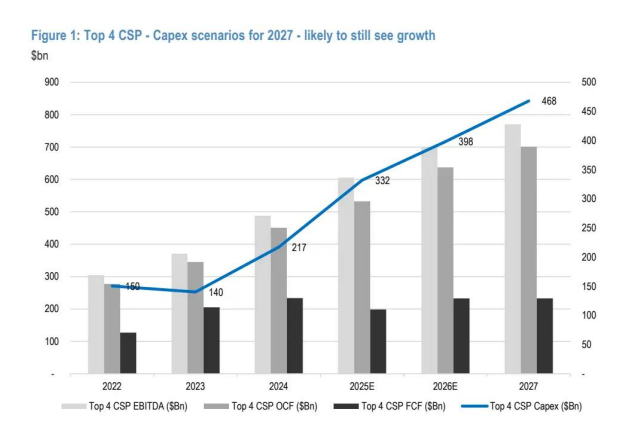
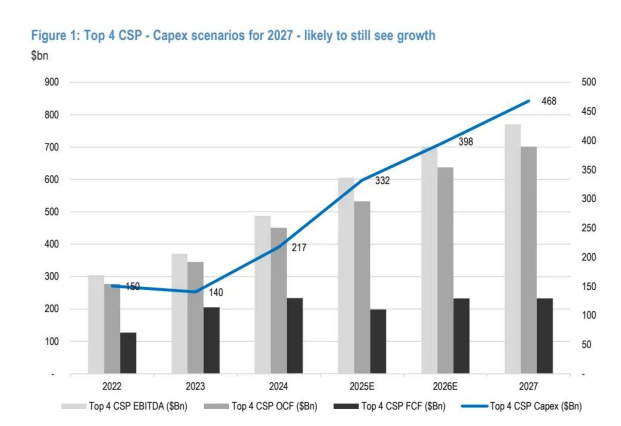
Core Viewpoint - Market concerns about AI capital expenditure (capex) potentially peaking in 2026 are prevalent, but JPMorgan presents a counterargument based on four key points: no signs of overheating in generative AI, continuous entry of new investment players, significant expansion of AI application scenarios, and the potential demand release in the Chinese market [1][2]. Group 1: AI Capital Expenditure Insights - JPMorgan predicts that AI capex growth will reach at least 20% in 2026, with further growth expected in 2027 if the penetration rate of reasoning models continues to rise [3]. - The top four cloud service providers (CSPs) are expected to maintain strong capital expenditure supported by robust operating cash flow, with a projected cumulative EBITDA and operating cash flow CAGR of 23% from 2022 to 2026 [5][4]. - The capital expenditure of the top four CSPs is anticipated to increase from $150 billion in 2022 to a projected $398 billion in 2026, with a consensus forecast showing a cumulative free cash flow CAGR of 16% [7]. Group 2: New Investment Players and Market Dynamics - New players, including private AI labs and sovereign funds, are entering the AI capex space, enhancing investment capabilities despite concerns about spending stability [9]. - The Chinese CSP market is just beginning its AI investment journey, with significant spending intentions from companies like ByteDance and Alibaba, although supply constraints from GPU availability pose challenges [10]. Group 3: Supply Chain and Growth Projections - The Google TPU supply chain is expected to experience the fastest growth in 2026, driven by strong internal demand and recovery from previous supply issues [11]. - NVIDIA's supply chain is projected to maintain robust growth in 2026, with no significant delays anticipated in production schedules [13]. - The ODM sector is showing strong performance, particularly with companies like Hon Hai, which have seen significant stock price increases due to strong demand for NVIDIA products [15]. Group 4: Pricing Trends and Earnings Adjustments - Discussions of price increases across various non-AI sectors are emerging, which could drive the next round of earnings per share (EPS) adjustments [16]. - The Asian technology sector is experiencing a pause in earnings revisions, but future price increases and sustained AI demand are expected to be key drivers for further EPS adjustments [17][18].


生成式AI无过热迹象!小摩:明年AI资本支出增速至少20%!
Sou Hu Cai Jing· 2025-08-26 08:34
Core Viewpoints - Concerns about AI capital expenditure (capex) peaking in 2026 are overstated, with strong growth certainty expected in 2026-2027 [1][2] - Major cloud service providers (CSPs) can sustain capital expenditure through increasing operating cash flow, with no signs of overheating in generative AI [2][4] - New investment players, including private AI labs and sovereign funds, are entering the market, further driving AI investment [2][9] AI Capital Expenditure Growth - Morgan Stanley predicts at least 20% growth in AI capex for 2026, with potential for further increases in 2027 if enterprise-level AI adoption continues [2][8] - The top four CSPs (Google, Amazon, Meta, Microsoft) are expected to see a compound annual growth rate (CAGR) of 23% in EBITDA and operating cash flow from 2022 to 2026 [6][7] - Capital expenditure for these CSPs is projected to rise from $150 billion in 2022 to $398 billion in 2026, with a CAGR of 16% in free cash flow [7][8] Investment Opportunities - The AI supply chain growth ranking for 2026 shows Google TPU leading, followed by NVIDIA, AMD, and AWS [3][11] - Non-AI sectors are experiencing price increases, which could drive the next round of earnings per share (EPS) adjustments in the tech sector [17] - Chinese CSPs are just beginning their AI investments, with significant potential for growth despite supply constraints [10][19] Supply Chain Dynamics - The supply chain for NVIDIA is expected to maintain strong growth in 2026, with no significant delays in production plans [13][14] - ODMs are experiencing a catch-up trend, with companies like Hon Hai (Foxconn) showing strong stock performance [15] - The Asian AI supply chain is benefiting from increased demand for Google TPU and other components, with PCB and CCL suppliers positioned to gain [11][12] Valuation and Earnings Adjustments - The recent stagnation in earnings adjustments for Asian tech stocks is attributed to currency fluctuations and preemptive demand ahead of tariffs [18][19] - Future price increases and sustained AI demand are expected to drive further EPS adjustments [18][21] - The valuation of Asian tech stocks remains reasonable, with no bubble expectations in most large tech segments [18][21]
黄仁勋盛赞台积 看好AI产业
Jing Ji Ri Bao· 2025-08-22 23:43
Group 1 - NVIDIA's CEO Jensen Huang praised TSMC as a great company that will continue to grow at an astonishing speed in the AI era, indicating a new industry called "AI factories" will emerge in Taiwan, presenting significant opportunities for the region [1][2] - Huang announced that the Blackwell Ultra GB300 has entered full production with successful output increases, and TSMC along with NVIDIA's ecosystem partners, including Foxconn, Quanta, Wistron, and ASUS, are performing exceptionally well in this regard [2] - NVIDIA is the global leader in AI chips, and Huang mentioned the upcoming advanced Rubin platform with six product designs already ordered from TSMC, including CPU, GPU, NVLINK switch chips, and optical switch chips [2] Group 2 - Huang expressed excitement for more factories in Taiwan, noting that NVIDIA has already begun its first factory with Foxconn and hopes to establish more [3] - Huang highlighted the potential for U.S. government initiatives to support chip manufacturing, suggesting that TSMC could also benefit from such measures, and he regards TSMC as one of the greatest companies in human history and a smart investment target [3]

AIDC头部厂家最新进展
2025-08-21 15:05
Summary of Conference Call on Liquid Cooling Technology Industry Overview - 2025 is projected to be the global year of liquid cooling, with an expected shipment of 30,000 units, significantly higher than the 1,000-2,000 units in 2024 [1][3] - Demand is anticipated to increase by over 30% in the second half of 2025 compared to the first half, driven by IT infrastructure expansion and capacity ramp-up [2][4] Key Insights and Arguments - NVIDIA plans to deliver 5 million GPUs in 2026, corresponding to approximately 60,000 to 70,000 liquid cooling cabinets, indicating a potential doubling of demand [4][5] - The liquid cooling market is fragmented, with leading suppliers like Weidi holding a 30%-35% market share, and North American suppliers collectively accounting for nearly 60% of the market [1][7][8] - Chinese manufacturers face challenges in the international market due to trade issues and technological gaps, primarily participating in Southeast Asian markets while focusing on domestic liquid cooling applications [1][9] Pricing and Cost Structure - The cost of overseas liquid cooling systems is approximately $70,000 for an N172 cabinet and $50,000 for an N272 cabinet, while domestic systems are cheaper, averaging around 2,000 RMB per kW [10][11] - Domestic cooling systems are generally less expensive due to lower component costs and simpler designs, with total costs around 2,000 RMB per kW [12] Profitability and Market Entry - Overseas manufacturers typically require a gross margin of at least 35%, while some domestic companies are willing to operate with margins as low as 20% [13][14] - There are currently no clear indications that domestic companies can directly enter the overseas market, although some have received certifications from major clients like NVIDIA [15] Technological Developments - The liquid cooling technology is evolving, with potential shifts towards hybrid cooling solutions that combine GPU direct cooling with cabinet-level silent cooling [3][16] - The Rubin architecture may introduce new challenges for liquid cooling systems, necessitating further validation of new technologies [17][18] Future Trends - The development of server power supplies is moving towards higher capacities, with a new generation of 12 kW power supplies expected in early 2026 [19][20] - The transition to high-voltage direct current (DC) power supplies is anticipated, which could enhance energy density and efficiency [20] Challenges in Implementation - The low-voltage 848V systems face limitations due to high current requirements, necessitating the development of high-voltage to low-voltage onboard power supplies [23] - High-frequency conversion technologies present significant challenges in terms of design complexity and cost [24][25] Conclusion - The liquid cooling market is poised for significant growth, driven by technological advancements and increasing demand from the IT sector. However, challenges remain in terms of international market entry for Chinese manufacturers and the need for ongoing innovation in cooling technologies.
GB200出货量上修,但NVL72目前尚未大规模训练
傅里叶的猫· 2025-08-20 11:32
Core Viewpoint - The article discusses the performance and cost comparison between NVIDIA's H100 and GB200 NVL72 GPUs, highlighting the potential advantages and challenges of the GB200 NVL72 in AI training environments [30][37]. Group 1: Market Predictions and Performance - After the ODM performance announcement, institutions raised the forecast for GB200/300 rack shipments in 2025 from 30,000 to 34,000, with expected shipments of 11,600 in Q3 and 15,700 in Q4 [3]. - Foxconn anticipates a 300% quarter-over-quarter increase in AI rack shipments, projecting a total of 19,500 units for the year, capturing approximately 57% of the market [3]. - By 2026, even with stable production of NVIDIA chips, downstream assemblers could potentially assemble over 60,000 racks due to an estimated 2 million Blackwell chips carried over [3]. Group 2: Cost Analysis - The total capital expenditure (Capex) for H100 servers is approximately $250,866, while for GB200 NVL72, it is around $3,916,824, making GB200 NVL72 about 1.6 to 1.7 times more expensive per GPU [12][13]. - The operational expenditure (Opex) for GB200 NVL72 is slightly higher than H100, primarily due to higher power consumption (1200W vs. 700W) [14][15]. - The total cost of ownership (TCO) for GB200 NVL72 is about 1.6 times that of H100, necessitating at least a 1.6 times performance advantage for GB200 NVL72 to be attractive for AI training [15][30]. Group 3: Reliability and Software Improvements - As of May 2025, GB200 NVL72 has not yet been widely adopted for large-scale training due to software maturity and reliability issues, with H100 and Google TPU remaining the mainstream options [11]. - The reliability of GB200 NVL72 is a significant concern, with early operators facing numerous XID 149 errors, which complicates diagnostics and maintenance [34][36]. - Software optimizations, particularly in the CUDA stack, are expected to enhance GB200 NVL72's performance significantly, but reliability remains a bottleneck [37]. Group 4: Future Outlook - By July 2025, GB200 NVL72's performance/TCO is projected to reach 1.5 times that of H100, with further improvements expected to make it a more favorable option [30][32]. - The GB200 NVL72's architecture allows for faster operations in certain scenarios, such as MoE (Mixture of Experts) models, which could enhance its competitive edge in the market [33].
黄仁勋「王储」曝光:长公主比他还狠,太子低调进入权力核心
创业邦· 2025-08-12 03:33
Core Viewpoint - The article discusses the emergence of Jensen Huang's children, Spencer and Madison, within NVIDIA, highlighting their unique paths and contributions to the company, contrasting with the typical trajectories of heirs in Silicon Valley [3][4][21]. Group 1: Background and Family Dynamics - Jensen Huang's children, Spencer and Madison, have chosen unconventional career paths, diverging from the typical tech industry routes taken by heirs of other tech giants [7][21]. - The siblings grew up in Silicon Valley during NVIDIA's rise, with their father founding the company in 1993 while they were still young [7][9]. Group 2: Career Paths and Education - Spencer pursued a career in the arts, focusing on photography and film, while Madison immersed herself in the culinary world, attending prestigious cooking schools [9][11]. - Both siblings later shifted their focus to technology, enrolling in an AI course at MIT and pursuing MBAs, with Madison working at LVMH before joining NVIDIA [14][16]. Group 3: Roles at NVIDIA - Madison joined NVIDIA's marketing team for the Omniverse project, which aims to create digital twins for industrial giants, showcasing her father's trust in her capabilities [17][19]. - Spencer entered the company focusing on robotics simulation, specifically working on projects related to Amazon's sorting robots, reflecting a strategic alignment with NVIDIA's future goals [17][19]. Group 4: Public Perception and Internal Dynamics - Madison has gained significant visibility within NVIDIA, with her salary increasing from approximately $160,000 in 2021 to over $1 million in 2022, and she has been promoted to a senior director role [19][20]. - Spencer, in contrast, maintains a lower profile, focusing on understanding team dynamics rather than asserting authority, yet both siblings are recognized for their hard work and business acumen [20][21]. Group 5: Cultural Impact and Future Challenges - The presence of Huang's children at NVIDIA signifies a shift in Silicon Valley's culture, where heirs typically avoid involvement in their parents' companies, contrasting with the Huang siblings' active roles [21][23]. - As NVIDIA continues to grow, the expectations and pressures on Madison and Spencer will increase, marking the beginning of a new chapter for the Huang family within the tech industry [23].

当前AI机柜内,液冷趋势与空间
2025-08-11 01:21
Summary of Conference Call Records Industry Overview - The conference call discusses advancements in liquid cooling technology within the server cabinet industry, particularly focusing on the Blackwell and Rubin series of products [1][2][6]. Key Points and Arguments 1. **Blackwell 300 Improvements**: The Blackwell 300 has undergone significant enhancements over the Blackwell 200, including a full cold plate covering that increases the number of liquid cooling plates and connectors, resulting in a 16% increase in infrastructure value and a 30% overall value increase [1][4]. 2. **Liquid Cooling System Value Distribution**: In the liquid cooling system, quick connectors hold a substantial value due to their high quantity, while the material cost of cold plates is relatively low. Major ODM manufacturers like Foxconn capture most of the core value by sourcing and assembling components [5]. 3. **Rubin Architecture Changes**: The Rubin architecture introduces a substantial technological upgrade, moving away from simple iterations to a new cooling solution, which may significantly alter supplier dynamics and market shares [6][7]. 4. **Strategic Collaboration**: Vertu and NV's strategic partnership focuses on developing next-generation cooling systems for the Rubin series, with initial tests using B100. Future cabinet power densities may reach 200-500 watts, necessitating advanced cooling methods [8]. 5. **Cost Implications of Cooling Solutions**: The coupling silent solution may double the cost per kilowatt compared to the existing Blackwell 200 solution, while the all-in-one plate attachment model could reduce costs to 1.5-1.6 times [9][10]. 6. **Future Trends in Liquid Cooling**: As server power densities increase, the adoption of comprehensive liquid cooling solutions is expected to rise, with competition among components intensifying due to declining material costs [7]. 7. **Market Entry Barriers**: New entrants into the Rubin ecosystem will depend more on supply chain relationships, capacity, and pricing rather than technical capabilities [19]. 8. **Material Compatibility Testing**: Liquid materials entering the NV ecosystem must undergo rigorous compatibility testing to prevent corrosion and ensure system integrity, typically starting 3-6 months before product release [17][18]. Additional Important Content - **Electronic Cooling Fluids**: Electronic cooling fluids are more expensive than traditional water-based coolants, with costs averaging 200-300 RMB per liter compared to less than 20 RMB per kilogram for water-based solutions. Despite better cooling performance, the long-term costs may be higher due to the need for continuous replenishment [16]. - **Domestic Supplier Landscape**: Domestic manufacturers like Invec and Bihai have entered the NV supply chain, indicating a shift towards local sourcing despite the historical reliance on foreign suppliers [14][15]. - **Impact of ASIC Shipments**: The anticipated increase in ASIC shipments in 2026 is expected to stabilize the demand for liquid cooling solutions, with no significant decline expected due to the introduction of Rubin [12]. This summary encapsulates the critical insights from the conference call, highlighting the advancements in liquid cooling technology and the strategic movements within the industry.
通信行业周报2025年第32周:GPT5推理成本下降,卫星互联网组网进程提速-20250809
Guoxin Securities· 2025-08-09 14:25
Investment Rating - The report maintains an "Outperform" rating for the communication industry [5][68]. Core Insights - The AI inference demand is driving significant upgrades in front-end networks, as evidenced by the strong performance of North American tech companies like Arista and AMD [12][17]. - OpenAI's release of the GPT-5 series has significantly reduced inference costs and improved industry applications, particularly in health and coding [20][21]. - The commercial space sector in China is accelerating, with successful satellite launches enhancing the satellite internet landscape [61]. Summary by Sections Industry News Tracking - North American tech companies are showing strong earnings, with Arista reporting Q2 2025 revenue of $2.205 billion, a 10% increase quarter-over-quarter and a 30.4% increase year-over-year [12]. - AMD's data center business is rapidly growing, with Q2 2025 revenue of $3.24 billion, a 14% year-over-year increase [17]. - Taiwan's AI server ODM manufacturers reported a total revenue of NT$123.8577 billion in July 2025, an 18.82% year-over-year increase [37]. Investment Recommendations - Focus on AI computing infrastructure and the satellite internet industry, recommending companies like Huagong Technology, Guangxun Technology, and ZTE [68]. - Long-term investment in the three major telecom operators is advised due to their stable operations and increasing dividend payouts [68]. Market Performance Review - The communication index rose by 1.30% this week, with 5G, satellite internet, and IoT controllers showing strong performance [63][65].
