长安汽车

Search documents
有门店单日客流量破千!“新‘国补’+车企限时促销”点燃元旦车市
Mei Ri Jing Ji Xin Wen· 2026-01-05 14:33
Core Viewpoint - The introduction of the new "National Subsidy" policy and various promotional strategies by car manufacturers have significantly boosted consumer interest and foot traffic in car dealerships during the New Year holiday period, indicating a potential increase in automotive sales for 2026 [1][12][22]. Group 1: Consumer Behavior - Many consumers are waiting for the new "National Subsidy" policy to make vehicle purchases, as evidenced by increased foot traffic in dealerships during the holiday season [1][3]. - Sales personnel report that daily customer traffic has exceeded a thousand, with staff working long hours without breaks due to high demand [3]. Group 2: Promotional Strategies - Car manufacturers have launched various promotional policies, including limited-time subsidies on vehicle purchase taxes, "0% interest" financing, and cash discounts, in response to the new subsidy policy [3][4]. - Over ten automotive brands have announced January promotional policies affecting more than 70 vehicle models [3]. Group 3: Tax and Subsidy Changes - Starting January 1, 2026, the vehicle purchase tax for new energy vehicles will be set at 5%, but several brands are offering tax subsidies to offset this cost [4][6]. - The new subsidy policy will transition from fixed subsidies to proportional subsidies based on vehicle price, maintaining the upper limit for subsidies [12][14]. Group 4: Impact of New Policies - The new "National Subsidy" policy is expected to mitigate the impact of the vehicle purchase tax changes and stimulate automotive consumption in 2026 [12][15]. - The implementation of the "old-for-new" vehicle replacement policy has already shown significant results, with over 1.15 million vehicles replaced in 2025, contributing to substantial new car sales [20][22]. Group 5: Regional Implementation - Several regions, including Jiangxi and Hebei, have begun implementing the new subsidy policies, allowing consumers to apply for up to 20,000 yuan in subsidies for vehicle purchases [16][19]. - The central government has allocated 625 billion yuan for the first batch of subsidies in 2026, aimed at supporting the "old-for-new" vehicle replacement initiative [19].

至信股份成功举行网上路演 2025年归母净利润预增逾25%
Xin Lang Cai Jing· 2026-01-05 14:11
公司财务总监邓平提供的一组数据显示,2022年度至2024年度公司营业收入和扣非后归母净利润复合增 长率分别为21.52%和88.02%,业务规模和盈利能力稳健增长。随着新能源汽车市场的扩容,公司积极 调整产品结构,新能源车型的收入占比从25.27%显著提升至71.42%,成为业绩增速的重要来源。2025 年1-9月,公司实现营业收入26.97亿元,扣非后归母净利润1.55亿元,分别同比增长28.52%和25.76%, 继续保持较快增长。基于目前的经营状况和市场环境,公司预计2025年度实现营业收入39.00亿元至 40.50亿元,同比增长26.30%至31.16%;预计实现归母净利润2.55亿元至2.65亿元,同比增长25.02%至 29.92%;预计扣非后净利润2.35亿元至2.45亿元,增幅27.22%至32.63%。 展望未来,陈志宇表示,将以本次上市为新起点,在国家积极支持汽车工业发展的政策背景下,紧抓市 场机遇,在稳固现有客户的基础上,积极拓展优质新客户,提升新能源车型产品占比;通过高效自动化 设备扩张产能,优化产品结构,重点发展轻量化产品,为更多客户提供优质产品和服务,持续夯实技术 护城河、优化 ...
汽车行业年度策略报告:汽车行业2026年十大趋势及投资策略-20260105
Guoyuan Securities· 2026-01-05 13:43
Core Insights - The report highlights that the Chinese automotive industry is entering the mid-to-late stage of the electric and intelligent transformation, characterized by the coexistence of traditional fuel vehicles, electric intelligent vehicles, and future industries represented by autonomous driving. This necessitates a layered and structured investment approach based on the different stages of these industry curves [2][3]. Trend Summaries Trend 1: Scrap Gap Provides Long-term Space, Trade-in Policies Expected to Normalize - The Chinese automotive market has stabilized at an annual sales level of 31 million units, with a substantial vehicle ownership base of 350 million units, laying the groundwork for future updates. The annual scrappage volume is still significantly lower than new car sales, leading to an expanding replacement gap. The "trade-in" policy is expected to evolve from a temporary stimulus to a normalized tool, enhancing the precision of policies to support domestic demand and industrial production [2][13][27]. Trend 2: New Forces Drive China's Automotive Exports to a New Structural Upgrade Stage - China's automotive exports have entered a high-growth phase, achieving several-fold growth over four years. The export structure has undergone profound changes, with a significant increase in the penetration of new energy vehicles. New force car manufacturers are enhancing China's brand premium and technological image in the global market through high-value product exports [2][30][34]. Trend 3: "Mass Market Pure Electric + High-end Range Extender" Trend Continues to Deepen - With the penetration rate of new energy vehicles surpassing 50%, market demand is showing structural differentiation. In the mass market under 200,000 yuan, the 800V high-voltage platform significantly improves charging efficiency, driving pure electric growth to outpace plug-in hybrids and range extenders. In the high-end market above 300,000 yuan, the "large battery long-range range extender" remains the mainstream solution for full-size SUVs/MPVs [2][3]. Trend 4: The "Late Mass Market" Phase Will Continue to Strengthen the Matthew Effect - The industry is transitioning from the "early mass market" to the "late mass market" phase, where consumers prioritize brand endorsement, after-sales support, and residual value certainty. This pragmatic user base favors mature brands and ecosystem capabilities, leading to a concentration of market resources towards leading technology firms [2][3]. Trend 5: Focus on State-owned Enterprises for Opportunities Around "Certainty + Cost-effectiveness" - Regulatory bodies are intensifying the separate assessment and market value management of state-owned enterprises' new energy businesses, driving resources towards electric intelligence. Major automotive groups are restructuring to shorten development cycles, accelerating the integration of intelligent configurations into mainstream price segments [2][3]. Trend 6: Growth of New Energy Heavy and Light Trucks Enters Acceleration Phase - The electrification of commercial vehicles has crossed a critical point, entering a self-driven growth phase. The total cost of ownership (TCO) for heavy trucks has dropped to a recovery period of 1.5-2 years, accelerating the replacement of fuel vehicles. The light truck sector is also maturing, with urban delivery electrification fully established [3][6]. Trend 7: High-perception Intelligent Cockpit Configurations Will Reshape Purchase Decisions - Intelligent cockpits have become a default configuration in new energy vehicles, with the importance of intelligent features in purchase decisions rising to the forefront. Consumers are focusing on visual and perceptible components, making HUDs, large LCD screens, and intelligent seating core differentiation battlegrounds [3][6]. Trend 8: Intelligent Driving Accelerates Along "End-to-End" and "Equal Rights" Paths - The intelligent driving architecture is transitioning to an "end-to-end" model, enhancing efficiency across the perception and decision-making chain. The continued acceleration of L3 policies provides opportunities for leading manufacturers to compete and iterate rapidly in high-level intelligent driving [3][6]. Trend 9: Three Major Autonomous Driving Commercialization Scenarios Approaching Explosive Growth - Robotaxi, mining autonomous driving, and unmanned logistics vehicles are moving from pilot projects to mass production. The cost advantages of unmanned logistics vehicles are becoming increasingly evident, with sales curves showing signs of exponential growth [3][6]. Trend 10: Embodied Intelligence Enters Pre-production Phase, Releasing a Second Growth Curve for the Automotive Manufacturing Industry - Humanoid robots are transitioning from hardware-driven to intelligent dual-core driven, with the automotive supply chain naturally adapting to this field. The synergy between embodied intelligence and the automotive industry is expected to create dual dividends in performance and valuation [3][6].



一线调查丨有门店单日客流量破千!“新‘国补’+车企限时促销”点燃元旦车市 销售忙到没空吃饭
Mei Ri Jing Ji Xin Wen· 2026-01-05 13:31
Core Viewpoint - The introduction of the new "National Subsidy" policy for 2026 is expected to stimulate automobile consumption, particularly in the electric vehicle (EV) sector, as it offers various incentives and promotional activities from car manufacturers [16][20]. Group 1: Consumer Behavior and Demand - Many consumers, like Tan Rui, are waiting for the new "National Subsidy" to finalize their vehicle purchases, indicating a strong demand for new cars during the holiday season [1][2]. - Sales personnel report a significant increase in foot traffic at dealerships, with daily customer visits exceeding a thousand due to the holiday and the new subsidy announcements [2]. Group 2: Promotional Strategies by Car Manufacturers - Various car manufacturers have launched promotional strategies, including limited-time subsidies on vehicle purchase taxes, zero-interest financing, and cash discounts, in response to the new subsidy policy [2][3]. - Over ten automotive brands have introduced January promotional policies affecting more than 70 vehicle models [2]. Group 3: Tax Subsidy Details - Starting January 1, 2026, buyers of new energy vehicles will be required to pay a 5% vehicle purchase tax, but many brands are offering tax subsidies to offset this cost [3][6]. - For example, brands like Zhiji and Zeekr are providing tax subsidies ranging from 7,000 to 12,000 yuan for specific models during the promotional period [6][10]. Group 4: Price Adjustments and Market Strategy - BMW has announced price adjustments for several models, with significant reductions aimed at aligning with market demand rather than initiating a price war [11][14]. - The adjustments include substantial price cuts, such as a 301,000 yuan reduction for the i7 M70L, reflecting a strategic response to consumer preferences [11][14]. Group 5: Impact of New Subsidy Policies - The new "National Subsidy" policy includes changes to the vehicle purchase tax and the structure of subsidies, which are expected to mitigate the impact of tax adjustments on the market [16][17]. - The subsidy for scrapping old vehicles is capped at 20,000 yuan, while the replacement subsidy is limited to 13,000 yuan, with the overall subsidy structure shifting from fixed amounts to a percentage of the vehicle price [17][20]. Group 6: Regional Implementation of Subsidy Policies - Several regions, including Jiangxi and Hebei, have begun implementing the new subsidy policies, allowing consumers to apply for up to 20,000 yuan in subsidies for vehicle purchases [19]. - The central government has allocated 62.5 billion yuan for the first batch of subsidies, indicating strong support for the "old for new" vehicle replacement initiative [19][20]. Group 7: Market Outlook - The "old for new" vehicle replacement policy has been a significant driver of growth in the automotive market, with over 11.5 million vehicles replaced in 2025, generating substantial sales revenue [20]. - Industry experts predict that the new policies will lead to a positive growth trend in the automotive market in the first quarter of 2026 [20].
【整车主线周报】2026年以旧换新政策落地,景气度向上
东吴汽车黄细里团队· 2026-01-05 13:30
Investment Highlights - The automotive industry is expected to see a recovery in passenger vehicle demand in Q1 2026 due to the implementation of subsidy policies, with a focus on high-end electric vehicles and established export-oriented companies [3][4][5][34] - The heavy truck sector benefits from a new policy that maintains subsidy levels, with expectations of 800,000 to 850,000 units sold domestically in 2026, reflecting a 3% year-on-year increase [4][29][38] - The bus sector anticipates a slight increase in sales to 40,000 units in 2026, supported by the continuation of subsidy policies [4][28][38] - The motorcycle market is projected to grow, with total industry sales expected to reach 19.38 million units in 2026, a 14% increase year-on-year, driven by strong export growth [5][35] Passenger Vehicle Sector - The implementation of subsidy policies is expected to convert pent-up demand into sales, with a focus on companies less sensitive to policy changes, such as Jianghuai Automobile and high-end brands like Geely and Great Wall [3][34] - The domestic market is expected to prioritize stability, while exports will focus on companies with proven execution capabilities, such as BYD and Changan [3][34] Heavy Truck Sector - The new policy for heavy trucks has exceeded expectations, maintaining subsidy levels from 2025, which is anticipated to accelerate the rollout compared to previous years [4][29][38] - The domestic sales forecast for heavy trucks in 2026 is optimistic, with expectations of 80,000 to 85,000 units sold, reflecting a 3% increase year-on-year [4][29][38] Bus Sector - The bus sector's subsidy policy has also exceeded expectations, with sales projected to reach 40,000 units in 2026, a 5% increase year-on-year [4][28][38] - The market anticipates a continued push for electric buses, supported by government incentives [28][38] Motorcycle Sector - The motorcycle market is expected to see significant growth, particularly in the large-displacement segment, with total sales projected at 1.26 million units in 2026, a 31% increase year-on-year [5][35] - Exports are expected to rise significantly, with a forecast of 830,000 units in 2026, reflecting a 50% increase [5][35] Overall Market Outlook - The overall automotive market is projected to grow, with total industry sales expected to reach 19.38 million units in 2026, a 14% increase year-on-year [5][35] - The heavy truck and motorcycle sectors are particularly well-positioned for growth due to favorable policy environments and increasing export opportunities [4][5][35]




重庆2026年首只新股来了!至信股份1月6日申购发行
Zheng Quan Shi Bao Wang· 2026-01-05 12:24
Core Viewpoint - Zhixin Co., Ltd. is set to launch its initial public offering (IPO) on January 6, 2026, becoming the first new stock in Chongqing for that year, with a total fundraising amount of approximately 1.24 billion yuan [1] Group 1: IPO Details - The company plans to issue 56.67 million shares at a price of 21.88 yuan per share, resulting in a total share capital of 227 million shares post-IPO [1] - The issuance will combine strategic placement, offline, and online offerings, with 20% of the total shares allocated for strategic placement [1] - The final distribution will consist of 27.20 million shares for offline issuance and 18.13 million shares for online issuance, totaling 45.33 million shares [1] Group 2: Company Overview - Established in 1995, Zhixin Co., Ltd. focuses on the research, production, and sales of automotive stamping parts and related molds, creating an integrated service system of "components + molds + intelligent manufacturing" [1] - The company has developed significant technical barriers and system integration capabilities, holding 371 patents, including 58 invention patents as of June 30, 2025 [2] Group 3: Financial Performance - Zhixin Co., Ltd. reported revenues of 2.09 billion yuan, 2.56 billion yuan, and 3.09 billion yuan for the years 2022, 2023, and 2024, respectively, with a compound annual growth rate (CAGR) of 88.02% for net profit attributable to shareholders after excluding non-recurring gains and losses [2] - In the first half of 2025, the company achieved revenues of 1.60 billion yuan and a net profit of 87.18 million yuan [2] Group 4: Market Position and Strategy - The growth in Zhixin Co., Ltd.'s performance is attributed to the overall positive development of the domestic automotive industry and the increasing demand from major clients like Changan Automobile and Geely [3] - The company has established itself as a first-tier supplier for well-known automotive manufacturers and has expanded its client base to include new energy vehicle companies such as NIO and Li Auto [3] - Future plans include expanding production capacity, enhancing intelligent manufacturing levels, and increasing the proportion of new energy vehicle products in response to market trends [4]
多家A股车企公告披露2025年新能源汽车销量战报,比亚迪全年累计销量超460万辆
Feng Huang Wang· 2026-01-05 12:05
Core Insights - The article highlights the performance of several A-share listed automotive companies in the new energy vehicle (NEV) sector for December 2025 and the entire year, with BYD leading the market in both monthly and annual sales [1][2] - BYD's total NEV sales reached 4.6024 million units in 2025, marking a year-on-year increase of 7.73%, with pure electric vehicle sales at 2.2567 million units, up 27.86% [1] - In contrast, Tesla reported a total delivery of 1.64 million units for 2025, a decrease of 8.6% year-on-year, indicating that BYD has surpassed Tesla to become the world's top seller of electric vehicles [1] Summary by Company - **BYD** - December sales: 420,400 units, down 18.34% year-on-year - Annual sales: 4,602,400 units, up 7.73% year-on-year [2] - **SAIC Motor** - December sales: 143,800 units, down 6.65% year-on-year - Annual sales: 1,642,800 units, up 33.12% year-on-year [2] - **Changan Automobile** - December sales: 115,100 units, up 26.02% year-on-year - Annual sales: 1,110,000 units, up 51.10% year-on-year [2] - **Seres** - December sales: 61,000 units, up 63.40% year-on-year - Annual sales: 472,300 units, up 10.63% year-on-year [2] - **Great Wall Motors** - December sales: 38,900 units, down 7.91% year-on-year - Annual sales: 403,700 units, up 25.44% year-on-year [2] - **Beijing Automotive Blue Valley** - December sales: 35,200 units, up 114.56% year-on-year - Annual sales: 209,600 units, up 84.06% year-on-year [2]

2025车市收官:零跑领跑新势力,比亚迪反超特斯拉
Xin Lang Cai Jing· 2026-01-05 11:45
Industry Overview - In October 2025, China's new energy vehicle (NEV) sales reached approximately 1.715 million units, accounting for 51.6% of total new car sales, marking a significant shift in the market dynamics [1][11] - By November 2025, the penetration rate of NEVs further increased to 53.2%, indicating a transition from niche to mainstream consumer choice [1][11] - The automotive market is expected to face challenges as multiple consumer stimulus policies are set to exit, leading to a return to a demand-supply driven seasonal operation [1][12] New Entrants and Performance - Leap Motor emerged as the top new force with 596,600 units delivered, surpassing competitors like NIO, Xiaopeng, and Hongmeng Zhixing [3][14] - Xiaopeng Motors delivered 429,400 units, while Li Auto and NIO delivered 406,300 and 326,000 units respectively, with NIO experiencing a significant sales boost in Q4 due to the new ES8 model [3][14] - Xiaomi Auto achieved over 410,000 units, exceeding its target of 350,000 units, and plans to challenge a target of 550,000 units in 2026 [6][16] Established Brands Performance - BYD sold 4.6024 million vehicles globally, achieving its target and becoming the world's top seller of pure electric vehicles with 2.26 million units sold, a 28% year-on-year increase [7][17] - Geely and Changan both met their sales targets, with Geely selling 3.0246 million vehicles and Changan reaching 2.913 million, with significant growth in their NEV segments [8][18] - Great Wall Motors and Chery reported sales of 1.3237 million and 2.6314 million units respectively, with Chery's sales boosted by its collaboration with Huawei [8][18] Market Dynamics and Future Outlook - The competition among new entrants and established brands is intensifying, with the market expected to undergo significant changes as policy support diminishes [1][12] - The automotive industry is preparing for a challenging 2026, with various companies adjusting their strategies to maintain competitiveness [1][12]


至信股份沪市主板IPO明日新股申购
Xin Lang Cai Jing· 2026-01-05 11:45
来源:上海证券报·中国证券网 上证报中国证券网讯 1月5日,至信股份发布首次公开发行股票并在沪市主板上市公告,明日将进行网 上网下新股申购。上午,至信股份在上证路演中心·上海证券报及中国证券网成功举行网上路演,公司 管理层主要成员及保荐机构申万宏源一起做客直播室,围绕本次发行情况、公司核心技术优势、未来战 略规划以及募集资金运用等话题,与网友进行了为时三个小时的在线交流。 来源:上海证券报·中国证券网 据公司董事长陈志宇介绍,至信股份深耕汽车冲焊件及模具领域三十余年, 目前已在全国布局十余个 生产基地,实现了对客户需求的快速响应。并以此为中心,积极辐射并开拓周边的新老客户。在智能制 造方面,公司拥有大吨位大台面自动化和连线生产线16条,自动化焊接机器人超1500台,整体自动化率 超96%。此外,在赋能自身智能制造与数字化管理的同时,公司机器人工作站及集成业务已实现对外销 售,正逐步形成第二增长点。经过多年积累,至信已发展成为长安汽车、吉利汽车、长安福特、蔚来汽 车、理想汽车、比亚迪、长城汽车、零跑汽车等知名整车制造厂商的一级供应商,并已配套宁德时代、 英纳法、伟巴斯特等知名汽车零部件供应商。 谈到本次发行情况 ...
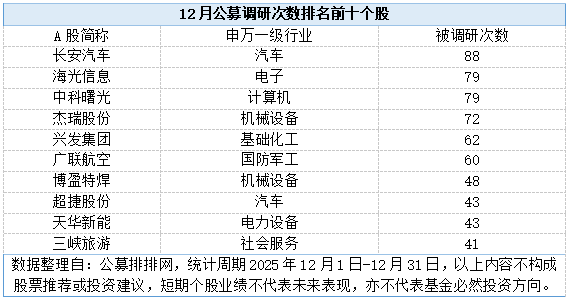
涉及451家公司!公募上月积极调研布局2026年行情
Zhong Guo Jin Rong Xin Xi Wang· 2026-01-05 11:36
Core Insights - Public fund research enthusiasm is high as firms prepare for 2026, with 155 public institutions participating in A-share research in December 2025, totaling 3,472 research instances across 451 stocks in 29 industries [1][2]. Group 1: Company Focus - Changan Automobile is the most researched stock with 88 instances, focusing on automotive manufacturing and transitioning towards smart low-carbon travel technology [1][2]. - Other notable companies include Haiguang Information and Zhongke Shuguang, each with 79 research instances, indicating strong interest in the electronics and computer sectors [2][3]. - In the mechanical equipment sector, Jerry Holdings and Boying Welding received 72 and 48 research instances, respectively, highlighting their prominence in the industry [1][3]. Group 2: Industry Insights - The electronics industry received the highest attention with 654 research instances across 64 stocks, led by Haiguang Information, Lingyi Technology, and Canxin Semiconductor [3]. - The mechanical equipment sector followed closely with 505 research instances, covering 72 stocks, with Jerry Holdings and Boying Welding being the most researched [3]. - Other industries such as electric power equipment, pharmaceuticals, automotive, computers, and basic chemicals also saw significant research activity, each exceeding 200 instances [3]. Group 3: Institutional Activity - A total of 71 public institutions were active in research, with 3 firms leading: Huaxia Fund with 100 instances, followed by Bosera Fund with 90, and Southern Fund with 77, primarily focusing on the electronics and mechanical equipment sectors [3].