小鹏X9超级增程版

Search documents
五年开了五次会,小鹏终于下场做增程
21世纪经济报道· 2026-03-26 07:29
Core Viewpoint - The article discusses the evolution of XPeng's strategy towards range-extended electric vehicles (REEVs), highlighting the internal debates and market dynamics that led to the eventual decision to develop the X9 model with a "super range extender" technology. The narrative emphasizes the importance of understanding user needs over merely pursuing advanced technology [6][11][26]. Group 1: Development Process - XPeng's journey towards launching the X9 REEV involved five internal meetings over five years, with initial resistance from the management team against adopting range-extending technology [6][9]. - The first proposal for developing range extension was made by CEO He Xiaopeng in 2019 but was rejected due to the prevailing belief that it was a backward technology [7][8]. - By 2022, the market for range-extended vehicles began to grow significantly, with a 116% increase in sales, indicating a shift in consumer demand [8][10]. Group 2: Market Dynamics - The article notes that in 2021, the sales of Li Auto's ONE model demonstrated the potential of the range-extended market, with monthly sales exceeding 13,000 units [7]. - XPeng's internal discussions revealed a split in opinion regarding the adoption of range extension, with market-oriented voices gaining traction as consumer preferences evolved [9][10]. - The competitive landscape intensified in 2024, with multiple brands launching their own REEVs, prompting XPeng to refine its strategy and product offerings [12][29]. Group 3: Technological Advancements - The development of the "mixed silicon carbide" technology was a key innovation that significantly reduced energy consumption in the new generation of range extenders, achieving a comprehensive range of 1,602 kilometers for the X9 [15][16]. - The article highlights the importance of integrating various subsystems to optimize efficiency, emphasizing that the success of the REEV system relies on a holistic understanding of the technology [16][17]. - XPeng's focus on energy efficiency is underscored by the G9 model's performance, which achieved a consumption rate of only 15.2 kWh per 100 km, outperforming competitors [13][14]. Group 4: User-Centric Approach - The shift towards developing the X9 REEV was driven by a deeper understanding of user needs, particularly in regions with challenging charging infrastructure [20][21]. - XPeng's product team conducted extensive market research to identify the specific requirements of consumers, leading to the inclusion of features like "ice and snow stability" and "tire blowout stability" [22][23]. - The company recognized the importance of adapting to user preferences, particularly among younger families, which influenced the pricing and positioning of the X9 model [24][25]. Group 5: Future Outlook - Despite the initial success of the X9 REEV, the article cautions that XPeng has not yet mastered all elements of automotive success, indicating ongoing challenges in the competitive landscape [26][28]. - The company plans to expand its REEV offerings with a strategy that includes multiple models, aiming to capture a broader market segment [26][28]. - The narrative concludes with a reminder that there is no "silver bullet" in the automotive industry, emphasizing the need for continuous learning and adaptation to market demands [27][30].


【新能源】2025年12月新能源汽车行业月报
乘联分会· 2026-02-03 10:48
Sales Performance - In December, the total passenger car sales reached 2.317 million units, a month-on-month increase of 14.2% but a year-on-year decrease of 16.1% [4] - The new energy vehicle (NEV) market saw sales of approximately 1.33 million units, a year-on-year increase of 2.9% and a month-on-month increase of 9.2% [4] - NEVs accounted for 57.4% of total passenger car sales in December, a decrease of 2.6% from the previous month but an increase of 10.6% compared to the same month last year [4] New Energy Market Overview - In December, pure electric vehicle sales were approximately 778,000 units, a year-on-year increase of 0.9% and a month-on-month increase of 1.1% [9] - Plug-in hybrid sales reached about 552,000 units, with a year-on-year increase of 5.9% and a month-on-month increase of 23.0% [9] - Cumulative NEV sales for 2025 reached 12.372 million units, with a cumulative year-on-year increase of 15.1% [9] Top Cities for NEV Sales - The top 10 cities accounted for 29.6% of NEV sales, an increase of 2.4% from the previous month [10] - The top three cities for NEV sales were Shanghai, Hangzhou, and Guangzhou, with Dongguan and Tianjin replacing Wuhan and Xi'an in the top ten [10] - The highest NEV penetration rates were in Shenzhen (71.0%), Shanghai (68.8%), and Tianjin (68.1%), while Dongguan had the lowest at 53.8% [10] Pure Electric Market Analysis - The top three segments in the pure electric market in December were B-SUV (19.5%), C-SUV (15.6%), and A0 class (14.3%) [14] - The market shares for B-SUV and C-SUV increased significantly by 3.7% and 2.5% respectively, while the A00 class market share decreased by 8.2% [14] - Compared to the same month last year, the C-SUV market share expanded from 7.2% to 15.8%, while the A00 class market share shrank from 13.8% to 5.2% [14] Market Dynamics - Key industry events in December included the global launch of the Xiaopeng X9 super range extender and the introduction of Huawei's next-generation DriveONE range extender generator [21] - GAC Group's internal restructuring led to the integration of its two NEV brands, Haobo and Aion, into a new business unit [23] - SAIC's semi-solid-state battery achieved mass production and delivery, marking it as the world's first and only semi-solid-state battery to be mass-produced [25] Industry Policy - The Ministry of Industry and Information Technology released a digital transformation implementation plan for the automotive industry on December 30, aiming to promote digitalization and intelligent upgrades [28] - The plan includes six key tasks, such as establishing a diagnostic assessment system and promoting the application of artificial intelligence in the automotive sector [29] - By 2027, the plan aims to improve labor productivity in the industry by 10% and shorten product development and delivery cycles by 20% [29]
小鹏X9用户画像:90后成购车主力,女性用户占比高达行业平均值5倍
Xin Lang Cai Jing· 2026-01-19 08:51
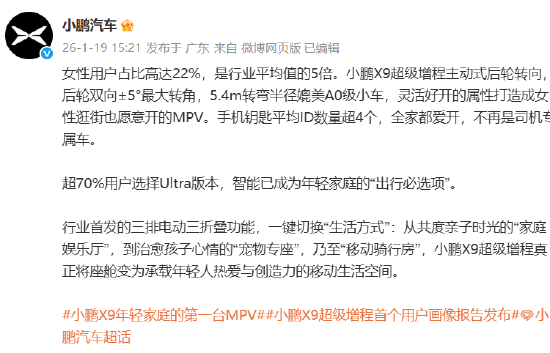
Core Insights - Xiaopeng Motors released user demographics for the Xiaopeng X9 Super Extended Range version, highlighting its appeal to younger families and a departure from traditional MPV designs [1][11] User Demographics - Over 70% of users opted for the Ultra version of the Xiaopeng X9 [1][15] - 57.2% of owners are born in the 1990s, with 13.7% from the 2000s, and 21% are first-time buyers [1][11] - 80% of users upgrading from luxury brands [1] - Female users account for 22% of the customer base, five times the industry average [2][11] Vehicle Features - The Xiaopeng X9 features advanced rear-wheel steering and a turning radius comparable to Smart cars [4][13] - The vehicle is designed to be family-friendly, with an average of over four mobile keys per user, indicating it is not just for the driver [4][13] - The car includes a spacious trunk and entertainment options for rear passengers, enhancing family outings [6][16][18] Driving Experience - The Xiaopeng X9 boasts industry-leading assisted driving capabilities, making long-distance travel easier [5][15] - Users reported a seamless driving experience, with one user mentioning a 1041 km journey from Guizhou to Wuhan [14]
四车齐发!何小鹏:今年小鹏汽车仍然会高速增长
Nan Fang Du Shi Bao· 2026-01-09 15:15
Core Insights - The launch of the new P7+ and G7 Super Extended Range models marks a significant advancement in Xpeng's technology, featuring the latest Kunpeng Super Extended Range technology that achieves a global record in range while maintaining price parity with pure electric models, allowing users to enjoy both long range and flexible refueling without additional costs [1][4][5] Product Launch and Features - On January 8, Xpeng officially unveiled four new models for 2026, including the P7+, G7 Super Extended Range, G6, and G9, emphasizing breakthroughs in dual energy and smart upgrades [2] - The G7 Super Extended Range features a leading 55.8 kWh battery and a 60L fuel tank, achieving a CLTC comprehensive range of 1704 km and a pure electric range of 430 km. The P7+ Super Extended Range boasts a pure electric range of 430 km and a comprehensive range of 1550 km, with energy consumption rates of 10.9 kWh/100 km in pure electric mode and 12.5 kWh/100 km in extended range mode, both leading in its class [4][5] Technological Advancements - The new models support a "pay to upgrade" option for enhanced AI capabilities, allowing users to experience the second-generation VLA technology, which includes options for different AI chip configurations to meet varying user needs [8] - The second-generation VLA model represents a breakthrough in physical AI, eliminating the "language translation" step and enabling direct generation of action commands from visual signals, positioning Xpeng as a leader in the industry with L4 capabilities [7][8] Global Strategy and Market Performance - Xpeng's global delivery volume reached 45,000 units in 2025, a 96% year-on-year increase, with plans to expand into more countries and regions, enhancing local R&D and manufacturing capabilities [8][9] - The company aims to launch four new global SUV models in 2026, further solidifying its presence in both left-hand and right-hand drive markets [9] Strategic Vision for 2026 - The year 2026 is identified as a pivotal year for Xpeng, focusing on the transition from "steady progress" to "strategic breakthroughs," with an emphasis on strengthening market foundations and advancing from software to AI paradigms [10][11] - The CEO expressed confidence in achieving significant growth in 2026, despite current market pressures, viewing the situation as an opportunity to focus on technological advancements and global expansion [11][12]
2025车市收官:零跑领跑新势力,比亚迪反超特斯拉
Xin Lang Cai Jing· 2026-01-05 11:45
Industry Overview - In October 2025, China's new energy vehicle (NEV) sales reached approximately 1.715 million units, accounting for 51.6% of total new car sales, marking a significant shift in the market dynamics [1][11] - By November 2025, the penetration rate of NEVs further increased to 53.2%, indicating a transition from niche to mainstream consumer choice [1][11] - The automotive market is expected to face challenges as multiple consumer stimulus policies are set to exit, leading to a return to a demand-supply driven seasonal operation [1][12] New Entrants and Performance - Leap Motor emerged as the top new force with 596,600 units delivered, surpassing competitors like NIO, Xiaopeng, and Hongmeng Zhixing [3][14] - Xiaopeng Motors delivered 429,400 units, while Li Auto and NIO delivered 406,300 and 326,000 units respectively, with NIO experiencing a significant sales boost in Q4 due to the new ES8 model [3][14] - Xiaomi Auto achieved over 410,000 units, exceeding its target of 350,000 units, and plans to challenge a target of 550,000 units in 2026 [6][16] Established Brands Performance - BYD sold 4.6024 million vehicles globally, achieving its target and becoming the world's top seller of pure electric vehicles with 2.26 million units sold, a 28% year-on-year increase [7][17] - Geely and Changan both met their sales targets, with Geely selling 3.0246 million vehicles and Changan reaching 2.913 million, with significant growth in their NEV segments [8][18] - Great Wall Motors and Chery reported sales of 1.3237 million and 2.6314 million units respectively, with Chery's sales boosted by its collaboration with Huawei [8][18] Market Dynamics and Future Outlook - The competition among new entrants and established brands is intensifying, with the market expected to undergo significant changes as policy support diminishes [1][12] - The automotive industry is preparing for a challenging 2026, with various companies adjusting their strategies to maintain competitiveness [1][12]



年末车企“兜底”购置税 新能源车市缓冲跨年
Zhong Guo Jing Ying Bao· 2025-12-26 20:31
Core Viewpoint - The impending adjustment of the new energy vehicle (NEV) purchase tax policy from full exemption to a 50% reduction starting January 1, 2026, is prompting major car manufacturers to implement strategies to stabilize sales and manage consumer expectations during this transitional period [2][3]. Group 1: Company Responses - Major car manufacturers such as GAC Group, Seres, and Xpeng Motors are introducing purchase tax "bottom line" or equivalent subsidy schemes to offset the cost changes resulting from the policy shift, aiming to maintain sales momentum and capitalize on the limited time window before the policy change [2][3]. - GAC Group has extended its purchase tax subsidy policy until the end of 2025, allowing customers who complete orders by December 31, 2025, to receive a subsidy of up to 15,000 yuan if their vehicle delivery is delayed due to company reasons [4]. - Seres and Xpeng Motors are also implementing similar subsidy strategies, with Seres offering tax subsidies for specific models and Xpeng focusing on new products to lower the transaction threshold during the policy transition [4]. Group 2: Market Dynamics - The combination of policy changes and corporate subsidies is beginning to show effects, with November's NEV retail sales reaching 1.354 million units, a year-on-year increase of 7% [5]. - Despite the positive short-term effects, the market is still in a transitional phase, with a decline in retail sales observed in early December, indicating that the demand recovery may be temporary rather than indicative of a long-term trend [5]. - The overall automotive market is expected to achieve growth beyond initial forecasts for 2025, driven by policies such as trade-in subsidies and NEV purchase tax exemptions, with production and sales figures showing significant year-on-year increases [6][7]. Group 3: Future Considerations - The shift from a policy-driven market to one reliant on endogenous growth remains a critical challenge for car manufacturers post-policy adjustment [3]. - The potential for diminishing returns from frequent subsidies raises concerns about consumer dependency on temporary discounts, which could lead to increased volatility in demand around policy changes [3]. - The automotive industry may face intensified price competition in early 2026, particularly affecting smaller manufacturers, necessitating a focus on technological and service differentiation rather than solely price competition [8].


小鹏X9超级增程,一门关于操控、空间、能耗与成本的极致平衡术
2 1 Shi Ji Jing Ji Bao Dao· 2025-12-12 05:42
Core Viewpoint - The launch of the Xiaopeng X9 Super Extended Range model has led to a significant increase in sales, indicating the effectiveness of Xiaopeng's self-developed next-generation range extension technology [1][5]. Group 1: Sales Performance - The Xiaopeng X9 has struggled with sales, averaging around 1,200 units per month from January to November, with a peak of 2,767 units in May. However, after the introduction of the Super Extended Range technology, sales rose to 2,260 units in November, nearing the May peak, not including nearly 1,000 units sold overseas [1]. Group 2: Technological Innovations - The Super Extended Range X9 features an upgraded rear-wheel steering system, achieving a turning radius of 5.4 meters, which is better than the luxury model Mercedes EQS at 5.45 meters. It also includes an "Ice and Snow Stability System" designed for challenging driving conditions in western and northern China [2]. - The vehicle has undergone extensive testing in snow conditions, demonstrating capabilities such as climbing a 10-degree slope without slipping and maintaining stability at 60 km/h [2]. - The Super Extended Range X9 introduces an industry-first three-row electric folding system, allowing for flexible seating arrangements and maximizing cargo space [3]. - The integration of nine technologies into a single rear axle assembly has improved space utilization to 95.8%, while the use of one-piece die-casting and advanced materials has further enhanced efficiency and reduced weight [4]. Group 3: Cost Efficiency - Despite the comprehensive upgrades, the starting price of the Super Extended Range X9 has decreased by 60,000 yuan, positioning it as a competitive offering in the market [5]. - The reduction in costs is attributed to the use of hybrid silicon carbide materials in the electric drive system, which has lowered costs by 60% while maintaining performance. Additionally, the adoption of lithium iron phosphate batteries has allowed for a pure electric range of 460 km [6]. - Xiaopeng's focus on technological advancements over price competition aligns with its strategy to balance performance, space, energy consumption, and cost [6].
11月新势力销量解析:鸿蒙智行破8万 蔚小理陷3万瓶颈
Zhong Guo Zhi Liang Xin Wen Wang· 2025-12-04 03:56
Core Insights - The competition landscape for China's new energy vehicle market is becoming clearer as various automakers disclose their sales data for November 2025, with a focus on efficiency and technological innovation reshaping the industry dynamics [1] Group 1: Sales Performance - Hongmeng Zhixing and Leap Motor both surpassed 70,000 units in deliveries, showcasing over 75% year-on-year growth, significantly widening the gap with traditional leading brands [3] - Hongmeng Zhixing achieved a record delivery of 81,864 vehicles in November, marking a 90% increase year-on-year, with the Aion brand being the main contributor [5] - Leap Motor delivered 70,327 vehicles, maintaining its position as the single brand champion in the new energy vehicle sector, with a 75% year-on-year increase [7] - Xiaomi Auto delivered over 40,000 vehicles, achieving a 100% year-on-year growth, and has exceeded its annual target of 350,000 vehicles [7] - Changan Qiyuan reported 46,909 vehicles delivered, with a 31% year-on-year increase, driven by strong product positioning [9] - NIO delivered 36,275 vehicles, reflecting a 76.3% year-on-year increase, with the ES8 model being a key contributor [10] - Ideal Auto's deliveries were 33,181 vehicles, showing a 31.92% year-on-year decline, attributed to market competition and product transition [12] - Deep Blue Auto delivered 33,060 vehicles, maintaining a steady performance despite market pressures [12] - Zeekr brand achieved 28,843 vehicles delivered, benefiting from improved production efficiency [13] - Lantu Auto reached a new high with 20,005 vehicles delivered, supported by product innovation and manufacturing capabilities [14] - Avita and Zhiji both set new sales records, with 14,057 and 13,577 vehicles delivered respectively, indicating their emergence as stable mainstream brands [16] Group 2: Market Trends and Outlook - The new energy vehicle market is expected to continue its growth in December 2025, driven by seasonal consumption peaks, tax incentives, and promotional activities from automakers [16] - The performance of different brand tiers is anticipated to show significant differentiation, influenced by the delivery rhythm of new models and promotional efforts [16]


小鹏X9超级增程搭载华为「心脏」,小鹏副总裁表态:未来合作无上限
雷峰网· 2025-12-04 00:41
Core Viewpoint - The collaboration between Xiaopeng and Huawei focuses on enhancing range extender technology to align with the user experience of pure electric vehicles, aiming to eliminate range anxiety and improve charging efficiency [5][9]. Group 1: Collaboration Details - Xiaopeng and Huawei's partnership has led to the launch of the Xiaopeng X9 Super Range Extender, which features Huawei's DriveONE high-integrated high-voltage oil-cooled generator [2][4]. - This is the second formal technical collaboration in 2023, following the release of the AR-HUD system in June [4]. - The collaboration aims to address four major issues in traditional range extender systems: layout space, endurance, efficiency, and seamless operation [6]. Group 2: Technical Innovations - The new range extender system integrates the generator and electronic control components to optimize space in the vehicle's front compartment, achieving an 82-in-1 component design [6]. - Huawei's innovative "stacked waterfall oil cooling" architecture improves generator efficiency by 1%, which translates to an additional 16 kilometers of range when the fuel tank is nearly empty [7][9]. - By 2027, the goal is to achieve charging speeds of less than 10 minutes, potentially even under 5 minutes, to match the refueling speed of traditional fuel vehicles [9]. Group 3: Future Projections - Wang Chao from Huawei predicts that by 2027, range extender products could achieve a range of 2000 kilometers [10]. - The collaboration is characterized by a high level of trust and commitment to pushing technological boundaries, with both teams striving to meet challenging performance standards [10][18]. Group 4: Market Positioning - Xiaopeng emphasizes its commitment to self-research while recognizing the importance of strategic partnerships, particularly with Huawei, to enhance product capabilities [13]. - The collaboration is expected to evolve further, with potential expansions into powertrains and performance domains, contingent on improving user experience [13].

造车新势力Q3财报
2 1 Shi Ji Jing Ji Bao Dao· 2025-12-01 23:13
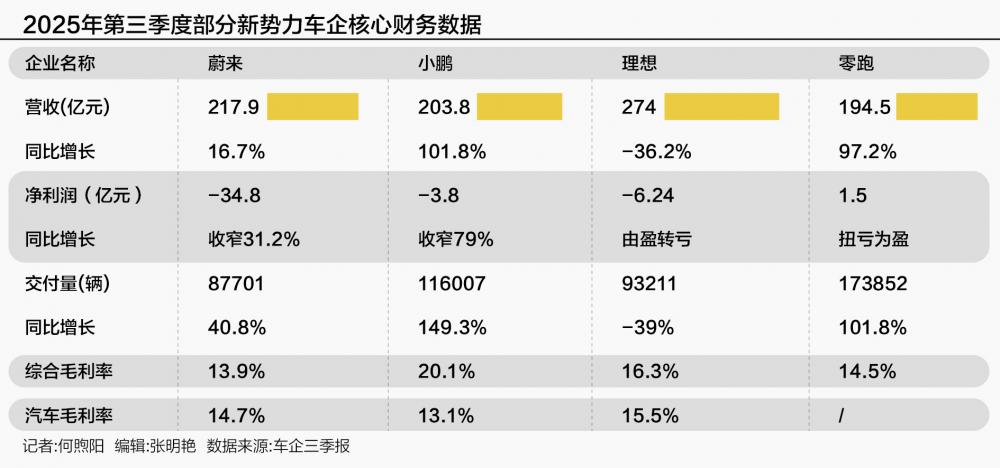
Core Insights - The competitive landscape of new energy vehicle manufacturers in China is undergoing significant changes as Q3 2025 financial reports are released, with Xpeng Motors showing remarkable growth while NIO and Li Auto face challenges [1][2][3] Company Performance - **Xpeng Motors**: Achieved a revenue of 203.8 billion yuan, with a year-on-year growth of 101.8%. Despite a net loss of 3.8 billion yuan, this represents a 79% reduction in losses compared to the previous year. The company delivered 116,007 vehicles, marking a 149.3% increase year-on-year [4][6][8] - **NIO**: Reported a revenue of 217.9 billion yuan, with a year-on-year growth of 16.7%. The net loss was 34.8 billion yuan, a 31.2% reduction from the previous year. NIO delivered 87,701 vehicles, a 40.8% increase year-on-year [4][12][14] - **Li Auto**: Generated a revenue of 274 billion yuan, but experienced a 36.2% year-on-year decline. The company reported a net loss of 6.24 billion yuan, ending an 11-quarter streak of profitability. Vehicle deliveries fell by 39% to over 93,000 units [4][9][11] - **Leap Motor**: Achieved a revenue of 194.5 billion yuan, with a year-on-year growth of 97.2%. The company reported a net profit of 1.5 billion yuan, marking its second consecutive profitable quarter. Leap Motor delivered nearly 174,000 vehicles, a 101.8% increase year-on-year [4][15][16] Strategic Adjustments - The new energy vehicle market is shifting from growth to competition based on product, technology, and brand strength, as companies adapt their strategies to survive in a more competitive environment [3][16] - **Xpeng Motors**: Focused on improving operational efficiency and profitability, launching new models like the X9 Super Range Extender, which aims to address consumer pain points regarding range and charging speed [7][8] - **Li Auto**: Shifted focus towards AI integration in vehicles, moving away from traditional family-oriented branding to emphasize technological advancements [10][11] - **NIO**: Reduced operational costs and refocused on core automotive sales, moving away from previous explorations in other business areas [12][13] - **Leap Motor**: Adjusted its strategy to enter the range extender market and target the high-end SUV segment, while also attempting to elevate its brand image [15][16]