西门子

Search documents
汇川技术高歌猛进
2 1 Shi Ji Jing Ji Bao Dao· 2026-01-20 23:23
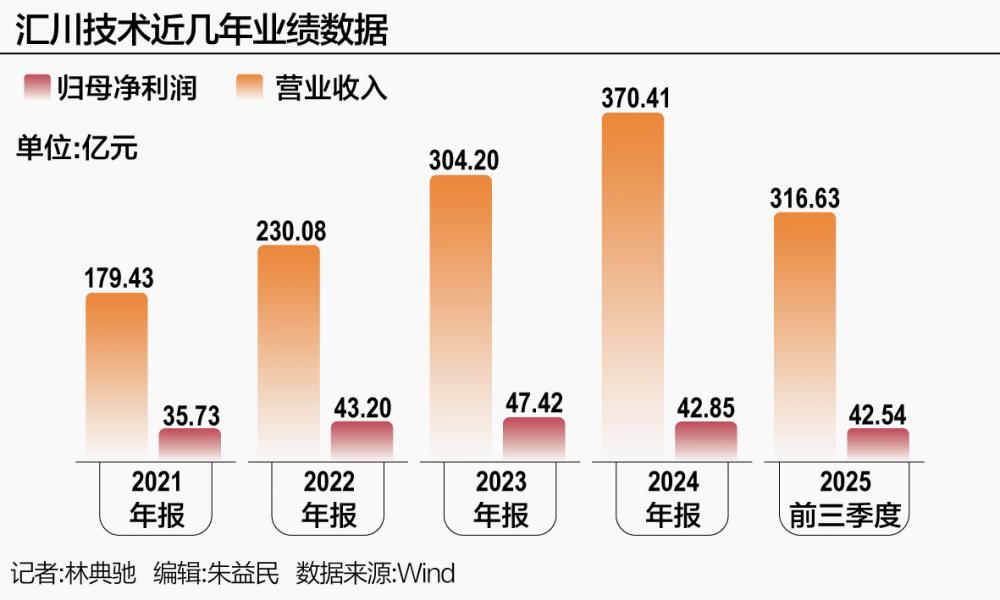
Core Viewpoint - The article discusses the strategic evolution and growth of Huichuan Technology, highlighting its transition from a domestic manufacturer to a significant player in the international market, particularly in the fields of industrial automation and new energy vehicles [2][10][14]. Company Background - Huichuan Technology was founded in 2003 by Zhu Xingming and former employees of Huawei Electric after its sale to Emerson [1]. - The company has grown to a market capitalization of 200 billion RMB, becoming a "white horse stock" that attracts significant attention in the capital market [2]. Business Strategy - Zhu Xingming emphasizes the dangers of a low-price market strategy, which can harm profits and innovation capabilities. Huichuan has closed several low-margin businesses to focus on strategic growth [3]. - The company has a strong profitability profile, with projected revenues of nearly 46 billion RMB and a net profit of 5.5 billion RMB by 2025 [3]. Internationalization Efforts - Huichuan Technology is planning to issue H-shares and list on the Hong Kong Stock Exchange to enhance its internationalization strategy and diversify financing channels [3][14]. - The company is currently in discussions with intermediaries regarding the details of the H-share issuance [3]. Product Development and Market Position - Huichuan's initial product was a frequency converter, which has evolved to dominate the domestic market, competing with international brands like ABB and Siemens [6][7]. - The company has expanded its product line to include servo systems, PLCs, and components for new energy vehicles, achieving a market share of 15.9% in servo motors [7][9]. Financial Performance - For the first three quarters of 2025, Huichuan reported revenues of 31.66 billion RMB, a year-on-year increase of 24.67%, and a net profit of 4.25 billion RMB, up 26.84% [10]. - Despite strong performance, challenges include slowing growth in core industrial control segments and rising raw material costs, prompting a price increase for some products starting January 2026 [10][11]. Future Directions - Huichuan plans to enter the humanoid robotics and energy storage sectors by 2025, having already developed key components for humanoid robots and ranked third in the domestic market for energy storage inverters [12][13]. - The company aims to enhance its international presence and brand image while developing solutions for energy transition, focusing on both domestic and overseas markets [14].


投资者提问:公司产品满足西门子、艾利丹尼森、德莎、生益科技、联茂、斯迪克、...
Xin Lang Cai Jing· 2026-01-20 12:14
Core Viewpoint - The company has been exporting products to certain EU member states, although the export proportion is relatively small [1] Group 1: Export and Sales Information - The company meets the high-quality requirements of well-known international enterprises such as Siemens, Avery Dennison, and others [1] - The revenue from the EU market constitutes a minor portion of the company's overall operating income [1] - Sales to the EU market are primarily conducted through direct exports from domestic entities, rather than through subsidiaries or third-party traders [1]


福达合金:公司管理层将再接再厉,抢抓行业发展机遇
Zheng Quan Ri Bao· 2026-01-20 12:10
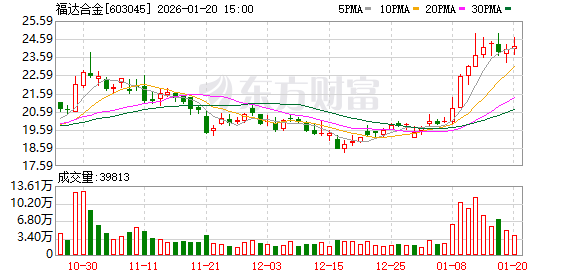
Core Viewpoint - Fuda Alloy is positioned as a leading player in the low-voltage electrical equipment market, with significant growth in revenue and net profit projected for 2024 and beyond, driven by increasing demand from downstream industries and a strong international expansion strategy [2] Market Position - According to the "2024 White Paper on China's Low Voltage Electrical Market," Fuda Alloy, along with Goodson, Chint, Schneider, Delixi, and Siemens, holds approximately 30% market share in the "Power Generation & Grid" sector [2] - The aforementioned five companies are expected to be among Fuda Alloy's top ten customers in 2024 [2] Financial Performance - In 2023, Fuda Alloy reported a revenue growth of 27.31% and a net profit growth of 37.24% [2] - Projections for 2024 indicate a revenue increase of 37.94% and a net profit increase of 11.69% [2] - For the first nine months of 2025, the company anticipates a revenue growth of 30.03% and a net profit growth of 33.52% [2] Strategic Initiatives - The company is enhancing its research and development capabilities to quickly respond to market demands and is expanding its production capacity [2] - Fuda Alloy is accelerating its efforts to explore overseas and high-end markets, further deepening its international presence [2] - The management team is committed to seizing industry development opportunities to increase both domestic and international market share [2]

既是青年博士教师,也是技术骨干!南京工业职业技术大学“双师型”教师占比已达92%
Yang Zi Wan Bao Wang· 2026-01-20 02:59
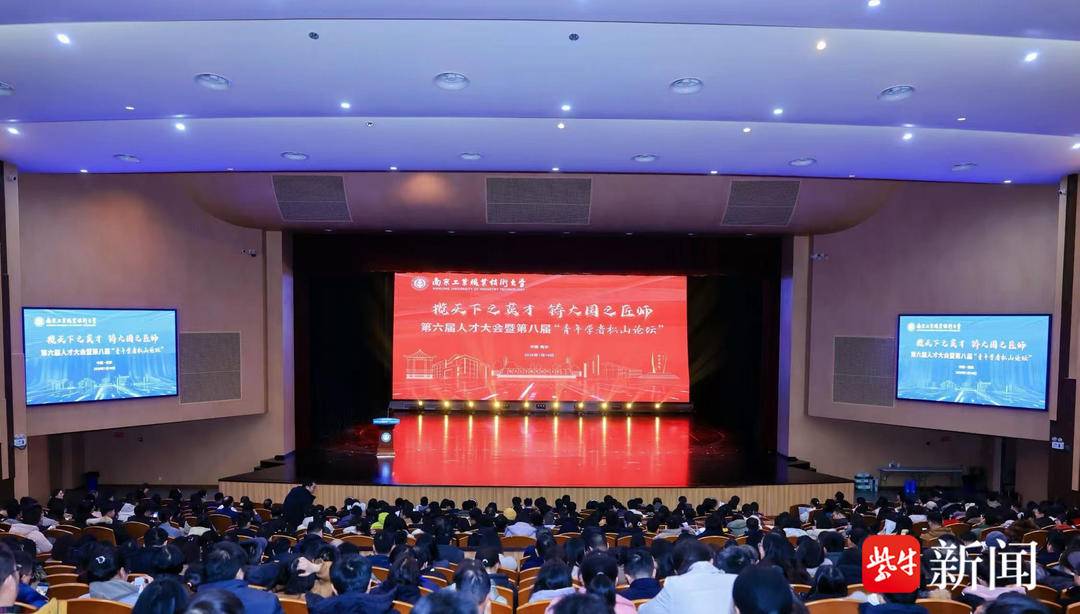
Core Insights - Nanjing University of Technology and Vocational Education held its sixth Talent Development Conference and the eighth "Youth Scholars Songshan Forum," awarding various honors to faculty and industry professionals [1] Group 1: Talent Development Initiatives - The university emphasizes the training of "dual-qualified" teachers, establishing multiple skill master studios across fields such as mechanical, electronic, and artificial intelligence [3] - The number of doctoral faculty members has increased from 8.6% in 2017 to 46.6% currently, with "dual-qualified" teachers reaching 92%, ranking among the top in national vocational undergraduate institutions [3] - The university collaborates with over 60 leading companies, including Huawei and Siemens, to build industry colleges and practice bases, making industry experience a requirement for teacher evaluation and promotion [3] Group 2: Faculty and Student Development - Faculty members are provided opportunities for enterprise internships and basic research funding, enhancing their understanding of industry developments [3] - The university aims to create an environment that respects talent and encourages innovation, implementing flexible and diverse distribution and evaluation mechanisms [4] - The university has successfully hosted six Talent Development Conferences and eight "Youth Scholars Songshan Forums," gradually forming a talent development hub with vocational education characteristics [4]
北约历史性一幕发生,77年来首次,德国总理决定:马上带人去中国
Sou Hu Cai Jing· 2026-01-19 09:57
Core Viewpoint - The recent crisis within NATO, triggered by Trump's tariff threats against European allies, has led to significant geopolitical shifts, particularly with Germany's decision to strengthen ties with China instead of aligning with U.S. interests [1][3][20]. Group 1: U.S. Tariff Threats - Trump announced a 10% tariff on goods from eight European countries starting February 1, escalating to 25% by June 1, citing the failure to purchase Greenland as justification [5][9]. - The affected European nations issued a joint statement condemning the tariffs as a threat to transatlantic relations, urging unity to defend their sovereignty [7][9]. Group 2: European Response - European leaders, including Macron and Merkel, expressed outrage and proposed countermeasures, including tariffs on $93 billion worth of U.S. goods and restrictions on U.S. companies in the EU [9][19]. - Germany's withdrawal of troops from Greenland was interpreted as a sign of weakness, but it was a strategic move to focus on economic cooperation with China [11][13]. Group 3: Germany's Shift Towards China - Germany is prioritizing economic collaboration with China, recognizing the importance of the Chinese market for its automotive and industrial sectors [15][20]. - Merkel's upcoming visit to China with a delegation of business leaders aims to solidify economic ties and serve as a model for other European nations to follow [19][22]. Group 4: Implications for NATO and Transatlantic Relations - The crisis highlights the internal divisions within NATO, as U.S. unilateralism pushes European allies to seek alternative partnerships, particularly with China [17][20]. - If the U.S. continues its aggressive tariff policies, Europe is likely to deepen its cooperation with China, further straining transatlantic relations [22].

航改燃机正成为电力缺口的解决方案之一
GF SECURITIES· 2026-01-19 07:42
Investment Rating - The industry investment rating is "Buy" [2] Core Insights - The aviation modified gas turbine is becoming one of the solutions to address the electricity gap [1] - The demand for aviation modified gas turbines is increasing due to the rapid growth of data centers and the need for reliable power supply [6][67] - The global market for aviation modified gas turbines is expected to reach $12.5 billion in sales over the next five years [75] Summary by Sections AIDC and Power Grid Renovation - The development of AI infrastructure and the renovation of power grids are driving strong demand for overseas power construction [14] - Global data center electricity consumption is projected to grow from 49 GW in 2023 to 96 GW in 2026, with 90% of this growth driven by AI [14] - The aging of power equipment in developed economies necessitates updates, with over 50% of grid infrastructure exceeding 20 years of use [16] Performance and Cost Efficiency of Aviation Modified Gas Turbines - Aviation modified gas turbines share core technologies with aircraft engines, making them efficient and cost-effective [55] - These turbines are increasingly being used in various applications, including emergency power and distributed energy systems [59] Flexibility and Rapid Installation of Aviation Modified Gas Turbines - Aviation modified gas turbines can be installed in as little as 1.5 months, making them ideal for data center power needs [65] - They offer quick start-up times and high efficiency, suitable for current trends in distributed and flexible power generation [63] Investment Recommendations - Companies such as Hangya Technology, Zhenhua Co., and others are expected to benefit from the growing demand for aviation modified gas turbines [6][67] - The report suggests focusing on companies that can enhance their market share in the aviation modified gas turbine sector due to the current supply-demand mismatch [6]
2026,车企反攻智能硬件
3 6 Ke· 2026-01-18 23:37
Core Viewpoint - The rise of smart glasses, particularly from automotive companies, signifies a shift in the automotive industry towards integrating AI and smart hardware, transforming traditional business models from one-time vehicle sales to ongoing subscription-based services [1][3][9]. Group 1: Transition from Hardware to Smart Hardware - The transition from hardware to automotive manufacturing began in 2019, driven by a peak in smartphone sales and a surge in electric vehicle sales, leading hardware manufacturers to explore automotive opportunities [3][5]. - Companies like Xiaomi and Huawei have either entered the automotive market directly or partnered with automakers to develop smart driving and vehicle integration solutions [3][5]. - The evolution of smart hardware in vehicles is seen as a natural progression, with the automotive industry now embracing AI to create a unified smart ecosystem [1][3]. Group 2: New Profit Models for Automotive Companies - The introduction of smart glasses, such as Li Auto's Livis, illustrates a shift towards products that enhance brand loyalty and provide continuous data collection, which can improve AI model capabilities [10][11]. - The automotive industry is moving towards a model where vehicle sales become part of a broader consumer lifestyle platform, focusing on software services that offer higher profit margins compared to traditional vehicle manufacturing [13][14]. - The integration of AI into both vehicles and smart hardware allows for shared components and reduced costs, enhancing overall efficiency and profitability [14][16]. Group 3: Challenges in the AI Transition - The transition to AI-driven models presents significant challenges, including high costs associated with data, algorithms, and computational power, which create barriers to entry for new players [17][19]. - Successful companies in this space must have substantial financial resources, technical expertise, and the ability to scale operations to effectively compete [18][19]. - The competitive landscape is likely to solidify around a few leading brands capable of leveraging their existing consumer base and data to enhance their AI capabilities [19].


科技制造产业月报(2025年12月):奔跑的机器人,与变局的制造业-20260117
Huachuang Securities· 2026-01-17 14:01
Investment Rating - The report does not explicitly provide an investment rating for the industry Core Insights - The human-shaped robot's ability to run smoothly represents a significant technological leap from mere functionality to human-like capabilities, indicating a potential shift towards practical applications in complex environments [9][20] - The competition in the humanoid robot industry has evolved into a multi-dimensional strategic game, with different focuses across the supply chain, emphasizing the need for companies to integrate technology, establish standards, and meet real industry demands [22][30] - The future of humanoid robots hinges on overcoming five critical conditions: technological maturity, cost control, clear market positioning, infrastructure development, and societal acceptance [30][31] Summary by Sections Section 1: The Impact of Robot Running Demonstrations - The recent running demonstrations by Tesla's Optimus and Figure AI have generated significant global interest, suggesting a potential breakthrough in the commercialization of humanoid robots [5][6] - These demonstrations challenge the notion that advanced robotics can only exist in controlled environments, indicating a shift towards practical, scalable applications [31] Section 2: Technical Breakdown of Running Capabilities - Achieving running capabilities involves overcoming substantial technical challenges, including dynamic balance, rapid response times, and energy efficiency [10][19] - The transition from walking to running signifies a fundamental change in robotic capabilities, moving from static to dynamic balance, which is essential for operating in unpredictable environments [12][20] Section 3: Business Logic Behind the Demonstrations - The timing of these demonstrations reflects a strategic move by industry leaders to signal their technological advancements and readiness for market integration [32] - Both Tesla and Figure AI are pursuing different paths: Tesla aims for a universal platform while Figure AI focuses on specific industrial applications, highlighting the diverse strategies within the industry [26][30] Section 4: Industry Chain Dynamics - The competition among suppliers, manufacturers, and application developers is intensifying, with each segment vying for control over standards and market share [22][30] - The report emphasizes the importance of establishing a robust ecosystem that supports the development and deployment of humanoid robots in real-world applications [30] Section 5: Future Outlook - The next few years are critical for validating the feasibility of humanoid robots, with key indicators including commercial orders, supply chain formation, and cost reduction trends [31] - The industry is at a pivotal moment, transitioning from experimental demonstrations to practical implementations that can deliver economic value [31]



PC硬件全线告急!电源与散热器也扛不住了?装机成本再增
猿大侠· 2026-01-16 04:11
Core Viewpoint - The budget threshold for assembling a computer is expected to rise significantly in the coming months due to price increases in various components, including power supplies and coolers, which were previously considered stable [1][14]. Price Increases in Components - Recent market dynamics indicate that power supplies and coolers are about to experience a significant price surge, following previous increases in memory, hard drives, and graphics cards [1][2]. - A notice from Guangzhou Xinhongzheng Electronics Technology has circulated, stating that core raw material prices for power supplies and coolers have risen sharply due to global market influences [3][5]. Raw Material Price Trends - The core raw materials for power supplies and coolers include copper, silver, tin, and aluminum, all of which have seen substantial price increases since 2025 [5]. - Copper prices have led the surge with an annual increase exceeding 37%, while aluminum prices surpassed 22,000 yuan per ton by the end of 2025, marking the highest level since 2022 [6]. Impact on Various Industries - The rising prices of metal raw materials have been transmitted to multiple industries closely related to daily life, with nearly 20 lighting companies recently announcing price hikes attributed to the soaring costs of base metals like gold, silver, and copper [9]. - Electronic component manufacturers, such as Sunlord Electronics and Fenghua Advanced Technology, have also announced price increases for certain products due to rising raw material costs [9]. Specific Price Adjustments - A price adjustment notice from Delixi Electric indicates a range of price increases for various product categories, with adjustments ranging from 3% to 30% depending on the product type [11]. - The expected cost increases for power supplies are projected to be between 6% and 10%, while coolers may see increases of 6% to 8% [16]. Consumer Implications - The final retail prices may rise more than the cost increases due to the situation with distributors, potentially leading to shortages or the need for consumers to pay higher prices [17][19]. - Starting February 1, all promotional activities will be canceled, and prices may increase further, suggesting that consumers should consider purchasing now to avoid higher costs later [20].

中国灯塔工厂数量已突破百家大关
麦肯锡· 2026-01-16 04:01
Core Insights - The Global Lighthouse Network has added 23 new manufacturing benchmark companies, reflecting the ongoing industrial transformation and ambition for change in the global manufacturing sector since its inception in 2018 [2][3] - The new lighthouse factories are transitioning from fragmented digital pilots to comprehensive AI-driven transformations, excelling in five dimensions: production efficiency, supply chain resilience, customer-centricity, sustainability, and talent [3][5] - China has surpassed 100 lighthouse factories, marking a significant milestone in smart manufacturing and showcasing the country's capabilities in large-scale implementation and technological innovation [6] Group 1: New Lighthouse Factories - The new lighthouse factories are focusing on three AI-enabled scenarios: building scalable digital and data infrastructure for agility, empowering employees through human-machine collaboration, and enhancing AI impact through cross-departmental collaboration [5] - These factories are evolving from "smart factories" to "cognitive networks," achieving a balance between speed, standardization, autonomy, visibility, connectivity, and cybersecurity [5] Group 2: Industry Impact - The Global Lighthouse Network aims to recognize world-class factories and value chains that excel in production efficiency, supply chain resilience, customer-centricity, sustainability, and talent [8] - The initiative is a collaboration between the World Economic Forum and McKinsey & Company, supported by industry leaders committed to shaping the future of global manufacturing [8]