赛力斯

Search documents
智驾股集体走强 ,北汽蓝谷今日涨停
Di Yi Cai Jing· 2025-12-16 08:16
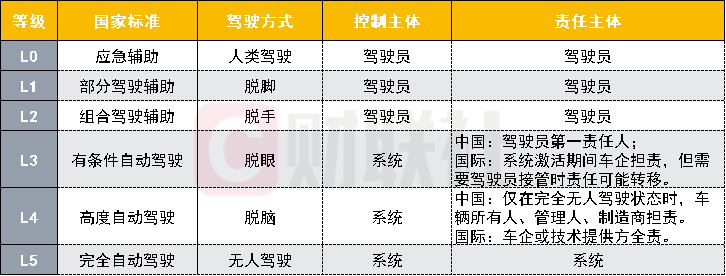
昨日,首批两款L3级自动驾驶车型获工信部准入许可,将在指定区域开展上路试点。这两款车型分别 为北汽蓝谷旗下极狐阿尔法S(L3)和长安汽车旗下深蓝SL03。 【#智驾股集体走强# ,#北汽蓝谷今日涨停#】12月16日,智能驾驶相关公司资本市场表现活跃,北汽 蓝谷(600733.SH)、多伦科技(维权)(603528.SH)、路畅科技(002813.SZ)等涨停,长安汽车 (000625.SZ)盘中一度涨超5%,赛力斯(601127.SH)、均胜电子(600669.SH)、中科创达 (300496.SZ)、德赛西威(002920.SZ)等均有上涨。 特斯拉(TSLA.US)也在自动驾驶领域迎来进展。12月15日,特斯拉涨幅一度超4%,股价创年内新 高,逼近历史高位488.54美元。12月14日,一名X用户拍摄到一辆特斯拉Model Y在奥斯汀街头行驶的 画面,车内似乎空无一人,甚至没有配备安全监督。随后,特斯拉CEO埃隆·马斯克对此回应称,公司 目前正在测试不配备人类安全员的无人驾驶出租车。 业内普遍认为,L3级是自动驾驶行业从辅助走向自动的分水岭。今年以来,L3智能驾驶相关政策加速 落地。今年9月份,工信部等八 ...



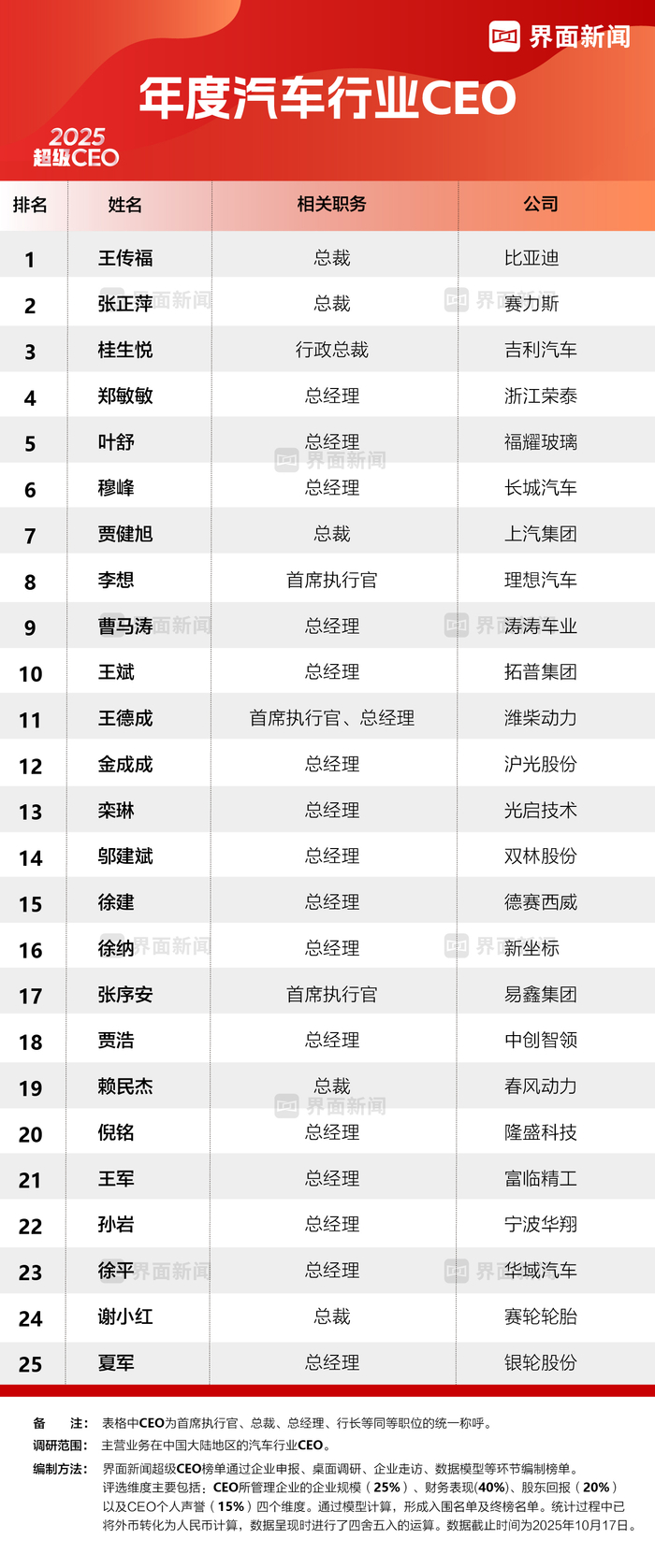
界面新闻发布2025年度汽车行业CEO榜单:比亚迪王传福、赛力斯张正萍、吉利汽车桂生悦位列前三
Xin Lang Cai Jing· 2025-12-16 08:10
Core Insights - The "Super CEO" list by Zhito Finance highlights outstanding leaders in the automotive industry, focusing on their financial growth and reputation, with BYD's Wang Chuanfu ranked first [1][12]. Industry Overview - The automotive industry in China, encompassing vehicles, parts, and services, is projected to produce and sell 31.28 million and 31.44 million units in 2024, reflecting year-on-year growth of 3.7% and 4.5% respectively, maintaining its position as the world's largest market for 16 consecutive years [2]. - In 2024, China's automotive exports are expected to reach 5.859 million units, marking a 19.3% increase, showcasing the industry's resilience amid global trade uncertainties [2]. New Energy Vehicles (NEVs) - NEVs are leading the transformation of the automotive industry, with production and sales expected to exceed 10 million units in 2024, achieving year-on-year growth of 34.4% and 35.5% respectively [3]. - NEV exports are projected to reach 1.284 million units, a 6.7% increase, as China strengthens its competitive edge in key overseas markets [3]. Automotive Parts Industry - The automotive parts sector is experiencing significant growth, with the demand for core components like batteries, motors, and electronic controls surging as NEV penetration exceeds 40% [4]. - In 2024, the installed capacity of power batteries is expected to grow by 47.6% to 531 GWh, with lithium iron phosphate batteries accounting for 69.2% of the total [4]. - The export value of automotive parts is anticipated to reach $105.61 billion, reflecting a 6.8% increase [4]. Intelligent Driving - The intelligent driving sector is witnessing rapid advancements, with consumer demand for safety and efficiency driving the adoption of L2 and higher autonomous driving features in mid-to-high-end vehicles [5]. - Technological breakthroughs in AI algorithms, automotive-grade chips, and high-precision mapping are laying a solid foundation for the industrialization of intelligent driving [5]. CEO Performance - The 25 CEOs on the list have demonstrated impressive performance, with median revenue growth of 23.3%, net profit growth of 31.42%, and return on equity of 15.35% [8]. - The average market capitalization of these companies is approximately 113.6 billion yuan, with 24 CEOs disclosing their 2024 salaries, the highest being 639.134 million yuan [8]. - The representation of post-80s CEOs has increased significantly, indicating a trend towards younger leadership in the automotive sector [8]. Notable CEOs - Wang Chuanfu of BYD leads the list, achieving sales of 4.2721 million units in 2024, with a revenue of 777.102 billion yuan, a 29.02% increase year-on-year [12]. - Zhang Zhengping of Seres has seen a remarkable revenue increase of over 305.04% to 145.176 billion yuan, with NEV sales rising by 182.84% [13]. - Li Xiang of Ideal Auto reported a revenue of 144.460 billion yuan, a 16.64% increase, and is focusing on expanding into the Middle East and Central Asia [14]. - Wang Bin of Top Group achieved a revenue of 26.6 billion yuan, growing by 35.02%, by implementing a Tier 0.5 platform strategy [15].





智驾股集体走强,北汽蓝谷涨停
第一财经· 2025-12-16 07:38
2025.12. 16 特斯拉(TSLA.US)也在自动驾驶领域迎来进展。12月15日,特斯拉涨幅一度超4%,股价创年内 新高,逼近历史高位488.54美元。12月14日,一名X用户拍摄到一辆特斯拉Model Y在奥斯汀街头 行驶的画面,车内似乎空无一人,甚至没有配备安全监督。随后,特斯拉CEO埃隆·马斯克对此回应 称,公司目前正在测试不配备人类安全员的无人驾驶出租车。 当前车企推出的智能驾驶功能普遍为L2级辅助驾驶。工信部数据显示,2025年前三季度,我国具备 组合驾驶辅助功能(即L2)的乘用车新车销量同比增长21.2%,渗透率已达到64%。 业内普遍认为,L3级是自动驾驶行业从辅助走向自动的分水岭。今年以来,L3智能驾驶相关政策加 速落地。今年9月份,工信部等八部门印发《汽车行业稳增长工作方案(2025-2026年)》,明确提 出推进智能网联汽车准入和上路通行试点,并首次写入"有条件批准L3级车型生产准入"。此次工信部 准入许可两款L3级自动驾驶车型,标志着我国自动驾驶技术发展逐步走向量产应用阶段。 此外,自动驾驶在法规层面也在今年迎来进展。7月23日,科技部公布的《驾驶自动化技术研发伦理 指引》称,2级 ...
智驾股集体走强,北汽蓝谷涨停
Di Yi Cai Jing· 2025-12-16 07:01
特斯拉(TSLA.US)也在自动驾驶领域迎来进展。12月15日,特斯拉涨幅一度超4%,股价创年内新 高,逼近历史高位488.54美元。12月14日,一名X用户拍摄到一辆特斯拉Model Y在奥斯汀街头行驶的 画面,车内似乎空无一人,甚至没有配备安全监督。随后,特斯拉CEO埃隆·马斯克对此回应称,公司 目前正在测试不配备人类安全员的无人驾驶出租车。 当前车企推出的智能驾驶功能普遍为L2级辅助驾驶。工信部数据显示,2025年前三季度,我国具备组 合驾驶辅助功能(即L2)的乘用车新车销量同比增长21.2%,渗透率已达到64%。 12月16日,智能驾驶相关公司资本市场表现活跃,北汽蓝谷(600733.SH)、多伦科技(603528.SH)、 路畅科技(002813.SZ)等涨停,长安汽车(000625.SZ)盘中一度涨超5%,赛力斯(601127.SH)、均 胜电子(600669.SH)、中科创达(300496.SZ)、德赛西威(002920.SZ)等均有上涨。 昨日,首批两款L3级自动驾驶车型获工信部准入许可,将在指定区域开展上路试点。这两款车型分别 为北汽蓝谷旗下极狐阿尔法S(L3)和长安汽车旗下深蓝SL03。 ...
持续盈利路漫漫,新势力盈利变奏曲
Zhong Guo Qi Che Bao Wang· 2025-12-16 06:50
2025年,一些造车新势力迎来了盈利的转折点。零跑、赛力斯、小米等企业凭借销量的迅猛增长, 率先实现了盈利;小鹏、蔚来等企业的亏损幅度也在不断缩小,盈利步伐逐步迈进。然而,理想汽车在 三季度却出现了"扭盈为亏"的情况,面临持续盈利的重大考验。在迈向盈利的道路上,领先的造车新势 力已取得显著成果,但能否保持持续盈利依然是一个严峻的挑战。 规模效应临界点逼近 在新能源汽车产业竞争白热化的当下,销量规模已成为造车新势力突破盈利困局的核心变量,其影响贯 穿企业运营的每个环节。汽车工业的规模经济特性在新能源汽车时代愈发显著。当企业年销量突破10万 辆临界点时,供应链议价能力将发生质变。以电池采购为例,头部新势力可凭借规模化订单将成本降低 15%~20%,这种优势直接转化为毛利率提升的关键支撑。对于新势力而言,销量增长带来的固定成本 分摊效率提升,同样不容忽视——研发费用、生产线折旧等固定支出,在规模化生产下被均摊至更低的 单车成本,为盈利创造空间。 小米汽车便是规模效应助力盈利的典型。2025年三季度,其交付量突破10万辆,销售收入总额约283亿 元,平均单车收入约26万元,毛利率高达25.5%,单车毛利润达6.65万 ...

16只L3自动驾驶产业链概念股曝光
2 1 Shi Ji Jing Ji Bao Dao· 2025-12-16 05:45
Core Insights - The news highlights a significant breakthrough in the commercialization of L3-level autonomous driving in China, with the Ministry of Industry and Information Technology officially granting the first conditional licenses for L3 autonomous vehicles [1][3]. Group 1: Market Activity - Several companies in the autonomous driving sector saw their stock prices surge, with Hanxin Technology reaching a 30% limit up, and other companies like Wanjie Technology and Zhejiang Shibao also hitting their daily limits [1]. - The market enthusiasm is driven by the recent regulatory approval for L3-level autonomous vehicles, indicating a shift from testing to commercial application [1]. Group 2: Regulatory Developments - The Ministry of Industry and Information Technology has approved two models for L3-level autonomous driving, which will operate in designated areas of Beijing and Chongqing, marking a critical step towards commercial deployment [1][3]. - The L3-level autonomous driving classification allows vehicles to take over driving tasks under specific conditions, although drivers must remain alert and ready to take control [1][2]. Group 3: Industry Competition - Major automotive companies are competing to establish timelines for mass production of L3 vehicles, with many setting 2025-2026 as a crucial period for development [3][4]. - Companies like GAC Group and Huawei are actively testing their L3 technologies in major cities, preparing for commercial launch [4]. Group 4: Policy and Infrastructure - The recent policy changes have facilitated the expansion of testing areas for autonomous vehicles, with cities like Shanghai and Beijing designating extensive road networks for trials [3]. - The ethical guidelines released by the Ministry of Science and Technology further clarify responsibility in case of accidents, which is essential for the industry's growth [3]. Group 5: Investment Opportunities - The news lists several companies involved in the autonomous driving sector, providing insights into their market capitalization and stock performance, indicating potential investment opportunities [6].


A股,大跌!
中国基金报· 2025-12-16 05:33
Market Overview - The A-share market experienced a collective decline on December 16, with the Shanghai Composite Index falling to 3820.85 points, down 1.22%, the Shenzhen Component Index down 1.88%, and the ChiNext Index down 2.35% [2][3] - The total trading volume in the Shanghai and Shenzhen markets was 1.12 trillion yuan, a decrease of 606 billion yuan compared to the previous trading day [4] Sector Performance - The smart driving sector saw significant gains, with multiple stocks in the automotive sector rising sharply. Notable stocks included Wanji Technology, which recorded a 20% increase, and several others achieving the daily limit of 10% [15][16] - Consumer sectors, including restaurant tourism and commercial retail, continued to rise, with several stocks hitting the daily limit. For instance, Yonghui Supermarket and Baida Group both recorded a 10% increase [9][10] - Conversely, the large technology sector experienced a downturn, while precious metals, communication equipment, and chemical sectors led the declines [4][5] Notable Stocks - In the smart driving sector, several companies such as North Car Blue Valley and Changan Automobile saw increases of over 5% [18][19] - The hospitality sector also showed strength, with Junting Hotel rising nearly 7% and other hotel stocks following suit [11][12] Regulatory News - On December 15, the Ministry of Industry and Information Technology announced the approval of the first batch of L3-level autonomous driving vehicles for trial operations in designated areas of Beijing and Chongqing [20]




11月乘用车市场销量分析:新能源逆势增长 头部品牌领跑赛道
Zhong Guo Zhi Liang Xin Wen Wang· 2025-12-16 05:09
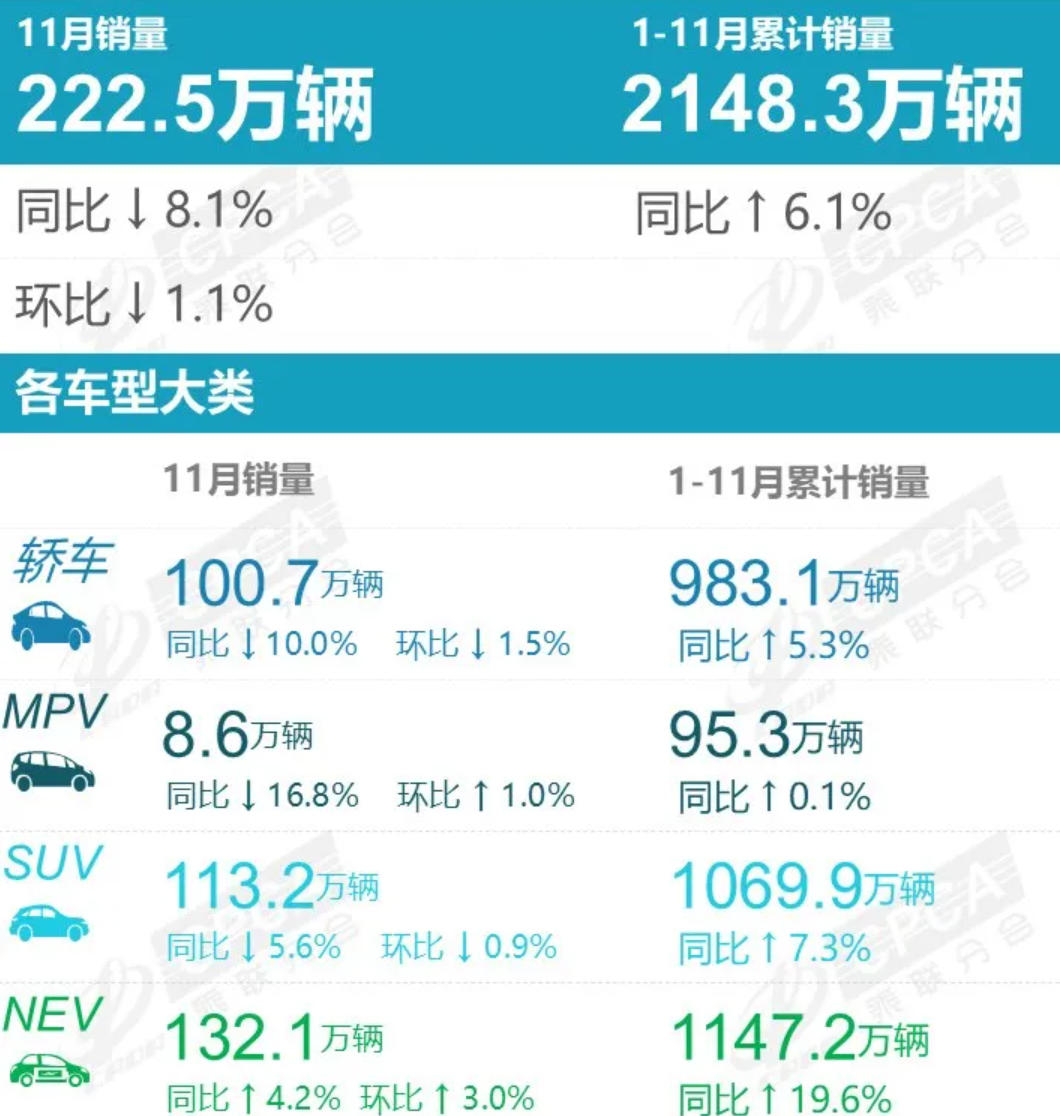
Group 1: Overall Market Performance - In November, the domestic passenger car market faced pressure, with retail sales reaching 2.225 million units, a year-on-year decline of 8.1% and a month-on-month decline of 1.1% [1] - The new energy vehicle (NEV) market, however, showed resilience with sales of 1.321 million units, a year-on-year increase of 4.2% and a month-on-month increase of 3.0%, achieving a penetration rate of over 59% [1] Group 2: Segment Performance - The sedan market saw retail sales of 1.007 million units, down 10.0% year-on-year and slightly down 1.5% month-on-month, with NEV sedans becoming a key growth point [4] - The MPV market was the weakest segment, with retail sales of 86,000 units, a year-on-year decline of 16.8% and a slight month-on-month increase of 1.0% [4] - The SUV market, while also facing year-on-year declines, performed better than sedans and MPVs, with retail sales of 1.132 million units, down 5.6% year-on-year and down 0.9% month-on-month; NEV SUVs sold 683,000 units, up 12.5% year-on-year [4] Group 3: Brand Performance - Among the top ten manufacturers, five were domestic brands, capturing 61% of the total market sales; domestic brands sold 1.49 million units, down 4% year-on-year, while joint venture brands sold 490,000 units, down 19% [4] - BYD led the sales with 306,561 units, although it experienced a year-on-year decline of 26.5% [7] - Geely ranked second with sales of 268,337 units, showing a year-on-year increase of 23.5%, becoming the fastest-growing company among the top brands [9] Group 4: Competitive Landscape - The German brands, particularly FAW-Volkswagen, maintained a stable performance in the shrinking joint venture market, with retail sales of 137,500 units [5] - SAIC Volkswagen's sales were 86,857 units, down 29.3% year-on-year, but it still retained a solid base in the fuel vehicle market [6] - New entrants like Hongmeng Zhixing and Xiaomi Auto showed significant growth, with Hongmeng Zhixing achieving a year-on-year increase of 95.2% [11][18] Group 5: Future Outlook - The market is expected to enter a phase of aggressive sales push in December, with domestic brands likely to maintain their lead in the NEV sector [18] - The competition is shifting from traditional product competition to a focus on technological strength and product quality, indicating a trend towards high-quality development in the automotive industry [18]
从“追赶”到“被追赶”:问界M9让中国豪华车赢得话语权
Di Yi Cai Jing· 2025-12-16 04:55
Core Insights - The article highlights the significant breakthrough of China's automotive industry, particularly with the launch of the AITO Wenjie M9, which has successfully penetrated the high-end vehicle market traditionally dominated by foreign brands [1][3][5]. Group 1: Market Dynamics - China has maintained its position as the world's largest automotive producer and seller for several years, but the high-end vehicle segment (priced above 500,000 yuan) has been largely monopolized by foreign brands [3][5]. - The launch of the Wenjie M9 marks a pivotal shift in the luxury car market, transitioning from a focus on historical prestige to a value-driven approach emphasizing practical experience and technological innovation [5][6]. Group 2: Product Performance - The Wenjie M9 has achieved cumulative deliveries exceeding 260,000 units and has become the sales leader in the 500,000 yuan and above market segment within just one year of its launch [1][5]. - The vehicle integrates advanced technologies such as Huawei's QianKun intelligent driving system and HarmonyOS smart cockpit, enhancing the luxury experience for users [6][8]. Group 3: Brand Positioning - The Wenjie brand has established a new luxury concept that combines traditional luxury with technological advancements, positioning itself as a leader in redefining luxury automotive standards in China [5][10]. - The vehicle's success is attributed to its ability to resonate with high-end consumers, transforming from a mere transportation tool to a status symbol among elite groups [9][14]. Group 4: Customer Experience and Service - The Wenjie M9 has demonstrated exceptional resale value, with a one-year depreciation rate of 18.7% for the pure electric version and 17.8% for the hybrid version, outperforming many traditional luxury brands [9]. - The brand has redefined customer service standards in the luxury segment, emphasizing safety and reliability, as evidenced by its innovative satellite eCall feature that provides emergency assistance in remote areas [10][11]. Group 5: Cultural Impact - The Wenjie M9 has engaged with high-profile cultural events, such as the Golden Rooster and Hundred Flowers Film Festival and the Spring Festival Gala, enhancing its brand visibility and cultural significance [12][14]. - The vehicle's narrative reflects a broader evolution in the luxury automotive sector, showcasing China's capability to redefine global luxury standards through innovation and customer-centric approaches [14].
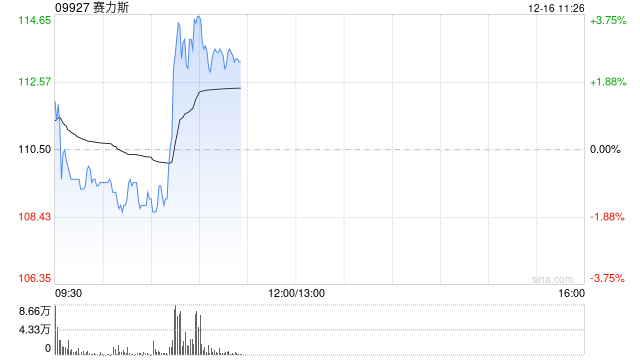
赛力斯逆市涨逾3% 新能源汽车11月销量55203辆
Xin Lang Cai Jing· 2025-12-16 03:27
Core Viewpoint - Seres Group has reported a significant increase in electric vehicle sales, indicating a successful growth strategy focused on high-end and intelligent offerings in a competitive market [4]. Group 1: Sales Performance - In November 2025, Seres' electric vehicle sales reached 55,203 units, marking a nearly 50% year-on-year increase and setting a new brand record [4]. - Cumulatively, Seres sold 411,288 electric vehicles in the first 11 months of this year, showcasing strong performance amid increasing competition in the electric vehicle market [4]. Group 2: Market Positioning - The sales figures reflect Seres' growth model driven by high-end and intelligent features, which has now entered a stable output phase [4].