
迈瑞医疗

Search documents
深圳千亿IPO来了
投资界· 2025-10-29 07:38
Core Viewpoint - The article discusses the upcoming IPO of Mindray Medical, highlighting its historical significance and growth trajectory in the high-end medical device market in China [5][12]. Company History - Mindray Medical was founded in 1991 by three colleagues, including Li Xiting, who left high-paying jobs to start the company, marking the beginning of China's high-end medical device industry [7][8]. - The company initially faced funding challenges but secured its first venture capital investment of $2 million in 1997, which helped it stabilize and grow [9]. - Mindray became the first Chinese medical device company to list overseas, successfully going public on the New York Stock Exchange in 2006 [11]. IPO and Market Performance - Mindray's IPO on the Shenzhen Stock Exchange in 2018 raised nearly 6 billion yuan, setting a record for the largest IPO on the ChiNext board that year [12]. - The company's market capitalization peaked at over 320 billion yuan during the surge in demand for medical devices in 2020, although it has since adjusted to a current market cap of over 270 billion yuan [12]. Strategic Goals - The upcoming listing on the Hong Kong Stock Exchange is part of Mindray's strategy to enhance its global business and capital presence, with a goal to increase international revenue to over 70% [12]. - The company aims to rank among the top ten global medical device companies by 2030, reflecting its ambition for international expansion [12].



太平洋证券看好迈瑞医疗国际化发展,维持“买入”评级
Jiang Nan Shi Bao· 2025-10-29 04:55
Core Insights - Mindray Medical is making significant strides in the global medical device market, with international business revenue expected to reach nearly 50% by mid-2025, marking a crucial milestone in the company's development [1] - The company has successfully balanced its domestic and international operations, achieving a "50-50" split in revenue distribution by mid-2025, which helps mitigate risks from macroeconomic and industry changes [1] - Mindray's three core business areas—In Vitro Diagnostics, Life Information and Support, and Medical Imaging—are performing well in overseas markets, with international revenue shares for Life Information and Support and Medical Imaging reaching 67% and 62% respectively, while In Vitro Diagnostics accounts for 29% of international revenue [1] International Market Expansion - In the overseas market, Mindray has made breakthroughs with over 160 new high-end clients and more than 50 existing high-end clients in the In Vitro Diagnostics sector in the first half of 2025 [2] - The Life Information and Support business also showed strong performance, acquiring over 100 new high-end clients and nearly 390 existing clients for additional products [2] - Key clients include renowned medical institutions such as Spain's HM Group and Italy's Policlinico Universitario Sant'Andrea-La Sapienza [2] Localization Strategy - Mindray's success in international markets is largely attributed to its deep localization strategy, with local production projects established in 14 countries, 11 of which are already in production, primarily focusing on In Vitro Diagnostics products [2] - Following the acquisition of Germany's DiaSys in 2020, Mindray has positioned it as a "bridgehead" for localized operations in Europe, resulting in an 18% year-on-year revenue growth in the European In Vitro Diagnostics business in the first half of 2025, with DiaSys contributing 40% of localized product revenue [2] Digital Transformation - Mindray is actively promoting digital transformation by building a "Device + IT + AI" smart medical ecosystem, integrating medical IoT and device innovation [3] - The company has developed specialized information systems, including "Rui Zhi, Rui Jian, Rui Ying," and launched the Qiyuan perioperative medical model in 2025 to enhance critical care capabilities [3] - This smart medical ecosystem is expected to improve overall diagnostic capabilities for global medical institutions and increase the company's penetration and brand loyalty among high-end clients [3] Market Outlook - Pacific Securities indicates that Mindray's international market growth and high-end breakthroughs are ongoing, with expectations for strong performance in the three core business lines in the second half of the year, maintaining a "buy" rating [3]

长期增长潜力巨大!创业板50ETF(159949)重获资金青睐 近5日净流入超4800万
Xin Lang Ji Jin· 2025-10-29 03:58
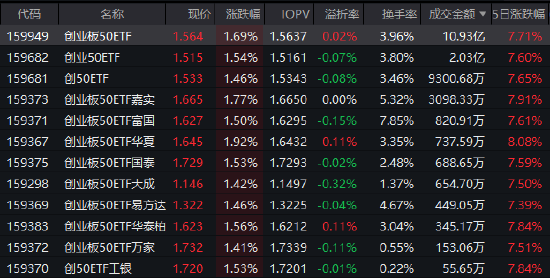
Core Viewpoint - The A-share market experienced a rebound, with the Shanghai Composite Index reclaiming the 4000-point mark and the ChiNext Index showing a significant increase, indicating positive market sentiment and potential investment opportunities in the technology sector [1][2]. Market Performance - On October 29, the ChiNext 50 ETF (159949) rose by 1.69% to 1.564 CNY, with a trading volume of 10.93 billion CNY, leading among similar ETFs in terms of transaction scale [1][4]. - The ETF's turnover rate was recorded at 3.96%, reflecting active trading interest [4]. Fund Flow - The ChiNext 50 ETF has shifted from net outflows to net inflows recently, with a total circulating scale of 271.20 billion CNY as of October 28, 2025 [2]. - Over the past 60 trading days, the ETF saw a cumulative net outflow of approximately 72 billion CNY, but in the last 5 trading days, it recorded a net inflow of 4.827 million CNY [2]. Holdings Analysis - The top ten holdings of the ChiNext 50 ETF predominantly showed price increases, with significant positions in companies like CATL, Zhongji Xuchuang, and Dongfang Wealth, among others [5]. - The total market value of the top ten holdings amounted to approximately 20.07 billion CNY, accounting for 69.35% of the ETF's total stock value [5]. Future Outlook - The fund manager's report indicates a cautious outlook due to weakening global economic growth and increasing trade barriers, particularly in the technology sector [6]. - However, there is a long-term positive trend towards high-end manufacturing, modern services, and innovation-driven industries, with significant growth potential in sectors such as information technology, new energy, and biomedicine [6]. - The ChiNext 50 ETF is positioned as a convenient investment tool for those optimistic about the long-term growth of China's technology sector, with recommendations for investors to adopt systematic investment strategies to mitigate short-term volatility [6].






A股“红包雨”超百亿,高频分红趋势吸引长线资金
Huan Qiu Wang· 2025-10-29 03:22
Core Viewpoint - The trend of high-frequency dividends is becoming a new norm in both A-share and Hong Kong markets, with over 100 billion yuan in dividends being distributed as companies release their third-quarter reports [1][2][4] Group 1: A-share Market Developments - As of October 27, 95 A-share companies have announced third-quarter dividend plans, totaling 10.87 billion yuan [1] - Leading companies like Wens Foodstuff Group, Huaxin Cement, and Dahua Technology have reported significant dividend amounts, with Wens Foodstuff Group leading at 1.994 billion yuan [1] - Huaxin Cement's unexpected announcement of a 706 million yuan cash dividend, amidst a surge in profits, resulted in stock price increases of 7.89% and 10.23% in A-shares and Hong Kong shares respectively [1] Group 2: Hong Kong Market Developments - Major blue-chip companies in Hong Kong, such as HSBC Holdings and Hang Seng Bank, have also announced third-quarter dividend plans [1] - HSBC Holdings declared a dividend of $0.1 per share, maintaining the same level as the previous year, with total dividends for the year reaching $0.3 per share, which helped its stock price rise over 4% despite a decline in quarterly profits [1] Group 3: Trends and Policy Implications - The increase in high-frequency dividends is attributed to both policy guidance and market mechanisms, with new regulations encouraging companies to adopt multiple dividend distributions within a year [4] - The trend is reshaping the investment landscape, with long-term investors, such as insurance funds, increasingly favoring high-dividend companies [4] - As of mid-2023, the balance of insurance company investments exceeded 36 trillion yuan, and public fund sizes reached 36.25 trillion yuan, indicating a growing preference for high-dividend strategies in a declining interest rate environment [4]


2025碳达峰碳中和论坛暨深圳国家低碳城论坛启幕
Zhong Guo Xin Wen Wang· 2025-10-28 13:45
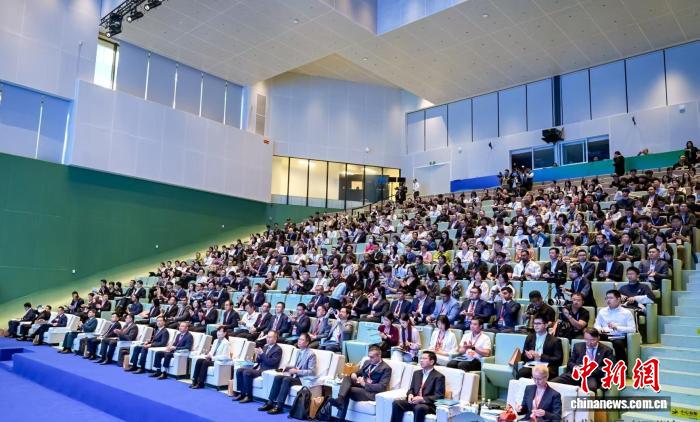
Core Viewpoint - The forum focuses on "AI Empowering Urban Green Development" and discusses new solutions for achieving carbon peak and carbon neutrality goals [1][3]. Group 1: Government Initiatives - Guangdong Province is leading carbon peak and carbon neutrality efforts, promoting ecological construction and modern industrial systems for green low-carbon development [1]. - Shenzhen is pioneering a dual control system for carbon emissions, advancing energy green low-carbon transformation, and promoting electric vehicles and green building clusters [3]. Group 2: Key Publications and Achievements - The "2025 Shenzhen Green Low-Carbon Development White Paper" showcases actions and achievements in carbon reduction, pollution reduction, green expansion, and economic growth [3]. - The release of carbon footprint certification results and white papers in the Guangdong-Hong Kong-Macao Greater Bay Area marks significant progress in international green trade compliance and regional carbon reduction collaboration [3]. Group 3: Technological Insights - The construction of a new energy system involves developing wind and solar energy, flexible coal power, hydrogen energy, and other energy collaborations [3]. - Key technologies for new energy include deep-sea wind power, carbon capture and storage (CCUS), new grid forms, and digital technologies for supply-demand interaction [3]. Group 4: Urban Carbon Neutrality - Urban carbon emissions are critical for achieving carbon neutrality, necessitating attention to renewable energy use, low-carbon industrial processes, zero-carbon buildings, and green transportation [5]. Group 5: Recognition and Awards - The forum included the awarding of "2025 Urban Green Low-Carbon Scenario Demonstration Base" and "2025 Shenzhen ESG Practice Pioneer Enterprise" to various projects and companies, highlighting successful initiatives in sustainability [5].
10月28日生物经济(970038)指数跌0.16%,成份股美亚光电(002690)领跌
Sou Hu Cai Jing· 2025-10-28 12:22
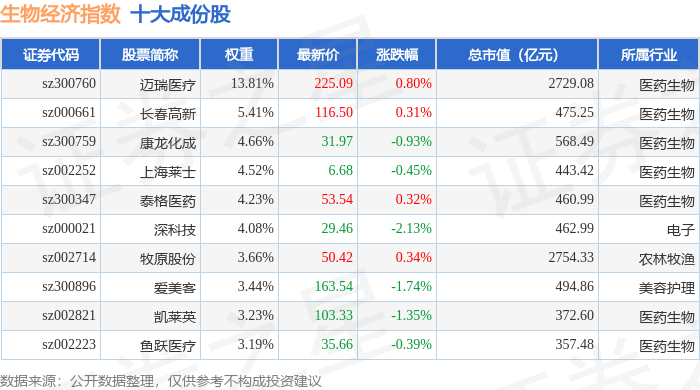
Core Points - The Bioeconomy Index (970038) closed at 2277.51 points, down 0.16%, with a trading volume of 18.883 billion yuan and a turnover rate of 1.2% [1] - Among the index constituents, 23 stocks rose while 27 fell, with Iwubio leading the gainers at 6.71% and Meiya Optoelectronics leading the decliners at 3.02% [1] Index Constituents Summary - The top ten constituents of the Bioeconomy Index include: - Mindray Medical (sz300760) with a weight of 13.81%, latest price at 225.09 yuan, and a market cap of 272.908 billion yuan [1] - Changchun High-tech (sz000661) with a weight of 5.41%, latest price at 116.50 yuan, and a market cap of 47.525 billion yuan [1] - Kanglong Chemical (sz300759) with a weight of 4.66%, latest price at 31.97 yuan, and a market cap of 56.849 billion yuan [1] - Other notable constituents include Shishihistory (sz002252), Table Pharmaceutical (sz300347), and Muyuan Foods (sz002714) [1] Capital Flow Analysis - The Bioeconomy Index constituents experienced a net outflow of 871 million yuan from institutional investors, while retail investors saw a net inflow of 544 million yuan [3] - Key capital flows include: - Iwubio (300357) with a net inflow of 52.9277 million yuan from institutional investors [3] - Dabo Medical (002901) with a net inflow of 31.8434 million yuan from institutional investors [3] - Changchun High-tech (000661) with a net inflow of 27.6452 million yuan from institutional investors [3]





不再跟着西方屁股定义“卡脖子”,这样只会被动挨打
Guan Cha Zhe Wang· 2025-10-28 12:06
Core Viewpoint - The report emphasizes that China's modernization relies on technological advancement, highlighting the importance of original innovation and the integration of technology and industry to achieve high-level self-reliance in technology [1] Group 1: Technological Innovation and Industry Integration - The "14th Five-Year Plan" outlines the need for deep integration of technological innovation and industrial innovation, with a focus on addressing "bottleneck" issues in high-end chips and industrial software [1][2] - The government is encouraged to transform specific industry challenges into national technology tasks, thereby supporting enterprises in overcoming technological barriers [2][3] Group 2: Role of Enterprises in Innovation - Enterprises are identified as the main body of technological innovation, with a call for vertical integration strategies to address complex interdisciplinary challenges [3][11] - The importance of fostering a collaborative environment between enterprises and research institutions is highlighted, allowing for timely solutions to innovation challenges [5][10] Group 3: Government's Role in Supporting Innovation - The government should act as a market rule designer and key buyer, creating a long-term vision for industry participants and breaking down information barriers [5][12] - A shift from reactive support to proactive engagement with leading enterprises and scientists is recommended to better understand future industrial development directions [4][15] Group 4: AI and Industrial Applications - The report discusses the significance of artificial intelligence (AI) in driving industrial innovation, with examples of successful applications in companies like Zhejiang University Control [13][14] - The relationship between traditional industrial enterprises and AI companies is crucial, as traditional firms provide the operational context and data necessary for AI development [15][19] Group 5: Challenges in Basic Research and Industry Needs - The need for a strategic, forward-looking, and systematic approach to basic research is emphasized, ensuring alignment with industrial demands [16][20] - The report suggests that universities and research institutions must equally value both vertical and horizontal projects to effectively serve industry innovation needs [20][21] Group 6: Non-linear Relationship Between Science, Technology, and Industry - Innovation is characterized as a practical process, where the development of technology is driven by industrial needs and experiences [25][27] - The report provides examples from the dairy and agricultural sectors to illustrate how industry-driven research can lead to significant technological advancements [22][24]

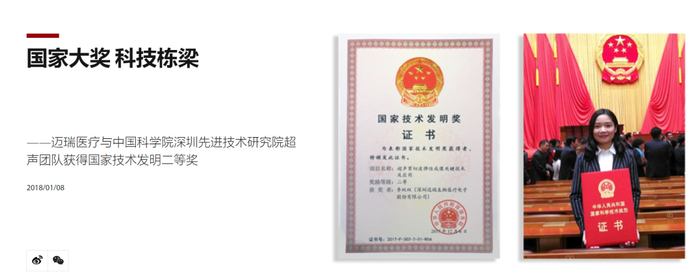
10月28日中证医疗(399989)指数跌0.78%,成份股英科医疗(300677)领跌
Sou Hu Cai Jing· 2025-10-28 10:37
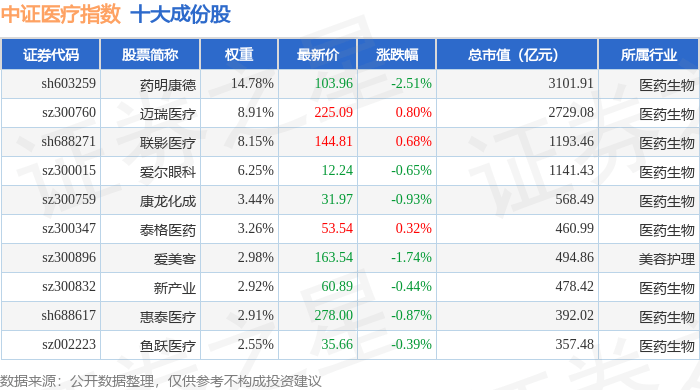
Core Points - The CSI Medical Index (399989) closed at 7426.33 points, down 0.78%, with a trading volume of 21.164 billion yuan and a turnover rate of 1.59% [1] - Among the index constituents, 17 stocks rose while 33 stocks fell, with Weikang Medical leading the gainers at 4.6% and Yingke Medical leading the decliners at 8.58% [1] Index Constituents Summary - The top ten constituents of the CSI Medical Index include: - WuXi AppTec (603259) with a weight of 14.78%, latest price at 103.96 yuan, down 2.51%, and a market cap of 310.191 billion yuan [1] - Mindray Medical (300760) with a weight of 8.91%, latest price at 225.09 yuan, up 0.80%, and a market cap of 272.908 billion yuan [1] - United Imaging Healthcare (688271) with a weight of 8.15%, latest price at 144.81 yuan, up 0.68%, and a market cap of 119.346 billion yuan [1] - Other notable constituents include Yir Eye Hospital (300015), Kanglong Chemical (300759), and Tigermed (300347) [1] Capital Flow Analysis - The CSI Medical Index constituents experienced a net outflow of 1.035 billion yuan from institutional investors, while retail investors saw a net inflow of 598 million yuan [3] - Notable capital flows include: - United Imaging Healthcare (688271) with a net inflow of 67.12 million yuan from institutional investors [3] - Meinian Health (002044) with a net inflow of 45.66 million yuan from institutional investors [3] - Other companies like Kingmed Diagnostics (603882) and Yir Medical (002223) also showed varying capital flows [3]
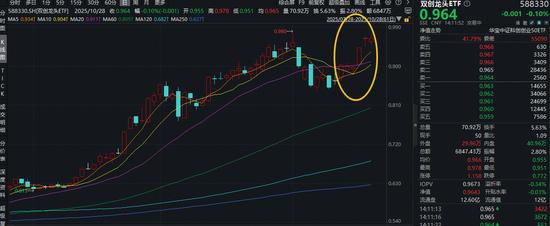
创业板改革来袭!双创龙头ETF盘中涨逾1.2%冲击日线6连阳!多条均线呈多头排列,上升趋势未被破坏!
Xin Lang Ji Jin· 2025-10-28 06:33
Group 1 - The core viewpoint of the news is the initiation of deep reforms in the ChiNext board, aimed at providing more precise and inclusive financial services for emerging industries and innovative enterprises [1] - The China Securities Regulatory Commission announced that the first batch of newly registered companies will be listed on the Sci-Tech Innovation Board, with the reform effects becoming increasingly evident [1] - The new five-year plan emphasizes technological self-reliance and quality improvement in economic development, with a focus on enhancing "new quality productivity" [1] Group 2 - The Double Innovation Leader ETF (588330) has shown a significant upward trend since its low point on April 8, with a cumulative increase of 95.62%, outperforming major indices such as the ChiNext Index and the Sci-Tech Innovation Index [5][6] - The ETF is designed to capture high-growth companies in strategic emerging industries, including new energy, photovoltaics, semiconductors, and medical devices, reflecting the importance of technological self-reliance [4] - The ETF's investment threshold is relatively low, allowing investors to start with less than 100 yuan, making it an accessible option for capturing technology market trends [4]
创50ETF(159681)涨超1%,科技板块持续反弹
Xin Lang Cai Jing· 2025-10-28 05:22
Group 1 - The technology sector continues to rebound due to favorable policies, with the "self-reliance and self-improvement in technology" being included in the "14th Five-Year Plan" goals [1] - The ChiNext 50 Index (399673) rose by 0.86%, with notable increases in constituent stocks such as Zhuosheng Microelectronics (300782) up 3.95% and Xinyisheng (300502) up 3.47% [1] - The ChiNext 50 ETF (159681) closely tracks the ChiNext 50 Index, which consists of 50 stocks with high trading volume, reflecting the overall performance of well-known, large-cap, and liquid companies in the ChiNext market [1] Group 2 - As of September 30, 2025, the top ten weighted stocks in the ChiNext 50 Index accounted for 69.36% of the index, including companies like CATL (300750) and Zhongji Xuchuang (300308) [2]