
比亚迪

Search documents
汽车行业周报:特斯拉举行2025Q4业绩财报会,比亚迪天神之眼5.0辅助驾驶发布-20260202
Guohai Securities· 2026-02-02 08:02
Investment Rating - The report maintains a "Recommended" rating for the automotive industry [1] Core Insights - Tesla's total revenue for 2025 was $94.827 billion, a 3% year-on-year decline, marking its first revenue drop. The net profit for the year was $3.794 billion, down 46% year-on-year. In Q4 2025, total revenue was $24.901 billion, also down 3%, with a net profit of $840 million, down 61% year-on-year. Tesla plans to focus on autonomous driving, robotics, and AI, with a new model, Cybercab, set to launch in April 2026 [5][13] - BYD launched its Tian Shen Zhi Yan 5.0 advanced driver assistance system, which incorporates enhanced learning capabilities and claims to improve driving stability and response times. As of December 31, 2025, BYD's assisted driving vehicle ownership exceeded 2.56 million, generating over 160 million kilometers of data daily [6][14] - The automotive industry is expected to face challenges in 2026 due to the reduction of new energy vehicle purchase tax incentives and trade-in subsidies. However, there are opportunities in the high-end upgrade of domestic brands and the acceleration of smart technology integration [15][16] Summary by Sections Recent Developments - Tesla held its Q4 2025 earnings call on January 29, 2026, announcing a strategic focus on autonomous driving and AI, with plans for significant capital expenditures exceeding $20 billion in 2026 [5][13] - BYD's Tian Shen Zhi Yan 5.0 was announced on January 28, 2026, featuring a new technology framework for enhanced learning capabilities [6][14] Market Performance - From January 26 to January 30, 2026, the automotive sector underperformed the Shanghai Composite Index, with the automotive index down 5.1% compared to a 0.4% decline in the Shanghai Composite [17][24] Industry Trends - The report highlights a shift towards high-end domestic brands and the integration of smart technologies in the automotive sector, recommending companies such as Jianghuai Automobile, Leap Motor, Great Wall Motors, and BYD for investment [15][16]


A股收评:指数集体下挫!贵金属现跌停潮,白酒、电网设备逆势上扬
Ge Long Hui· 2026-02-02 07:41
Market Overview - Major A-share indices collectively declined, with the Shanghai Composite Index falling by 2.48% to 4015 points, the Shenzhen Component Index down 2.69%, and the ChiNext Index down 2.46% [1][2] - The trading volume in the Shanghai and Shenzhen markets was 2.58 trillion yuan, a decrease of 250.8 billion yuan compared to the previous trading day [1] Sector Performance - The precious metals sector experienced a significant downturn, with over 4600 stocks declining and more than a hundred hitting the daily limit down [1][2] - Semiconductor stocks also faced heavy losses, with several companies, including Zhongwei Semiconductor and others, dropping over 10% [2][7] - Telecom operators showed weakness, with China Unicom falling over 5% and other major telecom companies following suit [9] - The automotive sector saw declines, with companies like Zotye Auto and BYD dropping over 4% [11] - In contrast, the liquor sector saw gains, with Jinhuijiu and Huangtai Jiuye hitting the daily limit up [3][13] - The electric power equipment sector surged, with Yinen Electric rising nearly 22% and several other stocks hitting the daily limit up [15] Specific Stock Movements - Precious metals stocks collectively fell, with notable declines including Xiaocheng Technology down nearly 19% and several others hitting the daily limit down [5][6] - In the semiconductor sector, stocks like Jucheng Technology and Mingwei Electronics dropped over 13% [7][8] - Telecom stocks were negatively impacted by a new tax policy, with UBS predicting significant adverse effects on the profitability of major telecom operators [10] - Automotive companies reported declines in January delivery data, with BYD's new energy vehicle sales down 30.11% year-on-year [11][12] - The liquor sector's positive performance was attributed to unexpected demand ahead of the Spring Festival, with market expectations previously low [13][14] - The electric power equipment sector's growth was driven by increased investment from the State Grid, with fixed asset investments expected to reach 4 trillion yuan during the 14th Five-Year Plan [15][16]


BYD, Xpeng Lead Chinese EV Stock Selloff Amid Poor January Sales - BYD (OTC:BYDDY)
Benzinga· 2026-02-02 07:32
Chinese automakers BYD Co. Ltd. (OTC:BYDDY) (OTC:BYDDF) , Xpeng Inc. (NYSE:XPEV) , among others, recorded a decline in stock values on the Hong Kong exchange following poor January sales figures.BYD Shares Fell 5.1%BYD shares fell by over 5.1% in early trading on the Hong Kong stock exchange after it reported a sales decline of over 30% in January, Bloomberg reported on Sunday.The world's largest EV maker sold 210,051 units in January, which also demonstrated a 50% MoM decline in sales, amid strong overseas ...


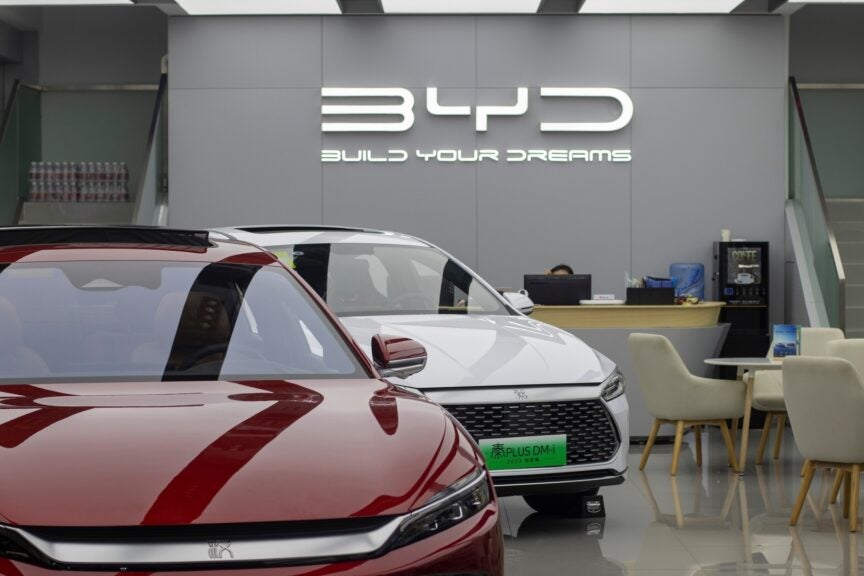
1月车市“大变天”:吉利反超比亚迪,小米SU7停产致销量跌超二成
Feng Huang Wang· 2026-02-02 07:06
"2026年是吉利汽车产品大年,吉利汽车将在每个季度都推出1-2款全新产品,涵盖多款全新混动车型及 全新一代醇氢能源车型,全力冲击全年345万辆的销量目标。"吉利汽车方面表示,公司将2026年的出口 销量目标锚定64万辆,同比增幅超50%以上。 "痛失"销冠的比亚迪,1月呈现"国内下滑、海外增长"的分化态势。产销快报显示,比亚迪当月实现销 售21万辆,同比下降30.11%,环比下降50.04%。其中,国内市场销量10.5万辆,同比下降54.35%;海外 市场销量10万辆,同比增长51.47%。 2月2日,车市告别"先抑后扬"的2025年后,受市场订单提前"透支"、促销费政策调整、传统淡季等叠加 因素影响,多家传统车企和造车新品牌于2月初发布的销量数据表明,今年1月汽车市场整体呈现销量环 比下滑、同比上扬的局面。 在极氪销量同比超100%带动下,虽然吉利品牌、领克品牌录得小幅下滑,但吉利汽车于2月1日晚间披 露的1月销量数据显示,其当月乘用车销量达27.02万辆,同比增长1.29%,环比增长14.08%,成为目前 唯一实现同环比正增长的企业,并借此反超比亚迪,登顶当月"销冠"。 在新能源领域,吉利汽车1月新能源 ...

吉利反超比亚迪
财联社· 2026-02-02 07:01
车市告别"先抑后扬"的2025年后,受市场订单提前"透支"、促销费政策调整、传统淡季等叠加因素影响,多家传统车企和造车新品牌于2月初发布的 销量数据表明,今年1月汽车市场整体呈现销量环比下滑、同比上扬的局面。 在国内车市普遍承压背景下,海外市场的快速拓展正成为比亚迪重要的增长引擎。 比亚迪品牌及公关部门总经理李云飞于年初透露,公司 计划在2026年向中国以外地区销售130万辆汽车。这一目标较2025年约105万辆的海外交付量,预计增长约24%。 同为多品牌运营的汽车集团,奇瑞汽车1月五大品牌总销量为19.1万辆,同比下降10.7%。广汽集团1月销量11.66万辆,同比增长 18.47%,昊铂埃安BU和传祺BU完成组建后,昊铂埃安BU销量同比增长171.63%,传祺BU销量同比增长51.06%。长城汽车1月销量9万 辆,同比增长11.59%,其中WEY品牌7873辆,同比增长57.24%,在旗下五大品牌中涨幅最高。 新造车品牌中,小米汽车于2月1日率先公布2026年1月成绩单——交付量超39000辆,环比下滑22%但同比增幅接近翻倍。"SU7马上改 款,目前主要交付的是YU7。"小米创办人、董事长兼CEO雷军解 ...

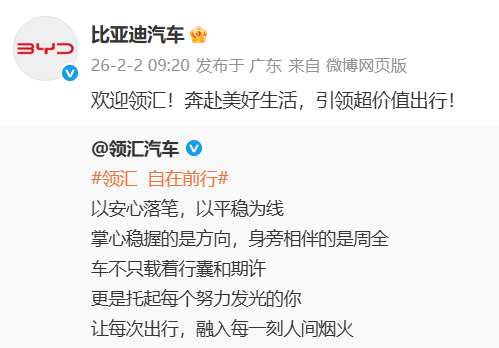
比亚迪第四款子品牌“领汇汽车”正式官宣亮相
Xin Lang Cai Jing· 2026-02-02 05:42
Group 1 - BYD officially announced the launch of its fourth sub-brand "Linghui Auto" on February 2, following Fangchengbao, Tengshi, and Yangwang [1][4] - The Linghui brand is positioned as a "super value travel practitioner," targeting the B-end operation market, including ride-hailing, taxis, and government vehicles, distinguishing itself from the personal passenger car market [1][4] Group 2 - The first batch of Linghui models includes four vehicles, covering both pure electric and plug-in hybrid powertrains, forming a complete product line from compact sedans to mid-to-large MPVs [3][7] - Linghui e5 is based on the Qin PLUS EV, targeting the entry-level market with a focus on economy and durability, suitable for ride-hailing scenarios [3][7] - Linghui e7 is derived from the Sea Lion 07 EV platform, positioned in the mid-range, balancing performance and cost to meet dedicated vehicle needs [3][7] - Linghui e9, based on the BYD Han, is over 5 meters long and features dual motors with 135kW/150kW, aimed at high-end business travel, potentially being the first operational vehicle equipped with the "Heavenly Eye" L2+ level driver assistance system [3][7] - Linghui M9 is based on the BYD Xia plug-in hybrid platform, with a comprehensive range of 1200 kilometers, suitable for long-distance transfers and business receptions, with plans to launch a right-hand drive version for overseas markets [3][7]
沃什被提名新任联储主席:环球市场动态2026年2月2日
citic securities· 2026-02-02 05:14
环球市场动态 沃 什 被 提 名 新 任 联 储 主 席 股 票 周五A股涨跌不一,板块走势分化; 港股高开低走,大型科技股普遍走 弱;欧洲股市上涨,市场情绪偏向 乐观;美股受特朗普提名沃什担任 美联储主席影响巨震,贵金属价格 暴跌。 $${\mathcal{H}}\;\;{\tilde{\chi}}\sqsubset\;I\;{\frac{\mathrm{{\hat{\mu}}}}{\left|\Phi\right|}}\;\;{\frac{\mathrm{{\hat{\mu}}}}{\left|\Phi\right|}}$$ 特朗普提名被视为立场相对鹰派的 沃什出任下一任美联储主席,上周 五美元大漲,贵金属近期凌厉涨势 逆转,黄金盘中创下 40 年来最大 跌幅,白银录得历史最大跌幅,抛 售潮波及更广泛的金属市场,伦敦 期铜大跌。 固 定 收 益 上周五美国国债收益率曲线趋陡。 特朗普提名沃什担任美联储主席。 亚洲债市相对偏弱,利差走宽 1-3 个基点。本周将有季度再融资公告 和非农数据公布。 产品及投资方案部 注:bp/bps=基点;pt/pts=百分点 中信证券财富管理 (香港) 免责声明请参考封底 2 ...
Flooded by cheap Chinese goods, Latin America is fighting back to protect its industries
Yahoo Finance· 2026-02-02 04:55
Core Insights - The influx of Chinese goods in Latin America, particularly in Mexico and Argentina, is significantly impacting local businesses and industries, leading to store closures and job losses [1][3][6] Group 1: Market Trends - The number of shops selling Chinese-made goods in Mexico City has more than tripled, affecting long-established local stores [1] - Temu and Shein, leading Chinese e-commerce platforms, have seen substantial growth in Latin America, with Temu averaging 114 million monthly active users in the first half of 2025, a 165% increase year-on-year [2][3] - E-commerce imports in Argentina surged by 237% in October 2025 compared to the same month the previous year, primarily driven by Chinese products [6] Group 2: Economic Impact - The rise of Chinese imports is causing significant job losses in Argentina, where local factories are shutting down and laying off workers [6][7] - Mexico has become the largest destination for Chinese auto exports, importing 625,187 vehicles in 2024, surpassing Russia [9][10] - Brazil's auto industry is also under pressure from low-priced Chinese cars, with over 80% of the 61,615 electric vehicles sold in Brazil in 2024 being Chinese brands [9][11] Group 3: Trade Relations - China's trade relationship with Latin America is characterized by a growing trade deficit for many countries, with Mexico's deficit reaching $120 billion in 2024 [13] - Argentina's trade deficit with China rose to nearly $8.2 billion in 2025, driven by increased imports of manufactured goods [14] - Brazil recorded a trade surplus of about $29 billion with China in the previous year, largely due to soybean exports [15] Group 4: Government Responses - Countries like Mexico and Brazil are implementing protective measures, including tariffs of up to 50% on various imports from China [18][19] - Argentina is facing challenges as local industries push back against the influx of Chinese goods, with calls for increased tariffs and regulations [19][20] - The balance between protecting local industries and maintaining trade relations with China is a significant concern for Latin American governments [20]

比亚迪股份暴跌近8%
Xin Lang Cai Jing· 2026-02-02 04:29
去年6月,比亚迪港股股价曾触达157.82港元/股,此后一路波动下行。截至今日发稿,比亚迪港股股价 自2025年6月高点的157.82港元/股,已累计下跌约42.69%,市值距高点缩水约2481亿港元。 比亚迪昨日发布公告称,2026年1月实现新能源汽车销量约21万辆,同比下降30%。其中,乘用车销量 约为20.55万辆,同比下降30.67%;纯电动汽车销量约为8.32万辆,同比下降33.60%;插电式混合动力 汽车销量约为12.23万辆,同比下降28.53%。(一财汽车) 来源:第一财经 2月2日,比亚迪股份(1211.HK)开盘即下跌,截至午间收盘,报90.10港元,跌幅逼近8%。同日,港 股汽车股集体下挫,小鹏汽车一度跌近10%,蔚来盘中跌近7%,零跑汽车跌超5%,长城汽车跌超4%, 理想汽车、广汽集团跌超3%,吉利汽车、小米集团跌超2%。 (本文来自第一财经) ...
鸿蒙智行、小米登顶,零跑失榜一,2026新能源开局“冷热交织”
Feng Huang Wang· 2026-02-02 04:25
Core Insights - The new energy vehicle market in China is experiencing a mixed performance, with some companies showing year-on-year growth while facing month-on-month declines [1][2][3] - The sales data for January indicates a challenging start to the year, influenced by structural adjustments and consumer sentiment [2][4] Group 1: Sales Performance - BYD reported January sales of 210,051 units, a year-on-year decline of 30.11% [1] - Hongmeng Zhixing achieved 57,915 deliveries in January, marking a year-on-year increase of 65.6% and becoming the only new force to exceed 50,000 monthly sales [1] - NIO delivered 27,182 vehicles in January, a significant year-on-year increase of 96.1% [1] - Li Auto faced substantial pressure with declines in both year-on-year and month-on-month sales [1][3] - Xiaomi's performance was notable, with a strong delivery figure in January, and plans for new models launching in April [1][2] Group 2: Market Trends - The overall retail volume of passenger vehicles in China from January 1-18 saw a year-on-year decline of 28% and a month-on-month drop of 37% [2] - The new energy vehicle market also faced challenges, with a year-on-year decline of 16% and a month-on-month drop of 52% [2] - The end of the vehicle purchase tax exemption policy by the end of 2025 and the impact of year-end promotions have led to a demand recovery phase in early 2026 [2] Group 3: Strategic Adjustments - Companies are shifting from price wars to innovative financing solutions, with Tesla leading the way by introducing long-term low-interest financing options [7] - Xiaomi, Li Auto, and NIO have followed suit with similar financing plans, aiming to attract consumers without direct price cuts [7] - Li Auto is also exploring deeper strategic adjustments, including potential entry into the AI and humanoid robot sectors [7] Group 4: Future Outlook - The overall sales targets for major automakers in 2026 are ambitious, with a combined target of at least 24.55 million units, representing 71.37% of last year's total sales [6] - Analysts predict a growth rate of around 10% for new energy vehicle retail volumes in 2026, despite current market challenges [6][8] - The competition among automakers is expected to shift towards new model launches and enhancing user experience in the second quarter of 2026 [8]