
成都银行

Search documents
首单民营创投科创债落地!中科创星“25创星PPN001”成功发行
Jing Ji Guan Cha Wang· 2025-06-16 13:25
据悉,"25创星PPN001"的发行由浦发银行担任牵头主承销商,由中国银行、中信银行和成都银行 (601838)担任联席主承销商,票面利率2.10%,全场认购倍数3.58倍。此外,该笔科创债由中债信用 增进投资股份有限公司提供全额担保,西安担保集团有限公司下属的西安投融资担保有限公司提供反担 保。 中科创星创始合伙人李浩说,创投机构在银行间债券市场发债融资,不仅有助于其拓宽融资渠道,推动 募、投、管、退业务良性循环,也将推动金融"活水"精准滴灌至掌握关键核心技术的科技创新企业。 6月16日,中科创星科技投资有限公司(下称"中科创星")在中国银行间债券市场成功发行"2025年度第一 期定向科技创新债券——25创星PPN001(科创债)",发行规模为4亿元,期限为5+5年。 这是国内债券市场首个"科技板"民营股权投资机构长期限科技创新债券落地。中科创星因此成为全国首 个成功发行科创债券的民营股权投资机构。 中科创星表示,该债券所募集资金将用于新一代信息技术、人工智能、半导体等硬科技领域基金的出资 及置换,壮大"耐心资本"。 中科创星成立于2013年。截至今年6月,该机构在管资金规模超过120亿元,已投资孵化超过5 ...
上市川企持续提升投资者回报 年度股利支付率达50.28%
Zheng Quan Shi Bao Wang· 2025-06-16 12:10
Core Viewpoint - The dividend performance of listed companies in Sichuan has shown significant improvement, characterized by increased dividend payout ratios, stable dividend amounts, and the gradual establishment of a normalized dividend mechanism, enhancing investment value [1][2]. Group 1: Dividend Payout Ratio - The annual dividend payout ratio for Sichuan-listed companies reached 50.28%, an increase of 7.02 percentage points from the previous year. Approximately 40% of the 43 companies had a payout ratio exceeding 50%, indicating a strong commitment to shareholder returns [1]. Group 2: Stability of Dividend Amounts - Despite some companies facing performance pressures, 105 Sichuan-listed companies announced a total cash dividend of 57.766 billion yuan in 2024, maintaining the same level as the previous year, even with a decrease in profitable companies. Notably, some companies with negative net profits still distributed dividends, reflecting their focus on investor relations [1]. Group 3: Leading Role of Major Companies - In 2024, seven Sichuan-listed companies distributed dividends exceeding 1 billion yuan each, collectively contributing about 43 billion yuan, which accounts for 74% of the total dividend amount [2]. Group 4: Performance of Newly Listed Companies - Over 60% of the 20 newly listed companies in the past three years introduced cash dividend plans for 2024, with an average payout ratio exceeding 50%. Six of these companies executed multiple dividend distributions within the year [2]. Group 5: Normalized Dividend Mechanism - A total of 27 companies increased their frequency of dividend payments by 285% year-on-year, with over 12 billion yuan distributed before the Spring Festival. Additionally, 61 companies have maintained continuous dividends for five years, and 53 companies have disclosed long-term return plans or sought shareholder approval for mid-term dividend strategies [2].




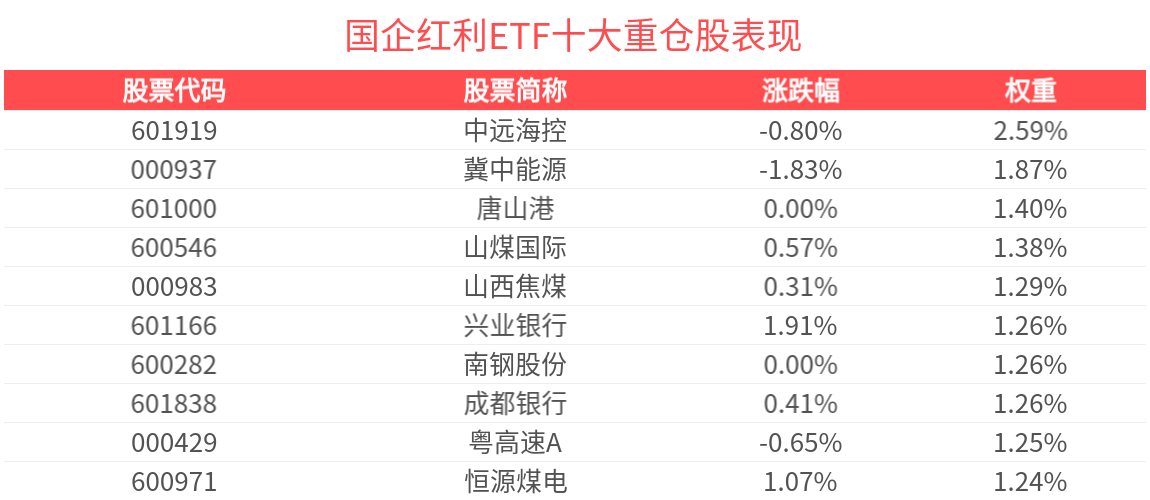
红利风格配置价值备受关注,国企红利ETF(159515)盘中上涨,兴业银行涨近2%
Sou Hu Cai Jing· 2025-06-16 03:54
Group 1 - The core viewpoint of the news is that the China Securities State-Owned Enterprises Dividend Index (000824) has shown a slight increase, indicating a positive trend in state-owned enterprises' stock performance, particularly in dividend-paying stocks [1][2] - The top ten weighted stocks in the China Securities State-Owned Enterprises Dividend Index account for 15.83% of the index, highlighting the concentration of investment in a few key companies [2] - The report from Xinda Securities suggests that if significant monetary and fiscal policies are implemented, there could be improvements in M2 and M1-M2 differential, which may positively impact market conditions [1] Group 2 - The China Securities State-Owned Enterprises Dividend ETF (159515) closely tracks the performance of the China Securities State-Owned Enterprises Dividend Index, which includes 100 listed companies with high and stable cash dividend yields [2] - As of May 30, 2025, the top weighted stocks include COSCO Shipping Holdings (601919), Jizhong Energy (000937), and Chengdu Bank (601838), among others, indicating a diverse portfolio within the index [2][4] - The report indicates that the absolute and relative price-to-earnings (PE) ratios are high, but the trading volume has decreased since early April, suggesting a potential for future market adjustments [1]



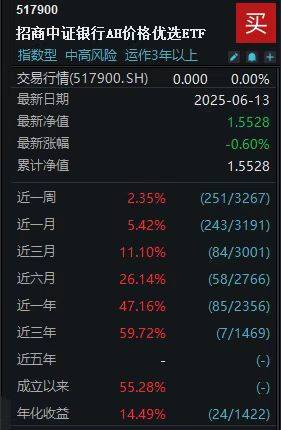
今日更名生效!历史年化超14%的银行AH优选ETF(517900)规模迭创历史新高
Sou Hu Cai Jing· 2025-06-16 01:35
Group 1 - The banking sector has shown strength recently, with stocks like China CITIC Bank and Chengdu Bank reaching historical highs. The AH Preferred ETF (517900) has seen continuous net inflows for seven weeks, totaling approximately 230 million since the beginning of the year, leading to a year-to-date growth of 238.69% in scale [1] - The banking sector's return on equity (ROE) remains above 10%, indicating a strong performance compared to other industries, despite a marginal decline in overall operating performance in Q1 due to macroeconomic conditions and market volatility [1] - The outlook for the banking sector remains positive, with expectations of a moderate recovery in credit issuance driven by policies aimed at expanding domestic demand, and a favorable environment for net interest margins due to reduced pressure on banks' funding costs [1] Group 2 - The name of the fund "Bank ETF Preferred" will change to "Bank AH Preferred ETF" starting June 16, 2025. The fund's index, "Bank AH," had a dividend yield of 6.51% as of the end of May, reflecting a strategy of selecting undervalued stocks in the AH market [2] - The fund has shown significant performance metrics, with a one-year increase of 47.16% and an annualized return of 14.49% since inception [3]
中金公司 5月金融数据解读
中金· 2025-06-15 16:03
Investment Rating - The report indicates a cautious investment outlook for the financial sector, highlighting a decrease in loan demand and potential liquidity pressures on banks [1][6]. Core Insights - The report emphasizes that the overall loan demand remains insufficient, particularly in medium to long-term corporate and retail loans, which are crucial indicators of real economic demand [1][2][8]. - Social financing growth is primarily driven by government bond issuance rather than credit growth, indicating a shift in leverage dynamics towards government projects that typically have longer return cycles [4][5]. - The phenomenon of financial disintermediation is noted, where funds are moving from traditional banking systems to other channels, increasing liquidity pressure on banks and weakening the transmission effect of monetary policy [7][12]. Summary by Sections Loan Demand and Credit Growth - In May, new loans increased by 620 billion, falling short of market expectations and reflecting a year-on-year decrease in both corporate and retail loans [2][3]. - The decline in short-term loans is attributed to reduced promotional efforts by banks, while medium to long-term loans show slight improvement due to lower mortgage rates [9][8]. Social Financing and Government Bonds - Social financing increased by over 220 billion year-on-year, with government bonds contributing more than 230 billion, indicating a reliance on government debt for financing rather than private sector credit [4][5]. - The structure of social financing is shifting towards government bonds, which typically fund projects that do not yield immediate returns, leading to a lag between financial data and real economic performance [4][5]. Banking Sector and Liquidity - Banks are experiencing significant liability pressure, relying on government-backed projects for stability, while credit demand in sectors like wholesale and manufacturing has not fully recovered [6][1]. - Future liquidity will be influenced by fiscal policies and the progress of large projects, necessitating close monitoring of financial disintermediation trends [6][7]. Financial Disintermediation - Financial disintermediation is occurring gradually, driven by the comparative pricing of financial products rather than strict regulatory constraints, leading to a slow outflow of deposits from banks [12][11]. - The trend is expected to continue, with asset management institutions increasingly focusing on bond allocations as traditional banking faces challenges in retaining deposits [14][15]. Market Indicators: M1 and M2 - M1 growth of 2.3% indicates a recovery, primarily due to increased corporate reserves, while M2 growth remains stable at 7.9% [10][11]. - The changes in M1 and M2 reflect underlying economic conditions, with capital market performance significantly influencing deposit trends in large banks [18][11].

转债周度专题:底仓转债持续缩圈后-20250615
Tianfeng Securities· 2025-06-15 08:42
1. Report Industry Investment Rating No information provided regarding the industry investment rating. 2. Core Viewpoints of the Report - Bank and other financial high - quality bottom - position convertible bonds are continuously shrinking, and medium - large bottom - position convertible bonds may benefit from the capital spill - over trend. It is recommended to select targets based on credit quality, remaining term, and clause games [1][11]. - The A - share market valuation has recovered but is still at a relatively low level in the long term, with a good risk - return ratio. Domestic economic fundamentals and capital flow may gradually resonate. For convertible bonds, be vigilant about valuation callback risks, focus on the game space of downward revisions and strong redemption risks, and pay attention to short - term game opportunities of near - maturity convertible bonds [14]. - Industries worthy of attention include popular themes, domestic demand - oriented sectors, central state - owned enterprises under the China - specific valuation system, and the military industry [15]. 3. Summaries Based on Relevant Catalogs 3.1. Convertible Bond Weekly Special and Outlook 3.1.1. After the Continuous Shrinking of Bottom - Position Convertible Bonds - This week, Nanyin Convertible Bond announced a strong redemption as expected. Since this year, 4 bank convertible bonds have announced early redemptions, and 1 has matured. As of June 13, the scale of bank convertible bonds has decreased to 1519.61 billion yuan, a decrease of about 39 billion yuan from the beginning of the year. There is still 5.7 billion yuan of Hangyin and Nanyin Convertible Bonds that will be converted or redeemed [1][9]. - In the future, 50 billion yuan of Pufa Convertible Bond will mature and delist. It is advisable to select convertible bonds based on credit quality, remaining term, and clause games, and pay attention to convertible bonds with a relatively large remaining scale and a remaining term of less than 2 years among those maturing in the non - downward - revision period in June [11]. 3.1.2. Weekly Review and Market Outlook - The market fluctuated this week, with an overall weekly decline. The A - share market valuation has recovered but is still at a relatively low level. The export order rebound drove a slight improvement in the May PMI. Domestic economic fundamentals and capital flow may gradually resonate [14]. - For convertible bonds, the issuance pressure is expected to be low. Be vigilant about valuation callback risks, focus on the game space of downward revisions and strong redemption risks, and pay attention to short - term game opportunities of near - maturity convertible bonds [14]. - Industries to focus on include popular themes, domestic demand - oriented sectors, central state - owned enterprises under the China - specific valuation system, and the military industry [15]. 3.2. Weekly Tracking of the Convertible Bond Market 3.2.1. The Equity Market Declined, and Cyclical Sectors such as Metals Strengthened - This week, major equity market indices declined. 13 Shenwan industry indices rose, and 18 declined. Industries such as non - ferrous metals, petroleum and petrochemicals, and agriculture, forestry, animal husbandry, and fishery led the gains, while food and beverage, household appliances, and building materials led the losses [18][20]. 3.2.2. The Convertible Bond Market Declined, and the Premium Rate per 100 - Yuan Par Value Slightly Decreased - This week, the convertible bond market declined. The average daily trading volume increased to 69.298 billion yuan, with a total weekly trading volume of 346.489 billion yuan [23]. - In terms of industries, 11 industries rose, and 18 declined. Agriculture, forestry, animal husbandry, and fishery, non - bank finance, and public utilities led the gains, while communication, media, and machinery and equipment led the losses [25]. - Most individual convertible bonds declined. The top five gainers were Jinling Convertible Bond, Jinji Convertible Bond, Haibo Convertible Bond, Liande Convertible Bond, and Zhite Convertible Bond; the top five losers were Zhengyu Convertible Bond, Huati Convertible Bond, Haomei Convertible Bond, Tianyang Convertible Bond, and Aofei Convertible Bond [26][28]. - The weighted conversion value of the whole market decreased, and the premium rate increased. The premium rate per 100 - yuan par value decreased slightly and is above the 50% quantile since 2017 [35]. 3.2.3. High - Frequency Tracking of Different Types of Convertible Bonds 3.2.3.1. Classification Valuation Changes - This week, the valuation of equity - biased convertible bonds and balanced convertible bonds declined significantly. The valuation of convertible bonds with a par value of 80 - 90 yuan and 110 - 120 yuan increased, while most other par - value convertible bonds' valuations decreased. The valuation of convertible bonds rated A+ and below decreased, while other ratings increased. The valuation of small - cap convertible bonds decreased, while other scale - graded convertible bonds increased [44]. - Since the beginning of 2024, the conversion premium rates of equity - biased and balanced convertible bonds have rebounded from the bottom [44]. 3.2.3.2. Market Index Performance - This week, convertible bonds rated AA+ and above and A and below rose, while others declined. Since 2023, high - rated AAA convertible bonds have performed steadily, and low - rated convertible bonds have shown weaker downside resistance and greater rebound strength [54]. - This week, large - cap convertible bonds rose, while other scale convertible bonds declined. Since 2023, small - cap convertible bonds have recorded a 13.98% return, medium - small - cap convertible bonds 14.10%, medium - cap convertible bonds 9.60%, and large - cap convertible bonds 10.31% [54]. 3.3. Tracking of Convertible Bond Supply and Terms 3.3.1. This Week's Primary - Market Issuance Plans - This week, there were no newly listed convertible bonds. Two convertible bonds (Dianhua Convertible Bond and Anke Convertible Bond) announced plans to be issued, and one (Hengshuai Convertible Bond) has been issued but not yet listed. Six convertible bonds passed the first - level approval [4][59]. - Since the beginning of 2023 to June 13, 2025, there have been 90 convertible bonds in the pipeline, with a total scale of 145.842 billion yuan [60]. 3.3.2. Downward Revision and Redemption Clauses - As of June 14, 2025, 20 convertible bonds announced that they were expected to trigger downward revisions, 7 announced no downward revisions, 1 proposed a downward revision, and 1 announced the result of a downward revision [64]. - Seven convertible bonds announced that they were expected to trigger redemptions, 3 announced no early redemptions, and 2 announced early redemptions [67][68]. - As of the end of this week, 3 convertible bonds were still in the put - option declaration period, and 33 were in the company's capital - reduction settlement declaration period [70].
2025年5月金融数据点评:信贷预期内少增,期待M1持续正增
Shenwan Hongyuan Securities· 2025-06-15 04:57
Investment Rating - The report maintains an "Overweight" rating for the banking sector, indicating a positive outlook for the industry compared to the overall market performance [2]. Core Insights - The report highlights that credit growth remains subdued, with May's new loans totaling 620 billion, a year-on-year decrease of 330 billion. However, the total credit volume from January to May is stable at 10.7 trillion, compared to 11.1 trillion in the same period last year [2][3]. - The report anticipates that the overall credit increment for 2025 will remain stable, projecting a credit growth rate of approximately 7.1% for the year [2]. - The report notes that the demand for retail credit has not shown signs of improvement since the second quarter, with May's household credit increasing by only 54 billion, a year-on-year decrease of 21.7 billion [2]. - Government bond issuance has exceeded 1 trillion, supporting stable social financing growth, while corporate bonds have also seen an increase due to a low-interest-rate environment [2][3]. - The report emphasizes the importance of focusing on regional banks with stable profit growth expectations and suggests specific banks such as Chongqing Bank, Suzhou Bank, and Chengdu Bank for investment [2]. Summary by Sections Credit Growth Analysis - In May, new credit was 620 billion, down 330 billion year-on-year, with total credit from January to May at 10.7 trillion [2]. - The report attributes the subdued credit growth to weak demand, debt replacement, and structural optimization [2]. Corporate Lending Trends - Corporate short-term loans increased by 110 billion, while medium to long-term loans decreased by 170 billion, primarily due to debt replacement affecting infrastructure investment [2]. - The report indicates that the government bond issuance has been robust, contributing to the overall social financing growth [2]. Retail Lending Insights - Retail credit demand remains weak, with May's household credit showing a net increase of only 54 billion, reflecting a cautious attitude from banks towards consumer loans [2]. - The report notes a decline in short-term household loans, indicating a challenging environment for retail lending [2]. Investment Recommendations - The report recommends focusing on banks with stable growth prospects and suggests specific banks for investment, including Agricultural Bank of China and other regional banks [2].



成都银行: 成都银行股份有限公司公开发行A股可转换公司债券2024年度受托管理事务报告
Zheng Quan Zhi Xing· 2025-06-13 09:54
Group 1 - The core point of the article is the issuance of convertible bonds by Chengdu Bank, with a total issuance scale of 8 billion yuan and a six-year term [2][3][4] - The initial coupon rates for the convertible bonds are set to increase over the years, starting from 0.20% in the first year to 2.00% in the sixth year [2][3] - The bonds are rated AAA, indicating a strong credit quality [3][15] Group 2 - As of the end of 2024, Chengdu Bank's total assets reached approximately 1.25 trillion yuan, reflecting a year-on-year increase of 14.56% [5][6] - The bank's net profit for 2024 was reported at 12.85 billion yuan, a 10.10% increase from the previous year [4][5] - The bank's loan issuance increased by 18.67% year-on-year, totaling approximately 742.57 billion yuan [5][6] Group 3 - The bank's operating income for 2024 was approximately 22.98 billion yuan, up 5.89% from 2023 [5][6] - The bank's cash flow from operating activities showed a significant decline, with a net outflow of approximately 94.23 billion yuan in 2024, compared to a net outflow of 23.75 billion yuan in 2023 [6][7] - The bank has established a special account for the management of raised funds, which has been closed as of December 31, 2022 [7][8] Group 4 - Chengdu Bank's debt repayment capacity remains stable, with no significant adverse changes reported during the tracking period [8][9] - The bank has implemented measures to ensure debt repayment, including the establishment of a bondholders' meeting rule and strict adherence to information disclosure obligations [8][9] - The bank's conditional redemption clause allows for the redemption of bonds if the stock price meets certain criteria [9][10] Group 5 - The bank's stock price adjustment led to a decrease in the conversion price of the convertible bonds from 13.13 yuan to 12.23 yuan [15] - The bank's long-term credit rating remains stable at AAA, with no changes reported in the latest assessment [15][16] - The bank's board of directors approved a cash dividend distribution plan, proposing a distribution of 0.8968 yuan per share [14][15]
成都银行: 成都银行股份有限公司2024年年度股东大会会议材料
Zheng Quan Zhi Xing· 2025-06-13 09:19
Core Viewpoint - Chengdu Bank aims to enhance its operational resilience and achieve high-quality development by focusing on strategic reforms and financial services that cater to the needs of the local economy and society [5][11][12]. Group 1: Meeting Agenda and Procedures - The annual shareholders' meeting is scheduled for June 25, 2025, at 9:30 AM, combining on-site and online voting methods [3][4]. - The meeting will cover various proposals, including the board and supervisory reports, financial statements, profit distribution plans, and the appointment of the accounting firm for 2025 [1][2]. Group 2: 2024 Annual Board Report Highlights - Chengdu Bank reported total assets of CNY 1,250.1 billion, with a year-on-year growth of 14.6%, and total deposits of CNY 885.9 billion, increasing by 13.5% [5][23]. - The bank's loan issuance reached CNY 742.6 billion, marking an 18.7% increase, and the net profit attributable to the parent company was CNY 12.9 billion, up 10.3% from the previous year [5][23][26]. - The non-performing loan ratio improved to 0.66%, down from 0.68% the previous year, indicating a solid asset quality [5][23][27]. Group 3: Strategic Initiatives and Financial Services - The bank has implemented five major financial actions to enhance service delivery, including technology-driven financial services and green finance initiatives, with green loans reaching nearly CNY 50 billion [6][11]. - Chengdu Bank has supported over 40,000 small and micro enterprises with loans exceeding CNY 120 billion, reflecting its commitment to inclusive finance [6][11]. - The bank's digital transformation efforts focus on improving data application and system construction to enhance operational efficiency [6][11]. Group 4: Corporate Governance and Compliance - The board has emphasized the integration of party leadership with corporate governance, ensuring compliance with regulatory requirements and enhancing decision-making processes [5][13]. - The supervisory board conducted evaluations of the board and management's performance, confirming adherence to legal and regulatory standards [13][19]. Group 5: Financial Performance and Capital Management - The bank's capital adequacy ratio improved to 13.88%, reflecting a robust capital position to support future growth [23][24]. - The bank plans to distribute CNY 3.776 billion in cash dividends, representing 30.04% of the net profit attributable to ordinary shareholders [29].
成都银行(601838) - 成都银行股份有限公司公开发行A股可转换公司债券2024年度受托管理事务报告
2025-06-13 09:02
证券代码:601838 证券简称:成都银行 可转债代码:113055 可转债简称:成银转债 成都银行股份有限公司 公开发行 A 股可转换公司债券 2024 年度受托管理事务报告 成都银行股份有限公司 (住所:四川省成都市青羊区西御街 16 号) 债券受托管理人 (住所:北京市朝阳区安立路66号4号楼) 二〇二五年六月 重要声明 本报告依据《公司债券发行与交易管理办法》(以下简称《管理办法》)、 《公司债券受托管理人执业行为准则》(以下简称《执业行为准则》)、《公司 信用类债券信息披露管理办法》、《关于深化债券注册制改革的指导意见》、《关 于注册制下提高中介机构债券业务执业质量的指导意见》、证券交易所公司债券 上市规则(以下简称"上市规则")、发行人与中信建投证券股份有限公司(以 下简称"中信建投证券"或"受托管理人")签订的债券受托管理协议(以下简 称"受托管理协议")及其它相关信息披露文件以及成都银行股份有限公司(以 下简称"发行人"、"公司"或"成都银行")出具的相关说明文件和提供的相 关资料等,由受托管理人中信建投证券编制。中信建投证券编制本报告所引用的 财务数据,引自经毕马威华振会计师事务所(特殊普通 ...