洋河股份

Search documents
告别传统渠道?五粮液低度酒营销“出狠招”!
Nan Fang Du Shi Bao· 2025-10-27 02:20
Core Insights - The article discusses a marketing revolution in the competitive Chinese liquor market, led by major players like Wuliangye, focusing on innovative sales strategies to attract younger consumers [1][8]. Group 1: Marketing Innovation - Wuliangye has launched a "fission" sales system for its product "29-degree Wuliangye · First Love," allowing consumers to become "recommendation officers" and earn cash rewards for referrals [1][3]. - This fission model is seen as a breakthrough in the brand's efforts to appeal to younger demographics, transforming traditional advertising budgets into user incentives and fostering emotional connections through social sharing [1][5]. - The brand's marketing strategy has shifted towards social-driven approaches, with celebrity endorsements and a focus on engaging younger audiences through platforms they frequent [3][10]. Group 2: Market Trends - The low-alcohol liquor segment is rapidly growing, with projections indicating the market will exceed 74 billion yuan by 2025, reflecting a compound annual growth rate of 25%, significantly outpacing the overall liquor industry [5][6]. - Many liquor companies are investing in low-alcohol products, with 21.1% of firms planning to enhance their offerings in this category as part of their 2025 strategies [5]. - The trend towards low-alcohol beverages aligns with younger consumers' preferences for lighter drinking experiences and more flexible consumption scenarios [6][8]. Group 3: Industry Challenges - The liquor industry is facing significant challenges, including high inventory pressure and price imbalances, with average inventory turnover days reaching 900, a 10% increase year-on-year [8][10]. - Traditional distribution models reliant on intermediaries are becoming less effective, prompting a shift towards user-centric marketing and direct consumer engagement [8][10]. - Companies are exploring diverse marketing innovations to establish deeper emotional connections with consumers, particularly the younger generation [8][10].

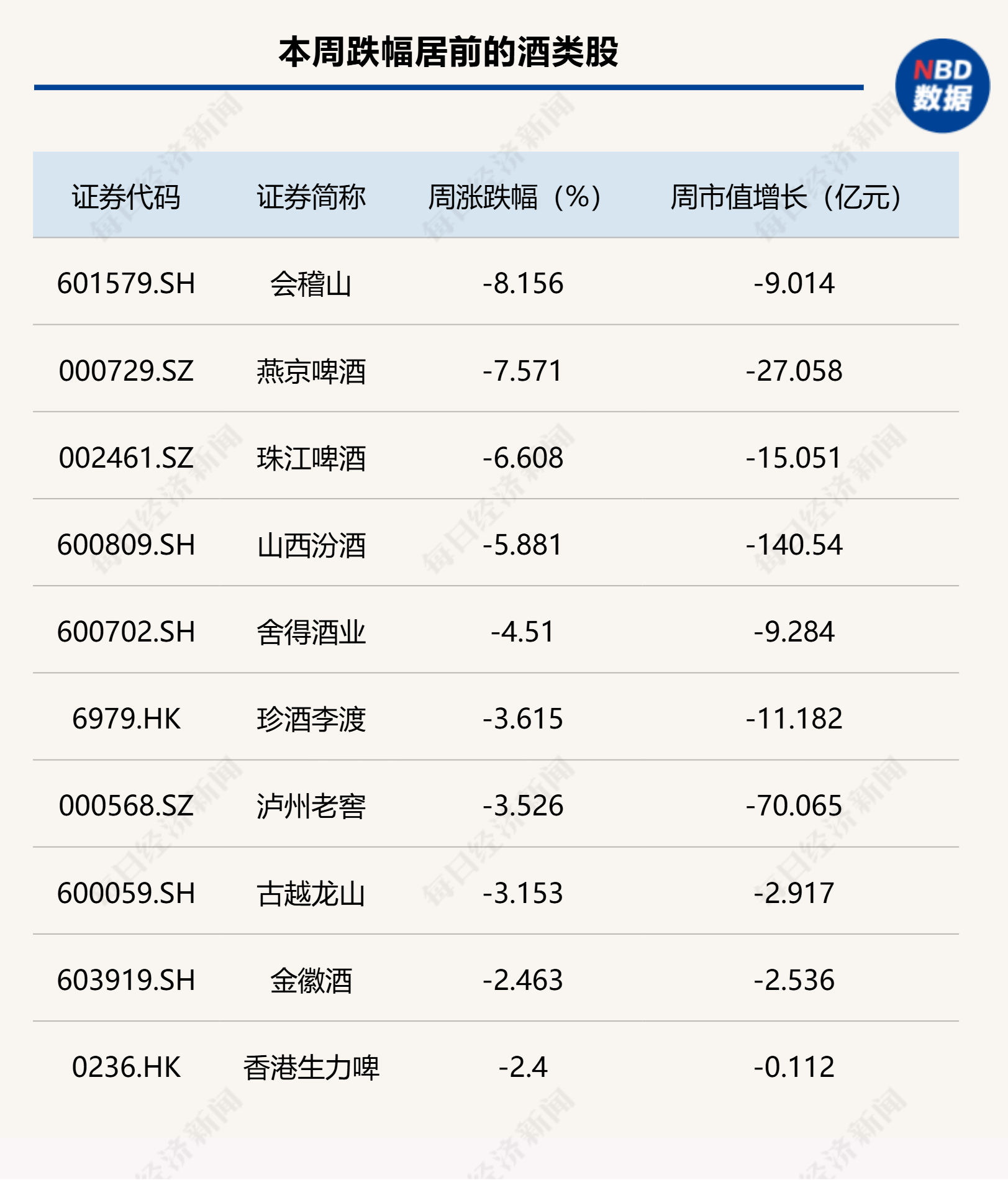
白酒指数周跌1.23%!啤酒三季报不及预期,燕京、珠江双双大跌超5%丨酒市周报
Mei Ri Jing Ji Xin Wen· 2025-10-26 10:40
Group 1 - The core viewpoint of the articles indicates that the liquor industry is currently in a state of "low expectations, weak reality," with significant declines in stock performance, particularly in the white liquor sector [1][4] - The Wind white liquor index fell by 1.23% this week, closing at 59,343.67 points, with Shanxi Fenjiu experiencing the largest drop of 5.88% [1][4] - The upcoming third-quarter reports for the liquor industry are expected to validate the current market conditions, with concerns about potential further declines in performance [4] Group 2 - The beer sector is also facing challenges, with regional beer companies reporting lower-than-expected earnings, despite maintaining stable growth overall [4][5] - Zhujiang Beer reported a 17.05% year-on-year increase in net profit for the first three quarters, but its third-quarter revenue saw a decline of 1.34%, marking the first such drop since 2018 [4][5] - Yanjing Beer achieved a revenue of 4.875 billion yuan in the third quarter, a year-on-year growth of approximately 1.55%, but faced pressure in market expansion due to weak consumer demand [5]


食品饮料行业周报:短期关注三季报业绩,长期关注提振内需政策-20251026
KAIYUAN SECURITIES· 2025-10-26 08:43
Investment Rating - The investment rating for the food and beverage industry is "Positive" (maintained) [1] Core Insights - The quarterly performance continues to show differentiation, with a recommendation to strengthen positions during the bottom cycle. The food and beverage index declined by 0.9% from October 20 to October 24, ranking 27th among primary sub-industries, underperforming the CSI 300 by approximately 4.2 percentage points. Sub-industries such as processed foods (+1.0%), meat products (+0.6%), and other alcoholic beverages (+0.5%) performed relatively well. The traditional consumption sector continues to face significant performance pressure, particularly in the liquor segment, where business demand remains under pressure. Although there has been a slight improvement in terminal consumption demand, the overall market demand remains weak. It is anticipated that the liquor sector will experience a further slowdown in performance growth for the third quarter [3][12][14]. Summary by Sections Market Performance - The food and beverage index experienced a decline of 0.9%, ranking 27th out of 28 sectors, and underperformed the CSI 300 by about 4.2 percentage points. Leading sub-industries included processed foods (+1.0%), meat products (+0.6%), and other alcoholic beverages (+0.5) [12][14]. Upstream Data - Some upstream raw material prices have decreased. For instance, the price of fresh milk was 3.0 yuan per kilogram, down 2.9% year-on-year. The price of pork was 17.7 yuan per kilogram, down 28.4% year-on-year [21][26]. Policy Insights - The 20th Central Committee's Fourth Plenary Session emphasized expanding domestic demand and building a strong domestic market, which is expected to inject clear policy dividends into the food and beverage industry. The core driver for long-term industry growth is the boost in domestic demand, which will directly stimulate market consumption and upgrade potential [4][13]. Recommended Stocks - The report recommends focusing on two types of stocks: first, leading companies with low valuations and national layout capabilities; second, growth companies that align with new consumption trends. Specific recommendations include Guizhou Moutai, Shanxi Fenjiu, Ximai Foods, Weilong, and Bairun [5][56].


能源专家掌舵茅台:陈华接任党委书记,跨界领导能否破解白酒行业困局
Sou Hu Cai Jing· 2025-10-26 07:34
Core Viewpoint - The appointment of Chen Hua, the former director of the Guizhou Provincial Energy Bureau, as the new party secretary of Kweichow Moutai has raised significant interest in the liquor industry, indicating a strategic shift by the Guizhou State-owned Assets Supervision and Administration Commission to enhance governance and operational efficiency in the company [1][4][9]. Group 1: Background and Experience - Chen Hua has a strong background in the coal mining sector, having worked for over 20 years and held various positions, including chairman of the Panjiang Coal and Electricity Group, where he implemented successful state-owned enterprise reforms [4][6]. - His tenure at the Guizhou Provincial Energy Bureau saw a significant increase in the province's clean energy share to 42%, showcasing his capability in energy management and structural adjustments [4][6]. Group 2: Strategic Implications of the Appointment - The appointment reflects a departure from traditional leadership profiles in Moutai, as previous leaders focused on marketing, politics, and finance, while Chen brings expertise in energy management, indicating a push for innovation and efficiency [4][9]. - The strategic location of Moutai in Renhuai City, a key node for the "West-to-East Power Transmission" project, suggests potential synergies between the energy and liquor industries that could be leveraged under Chen's leadership [4][6]. Group 3: Challenges Ahead - Chen faces significant challenges, including the need for a channel revolution following the dissolution of Moutai's e-commerce company, which revealed underlying distribution issues [6][7]. - International expansion is another critical area, as Moutai's overseas revenue has historically been below 5%. Chen's experience with cross-border energy projects may facilitate Moutai's entry into international markets [7]. - The need for a younger consumer base is pressing, as interest in traditional liquor declines among Generation Z. Chen's experience in digital transformation within the energy sector could be pivotal in modernizing Moutai's approach [7][8]. Group 4: Historical Context and Future Outlook - The liquor industry has seen successful cross-industry leaders in the past, but there are risks associated with blending technical management with traditional liquor culture, as evidenced by previous failures [8]. - Chen's background in heavy asset management aligns well with Moutai's production processes, but the challenge will be to harmonize the rigid standards of coal management with the artistry of liquor production [8][9]. - This appointment signifies a potential redefinition of Moutai's development philosophy, with implications for state-owned enterprise governance and the broader economic transformation in Guizhou [9].
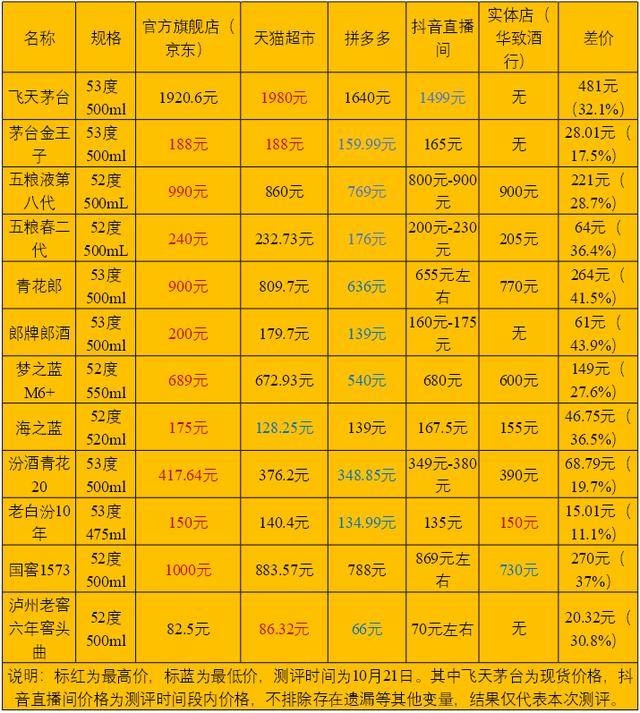
海报实验室丨同种白酒不同渠道价格悬殊?实测12种常见白酒:最多相差40%
Sou Hu Cai Jing· 2025-10-25 10:27
Core Viewpoint - The price of various brands of baijiu has been declining significantly this year, with some prices dropping by as much as 30% or nearly halved, leading to increased consumer attention and discussion about baijiu pricing [1][3] Price Discrepancies Across Channels - A recent survey conducted by the Haibao Laboratory revealed substantial price differences for the same type of baijiu across different purchasing channels, with official flagship stores generally having the highest prices and platforms like Pinduoduo offering the lowest prices, sometimes differing by over 40% [1][10][11] - For example, the price of 500ml Feitian Moutai varied from 1499 yuan (requiring reservation) to 1980 yuan (immediate purchase) on Tmall, while Pinduoduo offered it for 1640 yuan, showcasing a price difference of 32.1% [6][7][9] Specific Brand Price Comparisons - The survey included six well-known brands: Moutai, Wuliangye, Langjiu, Yanghe, Fenjiu, and Luzhou Laojiao, with findings indicating that the official flagship store prices were consistently higher than those on discount platforms [10][11] - For instance, the price of Wuliangye's 500ml product varied from 990 yuan on its official store to 769 yuan on Pinduoduo, reflecting a maximum difference of 28.7% [12] - Langjiu's 500ml Qinghua Lang had a price range from 900 yuan to 636 yuan across different platforms, resulting in a price difference of 41.5% [14] Reasons for Price Differences - Industry insiders suggest that the official prices set by liquor companies serve as a retail benchmark and are typically about 20% higher than prices found in other channels [18] - The rise of e-commerce has led to increased competition, with platforms often using baijiu as a loss leader to attract customers, resulting in lower prices compared to traditional retail [18][20] - Concerns about counterfeit products have also been raised, as some online sellers may mix genuine and fake products, particularly when prices are significantly lower than offline [20]

白酒双十一迎来“冷静期”?线上大促线下观望
Nan Fang Du Shi Bao· 2025-10-24 13:18
Core Insights - The annual Double Eleven shopping festival has begun, but the liquor industry is experiencing a "cooling period" with mixed price movements across online and offline channels [2][12] - High-end liquor prices have remained stable despite promotional activities, while some mid-to-high-end products are seeing slight price declines [2][12] Price Trends - In the Greater Bay Area, online platforms are using subsidies to lower high-end liquor prices, while offline channels are mostly observing the market [2][12] - In Guangzhou, over half of the sampled products saw price increases, with high-end products like Wuliangye and Guojiao 1573 experiencing minor price hikes [3][4] - Conversely, some products, including Moutai, saw price reductions due to adjustments by instant retail platforms [4][6] Regional Variations - In Shenzhen, liquor prices showed stability, with some products like Moutai and Guojiao 1573 experiencing slight declines, while others like Wuliangye saw price increases [5][6] - In Foshan, liquor prices remained stable, with Moutai showing a slight increase, while other products experienced minor fluctuations [8][9] - Dongguan reported significant price drops for Moutai, with online channels driving the decline, while mid-range products displayed mixed price movements [10][11] Market Dynamics - The Double Eleven promotions have intensified price competition among high-end liquors, with leading brands like Moutai facing downward pressure on prices [12] - The cautious attitude of distributors towards seasonal sales is reflected in the limited follow-up promotions in offline channels [12] - Despite overall pressure, some brands like Fenjiu and Xijiu have shown resilience with slight price increases, indicating consumer demand for specific products [12]


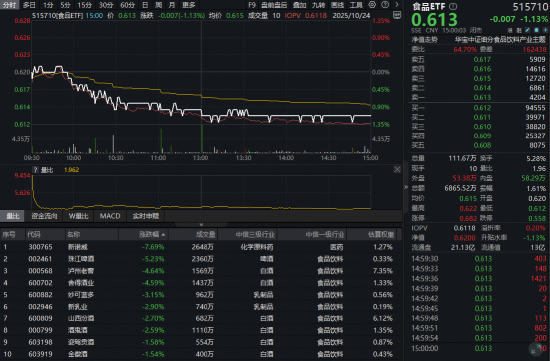
吃喝板块逆市下挫,白酒股集体“醉倒”!食品ETF(515710)跌超1%,机构高呼看好四季度行情!
Xin Lang Ji Jin· 2025-10-24 11:43
Group 1 - The food and beverage sector experienced a decline on October 24, with the Food ETF (515710) closing down 1.13% after fluctuating near the surface at the opening [1] - Key stocks in the sector, particularly in the liquor category, saw significant drops, with Zhujiang Beer down 5.23%, and both Luzhou Laojiao and Shede Distillery falling over 4% [1] - The overall performance of the sector was negatively impacted by declines in several stocks, including Miaokelando and New Dairy, which dropped over 3% and 2% respectively [1] Group 2 - Guosen Securities noted that as the impact of second-quarter consumption policies weakens, the restaurant supply chain is gradually recovering, with positive signals from the supply side, such as frequent mergers among leading companies [2] - The food and beverage sector is currently at a low valuation, with the food ETF's price-to-earnings ratio at 20.49, which is at the 7.06% percentile of the past decade, indicating a favorable configuration opportunity [2] - Historical trends suggest that any changes in supply and demand could catalyze stock price increases, especially in the fourth quarter when macro policies are expected to be active [2] Group 3 - Future outlook indicates that the food and beverage industry will focus on growth, with beverage leaders maintaining structural prosperity driven by major products, while companies in food raw materials and health products are expected to see accelerated performance [3] - The white liquor industry is currently in a "low expectation, weak reality" state, with the third-quarter reports being a crucial observation window as external factors diminish and liquor companies adjust strategies [3] - There is a mixed performance in consumer goods, with snacks, beverages, and health products showing good demand, while traditional products like dairy and beer are experiencing flat demand [3] Group 4 - Major liquor brands such as Luzhou Laojiao and Yanghe have launched new products recently, indicating ongoing innovation in the sector [4] - Luzhou Laojiao's new product was launched on Douyin, while Yanghe's new offering was showcased during the Nanjing Autumn Sugar event [4] Group 5 - The Food ETF (515710) focuses on core assets in the food and beverage sector, with approximately 60% of its portfolio allocated to high-end and mid-range liquor leaders, and nearly 40% to leading stocks in beverages, dairy, and condiments [5] - The top ten weighted stocks in the ETF include well-known brands such as Moutai, Wuliangye, and Yili [5] - Investors can also access the core assets of the food and beverage sector through the Food ETF linked funds [5]


10月24日深证国企股东回报R(470064)指数跌0.29%,成份股深物业A(000011)领跌




Sou Hu Cai Jing· 2025-10-24 11:00
Core Points - The Shenzhen State-Owned Enterprises Shareholder Return Index (470064) closed at 2305.1 points, down 0.29%, with a trading volume of 34.285 billion yuan and a turnover rate of 1.32% [1] - Among the index constituents, 20 stocks rose while 28 stocks fell, with China National Materials Technology leading the gainers at 5.67% and Shenzhen Properties A leading the decliners at 8.41% [1] Index Constituents Summary - The top ten constituents of the Shenzhen State-Owned Enterprises Shareholder Return Index include: - BOE Technology Group (sz000725) with a weight of 9.64%, latest price at 4.05, and total market value of 151.26 billion yuan [1] - Wuliangye Yibin (sz000858) with a weight of 7.95%, latest price at 120.29, and total market value of 466.92 billion yuan [1] - Hikvision (sz002415) with a weight of 7.72%, latest price at 33.29, and total market value of 305.10 billion yuan [1] - Luzhou Laojiao (sz000568) with a weight of 6.53%, latest price at 130.24, and total market value of 191.71 billion yuan [1] - XCMG Machinery (sz000425) with a weight of 6.28%, latest price at 11.37, and total market value of 133.63 billion yuan [1] - Changan Automobile (sz000625) with a weight of 3.87%, latest price at 12.72, and total market value of 126.11 billion yuan [1] - Shenwan Hongyuan (sz000166) with a weight of 3.78%, latest price at 5.46, and total market value of 136.72 billion yuan [1] - Yunnan Aluminum (sz000807) with a weight of 3.45%, latest price at 23.18, and total market value of 80.39 billion yuan [1] - Yanghe Brewery (sz002304) with a weight of 3.27%, latest price at 69.22, and total market value of 104.28 billion yuan [1] - Changchun High & New Technology (sz000661) with a weight of 3.17%, latest price at 117.84, and total market value of 48.07 billion yuan [1] Capital Flow Summary - The net outflow of main funds from the index constituents totaled 0.881 billion yuan, while speculative funds saw a net inflow of 0.65 billion yuan and retail funds a net inflow of 0.231 billion yuan [3] - Notable capital flows include: - Changan Automobile (000625) with a net inflow of 204 million yuan from main funds [3] - Yunnan Copper (000878) with a net inflow of 71.86 million yuan from main funds [3] - Hubei Energy (000883) with a significant net inflow of 44.39 million yuan from main funds [3]
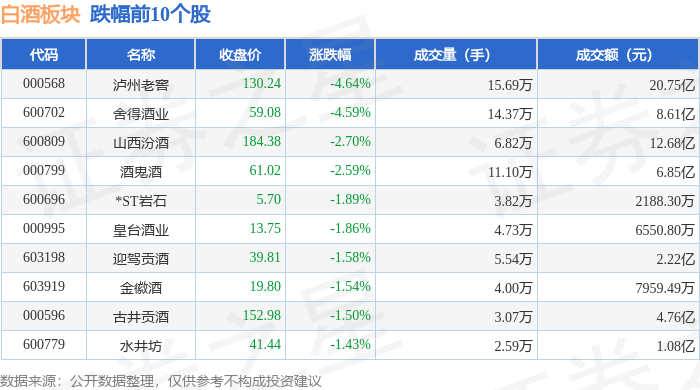
白酒板块10月24日跌1.53%,泸州老窖领跌,主力资金净流出15.36亿元
Zheng Xing Xing Ye Ri Bao· 2025-10-24 08:29
Core Insights - The liquor sector experienced a decline of 1.53% on October 24, with Luzhou Laojiao leading the drop [1] - The Shanghai Composite Index closed at 3950.31, up 0.71%, while the Shenzhen Component Index closed at 13289.18, up 2.02% [1] Liquor Sector Performance - Luzhou Laojiao's closing price was 130.24, down 4.64%, with a trading volume of 156,900 shares and a transaction value of 2.075 billion [1] - Other notable declines included Shede Liquor down 4.59%, Shanxi Fenjiu down 2.70%, and Jiu Gui Jiu down 2.59% [1] - The sector saw a net outflow of 1.536 billion from main funds, while retail investors contributed a net inflow of 794 million [1] Fund Flow Analysis - Guizhou Moutai experienced a main fund net outflow of 4.17 billion, with a retail net inflow of 7.28 million [2] - Luzhou Laojiao had a main fund net outflow of 2.57 billion, with retail inflows of 178 million [2] - Other companies like Wuliangye and Shanxi Fenjiu also faced significant main fund outflows of 2.06 billion and 1.92 billion respectively [2]
酒企、经销商无效沟通,“厂商一体化”该如何正确表达?
Xin Lang Cai Jing· 2025-10-24 02:31
Core Viewpoint - The current communication gap between liquor manufacturers and distributors is a significant challenge, as manufacturers focus on brand history and policy support while distributors seek practical solutions for inventory and profitability [1][4]. Group 1: Communication Breakdown - Manufacturers emphasize the need to strengthen communication with distributors, but many still engage in one-way communication that fails to address distributors' real pain points [1][4]. - Distributors express frustration over high inventory levels and declining profits, with average gross margins dropping from 20%-23% in 2019 to 15%-17% in 2024, and net profits decreasing from 8% to 3%-5% [4][9]. - The communication methods of liquor companies show a stark divide, with some companies effectively addressing issues while others continue to impose sales targets without understanding distributor challenges [4][9]. Group 2: Misaligned Development Rhythm - The traditional operational logic of liquor companies, which relies on pushing inventory through sales tasks and rebates, is becoming less effective in a saturated market [8][9]. - Distributors are shifting their survival strategies from traditional distribution to direct consumer engagement through platforms like Meituan and Douyin, indicating a significant change in market dynamics [9][12]. - Liquor companies are also adapting by exploring new channels and engaging in direct sales to consumers, showing a proactive approach to market changes [12][13]. Group 3: Relationship Reconstruction - Liquor companies are increasingly emphasizing "manufacturer-distributor integration" to transform distributors into profit-sharing partners, with initiatives like equity partnerships and profit guarantees being introduced [13][15]. - Some companies are establishing advisory committees to involve distributors in policy-making, aiming to create a more collaborative environment [15][18]. - The ongoing transformation of distributor roles from mere sales channels to partners in consumer service is seen as a positive trend, although achieving a truly integrated relationship will take time [15][18].