京东

Search documents
中泰国际:特朗普公布25%新的对等关税率调整报告
ZHONGTAI INTERNATIONAL SECURITIES· 2025-07-09 01:47
Market Overview - The Hang Seng Index rose by 260 points or 1.1%, closing at 24,148 points, driven by a rebound in technology stocks[1] - The Hang Seng Tech Index increased by 1.8%, closing at 5,325 points, with a total market turnover exceeding HKD 213.3 billion[1] - Net inflow into Hong Kong Stock Connect was HKD 386 million, indicating positive sentiment in the market[1] Sector Performance - Cathay Financial International (1788 HK) surged by 28.5%, becoming the most actively traded stock with a turnover of HKD 12.8 billion[1] - Other notable performers included Kuaishou (1024 HK), which rose by 5.2%, reaching a three-month high[1] - The gaming, cultural tourism, brokerage, and consumer electronics sectors showed strong performance, with major tech stocks like Alibaba (9988 HK) and Meituan (3690 HK) rising by 1.5% and 3.6% respectively[1] Economic Indicators - The new housing transaction volume in 30 major cities reached 1.89 million square meters, a year-on-year decline of 1.1%, showing improvement compared to the previous week's 23.1% drop[5] - The inventory-to-sales ratio for major cities was 63.1, higher than last year's 59.7 but lower than the previous week's 68.2[7] - Land transaction volume in 100 major cities increased by 15.3% year-on-year, totaling 2.063 million square meters[8] Policy and Market Outlook - The market is expected to maintain high-level fluctuations, with a focus on technology stocks for further upward movement[2] - Long-term capital is improving, suggesting no need for significant reduction in positions[2] - The government is expected to implement supportive policies to stabilize the real estate market, which may benefit both state-owned and local enterprises[11]
特朗普,关税突发!英伟达新高!
Zhong Guo Ji Jin Bao· 2025-07-09 00:55
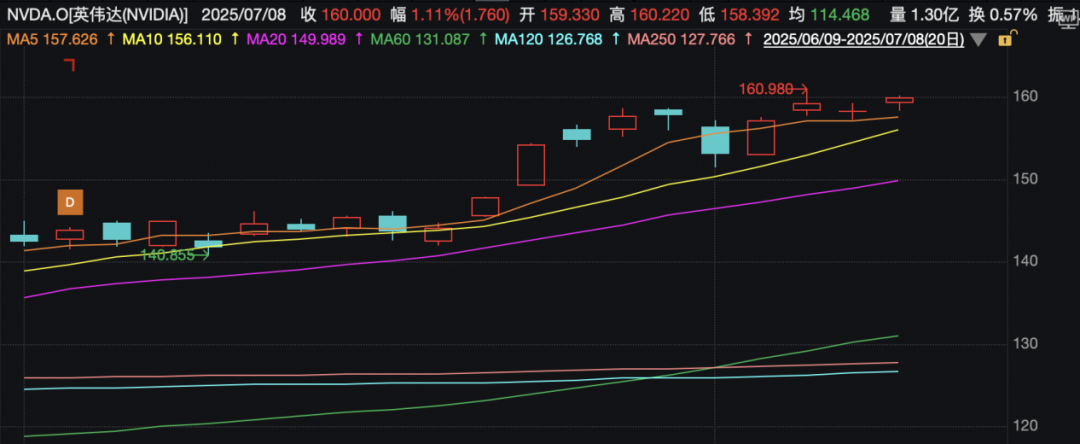
Market Overview - The three major U.S. stock indices closed mixed, with the Dow Jones down 0.37% at 44,240.76 points, the S&P 500 down 0.07% at 6,225.52 points, and the Nasdaq up 0.03% at 20,418.46 points [2] - European markets saw collective gains, with the Euro Stoxx 50 up 0.67%, Germany's DAX 30 up 0.76%, the UK's FTSE 100 up 0.56%, and France's CAC 40 up 0.56% [2] Nvidia Performance - Nvidia's stock rose 1.11% to $160 per share, reaching a historic high, with a total market capitalization exceeding $3.9 trillion [4] Semiconductor Sector - The Philadelphia Semiconductor Index increased by 1.8%, with Intel up 7.23%, GlobalFoundries up 6.96%, ON Semiconductor up 5.5%, and Micron Technology up 3.75% [9] Chinese Stocks - The Nasdaq Golden Dragon China Index rose by 0.71%, with notable gains in Chinese stocks such as Futu Holdings up 6.01%, JD.com up 2.12%, New Oriental up 2.07%, Alibaba up 1.62%, Tencent Music up 1.25%, and Baidu up 0.55% [10][11][12] Copper Market Reaction - President Trump announced a potential 50% tariff on imported copper, leading to a significant increase in copper prices, with COMEX copper rising 9.63% to reach its highest monthly gain [14][16] - Copper-related stocks also surged, with Freeport-McMoRan up 2.53% and Taseko Mines up 4.26% [18] Gold and Oil Prices - Spot gold was reported at $3,301.63 per ounce, having previously dipped below $3,300, with a trading range of $3,345.86 to $3,287.30 [18] - WTI crude oil for August delivery rose by $0.40, a nearly 0.59% increase, closing at $68.33 per barrel, while Brent crude for September delivery rose by $0.57, approximately 0.82%, closing at $70.15 per barrel [18]


特朗普,关税突发!英伟达新高!
中国基金报· 2025-07-09 00:47
Market Overview - The three major U.S. stock indices closed mixed, with the Dow Jones down 0.37% at 44240.76 points, the S&P 500 down 0.07% at 6225.52 points, and the Nasdaq up 0.03% at 20418.46 points [2][3] - European stock markets collectively rose, with the Euro Stoxx 50 index up 0.67%, the DAX 30 up 0.76%, the FTSE 100 up 0.56%, and the CAC 40 up 0.56% [2] Nvidia Performance - Nvidia's stock price increased by 1.11% to $160 per share, reaching a historical high, with a total market capitalization exceeding $3.9 trillion [6] Copper Tariff Announcement - President Trump announced a potential 50% tariff on imported copper, leading to a significant increase in copper prices, with COMEX copper rising by 9.63% [12][15] - Related copper stocks also saw gains, with Freeport-McMoRan Copper & Gold up 2.53% and Taseko Mines up 4.26% [16] Other Tech Stocks - Microsoft fell by 0.22%, Apple rose by 0.03%, Amazon dropped by 1.84%, Google decreased by 1.35%, Meta Platforms increased by 0.32%, and Tesla rose by 1.32% [8] Meta Platforms Investment - Meta Platforms reportedly acquired approximately 3% of EssilorLuxottica SA for about $3.5 billion, indicating a strategic investment in the growing smart glasses market [9] Tesla Developments - Cathie Wood, founder of Ark Invest, continues to support Tesla, noting CEO Elon Musk's decision to take direct control of U.S. and European sales as a pivotal moment for the company [9][10]

英伟达,再创新高!
第一财经· 2025-07-08 23:44
Market Overview - The US stock market experienced slight fluctuations with major indices showing mixed results, as investors remain cautious due to trade policy uncertainties under President Trump's latest tariff threats [1][2] - The Dow Jones Industrial Average fell by 165.6 points, a decrease of 0.37%, closing at 44,240.76 points; the S&P 500 index dipped by 4.46 points, down 0.07%, ending at 6,225.52 points; while the Nasdaq Composite Index rose by 5.95 points, an increase of 0.03%, closing at 20,418.46 points [1] Sector Performance - Among the 11 sectors of the S&P 500 index, only 5 sectors closed higher, with the energy sector leading the gains at 2.72%, benefiting from rising international oil prices [2] - The utilities and consumer staples sectors saw the largest declines, both dropping over 1% [2] Key Events - President Trump announced via social media that tariffs will be implemented starting August 1, 2025, following a delay from July 9 [2][3] - Market strategist Carol Schleif noted that the market is holding its breath for more details on tariffs, despite frequent policy signals causing disturbances [4] Technology Sector - The technology sector showed mixed results, with Nvidia rising by 1.11% to a record high of $160 per share, pushing its market capitalization above $3.9 trillion; however, Netflix, Amazon, and Google all fell by over 1% [5] - Tesla's stock increased by 1.3% [5] Chinese Stocks - Most popular Chinese stocks saw gains, with the Nasdaq Golden Dragon China Index rising by 0.71%; iQIYI surged over 3%, while JD.com and New Oriental both rose over 2%, and Alibaba increased by 1.62% [6] Individual Stock Highlights - Moderna, a vaccine manufacturer, surged by 8.8%, becoming the best-performing stock in the S&P 500 index amid criticisms of the US vaccine policy [7] - The renewable energy sector faced pressure after Trump directed federal agencies to review tax credits related to wind and solar energy, leading to declines in stocks like SunRun (down 11.4%) and Enphase Energy (down 3.6%) [7] Commodity Market - Copper stocks generally rose, with Freeport-McMoRan Copper & Gold increasing by 2.53% and Taseko Mines rising by 4.26%, following Trump's consideration of a 50% additional tax on copper imports [8] - The price of copper on the New York market spiked by 16% at one point [9] - In the broader commodity market, WTI crude oil futures rose by 0.59% to $68.33 per barrel, while Brent crude increased by 0.82% to $70.15 per barrel; COMEX gold futures fell by 0.77% to $3,316.9 per ounce [9]

暴涨,熔断!中国资产,大爆发!
券商中国· 2025-07-08 23:25
Core Viewpoint - The article highlights a significant rebound in Chinese assets, driven by improved market sentiment and expectations of high dividend payouts from Chinese companies, which are projected to reach a historical high of 3 trillion yuan by the end of 2025 [2][9][10]. Market Performance - On July 8, U.S. stock indices showed mixed results, while Chinese assets surged, with the Nasdaq China Golden Dragon Index rising over 2% at one point [1][4]. - The two-times leveraged ETF for Chinese internet stocks increased by 5%, and the three-times leveraged FTSE China ETF rose by 2.87% [4]. - Notable performances included Huami Technology, which surged over 107%, and other Chinese stocks like Lake Biotech and Mushroom Street, which rose by over 40% and 24%, respectively [4]. Market Sentiment and Analysis - Analysts noted that concerns over tariff risks have been postponed, leading to an increase in market risk appetite and a stock market rebound [2][5]. - Goldman Sachs projected that by the end of 2025, Chinese onshore and offshore listed companies will distribute a total of 3 trillion yuan in dividends, marking a historical high [9][10]. - The report indicated that the current low-interest environment would attract more investors to Chinese companies, potentially increasing their valuations [10][13]. Dividend and Buyback Insights - Goldman Sachs emphasized that if Chinese companies' dividend rates reach the average levels of Asia and Europe, A-share valuations could rise by 15% to 25% over the next decade [14]. - The report also stated that if companies allocate 10% of their total cash expenditures to dividends or buybacks, it could enhance their valuations by 14% on average [13]. Policy Impact - The article references the "New National Nine Articles" policy aimed at enhancing cash dividend regulations for listed companies, which is expected to drive higher cash returns for shareholders [12].
外卖市场“三国争霸”!这一赛道或成最大赢家
天天基金网· 2025-07-08 11:32
Core Viewpoint - The new-style tea beverage sector is expected to benefit significantly from the ongoing subsidy war among major food delivery platforms, with companies like Tea Baidao, Gu Ming, and Mi Xue Group showing substantial stock price increases this year [1][2]. Group 1: Market Performance - The Hong Kong stock market saw a collective surge in new-style tea beverage stocks, with Tea Baidao rising by 11% and Gu Ming and Mi Xue Group increasing by approximately 6% [1]. - Year-to-date performance shows Gu Ming up 178%, Mi Xue Group up 168%, and Luckin Coffee up 50% [1]. Group 2: Subsidy War Dynamics - On July 5, Alibaba and Meituan released a large number of high-value takeaway coupons, including offers like "25 off 21" and "16 off 16," with some items available for "zero purchase" [1]. - Following the launch of JD.com's food delivery service, a fierce competition has emerged among Alibaba, Meituan, and JD.com, with a reported total investment of 25 billion yuan in the second quarter [1]. Group 3: Financial Implications - Goldman Sachs predicts that the current food delivery price war will last longer than expected, with Alibaba's food delivery business projected to lose 41 billion yuan over the next 12 months, JD.com 26 billion yuan, and Meituan's EBIT expected to decline by 25 billion yuan [2]. - In the capital market, Meituan's stock has dropped over 21%, JD.com nearly 6%, while Alibaba's stock has risen by 30% due to better-than-expected growth in its e-commerce business [2]. Group 4: Sector Opportunities - The new-style tea beverage sector is identified as a potential winner in the ongoing subsidy competition, benefiting from high consumer frequency and low average spending, especially during the summer sales peak [2]. - The introduction of large subsidy coupons is expected to drive user engagement and increase the popularity of tea beverages on delivery platforms [2].

指数涨0.02%报3473.13点,深证成指跌
Xin Yong An Guo Ji Zheng Quan· 2025-07-08 11:12
Group 1: Market Performance - A-shares opened lower but ended slightly higher, with the Shanghai Composite Index up 0.02% at 3473.13 points[1] - The Hong Kong Hang Seng Index closed down 0.64% at 23916.06 points, with the Hang Seng Tech Index down 0.33%[1] - The total market turnover in Hong Kong decreased to 1937.904 million HKD[1] Group 2: Trade and Tariff Developments - Trump announced new tariffs of 25% on Japanese and South Korean goods, with rates of 36% for Thailand and Cambodia, effective August 1[12] - The EU is seeking to finalize a framework trade agreement with the US by the end of the week to avoid a potential increase in tariffs[12] - China is reportedly considering expanding the "Southbound Bond Connect" to non-bank financial institutions, with an additional quota of up to 500 billion RMB[12] Group 3: Economic Indicators - China's foreign exchange reserves stood at $3313.00 billion in June, showing a slight increase from $3285.26 billion[17] - China's PPI year-on-year for June was reported at -3.3%, while CPI remained unchanged at -0.1%[17] - The M2 money supply growth rate for June was 7.9%, down from 8.2% in May[17]



果然财经|外卖“三国杀”激战正酣,赢家到底是谁?
Qi Lu Wan Bao· 2025-07-08 07:53
Core Viewpoint - The ongoing competition in the food delivery market has intensified with significant subsidy wars initiated by platforms like Taobao Flash Sale and Meituan, leading to a rapid increase in order volumes and market dynamics [2][19]. Group 1: Market Dynamics - Taobao Flash Sale announced a subsidy plan worth 500 billion yuan to be distributed over 12 months, prompting Meituan to respond with substantial cash vouchers and promotions [2]. - The total daily order volume in the Chinese food delivery market has surged to over 200 million, doubling in less than three months [2]. - The competition has led to a significant increase in consumer engagement, but it raises questions about the sustainability of such growth and the long-term benefits for consumers [20]. Group 2: Consumer Experience - While consumers initially benefit from low prices and various promotions, many report a decline in service quality, including longer delivery times and poor food quality [8][9]. - Complaints about delivery delays have become common, with some consumers experiencing significant wait times for their orders [8][9]. - The aggressive pricing strategies may lead to a shift in consumer expectations, making it difficult for them to accept normal pricing once subsidies end [9]. Group 3: Impact on Delivery Riders - Delivery riders have seen increased earnings during the subsidy wars, with reports of daily earnings exceeding 1,700 yuan due to high order volumes [10]. - However, the increased workload and pressure to deliver multiple orders simultaneously have raised concerns about rider well-being and safety [10]. - Riders acknowledge that the current income boost may not be sustainable, as market conditions could revert to previous levels once the subsidy competition subsides [10]. Group 4: Merchant Challenges - Merchants, including both chain and small businesses, face significant pressure as they struggle to fulfill increased order volumes while maintaining profitability [11][14]. - Many merchants report that participation in subsidy programs often results in losses, as they have to subsidize part of the discounts offered to consumers [14]. - The intense competition forces merchants into a dilemma: participating in promotions to attract customers or risking reduced order volumes by opting out [14][15]. Group 5: Financial Implications for Platforms - The subsidy wars have led to substantial financial investments from major players, with estimates of 25 billion yuan spent in a single quarter by Alibaba, Meituan, and JD [17]. - Despite the short-term gains in market share, the long-term financial health of these platforms is under scrutiny, as their stock prices have declined amid concerns over profitability [18]. - Platforms are attempting to redefine their business models to ensure sustainability, with strategies like enhancing service quality and diversifying offerings [19]. Group 6: Future Considerations - The current competitive landscape raises questions about the long-term viability of such aggressive pricing strategies and their impact on consumer behavior and market stability [20][21]. - Experts suggest that platforms need to foster a healthier competitive environment that benefits all stakeholders, including consumers, riders, and merchants, to avoid a race to the bottom in pricing [21].

深度解读 | 稳定币随时颠覆金融体系,有望终结美元霸权?
Sou Hu Cai Jing· 2025-07-08 04:14
Core Viewpoint - The implementation of Hong Kong's Stablecoin Regulation on August 1 is expected to transform the financial system, enhancing cross-border remittance efficiency and reducing reliance on traditional banking systems like SWIFT [1][3]. Group 1: Stablecoin Overview - Stablecoins are a type of cryptocurrency whose value is pegged to fiat currencies or commodities, making them less volatile compared to other cryptocurrencies [3]. - The global legislative interest in stablecoins is rising, with various countries, including the US and UK, advancing their own regulations [3]. Group 2: Advantages of Stablecoins - Stablecoins can mitigate geopolitical risks by providing a stable value without the need for traditional banking transactions, potentially serving as an alternative to SWIFT for cross-border transactions [3][5]. - Transactions using stablecoins are faster and cheaper compared to traditional banking systems, with blockchain technology enabling transaction confirmations in about one minute, significantly reducing settlement times and costs [6]. Group 3: Market Implications - The clarity in stablecoin regulations has led to increased interest in related stocks in both US and Hong Kong markets, with a list of companies involved in stablecoin issuance and technology emerging [7]. - Major companies like Circle, Coinbase, and PayPal are actively involved in the stablecoin space, indicating a growing market presence [7]. Group 4: Impact on the Renminbi - The development of stablecoins could bolster the international status of the Renminbi, with Hong Kong potentially serving as a testing ground for Renminbi-linked stablecoins [8][10]. - Recent data shows that the Renminbi's share in bilateral trade settlements has reached over 30%, suggesting a growing acceptance that could be further enhanced by stablecoin initiatives [10]. Group 5: Challenges and Considerations - Despite the potential benefits, the international recognition of the Renminbi still depends on its inherent attractiveness, which is currently challenged by concerns over China's debt levels and economic stability [10]. - Structural reforms and easing of currency controls are necessary to enhance the appeal of Renminbi assets in the global market [10].


120亿!南向单日流入阶段新高,港股蓄势待发
Jin Rong Jie· 2025-07-08 03:19
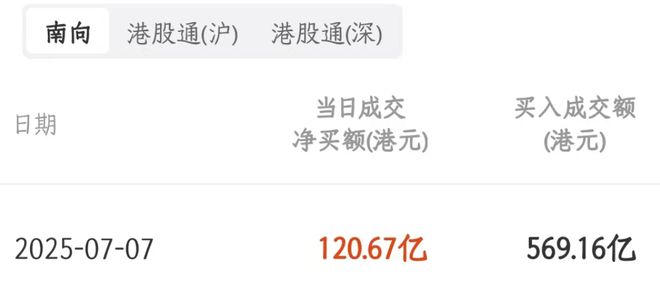
Group 1 - The core viewpoint is that the competition among Meituan, Alibaba, and JD in the food delivery sector is intense, leading to significant stock price pressure, with Meituan's stock nearly halving from its peak, JD's stock dropping below its April low, and Alibaba approaching its yearly low, indicating a "three defeats all hurt" scenario [1] - On July 7, net purchases of Hong Kong stocks exceeded 12 billion, marking the first time since May 27 that net purchases surpassed 10 billion, suggesting a potential bottom-fishing opportunity for tech leaders in Hong Kong [1][3] - Analysts predict a potential "valuation repair" and "earnings growth" for the Hang Seng Tech Index from 2025 to 2027, indicating a favorable time to position for this upward movement [3] Group 2 - The Hong Kong Tech 50 ETF (159750) tracks the Hong Kong Tech Index and has seen over a 24% increase this year, with significant growth in scale since early March [5] - As of July 7, the latest P/E ratio for Hong Kong tech is 20.27, which is at a low historical percentile, suggesting it is cheaper than 97% of the time in the past decade, indicating a strong willingness for southbound capital to invest at low levels [6] - The Hong Kong Dividend Low Volatility ETF (520550) has shown resilience during market fluctuations, achieving a 19% increase since its inception on January 15, 2025, and has attracted significant net inflows recently [10][12] Group 3 - The ETF structure allows for monthly dividend assessments, with a maximum of 12 cash inflows per year, supporting reinvestment and providing a cost advantage for long-term holding [12] - A strategy of building positions in the Hong Kong Tech 50 ETF (159750) while using the Hong Kong Dividend Low Volatility ETF (520550) as a defensive measure may help mitigate short-term risks while capitalizing on potential tech sector gains [14]