
沪农商行

Search documents
5月信贷投放有望改善 银行“剧透”经营新动向
Shang Hai Zheng Quan Bao· 2025-05-18 18:08
◎记者 黄坤 经历4月信贷"小月"后,5月信贷投放有望改善。 上海证券报记者近日从业内了解到,伴随一揽子政策落地,5月信贷增长可能明显好于4月,并且银行信 贷投放节奏更注重均衡和质效提升。投向上,银行加大了科技金融、普惠金融等领域的投放力度;零售 方面,消费贷仍是各家银行发力的主战场。 一些银行近期披露的机构投资者调研纪要还"剧透"了经营动向。面对净息差收窄、竞争加剧的市场环 境,银行正在想方设法推进业务,稳住经营业绩。 预计5月信贷投放明显改善 记者自业内了解到,预计5月信贷投放有明显改善。 一家股份制银行上海分行公司部总经理向记者说,进入5月,银行信贷投放明显更加注重质量和均衡, 信贷经理都在外面忙着跑客户,以完成月度和年中考核指标。 科技金融正成为银行发力的重中之重。"'五篇大文章'是带动银行经营能力持续提升的重要方向。"前述 股份制银行上海分行人士说,目前金融资源向科技型企业倾斜更多,希望通过培育专业特色,帮助该行 赢得未来的核心竞争力。 光大证券首席固收分析师张旭判断,5月出台了大量支持性政策,信贷增长情况很可能明显好于4月。"5 月我国外贸环境出现了积极变化,这有助于企业有效信贷需求的恢复甚至进一 ...
银行业周报(20250512-20250518):当前五大行A股股息率处于何种水平?-20250518
Huachuang Securities· 2025-05-18 08:16
证 券 研 究 报 告 银行业周报(20250512-20250518) 推荐(维持) 当前五大行 A 股股息率处于何种水平? 银行 2025 年 05 月 18 日 华创证券研究所 2015-2025 年,大致可以划分为四个阶段:1)2Q15-1Q16,五大行季度平均股 息率震荡上行,平均股息率从 4.4%升至 5.3%;2)2Q16-1Q18,五大行季度平 均股息率震荡下行,从 5.3%降至 4.0%;3)2Q18-1Q23,五大行季度平均股息 率开启较长时间的震荡上行,从 4.4%升至 7.2%;4)2Q23-2Q25,五大行季度 平均股息率呈现较快下行趋势,从 6.3%降至 4.4%。当前水平处于 2015 年以 来的较低分位,与 2Q15 和 2Q18 水平相当。 与历史上当期的国债收益率相比,除了 1Q18 跑输 10 年期国债收益率之外, 其余时间五大行季度平均股息率均高于 10 年期国债收益率。其中 1Q20-2Q21, 高于 10 年期国债收益率 2pct;3Q21-2Q24,高于 10 年期国债收益率 3-4pct。 25 年以来仍然高于 10 年期国债收益率 2pct。 24 年所有 A ...


银行角度看4月社融:政府债保持高增,透支与预期影响贷款
ZHONGTAI SECURITIES· 2025-05-18 07:50
银行角度看 4 月社融:政府债保持高增,透支与预期影响贷款 银行 证券研究报告/行业点评报告 2025 年 05 月 17 日 评级: 增持(维持) | 增持(维持) 评级: | | 重点公司基本状况 | | | | | | | | | | | | | --- | --- | --- | --- | --- | --- | --- | --- | --- | --- | --- | --- | --- | --- | | | 简称 | 股价 | | | EPS | | | | | PE | | | 评级 | | 分析师:戴志锋 | | (元) | 2023A | 2024A | 2025E | 2026E | 2027E | 2023A | 2024A | 2025E | 2026E | 2027E | | | 执业证书编号:S0740517030004 | 江苏银行 | 10.73 | 1.69 | 1.65 | 1.91 | 2.03 | 2.15 | 6.35 | 6.50 | 5.62 | 5.29 | 4.98 | 买入 | | | 渝农商行 | 7.27 | 0.94 | 0.99 | 1.07 ...



上海银行:选举顾建忠为第六届董事会董事长
Bei Jing Shang Bao· 2025-05-16 12:07
据了解,4月22日,上海银行召开干部会议宣布顾建忠担任党委书记,拟接任上海银行董事长。根据上 海市委组织部4月11日发布《上海市市管干部任职前公示》,时任上海农商行行长、党委副书记、副董 事长的顾建忠,拟任市管企业党委书记,并提名任董事长。 简历显示,顾建忠,男,1974年11月出生,研究生学历,经济学硕士学位,经济师。此前任上海农商行 党委副书记、副董事长、执行董事、行长,并兼任上海金融业联合会第四届理事会副理事长、上海市企 业家协会第五届理事会副会长。曾任上海银行金融部副总经理兼营销经理部、港台业务部总经理,上海 银行公司金融部总经理、授信审批中心总经理、营业部总经理,上海市金融服务办公室综合协调处副处 长(挂职)、金融机构处处长(挂职),上海银行党委委员、纪委副书记、人力资源总监、人力资源部 总经理,上海国际集团有限公司党委委员、副总经理。 北京商报讯(记者 宋亦桐)5月16日,上海银行发布《董事会2025年第五次会议决议公告》指出,该行 董事会会议经审议并通过《关于选举董事长的议案》,会议选举顾建忠为该行第六届董事会董事长,任 期与第六届董事会任期一致。 据悉,顾建忠的董事长任职资格尚需报中国银行业监 ...

机构建议继续将红利类资产作为底仓配置,国企红利ETF(159515)近3月新增份额居可比基金首位
Sou Hu Cai Jing· 2025-05-16 06:30
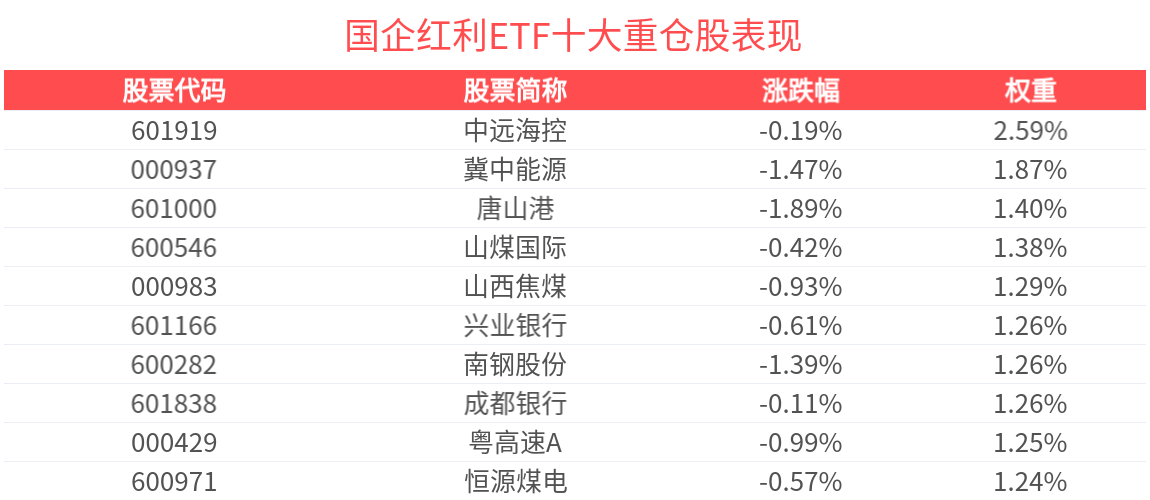
Group 1 - The China Securities State-Owned Enterprises Dividend Index (000824) decreased by 0.64% as of May 16, 2025, with mixed performance among constituent stocks [1] - Leading gainers included Kailuan Energy Chemical (600997) up 3.04%, Shenneng (600810) up 2.47%, and Fu'ao (000030) up 2.45%, while China Petroleum & Chemical (600028) led the declines down 2.08% [1] - The State-Owned Enterprises Dividend ETF (159515) fell by 0.55%, with the latest price at 1.09 yuan, and saw a significant increase in shares by 6.6 million over the past three months, ranking it in the top half among comparable funds [1] Group 2 - The China Securities State-Owned Enterprises Dividend Index is composed of 100 listed companies selected for high cash dividend yields, stable dividends, and certain scale and liquidity [2] - As of April 30, 2025, the top ten weighted stocks in the index included COSCO Shipping Holdings (601919) and Jizhong Energy (000937), collectively accounting for 15.18% of the index [2] Group 3 - Guohai Securities noted that recent joint statements indicate a positive shift in the economic and trade relations between the parties, marking a new phase of "offensive and defensive shifts" since the trade frictions began in 2018 [1] - The recommendation is to maintain dividend assets as a core allocation to mitigate potential volatility, while also considering segments of the export industry that have been overly pessimistic and undervalued [1]

低基数下社融提速,信贷靠前投放后回落
Huachuang Securities· 2025-05-16 04:44
Investment Rating - The industry investment rating is "Recommended," indicating an expected increase in the industry index by more than 5% over the next 3-6 months compared to the benchmark index [26]. Core Insights - The report highlights a significant increase in social financing, with April 2025 seeing a new social financing scale of 1.16 trillion yuan, which is an increase of 1.22 trillion yuan year-on-year, resulting in a year-on-year growth rate of 8.7%, the highest monthly growth rate in nearly a year [2][7]. - The report notes a decline in credit demand, particularly in corporate loans, which have decreased significantly after an initial surge, while household short-term loans are also under pressure [7][8]. - The report suggests that the banking sector is likely to see an increase in overall positioning, driven by medium to long-term capital inflows and public fund reforms, recommending a diversified investment strategy focusing on state-owned banks and quality regional banks [7][8]. Summary by Sections Social Financing Overview - In April 2025, the new social financing scale reached 1.16 trillion yuan, with a year-on-year increase of 1.22 trillion yuan, and a social financing stock growth rate of 8.7%, up 0.3 percentage points from the previous month [2][7]. - Direct financing saw a significant contribution from government bonds, which increased by 1.07 trillion yuan year-on-year, while corporate bonds improved slightly due to a low base effect [7][8]. Credit Data - New RMB loans in April amounted to 280 billion yuan, a decrease of 450 billion yuan year-on-year, primarily due to weakened corporate financing demand [7][8]. - Corporate loans decreased by 250 billion yuan year-on-year, with short-term loans and medium to long-term loans also showing declines [7][8]. Monetary Growth - M1 growth rate decreased to 1.5%, while M2 growth rate increased to 8% due to a low base effect from the previous year [7][8]. - The report indicates a significant reduction in both household and corporate deposits, with non-bank deposits increasing by 1.9 trillion yuan [7][8]. Investment Recommendations - The report emphasizes the importance of positioning in the banking sector, suggesting that banks with high dividend yields and strong asset quality should be prioritized for investment [7][8]. - It recommends focusing on state-owned banks and stable joint-stock banks, as well as regional banks with high provisioning coverage ratios [7][8].
一季度城农商行业绩现“冰火两重天”:江苏银行高歌猛进,厦门银行艰难前行
Tai Mei Ti A P P· 2025-05-15 12:57
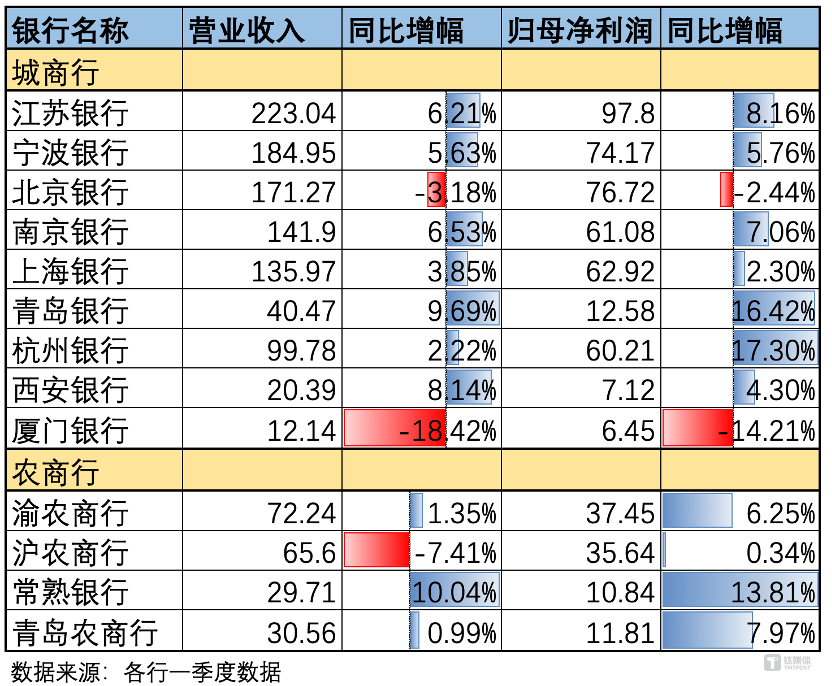
Core Viewpoint - The performance of the banking industry in Q1 2025 is mixed, with some banks showing strong growth while others face significant challenges, particularly in revenue and profit generation [1][13]. Summary by Category City Commercial Banks - Jiangsu Bank leads in operating income with 22.304 billion yuan, a year-on-year increase of 6.21%, and a net profit of 9.78 billion yuan, up 8.16% [1][3]. - Qingdao Bank shows a remarkable revenue growth of 9.69% and a net profit increase of 16.42%, indicating strong market performance [1][3]. - Xiamen Bank struggles with only 1.214 billion yuan in revenue, down 18.42%, and a net profit of 645 million yuan, down 14.21%, reflecting significant operational pressure [1][3][9]. Rural Commercial Banks - Chongqing Rural Commercial Bank reports the highest operating income at 7.224 billion yuan, with a net profit of 3.745 billion yuan, showing a year-on-year increase of 6.25% [1][3]. - Shanghai Rural Commercial Bank faces challenges with a revenue decline of 7.41% and a net profit growth of only 0.34%, indicating insufficient growth momentum [1][3][10]. Strategic Developments - Jiangsu Bank's strategic focus on optimizing asset allocation and enhancing retail and non-interest income has contributed to its strong performance [4][5]. - Qingdao Bank emphasizes a refined strategy targeting three major customer groups and six key industries, enhancing its product offerings and revenue generation [5][6]. Challenges Faced - Xiamen Bank's revenue decline is attributed to a significant drop in core income sources, particularly in commission and fee-related businesses, alongside a decrease in investment income [9][10]. - The overall banking sector faces pressure from narrowing net interest margins and a decline in non-interest income due to market volatility and high base effects from 2024 [13][14].
银行配置策略报告系列一:四维度再看当下银行配置机会-20250515
Huachuang Securities· 2025-05-15 06:11
Core Insights - The report maintains a positive outlook on bank sector investments, emphasizing the stability and dividend attributes of bank stocks, with an average dividend yield exceeding 4.3% [6][16] - The banking sector is expected to benefit from structural changes in the economy, leading to improved return on equity (ROE) and overall performance [7][10] Dimension One: Stability and Dividend Attributes of Bank Stocks - The core revenue growth of banks showed marginal improvement in Q1 2025, with a projected stable annual performance despite a slowdown in revenue and profit growth [10][11] - The average dividend payout ratio for listed banks increased to 26.1%, with an average dividend yield of over 4.3%, indicating strong dividend sustainability [16] - Major banks have received capital injections, enhancing asset quality and stabilizing market expectations, with non-performing loan ratios remaining steady at 1.16% [10][11] Dimension Two: Public Fund Reform and Increased Bank Allocations - The recent public fund reforms are expected to increase allocations to the banking sector, with potential incremental capital of approximately 222.7 billion yuan if funds align with industry benchmarks [10][12] Dimension Three: Influx of Long-term Capital - The acceleration of long-term capital inflows, particularly from insurance funds, is anticipated to provide additional support to bank stocks, with 14 cases of insurance fund acquisitions in 2025 [10][12] Dimension Four: Structural Economic Transformation and ROE Improvement - The banking sector's ROE is projected to stabilize between 8-9%, with potential for upward movement if economic conditions improve and structural transformations accelerate [7][10] Investment Recommendations - Emphasis on bank sector allocation, particularly focusing on state-owned banks and quality regional banks with strong provisioning coverage [7][10] - The report suggests a diversified investment strategy, highlighting the importance of dividend strategies and the potential for valuation improvements in selected banks [7][10]

存5年不如存1年利率高,中小银行存款利率倒挂范围扩大
Hua Xia Shi Bao· 2025-05-15 04:22
Core Viewpoint - Recent significant reductions in deposit rates by several small and medium-sized banks have led to unusual phenomena such as one-year deposit rates exceeding five-year rates, indicating a shift in banks' deposit management strategies [2][3][7]. Group 1: Deposit Rate Adjustments - Multiple small and medium-sized banks have initiated a new round of deposit rate cuts, with noticeable instances of one-year rates surpassing five-year rates, such as Xinjiang Korla Fumin Village Bank's one-year rate at 2.0% compared to 1.95% for five years [2][3]. - The phenomenon of "rate inversion" has become more common, with banks like Shandong Yinan Blue Ocean Village Bank showing three-year rates at 2.0% while five-year rates are at 1.8%, a 20 basis point difference [3][5]. - Guangdong Qingxin Rural Commercial Bank has also adjusted its rates, with one-year rates at 1.1% and three-year rates at 1.53%, indicating a trend where longer-term deposits yield lower returns [4]. Group 2: Market Reactions and Trends - The banking sector is experiencing a trend where deposit growth outpaces loan growth, with banks like Xiamen Bank reporting a 3.17% increase in deposits while loans decreased by 2.02% [6]. - There is a noticeable shift towards "regularization" of deposits, with personal term deposits increasing significantly across various banks, indicating pressure on banks' liability management [6]. - Analysts suggest that the ongoing trend of declining interest rates will lead to more frequent occurrences of deposit rate inversions, as banks adjust their strategies to manage costs more effectively [7][9]. Group 3: Future Expectations - The People's Bank of China has indicated a potential for further reductions in deposit rates, which may lead to a collective nationwide decrease in interest rates, impacting banks' ability to attract deposits [7][8]. - The expectation of continued downward pressure on rates suggests that banks will need to refine their deposit management strategies to remain competitive in attracting customers [9].

阔别10年,顾建忠重掌上海银行,但要先“除三害”
Sou Hu Cai Jing· 2025-05-14 04:35
Group 1 - Shanghai Bank's total assets reached 3.27 trillion yuan in Q1 2025, falling behind Ningbo Bank and dropping out of the top three city commercial banks [1] - The new leader, Gu Jianzhong, expressed that he is still familiarizing himself with the bank's current situation after returning [1] - Shanghai Bank's revenue and net profit growth rates for 2024 were only 4.79% and 4.5%, respectively, indicating a slowdown compared to its previous competitive position [1] Group 2 - Gu Jianzhong faces three major obstacles in revitalizing Shanghai Bank, starting with the need to streamline decision-making processes [2][3] - The second obstacle is the need for the bank to return to a growth trajectory, as its expansion has significantly slowed since 2016 [13] - The third obstacle involves the urgent need to rebuild the bank's unique characteristics to compete effectively in the crowded Shanghai market [26] Group 3 - Shanghai Bank's non-performing loan ratio in the real estate sector was 0.98% by the end of 2024, with an overall non-performing loan ratio of 1.18%, showing a downward trend [16] - The bank's corporate business profit margin has increased from 41.14% in 2020 to over 60% by 2024, indicating improved profitability despite challenges [16] - However, the bank's net interest margin has been declining, placing it at the bottom among its competitors in the Yangtze River Delta region since 2018 [18] Group 4 - Shanghai Bank has a significant market share in pension finance, with pension client deposits accounting for 52.6% of its total personal deposits as of mid-2024 [28] - Despite this, the bank's non-interest income as a percentage of total revenue has decreased significantly, indicating a lack of trust between the bank and its primary customer base [30] - Past controversies have damaged the bank's reputation among pension clients, necessitating a stronger commitment to rebuilding trust [32] Group 5 - Gu Jianzhong's return to Shanghai Bank presents both an opportunity and a challenge, as he must navigate the complexities of the bank's current landscape [32] - The bank's foundational strengths and the resources available in Shanghai provide a conducive environment for potential growth, but effective management and strategic decisions will be crucial [33]
