
国星宇航

Search documents
“算力”上天,航空航天ETF天弘(159241)近5日“吸金”超4100万元,份额续创新高,海内外巨头竞逐新赛道!
Xin Lang Cai Jing· 2025-11-13 06:45
Core Insights - The aerospace ETF Tianhong (159241) has seen significant trading activity, with a turnover of 8.93% and a transaction volume of 46.70 million yuan as of November 13, 2025 [1] - The ETF's latest scale reached 521 million yuan, marking a one-month high, and its share count hit 461 million, the highest since inception [1] - Recent inflows into the ETF totaled 15.70 million yuan, with a cumulative "capital absorption" of 41.19 million yuan over the past five trading days [1] Product Highlights - The aerospace ETF Tianhong (159241) effectively captures thematic investment opportunities, aligning with popular themes such as low-altitude economy, large aircraft, and satellite internet [1] - The constituent stocks are deeply involved in emerging fields like commercial aerospace, benefiting from both policy and market support [1] Hot Events - There has been a surge in global developments in the space computing sector, with domestic and international companies advancing key layouts, indicating a clear timeline of progress [2] - Notable advancements include NVIDIA's collaboration with Starcloud to deploy H100 GPUs on satellites, achieving a 100-fold increase in computing power for complex tasks [2] - Elon Musk's plans for a 100GW space data center deployment via Starship and Google's "Sun Catcher Project" to explore solar energy for orbital AI data centers highlight the accelerating commercialization of space computing [2] - Domestic advancements include the successful selection of Guoxing Aerospace's "Zero Carbon Space Computing Center" at the World Internet Conference, showcasing significant computing capabilities [2] Institutional Perspectives - Guosheng Securities notes that space computing has transitioned from conceptual validation to engineering implementation, presenting a strategic solution to ground-based computing challenges [2] - The involvement of major AI players like NVIDIA and Amazon indicates a growing trend, with potential acceleration in development due to policy support and investment [2]


太空算力获重磅突破,航空航天ETF(159227)规模份额齐创新高
Mei Ri Jing Ji Xin Wen· 2025-11-12 06:17
Group 1 - The aerospace sector continues to decline, with the aerospace ETF (159227) down by 2.31% as of 13:39, with a transaction volume of 163 million yuan, maintaining the highest position in its category [1] - The aerospace ETF (159227) has reached a new high in size at 1.961 billion yuan and a total of 1.747 billion shares, marking the highest since its inception [1] - The "Zero Carbon Space Computing Center," developed by Guoxing Aerospace, was recognized as one of the top ten premier debut achievements at the 2025 World Internet Conference, showcasing significant advancements in space computing capabilities [1] Group 2 - The aerospace ETF (159227) closely tracks the Guozheng Aerospace Index, which has a high military industry purity of 98.2%, covering key industry chain segments such as aerospace equipment, satellite navigation, and new materials [2] - The index includes leading companies in the military sector, with a commercial aerospace concept weight of 51.83% [2]
六小龙”齐聚乌镇背后:前沿技术已经“飞入寻常百姓家
Xin Jing Bao· 2025-11-11 14:20
Core Insights - The 2025 World Internet Conference in Wuzhen concluded with over 1,600 attendees from more than 130 countries, discussing topics such as AI, smart hardware, and cybersecurity [1] - The "Internet Light" Expo featured 670 exhibitors and attracted over 17,000 visitors in a single day, showcasing the growing public engagement with technology [1][5] Group 1: Technology Discussions - The "Six Little Dragons" forum was the most attended, featuring discussions on cutting-edge technologies and the challenges faced by companies in the tech sector [2] - Companies like Strong Brain Technology and Yushu Technology shared their experiences in overcoming obstacles in their respective fields, emphasizing the importance of innovation and problem-solving [2][3] - The dialogue highlighted the need for advancements in AI models and the challenges of current AI systems, with a focus on creating stable, generalizable learning algorithms [3][9] Group 2: Public Engagement with Technology - The expo showcased interactive products like AI models, robotic dogs, and flight simulators, indicating a shift in public perception and acceptance of advanced technologies [4][5] - The presence of vendors selling small robotic dog toys at the expo reflects the increasing accessibility of technology to everyday consumers [5] Group 3: Reports and Safety Initiatives - Multiple reports were released during the conference, addressing global AI safety and governance, and emphasizing the need for international cooperation in technology development [7][8] - The discussions underscored the dual pressures of internal and external risks associated with AI, highlighting the importance of understanding AI's inherent challenges [8][9]
“把算力送入太空” 中国企业卡位“AI军备”前沿赛道
3 6 Ke· 2025-11-11 07:52
Core Insights - The article discusses the emerging trend of space computing, highlighting the competitive landscape among global tech giants to establish capabilities in this area [1][2][3] - China's advancements in space computing are noted, with a complete chain from technology development to commercial application already in place [1][4] - The article raises critical questions regarding the high costs of construction and operation, the potential for market saturation, and the timeline for commercial viability in China's space computing sector [1][5] Industry Developments - StarCloud, a US startup, launched a test satellite equipped with NVIDIA H100 chips and Google's Gemini model, aiming to create a gigawatt-level distributed data center in space [2] - The European Union has initiated a "Space Data Center Plan" as part of its Horizon Green Transition strategy, focusing on building low-carbon computing clusters in space [2] - Madari Space in the Middle East plans to launch its first orbital data center by 2026, with a goal of deploying 8,000 space nodes by 2028 [2] Technological Trends - The demand for new computing capabilities in the AI era is driving the shift towards space computing, which is seen as a next-generation "green high-density computing platform" [3] - The natural conditions of space, such as low temperatures and long-term solar energy supply, provide ideal conditions for zero-carbon computing [3] - The concept of "space-based computing constellations" is emerging, with AI-driven management and coordination becoming essential for large satellite networks [3][4] Commercialization Pathways - The commercial path for space computing is becoming clearer, with applications in various sectors such as AI, research, and emerging industries like low-altitude economy and digital consumption [7] - The business model is shifting from "selling computing power" to "selling services," indicating a more integrated approach to customer needs [8] - The complete industry chain for space computing includes satellite manufacturing, communication devices, chip modules, AI algorithms, and ground access terminals [8] Challenges and Opportunities - The Chinese space computing industry faces structural challenges, including a high number of satellite constellation plans with low implementation rates [11] - The need for coordination among launch capabilities, manufacturing capacity, and orbital resource management is critical for the development of satellite constellations [11] - Despite initial high costs and long cycles, there is optimism about the long-term advantages of space computing as industrialization progresses and costs decrease [12]
把算力送入太空,中国企业卡位“AI军备”前沿赛道
财联社· 2025-11-11 05:28
Core Viewpoint - The article discusses the emerging trend of space computing, highlighting the global competition among tech giants to establish capabilities in this area, driven by the increasing demand for AI models and the limitations of terrestrial data centers [4][5][7]. Group 1: Global Trends in Space Computing - Space computing has become a new frontier for global tech companies, with initiatives like StarCloud's satellite equipped with NVIDIA H100 chips and Google's Gemini model, aiming to create a gigawatt-level distributed data center in space [6]. - The European Union has initiated a "Space Data Center Plan" as part of its green transition strategy, while companies in the Middle East, such as Madari Space, plan to launch their first orbital data center by 2026 [6][8]. - The increasing urgency for new computing capabilities in the AI era is pushing the development of space computing as a next-generation "green high-density computing platform" [8]. Group 2: China's Position in Space Computing - China has taken the lead in space computing, with companies like Guoxing Aerospace successfully launching the world's first space computing constellation, achieving an in-orbit computing capacity of 5 petaflops (POPS) [11]. - The "Zero Carbon Space Computing Center" developed by Guoxing Aerospace consists of 2,800 satellites, providing global space computing and high-speed interconnect capabilities [11][12]. - The commercial path for space computing in China is becoming clearer, with applications in various sectors, including AI, scientific research, and emerging industries like low-altitude economy and digital consumption [13]. Group 3: Challenges and Opportunities - Despite the optimistic outlook, the Chinese space computing industry faces structural challenges, including a high number of satellite constellation plans with low implementation rates [17]. - The industry must address issues related to launch capacity, manufacturing capabilities, and orbital resource management to realize the potential of satellite constellations [17]. - The article emphasizes the need for advancements in satellite manufacturing technology and the reduction of launch costs to achieve a cost inflection point for space computing during the 14th Five-Year Plan period [18].
西部大省,何以“先行”?
Xin Lang Cai Jing· 2025-11-10 19:24
Core Insights - The World Internet Conference in Wuzhen highlighted Sichuan's advancements in digital economy and technology, showcasing innovations like the "Zero Carbon Space Computing Center" and AI applications in healthcare [1][4][10] - Over the past decade, China's digital economy has grown significantly, projected to exceed 60 trillion yuan by 2025, with Sichuan emerging as a leader in this transformation [2][12] - Sichuan's digital economy is transitioning from "Internet+" to "AI+", with a focus on commercial aerospace and artificial intelligence as key growth areas [7][10] Digital Economy Development - Sichuan's digital economy core industry value added increased from 401.2 billion yuan in 2021 to 535.17 billion yuan in 2024, accounting for 8.3% of GDP [12] - The province aims to establish itself as a leading digital economy innovation province, with plans to exceed national averages in digital economy metrics by 2027 [13][14] - The number of AI companies in Sichuan has surpassed 1,300, with the AI industry revenue exceeding 130 billion yuan in 2024, reflecting a growth rate of over 25% [11] Technological Innovations - The "Zero Carbon Space Computing Center" developed by Guoxing Aerospace is a significant achievement, with a planned satellite constellation expected to provide a total computing power of 100,000 PFLOPS [9][10] - Sichuan has built 464 internet hospitals and implemented extensive digital infrastructure, including 20.7 million 5G base stations, enhancing healthcare and education accessibility [5][16] - The province is also advancing in cultural heritage digitization, utilizing technologies like VR and AI to enhance public engagement with historical sites [6] Future Goals and Infrastructure - Sichuan's commercial aerospace sector is projected to reach a scale of 50 billion yuan by 2025 and 100 billion yuan by 2030, positioning the province as a national hub for aerospace innovation [10] - The province's data resource system has expanded significantly, with nearly 39 million shareable data resources, facilitating growth in various sectors [15] - By 2027, Sichuan aims to achieve a total computing power of 40 EFLOPS, doubling its current capacity, which will support further technological advancements [16][17]
2025年第45周计算机行业周报:关注太空算力产业投资机遇-20251110
Changjiang Securities· 2025-11-10 15:18
Investment Rating - The report maintains a "Positive" investment rating for the industry [7]. Core Insights - The computer sector experienced a volatile correction last week, with an overall decline of 2.59%, ranking 32nd among primary industries in the Yangtze River region [2][4]. - Key developments include the launch of the commercial quantum computer Helios by Quantinuum, the establishment of a national data element comprehensive pilot zone in Beijing, and the release of the Kimi K2 Thinking model by Moonlight [5][10]. - The report emphasizes the potential investment opportunities in the space computing industry, particularly focusing on satellite manufacturers, space-hardened computing hardware suppliers, and space computing operators [6][52]. Summary by Sections Market Performance - The computer sector's trading volume accounted for 7.47% of the total market, with active mergers and acquisitions [2][4]. - The Shanghai Composite Index fluctuated around the 4000-point mark, closing at 3997.56 points with an overall increase of 1.08% [4][12]. Key Developments - Quantinuum's Helios quantum computer aims to accelerate the adoption of hybrid quantum-classical computing, featuring high fidelity and the highest accuracy among commercial quantum computers [20][23]. - Beijing's initiative to create a national data element comprehensive pilot zone is expected to enhance the data element industry, with a goal to complete pilot tasks by 2027 [24][25]. - The Kimi K2 Thinking model showcases advancements in agent and reasoning capabilities, achieving state-of-the-art performance in various benchmarks [31][34]. Investment Recommendations - The report suggests focusing on the space computing sector, particularly on companies involved in satellite manufacturing, launch services, and resilient computing hardware [6][52]. - The ongoing developments in space computing are seen as a critical direction for future computational resources, driven by the increasing energy demands of AI and data centers [42][43].


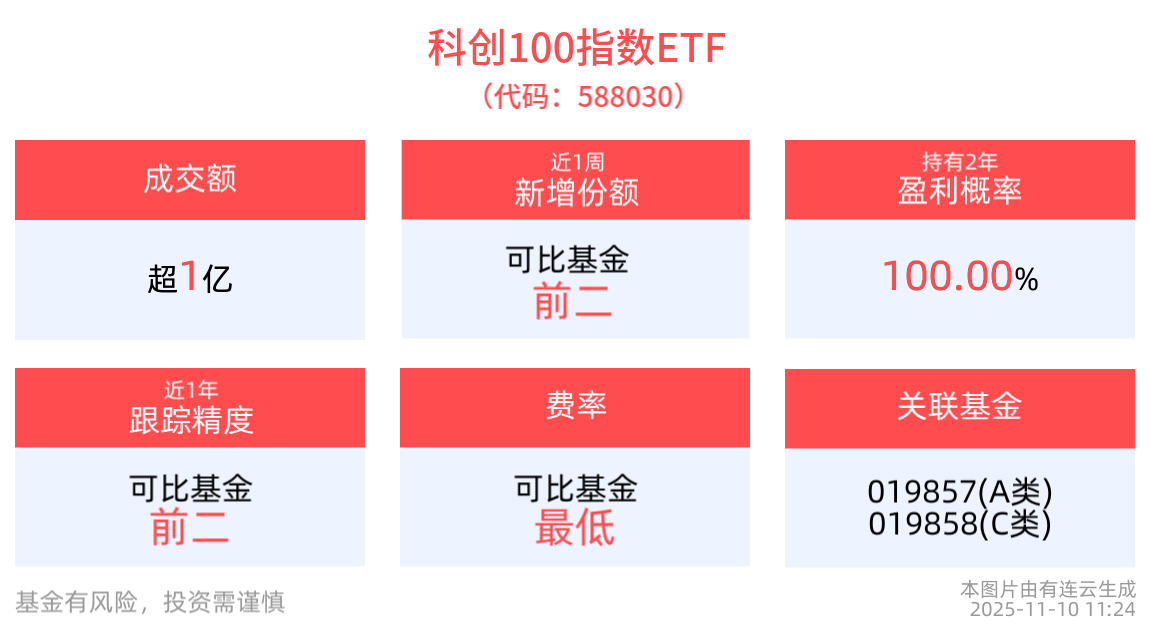
全球巨头竞逐太空算力新赛道,科创100指数ETF(588030)盘中交投活跃
Sou Hu Cai Jing· 2025-11-10 03:50
Group 1: Market Performance - The Shanghai Stock Exchange Sci-Tech Innovation Board 100 Index decreased by 1.87% as of November 10, 2025, with mixed performance among constituent stocks [3] - The top gainers included Baike Bio up 4.59%, Zhongke Xingtou up 3.92%, and Zhongxin Bo up 2.82%, while the largest decliners were Xiamen Tungsten down 8.26%, Guodun Quantum down 8.06%, and Huahong Semiconductor down 6.70% [3] - The Sci-Tech 100 Index ETF (588030) fell by 2.02%, with the latest price at 1.31 yuan, but has seen a cumulative increase of 20.11% over the past three months as of November 7, 2025 [3] Group 2: Liquidity and Trading Volume - The Sci-Tech 100 Index ETF had a turnover rate of 2.32% during the trading session, with a transaction volume of 133 million yuan [3] - Over the past year, the average daily trading volume of the ETF was 379 million yuan, ranking it first among comparable funds [3] Group 3: Space Computing Developments - Global tech giants are accelerating their investments in space computing, shifting AI competition from Earth to space, with Google launching Project Suncatcher and SpaceX building a space data center [4] - Chinese companies are also making rapid advancements, with Guoxing Aerospace's "Star Computing" plan and the upcoming launch of the "Tianlibo-10" satellite in 2026, which boasts a single satellite computing power exceeding 10 POPS [4] - Space computing is emerging as a solution to AI computing energy consumption and bandwidth bottlenecks, leveraging near-infinite solar energy supply and high energy efficiency [4] Group 4: Investment Recommendations - Minsheng Securities suggests that supernodes may become a mainstream technology under cluster expansion, enhancing the domestic computing ecosystem [5] - Key areas to focus on include domestic AI computing sectors such as chip design, advanced wafer manufacturing, and liquid cooling technologies [5] - The latest scale of the Sci-Tech 100 Index ETF reached 5.79 billion yuan, ranking it second among comparable funds, with a significant increase of 6 million shares over the past week [5] Group 5: Index Composition - As of October 31, 2025, the top ten weighted stocks in the Sci-Tech 100 Index accounted for 25.77% of the index, including Huahong Semiconductor and Guodun Quantum [6]
太空算力争夺赛开打
3 6 Ke· 2025-11-10 03:36
Core Insights - The article discusses the growing interest of AI companies in space computing, highlighting recent developments in space computing capabilities and infrastructure [1][2] Group 1: Space Computing Developments - The "Zero Carbon Space Computing Center" developed by Guoxing Aerospace has achieved a single satellite computing power of 744 TOPS and a constellation capability of 5 POPS, making it the strongest space computing capability globally [1] - NVIDIA has sent its H100 GPU to space, while Elon Musk announced plans to expand Starlink V3 satellites to create a space data center, aiming for 100 GW of data center deployment annually within 4-5 years [1] - Google has initiated the "Sun Catcher Project," planning to launch two prototype satellites with Trillium TPUs by early 2027, positioning space as a potential optimal location for scaling AI computing [1] Group 2: Advantages of Space Computing - Space computing allows satellites to perform data preprocessing and AI training in orbit, significantly improving real-time decision-making efficiency compared to traditional ground-based processing [2] - The deployment of data centers in space offers low operational costs, high power generation efficiency, and rapid deployment capabilities, addressing energy bottlenecks faced by terrestrial data centers [2][3] Group 3: Technological and Operational Benefits - High-orbit space data centers can utilize solar energy 24/7 with an efficiency of up to 95%, which is five times more efficient than ground-based systems [3] - The extreme cold of deep space (-270°C) allows for simpler thermal management, reducing the need for complex cooling systems [3] - Space data centers can be modularly assembled, and light travels faster in a vacuum than through standard fiber optics, enhancing deployment speed and flexibility [3] Group 4: Industry Progress and Future Outlook - China is leading in space computing deployment, with the "Three-Body Computing Constellation" set to launch over 50 satellites by 2025, aiming for a total computing power of 1000P by around 2030 [3] - The transition from "ground-based sensing and computing" to "space-based sensing and computing" is underway, creating a global space computing network [3] - Companies like Putian Technology are heavily involved in the "Three-Body Computing Constellation," contributing to key areas such as inter-satellite communication and ground station construction [3][4] Group 5: Key Companies in the Sector - Holoway is a core manufacturer in satellite measurement, addressing challenges in high-precision measurement and rapid validation for satellite mass production [4] - Shanghai Huanxun is a key supplier for the communication subsystem of the Qianfan Constellation, responsible for satellite communication payloads and ground station support [4] - Zhenlei Technology is a core supplier of satellite internet chips and components, collaborating with various research institutions and enterprises in the industry [5]
谷歌启动“太阳捕手”计划,关注太空算力产业进展
Changjiang Securities· 2025-11-10 00:51
Investment Rating - The report maintains a "Positive" investment rating for the industry [7] Core Insights - Google has officially launched the "Project Suncatcher" initiative to explore the deployment of satellites equipped with self-developed TPU AI chips, aiming to create a scalable computing network in space that utilizes solar energy more efficiently than terrestrial sources [2][4] - Energy is identified as a significant bottleneck for AI development, and space computing is seen as a crucial direction for both the US and China, potentially becoming an essential component of future computing resources [2][4] - The report suggests focusing on satellite manufacturers, launch service providers, hardware suppliers capable of withstanding space environments, and space computing operators as key investment opportunities [2][4] Summary by Sections Event Description - On November 4, Google announced the launch of "Project Suncatcher," which aims to deploy satellites with TPU AI chips to build a computing network in space, leveraging solar energy [4] Industry Trends - The demand for computing power is expected to surge, driven by large-scale projects like "Star Gate" and increased capital expenditures from major cloud providers. The International Energy Agency predicts that global data center electricity demand will more than double by 2030, reaching approximately 945 terawatt-hours, with AI being the primary driver of this increase [9] - Space computing is positioned as a potential solution to current energy bottlenecks, as solar energy can significantly reduce cooling energy consumption by 30% compared to ground-based data centers [9] Competitive Landscape - Other companies are also making significant moves in the space computing sector. For instance, Starcloud, in collaboration with NVIDIA, launched the Starcloud-1 satellite, and SpaceX plans to expand its Starlink V3 satellite network to address computing resource shortages in the AI era [9] - In China, Guoxing Aerospace has initiated the "Star Computing" plan, aiming to deploy 2,800 satellites to create a space-based computing network with a total computing power of 100,000 P per second, marking a significant advancement in the country's AI space infrastructure [9]