赛力斯

Search documents
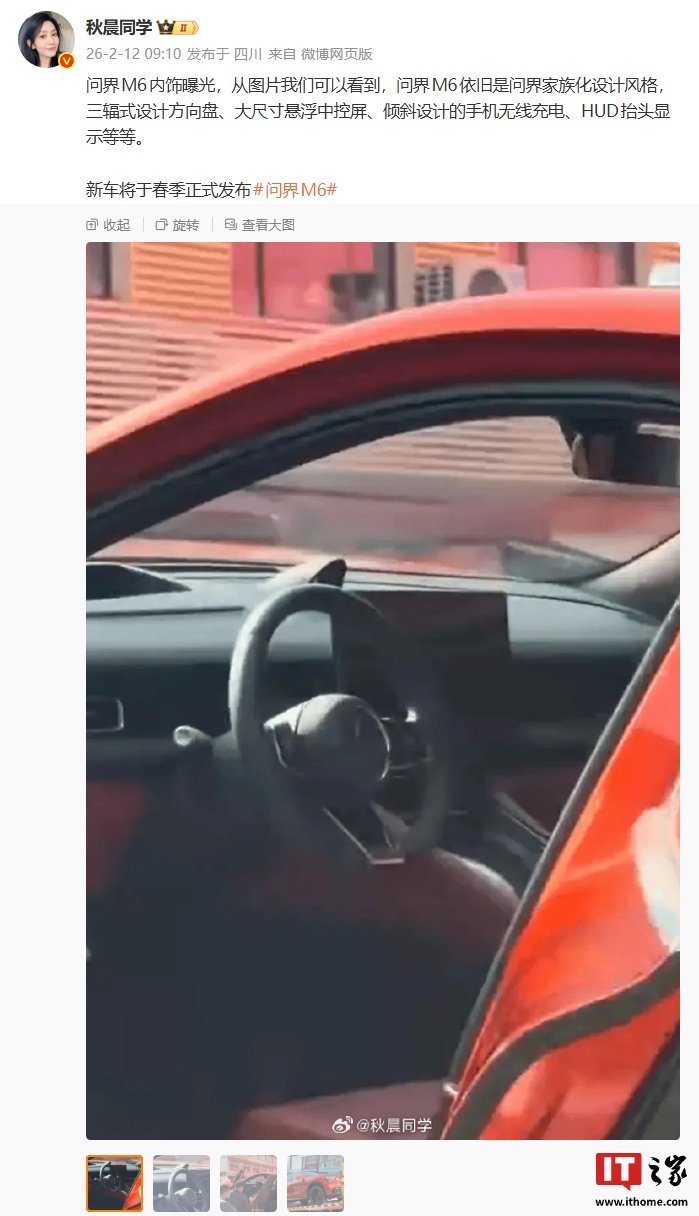
鸿蒙智行问界 M6 汽车内饰曝光:三幅式方向盘、大尺寸悬浮中控屏等
Xin Lang Cai Jing· 2026-02-12 12:18
Group 1 - The core point of the article is the unveiling of the AITO Wenjie M6 car's interior design and specifications, which will be officially launched in spring 2023 [30][33][39] - The car features a family design style, including a three-spoke steering wheel, a large floating central control screen, a slanted wireless phone charger, and a HUD display [30][32] - The M6 will offer three versions of extended-range electric driving range: 180 km, 260 km, and 272 km, with the pure electric version equipped with a standard 100 kWh battery [39][8] Group 2 - The exterior and interior colors of the M6 have been revealed as red and orange, although the actual colors may differ from the spy photos [6][37] - The car's dimensions are as follows: length 4960 mm, width 1985 mm, wheelbase 2950 mm, and height 1736 mm [14][45] - The M6 will be powered by Huawei's Whale battery, with the extended-range version offering optional battery sizes of 37 kWh or 53 kWh [39][56]

禁止亏本卖车,车圈反内卷新规出炉,价格战乱象大整治
3 6 Ke· 2026-02-12 11:25
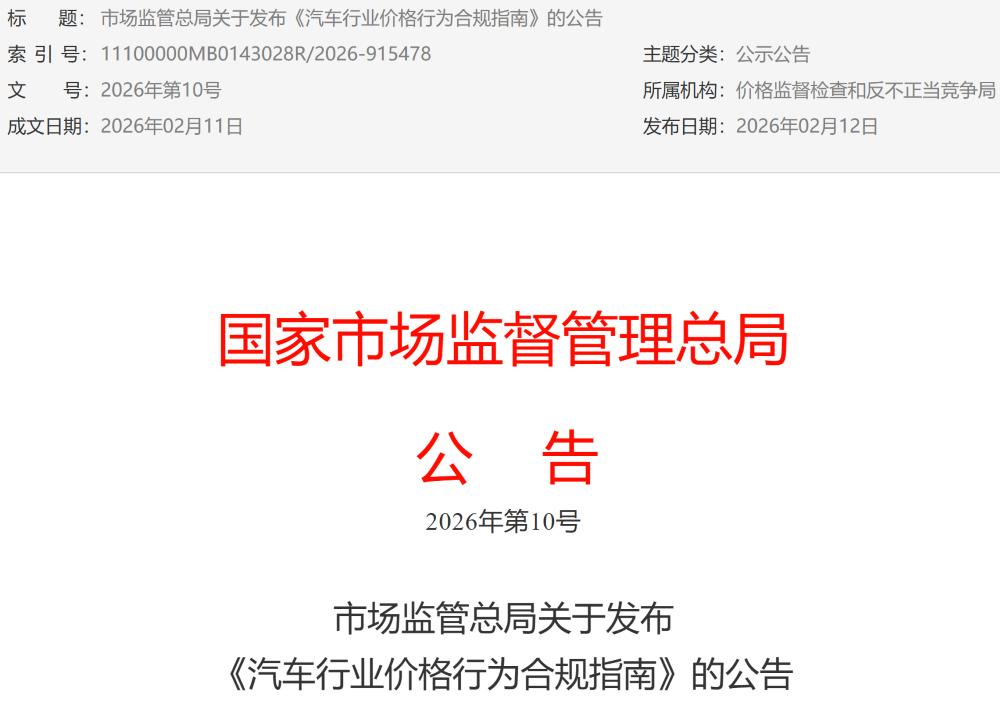
Core Viewpoint - The release of the "Guidelines for Compliance with Pricing Behavior in the Automotive Industry" by the State Administration for Market Regulation aims to standardize pricing behavior in the automotive sector, ensuring fair competition and protecting consumer rights while promoting high-quality industry development [3][24]. Group 1: Pricing Guidelines for Automotive Manufacturers - Automotive manufacturers must base pricing on production costs and market demand, prohibiting loss-leading sales aimed at eliminating competitors or monopolizing the market [5][6]. - Manufacturers are not allowed to significantly raise prices without justifiable reasons, even when there is a severe supply-demand imbalance in the automotive supply chain [6]. - The guidelines require manufacturers to clearly inform consumers about the terms and costs associated with "pay-to-unlock" features, including any free trial periods [6][13]. Group 2: Pricing Guidelines for Automotive Dealers - Automotive dealers are required to display clear pricing, including vehicle name, price, unit of measurement, model, manufacturer, and key specifications [13][18]. - Dealers must publicly disclose promotional rules, activity duration, and applicable scope, ensuring transparency in discounts and promotional offers [13][18]. - Similar to manufacturers, dealers are prohibited from loss-leading sales except during inventory clearance [14][18]. Group 3: Supplier Payment Terms and Industry Practices - A survey by the China Automotive Industry Association indicates that most of the 17 key automotive companies have reduced payment terms to within 60 days, with an average of 54 days, which is a reduction of about 10 days compared to the previous year [20][21]. - 15 companies have adopted cash or bank acceptance bills for payments, with some companies allowing early payment requests for cash-strapped small and medium enterprises [20][21]. - The guidelines are part of a broader effort to ensure compliance with the revised "Regulations on Payment of Funds to Small and Medium Enterprises" by the State Council, promoting timely payments to suppliers [21][24].
中汽协:17家车企中多数账期已低于60天,少数趁机“勒索”供应商
Jing Ji Guan Cha Wang· 2026-02-12 09:20
Core Insights - The China Automotive Industry Association (CAAM) released a report indicating that most of the 17 key automotive enterprises have reduced their payment terms to within 60 days, with an average payment term of approximately 54 days, which is a reduction of about 10 days compared to the previous year [2] - The revised "Regulations on Payment for Small and Medium-sized Enterprises" will take effect in June 2025, mandating large enterprises to pay small and medium-sized enterprises within 60 days of delivery [2] - The report highlights that the average accounts payable turnover days for domestic listed automotive companies in 2024 is 182 days, significantly higher than that of German (40.5 days) and American (60.5 days) automotive companies, causing financial strain on upstream enterprises [2] Group 1 - The CAAM's survey shows that all key automotive enterprises are prioritizing the implementation of payment term commitments, with many forming special task forces and establishing long-term mechanisms for commitment fulfillment [3] - The survey indicates that 15 out of 17 key automotive enterprises use cash or bank acceptance bills for payments, with 5 companies having a cash payment ratio exceeding 50% and 2 companies exceeding 70% [3] - 14 out of the 17 key enterprises are implementing additional preferential policies for small and medium-sized enterprises, ensuring that the payment process from delivery to payment does not exceed 60 days [3] Group 2 - There are still issues in the payment processes of some automotive enterprises, such as discrepancies in the starting point for payment terms, which can lead to extended payment periods despite nominally adhering to the 60-day term [4] - The CAAM emphasizes the need for continuous efforts to address these issues, as the management of the payment process is not sufficiently standardized [4]

韩国投资者加码港股市场 科技板块受追捧 扫货MINIMAX-WP(00100)、英诺赛科
智通财经网· 2026-02-12 08:34
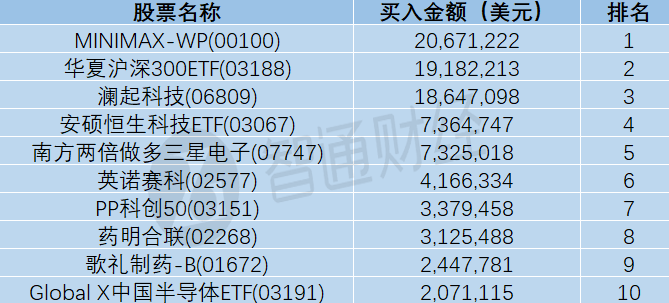
Group 1 - Korean investors are increasingly enthusiastic about allocating assets to Chinese markets, with over $8.8 million invested in various stocks and ETFs as of February 10, 2026 [1] - The top ten stocks purchased by Korean investors include MINIMAX-WP, 华夏沪深300ETF, and 澜起科技, with MINIMAX-WP receiving the highest investment of approximately $2.07 million [1][2] - Compared to 2025, there is a noticeable shift in Korean investment towards emerging technology companies in China, indicating a strategic pivot in investment focus [2] Group 2 - In 2025, the top ten stocks purchased by Korean investors included Xiaomi Group and Global X China Semiconductor ETF, with Xiaomi Group leading at approximately $87.75 million [3] - The investment trend shows a growing interest in new and emerging industries, particularly in technology and semiconductor sectors, reflecting a broader market strategy [2][3]



韩国投资者加码港股市场 科技板块受追捧 扫货MINIMAX-WP(00100)、英诺赛科(02577)
智通财经网· 2026-02-12 08:19
Group 1 - Korean investors are increasingly enthusiastic about allocating assets in China, with over $8.8 million invested in the Hong Kong Stock Exchange as of February 10 [1] - The top ten stocks purchased by Korean investors include MINIMAX-WP, 华夏沪深300ETF, and 澜起科技, among others, indicating a shift towards emerging technology companies [1][2] - The total investment amounts for the top ten stocks are as follows: MINIMAX-WP at $20.67 million, 华夏沪深300ETF at $19.18 million, and 澜起科技 at $18.64 million [2][3] Group 2 - Compared to 2025, Korean investors are now focusing on new emerging industries and technology companies, as evidenced by the change in their top ten investments [3] - In 2025, the top ten net purchases by Korean investors included Xiaomi Group and Global X China Semiconductor ETF, highlighting a different investment focus compared to 2026 [4][5] - The total investment amounts for the top ten stocks in 2025 were significantly higher, with Xiaomi Group at $87.75 million and Global X China Semiconductor ETF at $74.03 million [5]
拓普集团丨2025年收入稳健增长 “车+机器人+AI”协同【国联民生汽车 崔琰团队】
汽车琰究· 2026-02-12 06:17
Core Viewpoint - The company expects steady revenue growth in 2025, with projected revenue between 28.75 billion to 30.35 billion yuan, representing a year-on-year increase of 8.1% to 14.1%, while net profit attributable to shareholders is expected to decline by 3.4% to 13.4% [3] Group 1: Revenue Growth and Profitability - The median revenue for 2025 is projected at 29.55 billion yuan, reflecting an 11.1% year-on-year growth, with Q4 revenue expected to be between 7.82 billion to 9.42 billion yuan, indicating a year-on-year increase of 7.9% to 30.0% [4] - The decline in net profit is attributed to raw material price fluctuations and intensified market competition, leading to a decrease in gross margin, compounded by the complexities of the international situation [4] - The company is enhancing operational efficiency through large-scale procurement, smart manufacturing, and lean management, which helps to dilute R&D and operational costs [4] Group 2: Strategic Partnerships and Product Development - The company is strategically aligned with Tesla and emerging car manufacturers, aiming to penetrate the global supply chain, and has established stable partnerships with both international and domestic innovative car companies [5] - The company has developed eight product lines under the Tier 0.5 model, enhancing the value of single vehicle components, with a total value of approximately 30,000 yuan per vehicle [5] Group 3: Robotics and AI Applications - The company is actively expanding into robotics and AI applications, with a focus on products such as robotic actuators, sensors, and thermal management systems, and has secured orders worth 1.5 billion yuan as of June 30, 2025 [6] - Planned investments include 5 billion yuan for a robotics electric drive system production base and up to 300 million USD for a production base in Thailand, with expected completion by the end of 2025 [6] Group 4: Financial Projections - Revenue projections for 2025 to 2027 are 29.55 billion, 35.88 billion, and 42.84 billion yuan respectively, with net profits of 2.76 billion, 3.4 billion, and 4.26 billion yuan [7] - The expected EPS for 2025, 2026, and 2027 are 1.59, 1.96, and 2.45 yuan, with corresponding PE ratios of 45, 37, and 29 [8]

【月度分析】2026年1月份全国乘用车市场分析
乘联分会· 2026-02-12 06:06
Overall Market - In January 2026, the retail sales of passenger cars reached 1.544 million units, a year-on-year decrease of 13.9% [14] - The decline in retail sales is attributed to complex market factors and a historical pattern of fluctuating sales in January [14] - The end of the new energy vehicle purchase tax exemption in December 2025 has led to a recovery period for the new energy vehicle market, with some consumers having made purchases in December to take advantage of the policy [14] - January 2026 saw a significant increase in exports, with passenger car exports reaching 576,000 units, a year-on-year increase of 52.0% [16] - The production of passenger cars in January 2026 was 2.003 million units, a year-on-year decrease of 4.4% [16] - The wholesale volume for January 2026 was 1.973 million units, a year-on-year decrease of 6.2% [17] New Energy Market - In January 2026, retail sales of new energy vehicles (NEVs) totaled 596,000 units, down 20.0% year-on-year [18] - The penetration rate of NEVs in the domestic market was 38.6%, while the export penetration rate was 49.6% [15] - The production of NEVs reached 938,000 units, a slight decrease of 0.6% year-on-year [18] - The wholesale volume of NEVs was 864,000 units, down 3.3% year-on-year [18] - The export of NEVs reached 286,000 units, a significant increase of 103.6% year-on-year, accounting for 49.6% of total passenger car exports [22] Company Performance - BYD, Geely, and Chery are leading in the new energy vehicle market, with BYD's sales reaching 205,518 units in January 2026 [24] - The market share of domestic brands in the new energy sector is increasing, with a notable rise in the export of new energy vehicles to Europe and Southeast Asia [15][22] - The new energy vehicle market is characterized by a shift towards higher quality products, with an increase in the proportion of high-end NEVs [15] Market Outlook - February 2026 is expected to see lower sales due to the shorter working days caused by the extended Spring Festival holiday [27] - The market is anticipated to stabilize post-holiday, with potential recovery in the entry-level electric vehicle segment [28] - The overall sentiment in the consumer market remains cautious, influenced by high costs and economic factors [28]




拓普集团(601689):系列点评十五:2025年收入稳健增长,“车+机器人+AI”协同
Guolian Minsheng Securities· 2026-02-12 05:06
Investment Rating - The report maintains a "Recommended" rating for the company [4]. Core Insights - The company is expected to achieve a revenue of 287.5 to 303.5 billion yuan in 2025, representing a year-on-year growth of 8.1% to 14.1%. The net profit attributable to shareholders is projected to be between 26.0 to 29.0 billion yuan, reflecting a decline of 13.4% to 3.4% year-on-year [1][2]. - The revenue midpoint for 2025 is estimated at 295.5 billion yuan, indicating an 11.1% year-on-year increase. The fourth quarter of 2025 is expected to see revenue between 78.2 to 94.2 billion yuan, with a year-on-year growth of 7.9% to 30.0% [2]. - The company has successfully established a Tier 0.5 collaboration model, gaining recognition from both domestic and international clients, which has led to an increase in the per-vehicle component value [2][9]. - The company is accelerating its international expansion with overseas production bases and is implementing cost-reduction measures through scale procurement and smart manufacturing [2][9]. Financial Projections - For 2025, the company is projected to have total revenue of 29,550 million yuan, with a growth rate of 11.1%. The net profit attributable to shareholders is expected to be 2,764 million yuan, showing a decline of 7.9% [4][10]. - The earnings per share (EPS) for 2025 is estimated at 1.59 yuan, with a price-to-earnings (PE) ratio of 45 [4][10]. - The company anticipates a revenue increase to 35,877 million yuan in 2026 and 42,838 million yuan in 2027, with corresponding net profits of 3,400 million yuan and 4,260 million yuan respectively [4][10].
从“政策驱动”转向“产品驱动”地方两会擘画汽车产业新赛道
Xin Lang Cai Jing· 2026-02-11 20:52
Core Viewpoint - The year 2026 marks the beginning of the "14th Five-Year Plan" and presents significant opportunities for the development of the intelligent connected new energy vehicle industry, with a shift from policy-driven to product-driven growth in the automotive market [1] Policy Support - Consumption is a strong driver of economic growth, with the automotive industry being a strategic pillar for the national economy, crucial for stabilizing growth and expanding domestic demand [1] - The "trade-in" policy effectively supported the automotive market in 2025, with over 11.5 million vehicles traded in, of which nearly 60% were new energy vehicles, leading to a retail market share exceeding 50% for nine consecutive months [1] - Government reports from various regions frequently mention support for large consumer goods like automobiles and home appliances [2] Consumption Promotion Measures - Multiple provinces, including Hebei and Jilin, have proposed actions to stabilize and promote large consumer goods, particularly automobiles and home appliances [2] - The Ministry of Commerce plans to optimize the implementation of trade-in policies and conduct pilot reforms in automotive circulation to further unleash consumption potential [3] - Various local governments have introduced specific policies for trade-in subsidies, with Shanghai offering up to 20,000 yuan in subsidies for personal consumers [3] Technological Innovation - Continuous policy support for consumption provides stability for the automotive market, while technological innovation and systematic industrial layout are key to enhancing quality in the automotive industry [5] - The automotive market is shifting towards competition based on comprehensive capabilities, including scale, cost, technology, and business models [6] Industry Development Trends - The focus on intelligent, green, and integrated development is seen as a way to enhance the resilience and competitiveness of the automotive industry [7] - Various regions are accelerating the transition to new energy and intelligent connected vehicles, with expected production growth of around 15% for new energy vehicles in Jilin Province [7] Collaborative Development - The establishment of industrial clusters can drive synergy among upstream and downstream enterprises, enhancing the overall ecological advantages of the industry [8] - Regions like Guangdong and Anhui are emphasizing the development of new energy and intelligent connected vehicle industries, aiming to create significant industrial clusters [9] Urban Synergy - Internal collaboration within urban agglomerations contributes to the overall transformation and upgrading of the industry, with plans to strengthen the intelligent connected new energy vehicle sector in the Beijing-Tianjin-Hebei region [10] - The automotive industry is identified as a key area for developing new quality productivity, with expectations for accelerated progress in intelligentization and the rollout of L3-level autonomous driving policies [10]
中国边缘AI芯片第一股!两江新区直投企业爱芯元智登陆港交所
Xin Lang Cai Jing· 2026-02-11 10:16
Core Viewpoint - The Chongqing Liangjiang New Area High-Quality Development Industry Private Equity Investment Fund has successfully facilitated the listing of AI chip company Aixin Yuanzhi Semiconductor Co., Ltd. on the Hong Kong Stock Exchange, marking it as the first edge computing AI chip enterprise to be listed in Hong Kong [2][11]. Group 1: Investment and Listing Details - Aixin Yuanzhi completed its transition from Pre-IPO investment to listing on the Hong Kong Stock Exchange in just 260 days, showcasing the fund's deep involvement and efficient decision-making process [5][14]. - This listing represents the first direct investment exit for the Liangjiang Industry Fund in 2026 and highlights the fund's focus on key industries such as intelligent connected new energy vehicles and next-generation electronic information [4][13]. Group 2: Company Overview - Aixin Yuanzhi has been dedicated to the field of artificial intelligence perception and edge computing chips, with its product Aixin Zhimou capable of real-time pixel-level optimization under extreme lighting conditions, providing reliable technical support for advanced driver-assistance systems [7][16]. - As of September 30, 2025, Aixin Yuanzhi has delivered over 165 million system-level chips, with more than 510,000 chips specifically for intelligent vehicles, establishing itself as the world's leading provider of high-end visual edge AI inference chips [7][16]. Group 3: Future Investment Strategy - The Liangjiang Fund plans to continue its investment strategy focused on early-stage, small-scale, and technology-driven ventures, particularly in semiconductors, artificial intelligence, and intelligent equipment [9][18]. - The fund aims to leverage capital to connect technology, industry, and market, promoting more high-quality technology enterprises to enter the capital market and contributing to the growth of new productive forces in the Liangjiang New Area [9][18].