
常熟银行

Search documents
农商行板块1月13日涨0.62%,渝农商行领涨,主力资金净流入5648.9万元
Zheng Xing Xing Ye Ri Bao· 2026-01-13 09:06
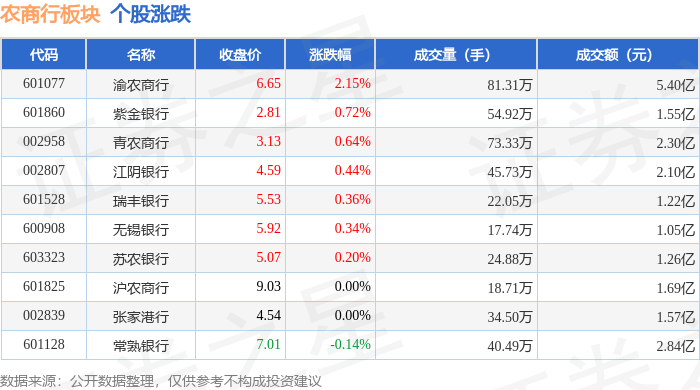
Core Viewpoint - The agricultural commercial bank sector experienced a rise of 0.62% on January 13, with Chongqing Rural Commercial Bank leading the gains, while the Shanghai Composite Index fell by 0.64% and the Shenzhen Component Index dropped by 1.37% [1] Group 1: Market Performance - Chongqing Rural Commercial Bank (601077) closed at 6.65, up by 2.15% with a trading volume of 813,100 shares and a transaction value of 540 million yuan [1] - Other notable banks included Zijin Bank (601860) with a closing price of 2.81, up by 0.72%, and Qingnong Bank (002958) at 3.13, up by 0.64% [1] - The overall trading volume for the agricultural commercial bank sector was significant, with total net inflow of main funds amounting to 56.49 million yuan [1] Group 2: Fund Flow Analysis - Main funds saw a net inflow of 17.50 million yuan into Chongqing Rural Commercial Bank, while retail investors experienced a net outflow of 47.08 million yuan [2] - Jiangyin Bank (002807) had a net inflow of 13.55 million yuan from main funds, but retail investors withdrew 8.41 million yuan [2] - The fund flow data indicates a mixed sentiment among retail and institutional investors, with main funds generally showing positive interest in several banks while retail investors were more cautious [2]




银行业 2026 年经营展望:资产负债篇:到期存款流向是资负格局的关键
Guoxin Securities Hongkong· 2026-01-13 05:12
Investment Rating - The report maintains an "Outperform" rating for the banking sector [6] Core Insights - The expected M2 growth rate for 2026 is approximately 7.5%, with credit growth around 6.0% and social financing growth at about 8.0%. This aligns with the goal of stabilizing economic growth and ensuring reasonable price recovery [2][18][19] - The banking sector is expected to see a structural differentiation in retail credit, with corporate lending remaining the primary contributor to new loans, accounting for approximately 80% to 85% of new loans [33][37] - The report highlights the importance of deposit flows, particularly the trend of deposits moving from large banks to smaller banks, which will influence the asset-liability gap for large banks in 2026 [3][41] Summary by Sections M2 and Credit Growth - The M2 increment for 2026 is estimated at about 25.4 trillion yuan, with fiscal net injection contributing approximately 12.0 trillion yuan and bank credit (including write-offs and ABS) contributing around 16.8 trillion yuan [2][29][24] - The anticipated new social financing for 2026 is about 35.3 trillion yuan, reflecting a growth rate of approximately 8.0% [30][32] Credit Allocation - Corporate lending is expected to remain strong, while retail lending will show structural improvements, contributing about 10% to 15% of new loans [33][37] - The report notes that retail credit is likely to experience a slight positive growth, particularly in quality consumption scenarios and personal operating loans [33][37] Asset-Liability Dynamics - The asset-liability gap for large banks is projected to continue, with marginal changes primarily driven by the liability side, influenced by deposit flows [3][41] - The report estimates that the maturity of fixed-term deposits for the six major banks in 2026 will be around 57 trillion yuan, with 2-year and longer-term deposits accounting for 27 to 32 trillion yuan [49][52] Investment Recommendations - The report recommends focusing on high-quality stocks with improving fundamentals, specifically highlighting Ningbo Bank and Changshu Bank, while also suggesting attention to Changsha Bank and Chongqing Rural Commercial Bank for potential excess returns [4] - Additionally, it emphasizes the value of stable, high-dividend stocks, recommending China Merchants Bank, Industrial and Commercial Bank of China, and Jiangsu Bank [4]





银行业周报(20260105-20260111):银行理财收益率走低,打通入市卡点可提升吸引力-20260112
Huachuang Securities· 2026-01-12 14:52
Investment Rating - The report maintains a "Recommended" rating for the banking sector, indicating an expectation that the sector will outperform the benchmark index by more than 5% in the next 3-6 months [25]. Core Insights - The average yield of bank wealth management products has been on a downward trend, with the average yield falling below the average personal deposit rate of listed banks for the first time since 2012. This trend is attributed to regulatory changes and market conditions [7][8]. - There is a potential for increasing the allocation of equity assets in wealth management products, which could enhance overall returns and attract more investors. Currently, equity products account for only 0.08% of the total wealth management product market, which has a total size of 31.63 trillion yuan [2][8]. - The banking sector is expected to see a systematic recovery in valuations in 2026, driven by a combination of improved fundamentals and capital inflows. The investment logic is shifting from pure defensive strategies to a dual focus on dividends and growth [8]. Summary by Sections Wealth Management Products - As of December 2025, the total market size of wealth management products reached 31.63 trillion yuan, with fixed income products making up 76.60%, cash management products 20.87%, mixed products 2.37%, and equity products only 0.08% [2]. - Regulatory bodies are exploring ways to facilitate greater equity market participation by wealth management funds, which could lead to an increase in the proportion of equity investments [2][8]. Company Earnings Forecasts and Valuations - Key companies in the banking sector have been rated as "Recommended" with projected earnings per share (EPS) and price-to-earnings (PE) ratios indicating potential for growth. For example, Ningbo Bank is projected to have an EPS of 4.33 yuan in 2025 with a PE ratio of 6.48 [3]. - The report highlights several banks, including China Merchants Bank and Jiangsu Bank, as having strong growth potential and favorable valuations, suggesting they are well-positioned for investment [3][8]. Market Performance - The report notes that the banking index underperformed the broader market indices, with a weekly decline of 1.90% compared to a 2.79% increase in the CSI 300 index [7]. - The report emphasizes the importance of monitoring market trends and the performance of individual banks to identify investment opportunities [5][8].
农商行板块1月12日跌0.14%,渝农商行领跌,主力资金净流出5928.29万元
Zheng Xing Xing Ye Ri Bao· 2026-01-12 09:04
Market Overview - The agricultural commercial bank sector experienced a decline of 0.14% on January 12, with Yunnan Agricultural Commercial Bank leading the drop [1] - The Shanghai Composite Index closed at 4165.29, up 1.09%, while the Shenzhen Component Index closed at 14366.91, up 1.75% [1] Individual Bank Performance - Zijin Bank closed at 2.79, with an increase of 0.72% and a trading volume of 386,600 shares, totaling a transaction value of 107 million yuan [1] - Su Nong Bank closed at 5.06, up 0.40%, with a trading volume of 204,900 shares, totaling 104 million yuan [1] - Ruifeng Bank closed at 5.51, up 0.36%, with a trading volume of 181,100 shares, totaling approximately 99.28 million yuan [1] - Qing Nong Bank closed at 3.11, up 0.32%, with a trading volume of 422,100 shares, totaling 131 million yuan [1] - Yunnan Agricultural Commercial Bank closed at 6.51, down 0.91%, with a trading volume of 690,100 shares [1] Capital Flow Analysis - The agricultural commercial bank sector saw a net outflow of 59.28 million yuan from institutional investors, while retail investors contributed a net inflow of 49.11 million yuan [1] - The table of capital flow indicates that Changshu Bank had a net inflow of 7.30 million yuan from institutional investors, while it faced a net outflow of 22.43 million yuan from speculative funds [2] - Yunnan Agricultural Commercial Bank experienced a net outflow of 21.20 million yuan from institutional investors, but a net inflow of 42.56 million yuan from speculative funds [2]


银行业周度追踪2026年第1周:如何理解银行股开年调整?-20260112
Changjiang Securities· 2026-01-12 04:41
Investment Rating - The investment rating for the banking sector is "Positive" and is maintained [12]. Core Insights - In the first week of 2026, the banking sector continued to adjust, with a cumulative decline of 1.9% in the banking index, significantly underperforming the CSI 300 and ChiNext indices by -4.7% and -5.8% respectively. Despite this, the fundamental expectations for the sector remain unchanged, and the market's risk appetite has notably increased [2][6][19]. - The main banks are expected to maintain stable growth in performance throughout 2026. Following recent adjustments, the PB-ROE valuation attractiveness of bank stocks has further increased, suggesting a favorable timing for allocation [2][6][19]. Summary by Sections Market Performance - The banking sector's performance in the first week of 2026 showed a cumulative decline of 1.9%, with significant negative excess returns compared to the CSI 300 and ChiNext indices [6][19]. - Individual stocks such as Chongqing Rural Commercial Bank saw price recovery after management uncertainties were resolved, while stable performers like Hangzhou Bank led the city commercial bank sector [2][6][19]. Fundamental Analysis - The banking sector's performance has been influenced by structural concerns, particularly regarding real estate and retail asset quality. Despite these concerns, overall performance remains stable with steady growth [8][37]. - The LTV (Loan-to-Value) ratios for major banks are stable at 40%-50%, providing a safety margin despite rising asset quality pressures in mortgage loans [8][37]. Trading Dynamics - The increase in market risk appetite has continued to suppress bank stock valuations. Historically, January has seen excess returns for bank stocks, but this year, the rapid recovery in market sentiment has led to underperformance [9][38]. - The report recommends focusing on high-quality city commercial banks such as Hangzhou Bank, Nanjing Bank, and Jiangsu Bank, as well as dividend-oriented assets like Bank of Communications and China Merchants Bank [9][38]. Convertible Bonds - The prices of convertible bonds linked to bank stocks have generally followed the sector's adjustment, with the distance to mandatory conversion prices widening. The report highlights potential trading opportunities in convertible bonds for banks like Changshu Bank and Shanghai Bank, which have stable fundamental performance expectations [7][32].


常熟农商行取得基于大模型的银行数据文件解析方法及系统专利
Sou Hu Cai Jing· 2026-01-09 02:15
Group 1 - Jiangsu Changshu Rural Commercial Bank Co., Ltd. has obtained a patent for a method and system for bank data file analysis based on large models, with the authorization announcement number CN120849363B and an application date of September 2025 [1] - The bank was established in 2001 and is located in Suzhou, primarily engaged in monetary financial services [1] - The registered capital of Jiangsu Changshu Rural Commercial Bank is approximately 3.316 billion RMB [1] Group 2 - The bank has made investments in 7 enterprises and participated in 1,164 bidding projects [1] - It holds 231 trademark information entries and 31 patent information entries, along with 115 administrative licenses [1]
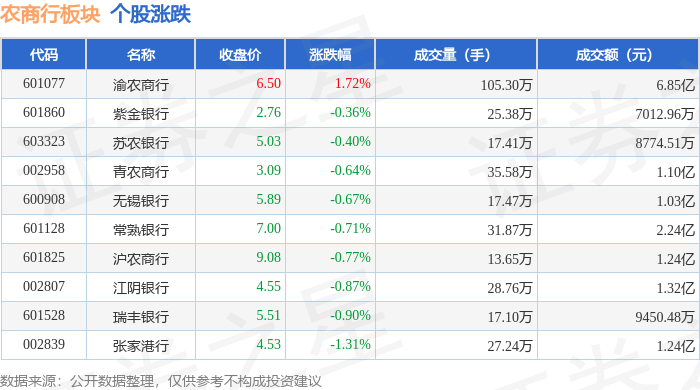
农商行板块1月8日跌0.18%,张家港行领跌,主力资金净流出3731.72万元
Zheng Xing Xing Ye Ri Bao· 2026-01-08 08:56
Core Viewpoint - The agricultural commercial bank sector experienced a slight decline of 0.18% on January 8, with Zhangjiagang Bank leading the drop [1] Group 1: Market Performance - The Shanghai Composite Index closed at 4082.98, down 0.07%, while the Shenzhen Component Index closed at 13959.48, down 0.51% [1] - The agricultural commercial bank sector's individual stock performance showed varied results, with Yunnan Agricultural Commercial Bank rising by 1.72% to a closing price of 6.50 [1] Group 2: Trading Volume and Turnover - The trading volume and turnover for various banks were reported, with Jiangyin Bank having a turnover of 1.32 billion and a trading volume of 287,600 shares [1] - The overall net outflow of main funds from the agricultural commercial bank sector was 37.32 million, while retail funds saw a net outflow of 18.16 million [1] Group 3: Fund Flow Analysis - The main fund inflow for Ruifeng Bank was 4.77 million, accounting for 5.04% of its total, while it faced a retail net outflow of 8.39 million [2] - Zhangjiagang Bank experienced a significant main fund outflow of 6.71 million, with retail investors also withdrawing 7.63 million [2]
陕国投拟8亿“入局”长安银行增资 区域银行资本补充潮起
Jing Ji Guan Cha Wang· 2026-01-08 03:18
Group 1: Core Insights - Shaanxi International Trust Co., Ltd. (Shaanxi Guotou) plans to invest up to 800 million yuan in Chang'an Bank's capital increase, acquiring no more than 209 million shares at a price of 3.83 yuan per share, which will be used to supplement core Tier 1 capital [1] - The capital increase is part of a broader trend where regional banks are receiving shareholder support to strengthen their capital bases amid intensified regulatory constraints and competitive pressures [1][7] - The investment by Shaanxi Guotou reflects a strategic shift from being a provider of financial products to becoming a long-term shareholder in core financial institutions, aiming to stabilize income and enhance influence within the regional financial system [2][3] Group 2: Financial Performance and Challenges - Chang'an Bank faces significant capital pressure, with its core Tier 1 capital adequacy ratio declining from 9.15% at the end of 2024 to 8.23% by September 2025, indicating a growing tension between asset expansion and capital replenishment [4] - The bank's revenue and net profit have shown a downward trend, with revenue decreasing from 9.779 billion yuan in 2023 to 9.461 billion yuan in 2024, and net profit dropping from 2.445 billion yuan in 2023 to 2.315 billion yuan in 2024 [4] - The bank's provision coverage ratio has decreased from 191.15% at the end of 2023 to 151.77% by September 2025, although it remains above regulatory requirements, indicating a buffer against potential asset quality fluctuations [5] Group 3: Strategic Implications - The pricing strategy for the capital increase reflects a discount to the book value, indicating a cautious market valuation of regional bank equities in the current economic environment [6] - The collective action of the Shaanxi state-owned enterprises in this capital increase is not merely a financial investment but a strategic move by the local government to maintain regional financial stability and enhance collaboration between finance and industry [6] - The ongoing capital increase trend among regional banks signifies a shift from "blood transfusion" to "blood production," highlighting the need for banks to convert capital advantages into sustainable competitive strengths amid structural changes in the banking environment [8]

国信证券晨会纪要-20260108
Guoxin Securities· 2026-01-08 01:30
Group 1: Banking Industry Outlook - The banking industry is expected to see M2 growth target around 7.5%, with credit growth at approximately 6.0% and social financing growth at about 8.0% for 2026, aligning with economic growth expectations [6][7] - The total M2 increment for 2026 is estimated to be around 25.4 trillion yuan, with fiscal net injection contributing approximately 12.0 trillion yuan and bank credit contributing about 16.8 trillion yuan [6] - The six major banks are projected to have a total of 57 trillion yuan in maturing time deposits in 2026, with a significant portion expected to flow from large banks to smaller banks [8] Group 2: Credit Allocation and Trends - Corporate lending is expected to contribute approximately 80%-85% of new loans, while retail lending is anticipated to show marginal improvement, contributing about 10%-15% [7] - The phenomenon of deposit migration from large banks to smaller banks is a key factor affecting the asset-liability gap in 2026, with large banks continuing to play a dominant role in credit and government bond allocations [7][8] Group 3: Investment Recommendations - The report suggests focusing on high-quality stocks such as Ningbo Bank and Changshu Bank, while also considering stable high-dividend stocks like China Merchants Bank and Industrial and Commercial Bank of China for investment opportunities in 2026 [8] Group 4: Wealth Management and Financial Products - The wealth management industry is experiencing a slight contraction but has reached a historical high with a total scale of around 31.6 trillion yuan by the end of December 2025, reflecting a 10% year-on-year growth [9][10] - The transition to net value-based products in the banking sector is pushing wealth management companies to innovate, focusing on stabilizing net values and exploring new product designs such as dividend-type products [10][11] Group 5: Social Services Industry Insights - The domestic travel market showed a positive trend during the New Year holiday, with an estimated 142 million domestic trips taken, reflecting a 5.2% increase compared to 2024 [15][16] - Investment recommendations for 2026 emphasize the potential for service consumption growth, particularly in high-end recovery and the new cycle of duty-free shopping, as well as the restaurant sector [15][16] Group 6: AI and 3D Printing Industry Developments - The global consumer-grade 3D printing market is projected to grow from 4.1 billion USD in 2024 to 16.9 billion USD by 2029, with a compound annual growth rate of 33% [17][18] - Domestic companies are leading the consumer-grade 3D printing market, with significant market shares held by firms like Tuo Zhu Technology and Chuangxiang Sanwei [17][18] Group 7: AI Application and Market Growth - The AI market in China is expected to grow from 93.7 billion yuan in 2022 to 160.7 billion yuan in 2024, with a compound annual growth rate of 31% [23] - The leading AI company, Zhiyuan, has seen rapid revenue growth, with a 35.03% year-on-year increase in the first half of 2025, despite facing short-term profit pressures [20][21]
央行预告开展11000亿元买断式逆回购
Feng Huang Wang· 2026-01-07 12:31
Group 1 - The central bank announced a 1.1 trillion yuan reverse repurchase operation on January 8 to maintain ample liquidity in the banking system, marking the third consecutive month of equal-scale operations [1] - The upcoming maturity of 1.1 trillion yuan in 3-month reverse repos on January 8 indicates a continuation of the policy tool without increasing the scale, reflecting the central bank's strategy to manage liquidity [1] - Market analysts expect the central bank to conduct another 6-month reverse repurchase operation in January, with a likelihood of increasing the scale due to the upcoming maturity of 600 billion yuan [1][4] Group 2 - Factors affecting the funding environment in January include credit demand, tax payments, government bond repayments, and cash withdrawals for the Spring Festival, which may tighten liquidity [2][3] - The anticipated issuance of local government bonds in January, following the early allocation of the 2026 debt limit, is expected to contribute to a tighter funding situation [4] - The first month of the year typically sees higher tax payments, which will further impact the liquidity landscape, as companies confirm and declare their previous year's income tax [4] Group 3 - Analysts predict that the central bank may increase its purchases of government bonds in January, with a possibility of a reserve requirement ratio (RRR) cut before the Spring Festival [6] - The overall expectation for the first quarter of 2026 includes potential interest rate cuts and reserve requirement reductions, with liquidity easing being a significant factor [5][6] - The central bank's approach in January is expected to be less aggressive in tightening liquidity compared to previous years, indicating a potential increase in government bond transactions and a higher likelihood of RRR cuts [6]