青岛啤酒

Search documents
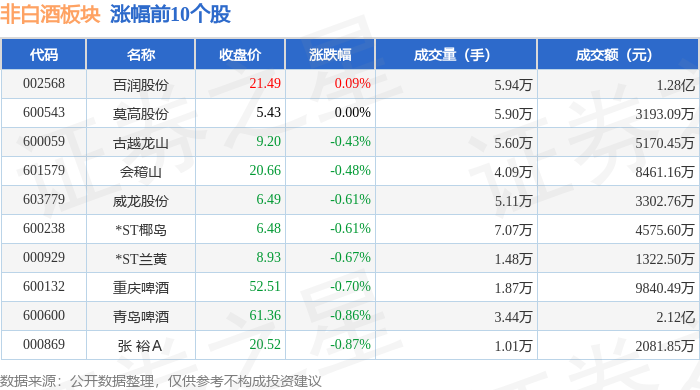
非白酒板块12月29日跌1.42%,惠泉啤酒领跌,主力资金净流出8152.72万元
Zheng Xing Xing Ye Ri Bao· 2025-12-29 09:06
Market Overview - The non-white liquor sector experienced a decline of 1.42% on the previous trading day, with Huichuan Beer leading the drop [1] - The Shanghai Composite Index closed at 3965.28, up 0.04%, while the Shenzhen Component Index closed at 13537.1, down 0.49% [1] Stock Performance - Key stocks in the non-white liquor sector showed varied performance, with Baijiu Co. closing at 21.49, up 0.09%, while other notable declines included Chongqing Beer at 52.51, down 0.70%, and Gu Yue Long Shan at 9.20, down 0.43% [1] - The trading volume for Baijiu Co. was 59,400 shares, with a transaction value of 128 million yuan, while Chongqing Beer had a trading volume of 18,700 shares and a transaction value of 98.4 million yuan [1] Capital Flow - The non-white liquor sector saw a net outflow of 81.52 million yuan from institutional investors, while retail investors contributed a net inflow of 9.23 million yuan [2] - Notable capital flows included Yanjing Lang with a net inflow of 18.08 million yuan from institutional investors, while ST Yedao experienced a net outflow of 9.32 million yuan [3]


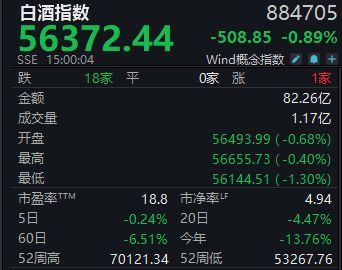
白酒指数周跌0.24%,燕京啤酒年线“翻绿”丨酒市周报
Mei Ri Jing Ji Xin Wen· 2025-12-28 11:29
Group 1 - The core viewpoint of the news highlights the mixed performance of the liquor industry, with the Wind liquor index declining by 0.24% despite a strong rebound from Shui Jing Fang, which saw a weekly increase of 6.87% [1][2] - The beer sector experienced significant declines, with major brands like Yanjing Beer and Huichuan Beer seeing stock price drops exceeding 3% this week, and Yanjing Beer turning from gains to a year-to-date decline of 1.27% [1][4] - The stock performance of liquor companies was varied, with only Shui Jing Fang and Zhen Jiu Li Du showing notable increases, the latter achieving a weekly rise of 10.75% and a year-to-date increase of 34.59% [2][3] Group 2 - Fundamental analysis indicates that leading liquor companies are prioritizing stable operations for 2026, focusing on inventory reduction, price recovery, and demand-driven sales, with upcoming policies for the Spring Festival being key indicators [3] - Yanjing Beer is actively pursuing digital transformation, expanding new retail channels, and enhancing brand marketing to improve its competitive edge, despite recent stock price declines [4][5] - Experts suggest that Yanjing Beer needs to enhance its brand recognition to compete more effectively with Qingdao Beer, as the gap lies in brand awareness rather than product quality [5]



2025年11月中国啤酒进出口数量分别为0.26亿升和0.66亿升
Chan Ye Xin Xi Wang· 2025-12-28 01:46
Group 1 - The core viewpoint of the article highlights the trends in China's beer import and export market, indicating a significant decline in imports and a notable increase in exports for November 2025 [1] Group 2 - In November 2025, China's beer import volume was 0.26 billion liters, representing a year-on-year decrease of 23.6%, while the import value was $0.38 billion, down 13.4% year-on-year [1] - Conversely, beer exports in November 2025 reached 0.66 billion liters, showing a year-on-year increase of 22.5%, with an export value of $0.44 billion, up 14.8% year-on-year [1] Group 3 - The article references a report by Zhiyan Consulting, which provides an analysis of the non-alcoholic beer industry market dynamics and competitive strategies in China from 2026 to 2032 [1] - Zhiyan Consulting is noted as a leading industry consulting firm in China, specializing in in-depth industry research reports, business plans, feasibility studies, and customized services [1]



食品饮料行业双周报(2025、12、12-2025、12、25):欧盟乳制品反补贴落地,把握结构性机会-20251226
Dongguan Securities· 2025-12-26 09:37
Investment Rating - The report maintains an "Overweight" rating for the food and beverage industry, indicating an expectation that the industry index will outperform the market index by more than 10% over the next six months [55]. Core Insights - The report highlights the structural opportunities arising from the EU's anti-subsidy measures on dairy products, which are expected to benefit domestic alternatives such as cheese and cream [50]. - The white liquor sector is experiencing a weak recovery in consumption, with expectations of continued pressure on sales in the fourth quarter and first quarter of the following year, but a potential rebound in the second quarter due to low base effects [50][51]. - The report emphasizes the importance of monitoring inventory levels ahead of the Spring Festival and the operational goals set by various liquor companies for the upcoming year [51]. - The report suggests focusing on high-end liquor brands like Kweichow Moutai (600519) and other regional brands such as Shanxi Fenjiu (600809) and Guojiao Liquor (000596) [51]. - The report notes that approximately 87% of stocks in the food and beverage sector recorded positive returns during the review period, with notable performers including Anji Food (+27.96%) and Huanlejia (+20.94%) [15]. Summary by Sections Market Review - From December 12 to December 25, 2025, the SW food and beverage industry index rose by 1.33%, underperforming the CSI 300 index by approximately 0.66 percentage points [11]. - Most sub-sectors outperformed the CSI 300 index, with the baking sector showing the highest increase of 7.63% [13]. Industry Data Tracking - **Liquor Sector**: The price of Feitian Moutai increased to 1575 RMB/bottle, while Guojiao 1573 decreased to 840 RMB/bottle [21]. - **Condiments Sector**: Prices for soybean meal and white sugar decreased, with soybean prices at 4288.90 RMB/ton [24]. - **Beer Sector**: Aluminum prices increased while glass and corrugated paper prices decreased; barley prices remained stable at 2200.00 RMB/ton [29]. - **Dairy Sector**: Fresh milk prices rose slightly to 3.03 RMB/kg [37]. - **Meat Sector**: The average wholesale price of pork decreased to 17.44 RMB/kg, with a year-on-year decline of 22.04% [39]. Important News - The report discusses the preliminary ruling on anti-subsidy measures for EU dairy imports, which is expected to positively impact domestic dairy producers [44][45]. - It also notes a decline in the production of white liquor and beer in November, with white liquor production down 11.3% year-on-year [43]. Company Announcements - Kweichow Moutai plans to distribute cash dividends amounting to at least 75% of its net profit for the years 2024-2026, alongside a share buyback plan [52]. - Haitian Flavoring plans to maintain a cash dividend payout ratio of no less than 80% of its net profit for the next three years [48].



青岛以场景开放助产业升级
Jing Ji Ri Bao· 2025-12-25 22:04
Group 1 - Qingdao is actively promoting the opening of application scenarios for state-owned enterprises, launching 24 scenarios in the first half of 2024 and an additional 65 digital transformation and AI scenarios this year, covering key areas such as strategic emerging industries, traditional advantageous industries, and public services [1][2] - The initiative has led to the creation of benchmark application demonstration scenarios, resulting in 33 application cases that help enterprises break through technological boundaries [1] - Companies like Guoxin Group and Huadong Group are collaborating with research institutions and technology companies to develop advanced technologies, including AI applications in aquaculture and quantum computing devices [1] Group 2 - The open scenarios identify pain points and opportunities in the industrial chain, guiding innovation and development while attracting investment and talent [2] - Qingdao Beer Smart Industrial Park has gathered 11 supporting enterprises to address supply chain issues for fresh products, ensuring nationwide delivery within 24 hours through a multi-modal transportation network [2] - The Qingdao State-owned Assets Supervision and Administration Commission emphasizes the importance of scenario openness in leading technological innovation, industrial chain development, and investment attraction, focusing on building a modern industrial system [2]
华源晨会精粹20251225-20251225
Hua Yuan Zheng Quan· 2025-12-25 14:38
Group 1: Food and Beverage Industry - The report indicates a gradual recovery in the food and beverage sector, with soft drinks and snacks leading the recovery, followed by the catering supply chain, condiments, dairy products, beer, and finally, liquor [2][9][10] - The analysis draws parallels with Japan's 1990s consumption differentiation, highlighting that successful industries often address demand pain points and have low penetration rates [10][11] - Investment strategies focus on sectors with stabilizing ROA and potential valuation recovery, emphasizing price as the primary selection logic, while volume is secondary [11][12] Group 2: Construction and Building Materials - The construction sector is expected to experience a "spring rally" in 2026, supported by historical investment patterns and major national projects [13][14] - The report highlights three core investment themes: major national projects, high-dividend low-valuation state-owned enterprises, and private construction firms leveraging cash flow for new growth areas [14][15] - Infrastructure investment data shows a decline in both narrow and broad infrastructure investment, indicating a need for policy support to stabilize the sector [15][16] Group 3: Real Estate Industry - The real estate sector continues to face pressure, with significant declines in new housing sales and investment, despite government efforts to promote high-quality development [18][20] - The report notes that the Ministry of Housing and Urban-Rural Development emphasizes maintaining a balance in supply and demand, which is crucial for economic stability [20][22] - Specific data indicates a 31.4% year-on-year decline in real estate development investment and a 26.1% drop in sales revenue, highlighting ongoing challenges in the market [20][21] Group 4: Electronics and Robotics - The report on Changying Precision emphasizes the introduction of employee stock ownership and stock option plans to enhance long-term development confidence and attract core talent [23][24] - The company is positioned as a leader in solder paste printing equipment, with a focus on high-end product demand driven by AI trends [33][34] - New product lines, including dispensing and packaging equipment, are expected to contribute to growth, with significant revenue increases anticipated [34][36] Group 5: Media Industry - The report on Giant Legend highlights the rapid growth of its IPs, particularly the "Zhou Classmate" and "Liu Genghong," which have gained substantial popularity on social media platforms [28][29] - The company is expanding its strategic investments to enhance collaboration with international stars and develop consumer products linked to its IPs [29][30] - Future growth is expected through a diversified approach that integrates emotional value into various products and experiences, positioning the company as a "disseminator of happiness" [30][31] Group 6: Mechanical and Building Materials - The report on Kaige Precision Machine outlines the company's leadership in solder paste printing equipment and its expansion into new product categories driven by AI [33][34] - The company is expected to see significant growth in its new product lines, including flexible automation equipment, which are crucial for enhancing manufacturing efficiency [34][36] - Profit forecasts indicate strong growth potential, with expected net profits increasing significantly over the next few years [36]


白酒板块午后直线拉升!水井坊涨停,贵州茅台涨1%
Mei Ri Jing Ji Xin Wen· 2025-12-25 05:42
Group 1 - The core viewpoint of the news highlights a significant rise in the liquor sector, particularly after Beijing's announcement to further relax housing purchase restrictions, which is expected to stimulate a cyclical recovery in the economy [1] - As of December 25, 2025, the food and beverage industry has experienced a decline of over 7% year-to-date, ranking it as the worst-performing sector among 31 Shenwan primary industries, indicating a potential for the fifth consecutive year of negative returns if the decline is not mitigated in the remaining trading days [1] - Looking ahead to 2026, many institutions are optimistic about a turnaround in the food and beverage sector, particularly in liquor and restaurant supply chains, following a five-year adjustment period from 2021 to 2025 [1] Group 2 - The food and beverage ETF (515170.SH) is based on the CSI sub-index for the food and beverage industry, focusing on leading liquor companies such as Kweichow Moutai, Wuliangye, and Luzhou Laojiao, which together account for nearly 60% of the index weight [2] - The ETF also includes leading consumer food companies, providing a diversified investment opportunity for individual investors to capture potential recovery in the industry [2] - The ETF and its linked funds are considered effective tools for investors looking to engage with the sector at a low capital threshold while diversifying their exposure [2]
华源证券:食品饮料板块复苏分化 关注ROA企稳与结构性景气赛道
智通财经网· 2025-12-25 03:57
Core Viewpoint - The report from Huayuan Securities indicates a recovery sequence in the food and beverage industry, with soft drinks and snacks leading the recovery, followed by the catering supply chain, condiments, dairy products, beer, and finally, liquor [1][2]. Group 1: Recovery Sequence Analysis - The recovery rhythm of different consumption sectors shows both differences and commonalities, driven by industry supply-demand dynamics and supply chain structures [2]. - The commonality lies in the prevailing competition in the existing market, where companies focus on increasing sales to digest capacity and enhance operational efficiency [2]. - ROA (Return on Assets) is identified as a leading indicator for the operational recovery of consumer enterprises, with a detailed analysis of the stages of enterprise and channel adjustments [2]. Group 2: Historical Context and Insights - An analysis of Japan's consumption differentiation in the 1990s reveals that industries that can capture structural opportunities typically meet two conditions: addressing demand pain points and having low penetration rates [3]. - The rapid development of cost-effective options and health-oriented niche categories in Japan during that period illustrates the potential for growth in low-penetration sectors [3]. Group 3: Investment Strategy - From a pricing perspective, rising CPI may lead to valuation recovery in traditional industries with higher penetration rates, such as liquor, beer, and dairy products, which are expected to attract incremental capital [4]. - Recommendations include focusing on leading companies in these sectors, such as Kweichow Moutai, Luzhou Laojiao, and Yili Group [4]. - From a volume perspective, companies with high supply chain efficiency in cost-effective consumption are likely to see volume growth, with specific recommendations for companies in the catering supply chain and soft drinks [4].
华源证券:重视ROA企稳的消费板块 寻找价或量仍景气的细分赛道
智通财经网· 2025-12-24 13:01
Core Viewpoint - Different consumer sectors exhibit both differences and commonalities in recovery rhythms, with ROA being a leading indicator for operational recovery in consumer enterprises [1][2] Group 1: Recovery Rhythm Analysis - The recovery rhythm of various consumer sectors is influenced by industry supply and demand, as well as supply chain structures, with a focus on stock market competition as a mainstream phenomenon [2] - The stages of enterprise and channel adjustments are outlined, starting from oversupply to a new balance in supply and demand, with ROA serving as a key indicator throughout these stages [2] - Current recovery sequences indicate that soft drinks and snacks are leading, followed by food supply chains, condiments, dairy products, beer, and finally, liquor [2][3] Group 2: Investment Strategy - Emphasis on sectors where ROA stabilizes, indicating potential valuation recovery opportunities, with a preference for sectors that still show price or volume growth [3] - Price logic suggests that rising CPI may drive valuation recovery in traditional industries with high penetration rates, such as liquor, beer, and dairy products, which are likely to attract incremental capital [3][4] - Recommended companies in the liquor sector include Kweichow Moutai, Luzhou Laojiao, and Shanxi Fenjiu, while in dairy, focus on Yili and Mengniu [3] Group 3: Volume Logic - In the context of cost-effective consumption, companies with high supply chain efficiency are expected to gain volume, with specific recommendations for companies in the food supply chain and soft drinks [4] - Industries with low penetration rates may withstand economic cycles, with recommendations for low-alcohol beverages and functional foods that can enhance brand premium through specialization [4] - Companies benefiting from overseas market expansion include Angel Yeast and Bailong Chuangyuan [4]




食品饮料2026年投资策略报告:曙光渐显,在分化中前行-20251224
Hua Yuan Zheng Quan· 2025-12-24 12:13
Group 1: Core Insights - The report emphasizes the recovery stage of consumer spending, highlighting that different sectors exhibit both commonalities and differences in their recovery rhythms, driven by supply-demand dynamics and industry structure [4][5] - ROA (Return on Assets) is identified as a leading indicator for the operational recovery of consumer companies, with a focus on analyzing various sub-sectors [4][13] Group 2: Sector Performance - The current recovery sequence indicates that soft drinks and snacks are leading, followed by the catering supply chain, condiments, dairy products, beer, and finally, liquor [5][25] - The report draws parallels with Japan's 1990s consumption differentiation, noting that sectors addressing consumer pain points and with low penetration rates are likely to succeed [5][6] Group 3: Investment Strategy - The report suggests focusing on sectors where ROA is stabilizing, indicating potential valuation recovery opportunities, particularly in traditional sectors like liquor, beer, and dairy [6][8] - It recommends identifying sub-sectors with either price or volume growth, with a preference for price-driven strategies [6][8] Group 4: Detailed Sector Analysis - The frozen food sector is showing signs of marginal improvement, with leading companies enhancing operational efficiency through product innovation and channel reforms [27][28] - The snack sector is experiencing high demand, driven by new channel developments, although competition is intensifying [33][35] - The beer industry is under pressure, with a focus on high-end products, but overall growth is slowing due to external economic factors [39][41] - The dairy sector is nearing the end of its adjustment phase, with expectations of improved performance as raw milk prices rise [41][42] - The liquor sector is currently in a phase of inventory reduction, with performance risks gradually clearing as channels stabilize [43][48]