三星电子

Search documents
【大涨解读】存储:海外存储大厂缩减产能维持利润,大模型还将迎来“记忆”时刻,行业紧张态势延续全年
Xuan Gu Bao· 2026-01-20 03:30
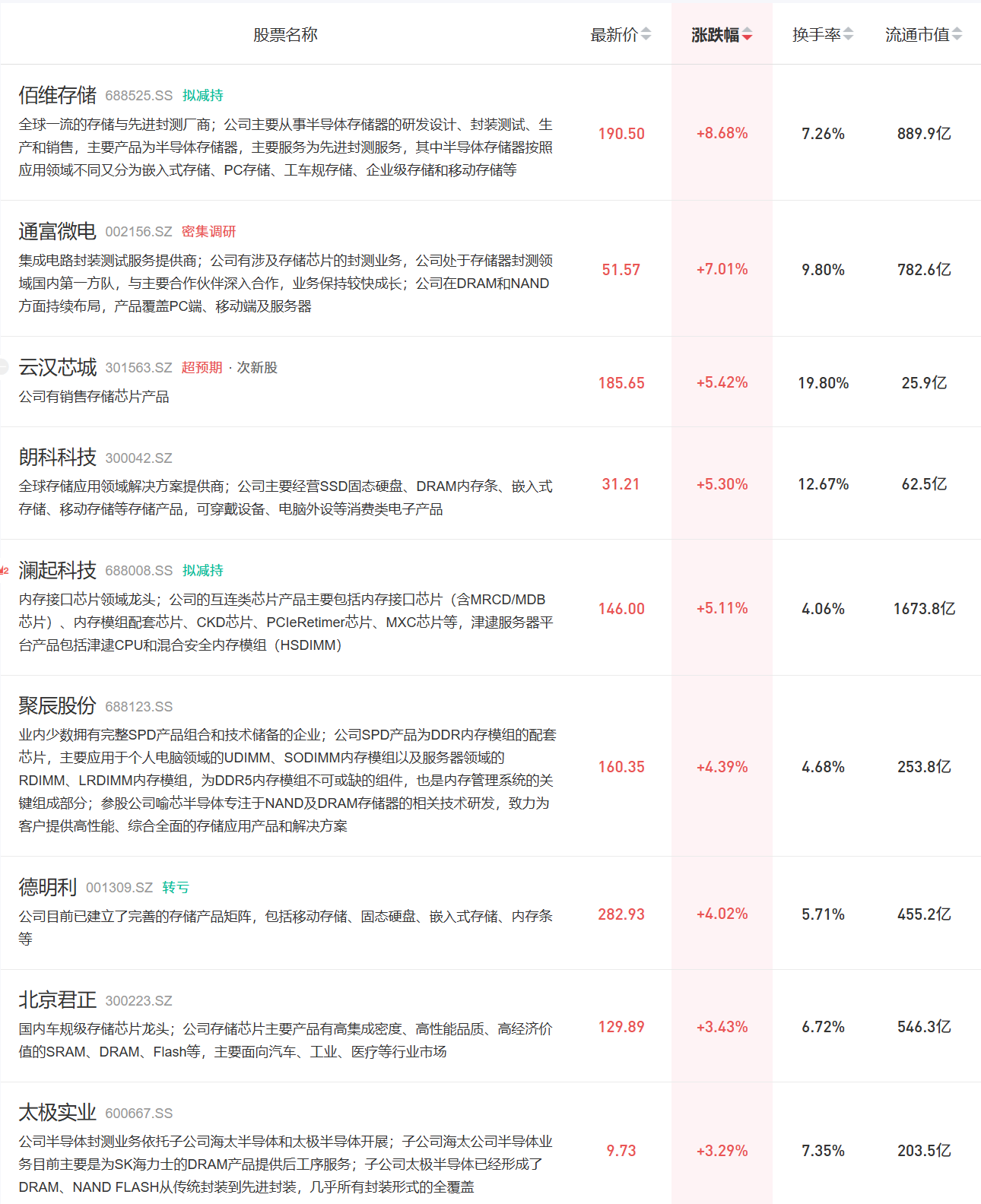
Market Overview - The storage sector saw a significant increase in early trading, with Baiwei Storage rising over 8%, and other companies like Tongfu Microelectronics, Purun Co., and Langke Technology also experiencing substantial gains [1][2]. Company Performance - Baiwei Storage (688525.SS) reported a price of 190.50, with an increase of 8.68% and a turnover rate of 7.26% [2]. - Tongfu Microelectronics (002156.SZ) had a price of 51.57, up by 7.01%, with a turnover rate of 9.80% [2]. - Langke Technology (300042.SZ) saw its stock rise by 5.30%, reaching a price of 31.21 [2]. - SK Hynix and Samsung Electronics, which together account for over 60% of NAND capacity, are reducing their flash memory production to maximize profits, potentially exacerbating supply shortages [3]. Industry Trends - Micron Technology indicated that the shortage of storage chips is expected to persist due to increased demand from AI infrastructure, with supply constraints likely to continue until 2026 [3][4]. - The global storage industry is shifting towards a "high profit, stable price, weak cycle" operational model, with DDR4 and DDR5 spot prices rising approximately 10% in the first half of January [3][4]. - The price of 16GB memory modules has surged from over 300 yuan a year ago to over 1100 yuan, reflecting a 2-3 times increase in other specifications [3]. Future Outlook - The storage industry's high demand is anticipated to drive growth in semiconductor equipment and materials companies, with domestic companies like Changxin Technology progressing in their IPOs, which may further expand capital expenditures [4]. - The introduction of new technologies, such as NVIDIA's memory storage platform, is expected to maintain the tight supply conditions in the storage sector, indicating a strong sustainability of the industry's super cycle [4][5].

HBF,正在加速
半导体行业观察· 2026-01-20 02:02
Core Viewpoint - The article discusses the rapid development and commercialization of High Bandwidth Flash (HBF) technology, which is expected to surpass High Bandwidth Memory (HBM) by 2038 due to the increasing demand for high-capacity storage solutions driven by AI data needs [1][5]. Group 1: HBF Technology Development - HBF technology is anticipated to be implemented in products by major companies like Samsung and SanDisk by the end of 2028, leveraging the design and process technologies developed during HBM research [2][3]. - HBF is designed to stack multiple 3D NAND flash memory vertically, similar to HBM, to enhance bandwidth, with predictions of exceeding 1638 GB/s in bandwidth [3]. Group 2: Market and Capacity Insights - HBF's capacity is projected to be 512 GB, significantly higher than HBM4's 64 GB, addressing the limitations of HBM in meeting the explosive growth of AI data requirements [3]. - The collaboration between Samsung, SK Hynix, and SanDisk aims to standardize HBF technology, with product development targeted for release by 2027 [3]. Group 3: HBF vs HBM - HBF is expected to complement HBM in AI accelerators, with a larger capacity but slower speed, making it suitable for different types of data processing tasks [4]. - The transition to HBM6 will involve a network of HBM units, while HBF will provide a more extensive data storage solution, potentially changing data processing pathways in GPUs [5]. Group 4: Future Predictions - By 2038, the market for HBF is predicted to exceed that of HBM, indicating a significant shift in memory technology preferences within the industry [5].

NAND雪上加霜,巨头削减产能
半导体行业观察· 2026-01-20 02:02
Core Viewpoint - Samsung Electronics and SK Hynix are expected to reduce NAND flash production this year, which may lead to a supply shortage and price increases across various sectors, including AI, servers, personal computers, and mobile devices [1][2]. Group 1: NAND Flash Market Dynamics - Samsung Electronics has slightly lowered its NAND flash wafer production forecast from 4.9 million last year to 4.68 million this year, following a previous reduction due to anticipated declines in NAND profitability [1]. - SK Hynix's NAND flash production is also expected to decrease from 1.9 million wafers last year to 1.7 million this year [1]. - The demand for NAND flash is surging due to the rise of AI, with major suppliers' adjustments potentially exacerbating supply shortages across all sectors [2]. Group 2: Impact of AI on NAND Flash Demand - Nvidia's next-generation AI accelerator, Vera Rubin, is set to have a solid-state drive (SSD) capacity of 1152TB, significantly increasing demand for NAND flash [2]. - The expected shipment of Vera Rubin is 30,000 units this year and 100,000 units next year, which will create additional demand of 34.6 million TB and 115.2 million TB by 2026 and 2027, respectively [2]. Group 3: Production Strategy and Market Position - Samsung and SK Hynix are prioritizing DRAM investments over NAND flash due to lower profitability, leading to intentional production cuts [3]. - China's Yangtze Memory Technologies has been steadily increasing its NAND flash production, indicating a strengthening market position and a shift in focus towards server and enterprise applications [3]. Group 4: Price Predictions and Market Trends - TrendForce predicts that NAND flash contract prices will rise by 33% to 38% in the first quarter, reflecting a conservative production strategy from major suppliers [3]. - IDC forecasts a 17% growth in NAND flash supply this year, which is below the average growth rate in recent years [3]. Group 5: HBM Production Expansion - Samsung and SK Hynix are increasing their semiconductor production capacity to meet the demand for various chips, including HBM and DDR [4]. - Samsung's HBM capacity is expected to grow by 50% by 2026 to fulfill large orders from Nvidia [4]. Group 6: Investment in New Facilities - Samsung plans to invest 60 trillion KRW (approximately 41.5 billion USD) in a new factory in Pyeongtaek, which is expected to begin production in 2028 [5]. - SK Hynix is investing over 20 trillion KRW in the M15X factory, which will include two clean rooms for chip production [7].

韩媒:三星美国泰勒晶圆厂将于3月启动EUV光刻机测试,计划下半年投产
Ge Long Hui· 2026-01-20 01:43
Core Viewpoint - Samsung Electronics is set to begin testing EUV lithography machines at its Taylor, Texas plant in March, with plans for full production in the second half of the year [1] Group 1: Production Plans - The company has applied for a temporary operating permit from the Texas government, allowing it to operate before the completion of the facility, provided it meets safety and fire regulations [1] - Samsung plans to gradually introduce etching and deposition equipment following the initial testing phase [1] Group 2: Capacity and Orders - Samsung has secured a $16.5 billion order for AI5 and AI6 chips from Tesla, with Elon Musk indicating that this amount is just a baseline, suggesting potential for significantly higher production [1] - Qualcomm's CEO has also mentioned that the company is considering having Samsung produce its next-generation application processor (AP) chips [1] - If customer demand continues to increase, Samsung may expedite the activation of the still-under-construction Taylor Phase 2 plant [1]
韩国交易所CEO看高Kospi指数至6000点,誓言清退“僵尸企业”
Zhi Tong Cai Jing· 2026-01-20 01:43
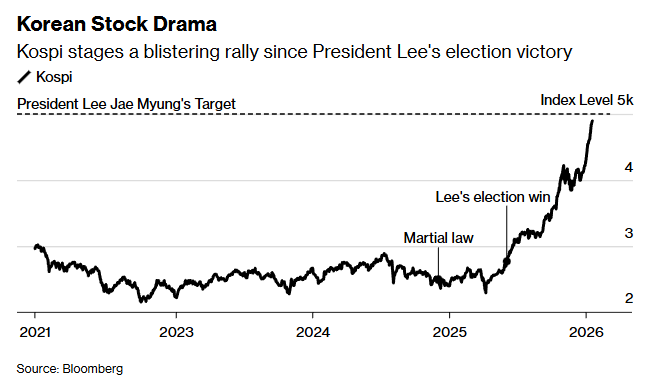
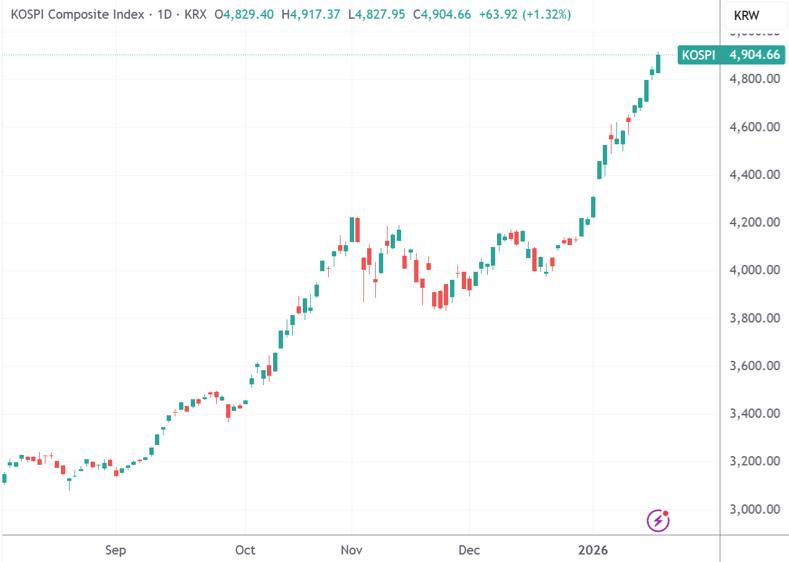
在过去12个月大涨逾94%之后,韩国基准股指Kospi指数距离曾被视为遥不可及的5000点关口仅差约 2%。这一目标已被写入韩国总统李在明的竞选承诺之中。郑恩博的乐观表态正是在这一背景下作出 的。 韩国股市的上涨很大程度上得益于与人工智能和国防相关股票的持续走强——这两个领域目前是全球最 热门的板块。同时,韩国立法机构在提升公司治理标准方面的关键改革也为市场上涨提供了支撑。 郑恩博上周五在接受采访谈及Kospi指数时表示:"Kospi指数正接近5000点,但我认为在此之上,甚至 6000点也是可能的。"尽管他并未给出达到6000点的具体时间表,但他补充称:"韩国的半导体、国防和 造船等核心产业竞争力不断提升,这似乎正在引领股市新一轮的价值提升。" Kospi指数升至6000点意味着还需再上涨约22%。尽管该指数在新的一年延续了惊人的涨势——周一连 续第12个交易日上涨并再创历史新高——但汇丰控股等机构的部分市场观察人士仍建议保持谨慎,市场 宽度不足、本币大幅贬值以及人工智能泡沫担忧都是潜在风险。 自去年上任以来,李在明承诺在4月前将Kospi指数推向5000点,韩国这个3万亿美元规模的股市投资者 对这类里程碑 ...
三星电子股价下跌3.1%,至144,700韩元,或终结四连涨走势。
Jin Rong Jie· 2026-01-20 01:37
本文源自:金融界AI电报 三星电子股价下跌3.1%,至144,700韩元,或终结四连涨走势。 ...
机器人引爆韩国股市
3 6 Ke· 2026-01-20 01:12
Group 1 - The core point of the article highlights the significant rise in the South Korean stock market, driven by the robotics sector, with Hyundai Motor's stock surging 16%, contributing to the KOSPI index reaching a historic high of 4900 points, doubling from 2400 points over the past year [1][2][3]. - Hyundai Motor has appointed Milan Kovac, former head of Tesla's Optimus robot project, as an advisor, indicating a strategic focus on robotics and AI, with plans to produce 30,000 humanoid robots annually by 2028 [5]. - The KOSPI index has shown a remarkable increase of nearly 15% in 2026, marking it as the best-performing major market index globally in 2025 with a gain of 75.63% [2]. Group 2 - Hyundai's sister company, Kia, also experienced a significant stock increase of 12%, reaching historical highs alongside Hyundai [3]. - The recent appointments of key personnel from Tesla and Nvidia to Hyundai's advanced vehicle platform and autonomous driving software divisions further solidify the company's commitment to integrating robotics and AI into its business strategy [8]. - Other major players in the South Korean market, such as Samsung Electronics and SK Hynix, are also performing well, reaching new closing highs despite external pressures, with positive signals from TSMC and Micron Technology's financial reports [10].

韩媒称“三星、SK海力士预计今年继续减产NAND闪存”,以追求利润最大化
Hua Er Jie Jian Wen· 2026-01-20 00:45
Core Viewpoint - Despite the surge in demand driven by artificial intelligence, South Korea's major memory chip manufacturers, Samsung Electronics and SK Hynix, will continue to cut NAND flash production this year, which is expected to drive up NAND prices across various sectors, enhancing profit margins comparable to DRAM [1][4]. Group 1: Production and Market Strategy - Samsung's NAND wafer production is projected to decrease from 4.9 million units last year to 4.68 million units this year, even below the reduction level planned for 2024 due to declining profitability [1]. - SK Hynix's NAND production is expected to drop from approximately 1.9 million units last year to 1.7 million units this year [1]. - Both companies together hold over 60% of the global NAND flash market share, and their production cuts are occurring amid intensified competition in AI-driven applications [1][3]. Group 2: Financial Performance and Bonuses - The global storage chip supercycle driven by AI has resulted in historic profits, prompting Samsung and SK Hynix to issue their largest performance bonuses in years [2][5]. - Samsung's semiconductor division has confirmed that eligible employees will receive bonuses equivalent to 47% of their base annual salary, a stark contrast to the zero bonus rate in 2023 due to market downturns [6]. - SK Hynix has adopted a more aggressive bonus strategy, eliminating the long-standing cap on bonuses and allocating 10% of operating profits for profit-sharing, with average bonuses expected to exceed 140 million KRW, marking a historical high [6]. Group 3: Price Expectations and Market Dynamics - Major market research firms anticipate a comprehensive increase in NAND prices starting from Q1 this year, with TrendForce projecting a contract price increase of 33% to 38% compared to the previous quarter [4]. - IDC forecasts a 17% growth rate in NAND supply this year, which is below the average levels seen in recent years [4]. - Analysts suggest that the supply control by Samsung and SK Hynix may exacerbate shortages in AI servers, mobile devices, and PCs, as both companies focus on maximizing profits during this storage chip supercycle [4].
韩国交易所CEO看高Kospi指数至6000点 誓言清退“僵尸企业”
Zhi Tong Cai Jing· 2026-01-20 00:37
韩国交易所首席执行官郑恩博(Eun-Bo Jeong)表示,随着韩国持续推进提升股东回报并吸引全球资本的 改革举措,韩国股市这轮领跑全球的涨势有望延续。 在过去12个月大涨逾94%之后,韩国基准股指Kospi指数距离曾被视为遥不可及的5000点关口仅差约 2%。这一目标已被写入韩国总统李在明的竞选承诺之中。郑恩博的乐观表态正是在这一背景下作出 的。 韩国股市的上涨很大程度上得益于与人工智能和国防相关股票的持续走强——这两个领域目前是全球最 热门的板块。同时,韩国立法机构在提升公司治理标准方面的关键改革也为市场上涨提供了支撑。 郑恩博上周五在接受采访谈及Kospi指数时表示:"Kospi指数正接近5000点,但我认为在此之上,甚至 6000点也是可能的。"尽管他并未给出达到6000点的具体时间表,但他补充称:"韩国的半导体、国防和 造船等核心产业竞争力不断提升,这似乎正在引领股市新一轮的价值提升。" 郑恩博还将政府持续推进公司改革作为其乐观判断的依据。他表示,Kospi权重股三星电子预计将在7月 前公布提升股东回报的具体措施。他还提到韩国争取升级为发达市场的努力。虽然MSCI的重新分类"可 能需要几年时间",但 ...